压缩天然气

Search documents
因天然气供应危机,秘鲁首都将实施紧急管控
中国能源报· 2026-03-07 03:22
Core Viewpoint - The natural gas supply crisis in Peru, triggered by a pipeline rupture in Cusco province, has led to significant energy management measures in the capital Lima and the Callao region starting March 9 [2][3]. Group 1 - The rupture of the natural gas pipeline in Cusco province has caused a nationwide crisis in compressed natural gas supply in Peru [2][3]. - The Peruvian Prime Minister, Denis Morales, announced emergency energy management measures for a week, affecting Lima and Callao [3]. - All public and private primary and secondary schools, as well as higher education institutions, will switch to remote learning [3]. Group 2 - The public sector is mandated to implement remote work, while private enterprises are encouraged to allow employees to take early leave to reduce energy consumption [3].


SINCEREWATCH HK拟100万元收购南通荣煜能源科技51%股权
Zhi Tong Cai Jing· 2026-02-03 13:34
Group 1 - The company announced the acquisition of a 51% stake in Nantong Rongyu Energy Technology Co., Ltd. for RMB 1 million, which will become an indirect non-wholly owned subsidiary of the company [1] - The target company primarily engages in natural gas and refined oil businesses, specializing in natural gas wholesale, vehicle refueling, and gas station construction [1] - The group operates in the distribution of luxury watches and accessories, as well as property investment, facing challenges from weak discretionary spending and macroeconomic uncertainties [1] Group 2 - The target company's main business includes wholesale and retail of natural gas, with sales of approximately RMB 24 million in 2025, and aims to establish stable sales channels across China [2] - The target company collaborates with several major gas companies as a supplier and aims to develop into a comprehensive clean energy enterprise [2] - The board believes that the acquisition will provide opportunities for the group to expand into the clean energy sector and diversify its revenue sources [2]
全国温室气体自愿减排交易市场扩容
Ke Ji Ri Bao· 2025-11-24 01:45
Core Viewpoint - The release of three new methodologies under the CCER mechanism aims to enhance greenhouse gas reduction efforts in the oil and gas industry, promoting innovative recovery and utilization of associated gas in both onshore and offshore oil fields [1][2][3] Group 1: CCER Methodologies - The third batch of CCER methodologies includes the recovery and utilization of gas from onshore gas fields, low-volume associated gas from onshore oil fields, and associated gas from offshore oil fields, expanding the total to nine methodologies [1] - The methodologies are characterized by their wide coverage across industry sectors and various types of greenhouse gases [1] Group 2: Onshore Gas Field Methodology - The "Onshore Gas Field Testing Gas Recovery Utilization Methodology" is noted for its unique Chinese innovation, addressing the lack of market-based emission reduction incentives for testing gas recovery projects globally [1] - This methodology encourages the recovery of testing gas for use in liquefied natural gas (LNG) and compressed natural gas (CNG), promoting technological upgrades in the oil and gas sector for greenhouse gas reduction and resource recovery [1] Group 3: Low-Volume Associated Gas Methodology - The "Onshore Oil Field Low-Volume Associated Gas Recovery Utilization Methodology" allows projects with associated gas production of less than 30,000 cubic meters per day to apply for CCER [2] - This methodology provides an incentive mechanism for small-scale, decentralized associated gas resource utilization projects that are currently not economically viable [2] - For example, a project in Heilongjiang with an associated gas source of 15,000 cubic meters per day could see its return on investment increase from 5% to approximately 8.5% with CCER benefits [2] Group 4: Offshore Oil Field Methodology - As of October this year, there are four projects that comply with the "Offshore Oil Field Associated Gas Recovery Utilization Methodology," with a total recovery volume of about 150 million cubic meters per year and an LPG production of 32,000 tons per year [3] - A new project is expected to recover about 100 million cubic meters of natural gas annually, resulting in a reduction of approximately 160,000 tons of emissions, which could generate an additional revenue of 12.8 million yuan per year based on an estimated CCER price of 80 yuan per ton [3]
全国温室气体自愿减排交易市场扩容 纳入油田气领域
Ke Ji Ri Bao· 2025-11-23 10:49
Core Insights - The Ministry of Ecology and Environment has released three new methodologies for voluntary greenhouse gas emission reduction (CCER mechanism), expanding the total to nine methodologies since the mechanism's launch [1][2][3] - The new methodologies focus on the recovery and utilization of associated gas from onshore and offshore oil fields, promoting technological upgrades in the oil and gas industry for greenhouse gas reduction and resource recovery [1][2] Group 1: Onshore Gas Recovery - The "Onshore Gas Field Testing Gas Recovery Methodology" is noted for its unique "Chinese innovation" characteristics, as there is currently no market-based emission reduction incentive mechanism for such projects globally [1] - This methodology encourages the recovery of gas during testing phases for use in liquefied natural gas (LNG) and compressed natural gas (CNG), aiming to enhance recovery technology in the oil and gas sector [1] Group 2: Low-Volume Associated Gas - The "Onshore Oil Field Low-Volume Associated Gas Recovery Methodology" allows projects with associated gas production of less than 30,000 cubic meters per day to apply for CCER [2] - This methodology provides an incentive mechanism for small-scale, decentralized projects that currently lack economic feasibility, such as those in remote areas [2] - An example project in Heilongjiang with a gas source of 15,000 cubic meters per day could see its return on investment increase from 5% to approximately 8.5% with CCER benefits [2] Group 3: Offshore Gas Recovery - The "Offshore Oil Field Associated Gas Recovery Methodology" has identified four projects that collectively recover about 150 million cubic meters of gas per year, producing 32,000 tons of liquefied petroleum gas (LPG) annually [3] - A new project is expected to recover 100 million cubic meters of natural gas annually, resulting in a reduction of approximately 160,000 tons of emissions [3] - Estimated CCER revenue at 80 yuan per ton could generate an additional income of 12.8 million yuan for the project [3]
一图读懂 | 温室气体自愿减排项目方法学 陆上油田低气量伴生气回收利用
国家能源局· 2025-11-21 13:05
Core Viewpoint - The article discusses the implementation of a new methodology for voluntary greenhouse gas emission reduction projects in the context of low gas recovery from onshore oil fields, aiming to enhance methane recovery, reduce carbon emissions, and promote the green transition of the oil extraction industry in China [4][5]. Summary by Sections Background - The methodology was jointly issued by the Ministry of Ecology and Environment and the National Energy Administration on November 21, 2025, to encourage broader industry participation in greenhouse gas emission reduction [4]. Principles of Methodology - **Scientific Principle**: The emission reduction mechanism must be scientifically sound and comply with industry technical standards [7]. - **Operability Principle**: The methodology should simplify monitoring parameters while ensuring data is verifiable and traceable [9]. - **Conservativeness Principle**: Emission reductions should be conservatively estimated to avoid overestimation [10]. - **Sustainable Development Principle**: Projects must align with sustainable development goals and not negatively impact the environment or socio-economic development [11]. Applicable Conditions - The methodology applies to low gas recovery projects from onshore oil fields, requiring specific conditions such as a processing capacity of at least 30,000 Nm³/d and compliance with national laws and industry policies [14][15]. Project Duration and Baseline Scenario - The project duration for emission reduction claims can last up to 10 years, with a baseline scenario established for comparison [17]. Additionality Demonstration - The projects face challenges such as complex gas composition, remote locations, and high investment costs, which necessitate additionality proof for the emission reduction claims [19][20]. Emission Reduction Calculation - Emission reductions are calculated based on the replacement of newly extracted natural gas with recovered gas, considering various emission sources [21][22]. Data Management Requirements - A robust data management system must be established, including monitoring, recording, and cross-verifying data, with a retention period of at least 10 years for all project-related data [25]. Verification and Public Oversight - Verification of emission reductions will be conducted by designated institutions, with monitoring data made publicly available through local ecological departments [27][30].

一图读懂 | 温室气体自愿减排项目方法学 海上油田伴生气回收利用
国家能源局· 2025-11-21 13:05
Core Viewpoint - The article discusses the implementation of a new methodology for voluntary greenhouse gas emission reduction projects related to the recovery and utilization of associated gas from offshore oil fields, aimed at promoting industry-wide participation in emission reduction efforts [4]. Background - The methodology was jointly issued by the Ministry of Ecology and Environment and the National Energy Administration on November 21, 2025, and is effective from the date of issuance [4]. - Associated gas, primarily composed of methane, ethane, propane, butane, pentane, and heavier hydrocarbons, is produced alongside oil extraction. The recovery and utilization of this gas can reduce carbon dioxide emissions, improve energy efficiency, and enhance the supply of clean energy, contributing positively to the green and low-carbon transformation of China's offshore oil industry [6]. Main Content 1. Applicable Conditions - The methodology applies to projects recovering associated gas from offshore oil fields for the production of natural gas, liquefied natural gas, compressed natural gas, and liquefied petroleum gas [12]. - Projects must have no existing pipeline connections between production facilities and land prior to approval [12]. - Monitoring data must be connected to the national carbon market management platform [12]. 2. Project Accounting Period - The accounting period for projects is defined as the time frame for which emission reductions are recorded, with a maximum duration of 10 years [16]. 3. Additionality Evidence - Projects face high construction and operational costs due to the offshore distance and dispersed sources of associated gas, which presents investment risks. Projects meeting the applicable conditions are exempt from additionality proof [20]. 4. Emission Reduction Calculation Method - Emission reductions are calculated based on the replacement of newly extracted natural gas with recovered associated gas, avoiding emissions from burning newly extracted gas [23]. 5. Data Management Requirements - Project owners must establish data management systems to ensure data quality and monitoring, with designated personnel responsible for data collection and verification [28]. - Measurement devices must be calibrated annually and maintained within their validity period [29]. - All data and information from the project design and implementation phases must be retained for at least 10 years after the final emission reduction registration [31]. 6. Approval and Verification Points - Verification institutions should refer to the methodology for applicable conditions, project boundaries, monitoring plans, and parameters during project approval and emission reduction verification [39]. 7. Public Supervision Channels - Monitoring data will be publicly accessible through the official websites of provincial and municipal ecological environment departments, allowing for public and media oversight [40].
一图读懂 | 温室气体自愿减排项目方法学 陆上气田试气放喷气回收利用
国家能源局· 2025-11-21 13:05
Core Viewpoint - The article discusses the implementation of a new methodology for voluntary greenhouse gas emission reduction projects related to the recovery and utilization of gas during the testing phase of onshore gas fields, aiming to promote industry participation in emission reduction efforts [5][6]. Group 1: Background and Significance - The testing phase of onshore natural gas exploration involves flaring gas, which can be converted into usable products, thus promoting methane recovery, reducing CO2 emissions, and enhancing energy efficiency [7]. - The methodology aims to support the green and low-carbon transformation of China's natural gas extraction industry [7]. Group 2: Methodology Principles - The methodology is based on principles of scientific validity, operability, conservativeness, and sustainable development, ensuring that emission reduction projects are feasible and do not negatively impact the environment or socio-economic development [8][9]. Group 3: Applicability and Conditions - The methodology applies to onshore gas field testing projects, requiring that they meet specific conditions, including being in the testing phase and converting flared gas into marketable products [12]. - The project monitoring data must be connected to the national carbon market management platform, and the project must comply with national laws and industry policies [12]. Group 4: Project Duration and Baseline Scenario - The project duration for emission reduction claims can last up to 10 years, with specific time limits for gas recovery from different types of wells [14]. - The baseline scenario involves the direct combustion of flared gas at the well site [14]. Group 5: Emission Reduction Calculation - Emission reductions are calculated based on the replacement of newly extracted natural gas with recovered gas, avoiding emissions from the combustion of new gas [16]. - The methodology emphasizes conservative estimates for emission reductions, ensuring that calculations do not overstate the benefits [19]. Group 6: Data Management and Verification - A robust data management system is required, including quality assurance measures, calibration of measurement devices, and data archiving for at least 10 years [24]. - Verification of emission reductions will involve cross-checking monitoring data with the national carbon market management platform [27]. Group 7: Public Oversight - Monitoring data will be publicly accessible through local ecological departments' official websites, allowing for public and media scrutiny of the projects [28].
中油洁能控股(01759.HK)上半年营收11.4亿元 净亏损270万元
Ge Long Hui· 2025-08-29 15:20
Core Viewpoint - The company reported an increase in revenue for the first half of 2025, alongside a decrease in gross profit and a reduction in losses attributable to equity shareholders [1]. Financial Performance - Revenue increased by approximately RMB 463 million to around RMB 1.14 billion [1] - Gross profit decreased by approximately RMB 2.9 million to around RMB 24.8 million [1] - Loss attributable to equity shareholders decreased by approximately RMB 600,000 to around RMB 2.7 million [1] Sales Volume - Liquefied petroleum gas sales volume increased by approximately 102.4 thousand tons to around 228.6 thousand tons [1] - Liquefied natural gas sales volume increased by approximately 1.3 thousand tons to around 2.3 thousand tons [1] - Compressed natural gas sales volume decreased by approximately 2.4 million cubic meters to around 20.2 million cubic meters [1]
新疆乌苏市市场监管局公布“铁拳”行动典型案例
Zhong Guo Shi Pin Wang· 2025-08-21 05:49
Group 1: Advertising Violations - A restaurant was penalized for using medical terminology in food advertising, resulting in a fine of 1380 yuan [1] - A store was fined 1000 yuan for similar violations in its advertising, which included disease prevention claims [2] Group 2: Quality and Safety Compliance - A car dealership was warned for failing to implement quality safety responsibilities in the sale of electric vehicles [2] - An investigation revealed that the dealership did not maintain required quality control records, violating multiple regulations [2] Group 3: Measurement Equipment Compliance - A gas station was penalized for using unqualified measurement equipment and failing to apply for mandatory inspections, incurring a fine of 1800 yuan [3] - The gas station was found using a non-compliant gas flow meter that was out of the inspection cycle [3]
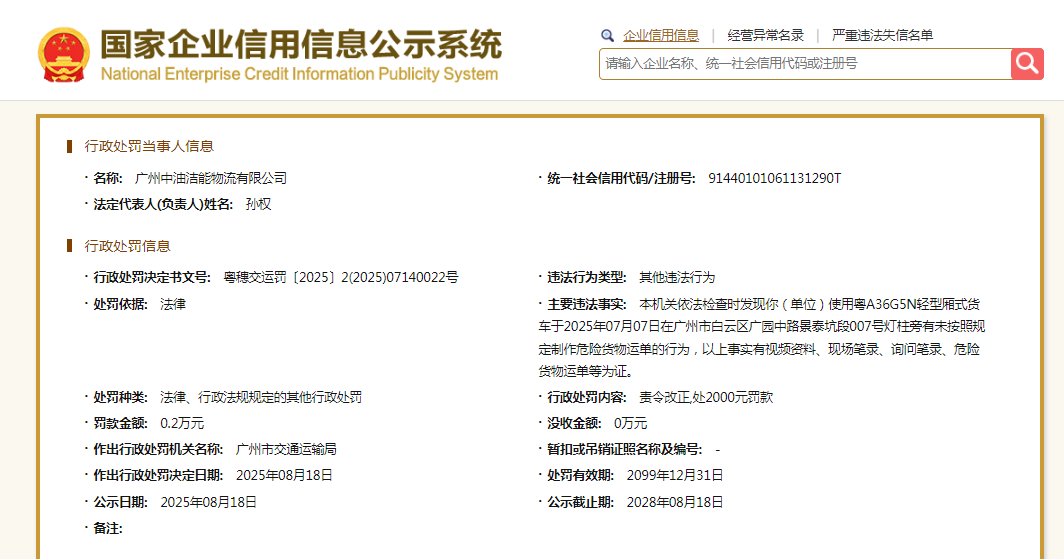
中油洁能控股旗下物流公司被罚:未按照规定制作危险货物运单
Qi Lu Wan Bao· 2025-08-20 04:33
Core Points - On August 18, 2025, China Oil Clean Energy Holdings (01759.HK) subsidiary Guangzhou China Oil Clean Energy Logistics Co., Ltd. received a fine for failing to properly create hazardous goods waybills [1][3] - The fine amounted to 2000 RMB, and the company has a history of multiple violations including improper waybill creation and unauthorized gas sales [3][4] Company Overview - Guangzhou China Oil Clean Energy Logistics Co., Ltd. was established in 2013 with a registered capital of 10 million RMB and is wholly owned by Guangzhou China Oil Clean Energy Gas Chain Co., Ltd., which is a subsidiary of China Oil Clean Energy Holdings [4][6] - The company operates as a comprehensive supplier of liquefied petroleum gas and natural gas, engaging in sales, operation of gas stations, and wholesale activities [6]