信托业

Search documents
广州:扩大直接融资渠道,支持符合条件的养老产业企业上市
Sou Hu Cai Jing· 2025-05-14 03:03
Group 1 - The core viewpoint of the news is the introduction of measures by various financial regulatory bodies in Guangzhou to promote the high-quality development of pension finance [1][2][3] - The measures aim to enrich the supply of third-pillar pension financial products, encouraging financial institutions to develop pension-related funds, wealth management, and insurance products tailored to individual risk preferences [1] - Banks are encouraged to develop exclusive personal pension savings products and to provide customized family trust services, thereby enhancing the personalized pension needs of different demographics [1] Group 2 - There is an emphasis on increasing financing support for the elderly care industry, with financial institutions encouraged to establish dedicated pension finance departments and provide credit support for elderly products, infrastructure, and smart elderly care equipment [2] - Financial institutions are urged to explore financing models that support the entire elderly care industry chain while ensuring risk control, promoting collaboration between financial and elderly care industry organizations [2] - The measures also support the expansion of direct financing channels for eligible elderly care enterprises through listings, bond issuance, and regional equity markets [3] Group 3 - The establishment of a silver economy investment fund by state-owned enterprises is encouraged, focusing on seed and early-stage innovative companies in the elderly care sector [3] - The news highlights the exploration of real estate investment trusts (REITs) for eligible projects in the pension sector and the facilitation of cross-border financing for elderly care enterprises [3] - Local financial organizations are encouraged to provide diversified financial services tailored to the needs of the elderly care industry [3]
以丰富供给壮大耐心资本
Jing Ji Wang· 2025-04-30 02:21
Core Insights - The article discusses the development of patient capital in China, emphasizing the need to enhance long-term capital supply in the capital market and optimize assessment mechanisms for patient capital [1][3][4]. Group 1: Patient Capital Development - The environment for patient capital, primarily focused on equity investment, has changed significantly in recent years, leading to rapid industry growth. However, private equity institutions in China face bottlenecks in fundraising, investment, management, and exit processes, which hinder the generation and expansion of patient equity capital [3][4]. - In 2024, the total amount pledged by national institutional LPs reached 1.27 trillion yuan, with 6,863 contributions made. Government funds played a crucial role, contributing 669.2 billion yuan, while financial institutions and social security funds contributed a total of 224.5 billion yuan, marking a 0.9 percentage point increase from 2023 [4][5]. Group 2: Investment Trends - There is a notable trend towards early-stage investments, with seed and startup project investment cases accounting for 41% in 2024, a 4 percentage point increase from 2021. Investments in angel, Pre-A, and A rounds collectively represent 66% of total investment cases [5][6]. - The focus of equity investment has shifted towards hard technology sectors, with IT, semiconductors, biotechnology/healthcare, and machinery manufacturing leading in both the number of investment cases and investment amounts, accounting for 74% and 63% respectively in 2024 [6]. Group 3: Policy Recommendations - To strengthen patient capital and increase long-term capital supply in the capital market, it is recommended to enhance the role of state-owned capital in equity investments. This includes optimizing the governance of government industry investment funds and integrating local government industry funds [7][8]. - Encouraging banks, insurance companies, and social security funds to enter the equity investment market is essential. This involves clarifying the usage scope and methods for these funds, simplifying investment decision-making processes, and enhancing risk management systems tailored to equity investment characteristics [8].

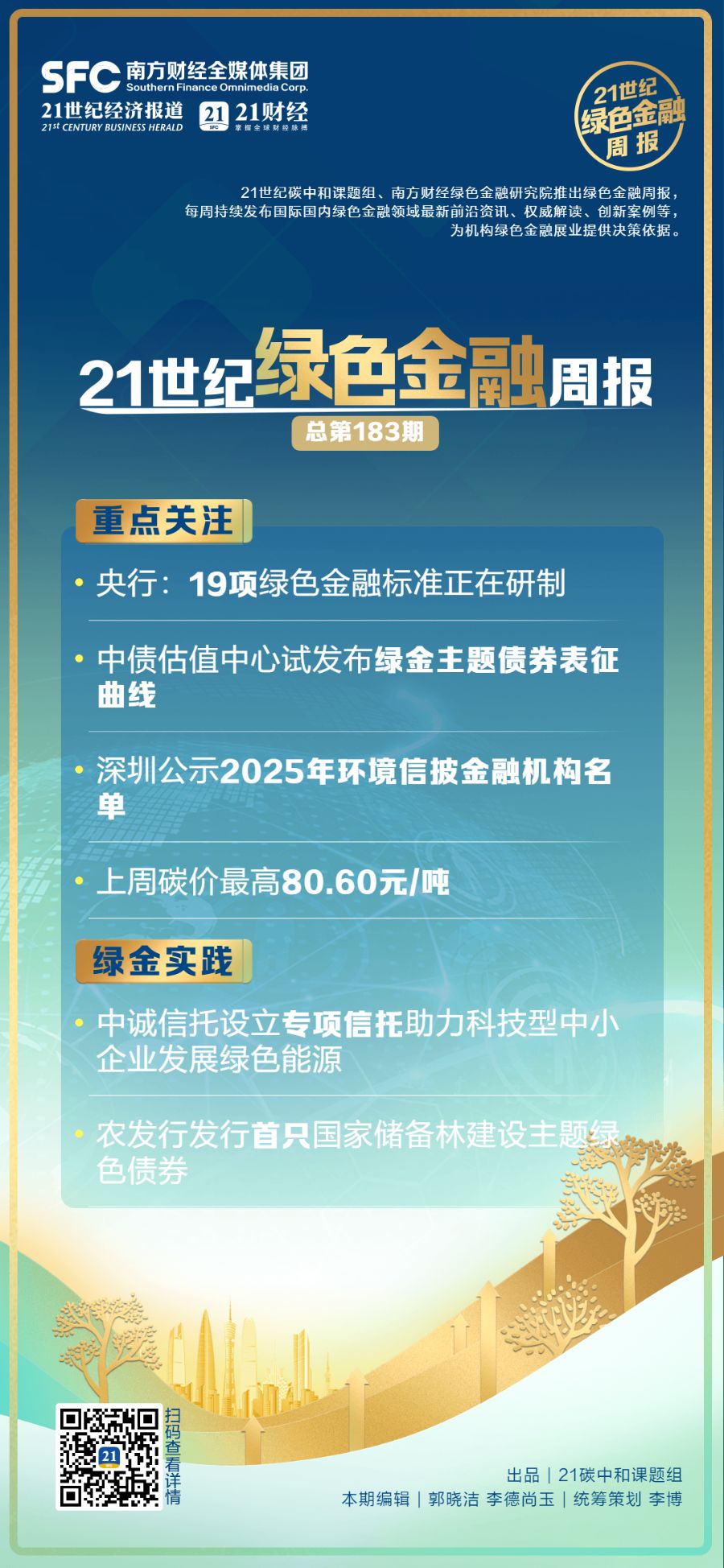
绿色金融周报(第183期)|央行:19项绿色金融标准正在研制;中债估值中心试发布绿金主题债券表征曲线
2 1 Shi Ji Jing Ji Bao Dao· 2025-04-29 08:46
Group 1: Key Developments in Green Finance - The People's Bank of China is developing 19 new green finance standards, building on 6 already published, to support the development of various green financial products and market regulations [4] - The China Central Depository & Clearing Co. plans to launch a green finance bond representation curve on April 27, 2025, which will provide refined investment analysis and research indicators for green bonds [5] - Shenzhen has publicly announced the list of financial institutions for environmental information disclosure by 2025, aiming to enhance green finance development and support sustainable finance center construction [6] Group 2: Market Trends and Performance - The national carbon market reported a highest price of 80.60 yuan/ton and a total trading volume of 1,614,145 tons for the week ending April 25, 2025, with a cumulative trading volume of 640,927,169 tons since January 1, 2025 [7] - The issuance of green bonds is gaining momentum, with the Agricultural Development Bank of China successfully issuing its first green bond for national reserve forest construction, raising 4 billion yuan at an interest rate of 1.4761% [9] Group 3: Innovative Practices in Green Finance - Zhongcheng Trust has established a specialized trust to support technology-based SMEs in the distributed photovoltaic market, addressing financing challenges and promoting sustainable development [8] - The issuance of the national reserve forest green bond emphasizes ecological services and carbon sequestration, reinforcing the connection between green finance and carbon neutrality goals [9]
用假黄金骗取超250亿,揭秘他如何操作
Sou Hu Cai Jing· 2025-03-31 19:34
Core Insights - The case of Jia Zhihong, who defrauded over 25 billion yuan through the use of pledged fake gold, highlights significant vulnerabilities in the financial system and regulatory mechanisms [1][7] Group 1: Background of the Case - Jia Zhihong, a former military personnel turned entrepreneur, founded Jinhuang Jewelry and grew it into one of China's largest gold jewelry manufacturers [3] - His company went public on NASDAQ in 2010, marking his entry into the capital market [3] - Despite the fraudulent activities, Jia did not flee but instead expanded his business empire into various sectors including hydrogen energy vehicles, real estate, and healthcare [3] Group 2: Financial Institutions Involved - A total of 15 financial institutions fell victim to Jia's scheme, leading to massive financial losses [1] - Financial institutions had inadequate risk control systems and were overly reliant on insurance policies, failing to verify the authenticity of the pledged gold [5] - The allure of high-interest financing terms offered by Jia led some institutions to overlook red flags, prioritizing short-term gains over due diligence [5] Group 3: Impact on Companies - Hengfeng Bank reported losses of 6.5 billion yuan, while Minsheng Trust, part of the Pan Hai Group, faced over 4 billion yuan in exposure, resulting in a significant credit impairment loss [6] - Pan Hai Holdings' total liabilities approached 100 billion yuan, with a debt-to-asset ratio reaching 90%, leading to its stock being delisted [6] Group 4: Legal Consequences - Jia Zhihong was sentenced to life imprisonment for his crimes, with other involved parties receiving varying prison terms [6] - The case has raised profound questions about the integrity of the financial system and the effectiveness of regulatory oversight [7]


两会|四川天府银行董事长黄毅:建议加快启动信托法修改工作,推动REITs市场高质量发展
券商中国· 2025-03-09 23:22
Core Viewpoint - The article discusses three key suggestions made by Huang Yi, Chairman of Sichuan Tianfu Bank, during the 2025 National People's Congress, focusing on the modification of the Trust Law, the development of the REITs market, and the governance of artificial intelligence. Group 1: Suggestions for Trust Law Modification - Huang Yi emphasizes the need to accelerate the modification of the Trust Law, which has not kept pace with the evolving financial landscape since its implementation in 2001 [3][4]. - Four main areas for modification are proposed: 1. Adjusting the definition of trust to clarify the transfer of property rights to trustees [3]. 2. Improving the property registration mechanism and clarifying tax principles related to trusts [3]. 3. Strengthening the responsibilities and liabilities of trustees to ensure compliance with fiduciary duties [3]. 4. Promoting the development of socially beneficial trust businesses, particularly in relation to charity and consumer protection [4]. Group 2: Suggestions for REITs Market Development - Huang Yi points out the rapid growth of the public REITs market since 2024, but notes the uneven development across different levels of the REITs market [5]. - Six policy recommendations are provided to enhance the REITs market: 1. Gradually improve the multi-tiered REITs market by enhancing exit mechanisms and liquidity for private and Pre-REITs [7]. 2. Refine the legal framework for public REITs to ensure asset independence and risk isolation [7]. 3. Utilize tax policies to drive REITs development, addressing issues of double taxation and establishing unified tax incentives [7]. 4. Enhance the dividend mechanism for REITs, including detailed capital expenditure disclosures and investor protection measures [7]. 5. Explore pension REITs to support the development of pension finance [8]. 6. Accelerate the issuance of data center REITs to support technological innovation [8].