
公路客运

Search documents
客流、收入断崖式下跌,谁来拯救公路客运业?
Di Yi Cai Jing· 2026-01-14 06:25
Core Viewpoint - The passenger transport industry is facing unprecedented challenges due to the rise of diversified travel options, leading to a significant decline in passenger flow and operational difficulties for traditional bus companies [3][4]. Group 1: Industry Challenges - The public transport sector has seen a decline in passenger volume, with the Ministry of Transport reporting a drop from 13.672 billion passengers in 2018 to an estimated 11.781 billion in 2024 [4]. - The passenger turnover for public transport has decreased dramatically, from 9,279.68 billion passenger-kilometers in 2018 to 5,117 billion in 2024, representing an 81.4% decline [4]. - The introduction of ride-hailing services has disrupted traditional bus routes, leading to reduced service frequency and income for drivers [5][6]. Group 2: Impact of High-Speed Rail - The opening of the China-Laos Railway in December 2021 has further exacerbated the situation, with travel time from Kunming to Jinghong reduced to 4 hours, resulting in the cancellation of long-standing bus routes [6]. - Companies like Kunman have seen a drastic reduction in driver salaries, with monthly wages dropping to 1,750 yuan, insufficient to cover living expenses [6]. Group 3: Company Responses and Adaptation - Starting in 2021, many passenger transport companies began exploring various self-rescue strategies, including partnerships with ride-hailing platforms and attempts to diversify services [7][8]. - Kunman Company has partnered with Didi to offer intercity bus services, adapting to the changing market by utilizing digital platforms for ticket sales and marketing [7][8]. - The company has also increased its service frequency and adjusted its pricing strategy to attract passengers, offering competitive fares compared to traditional bus services [13]. Group 4: Innovations and Future Directions - The industry is witnessing a shift towards customized transport services, with companies like Chao Da focusing on flexible routes and pricing strategies to compete with high-speed rail and unlicensed taxis [15][16]. - Chao Da has invested in electric vehicles to reduce operational costs, achieving a significant reduction in per-kilometer expenses, which allows for more competitive pricing [15]. - The Ministry of Transport has issued guidelines to encourage the development of customized transport services, promoting a blend of traditional and innovative transport solutions [20]. Group 5: Recruitment and Recovery - After a challenging period, companies are beginning to hire again, with Kunman recruiting 10 new drivers in 2025, indicating a recovery in the industry [18]. - The overall operational status of passenger transport companies has improved compared to the lows experienced in 2022 and 2023, with ongoing adjustments based on market feedback [19].


海汽集团(603069.SH):万宁分公司拟与海南万家福玛特商贸有限公司签订《房屋(场地)租赁合同》
Ge Long Hui A P P· 2026-01-13 12:32
Core Viewpoint - The company aims to leverage its station resources to explore the potential of the tertiary industry, reduce pressure on its main business, and promote sustainable development by publicly leasing the old bus station in Wanning [1] Group 1: Leasing Details - The company approved the public leasing of the Wanning old bus station building, which has a total area of 1,634.46 square meters [1] - The lease term is set for 9 years, with a preparation period for renovations not exceeding 6 months [1] - The annual rent is not less than the assessed rent of 341,340 yuan, translating to a monthly rent of 28,445 yuan [1] Group 2: Financial Terms - A security deposit of 100,000 yuan is required, with rent payments to be made quarterly [1] - The rental fee will increase by 1% every 3 years [1] Group 3: Business Scope - The permitted business activities for the leased space include legal commercial operations such as dining, tea arts, and chess [1] - The final lease was awarded to Hainan Wanjiafu Mart Trading Co., Ltd. [1]

海汽集团:万宁分公司拟与海南万家福玛特商贸有限公司签订《房屋(场地)租赁合同》
Ge Long Hui· 2026-01-13 12:19
Core Viewpoint - The company aims to leverage its station resources to explore the potential of the tertiary industry, reduce pressure on its main business, and promote sustainable development by publicly leasing the old bus station in Wanning [1] Group 1: Leasing Details - The company approved the public leasing of the Wanning old bus station building, which has a total area of 1,634.46 square meters [1] - The lease term is set for 9 years, with a preparation period for renovations not exceeding 6 months [1] - The annual rent is not less than the assessed rent of 341,340 yuan, translating to a monthly rent of 28,445 yuan [1] Group 2: Financial Terms - A security deposit of 100,000 yuan is required, with rent payments to be made quarterly [1] - The rental fee will increase by 1% every three years [1] Group 3: Business Scope - The permitted business activities for the leased space include legal commercial operations such as catering, tea arts, and chess [1] - The final leasing rights were awarded to Hainan Wanjiafu Mart Trading Co., Ltd. [1]
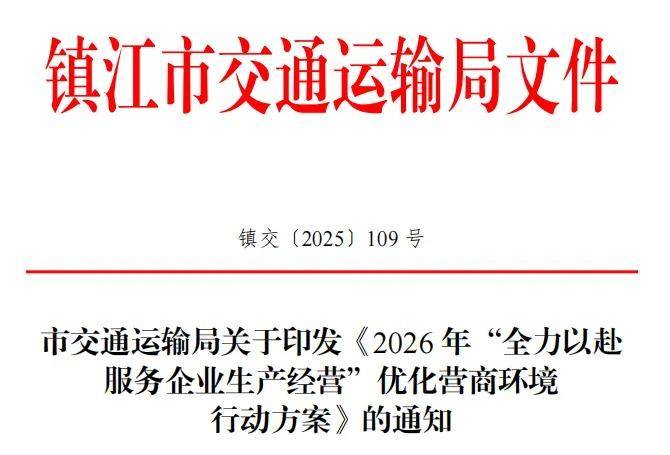
连续 4 年发力,五大举措助企发展!镇江交通印发 2026 优化营商环境方案
Yang Zi Wan Bao Wang· 2026-01-07 22:52
Core Viewpoint - The Jiangsu Provincial Transportation Bureau has issued an action plan for optimizing the business environment by 2026, focusing on enhancing service for enterprises and addressing their development challenges through a collaborative approach between government and businesses [1][3]. Group 1: Action Plan Overview - The action plan is guided by Xi Jinping's thoughts on socialism with Chinese characteristics and emphasizes principles such as party leadership, government-business collaboration, innovation-driven strategies, and results orientation [1]. - This marks the fourth consecutive year of the bureau's special actions to optimize the business environment, with previous efforts yielding significant results through various engagement methods [3]. Group 2: Key Tasks and Innovations - Five major tasks and innovative measures will be implemented this year, including strengthening party coordination and establishing a "three-in-one" leadership mechanism to ensure accountability and follow-up on enterprise issues [3]. - A series of face-to-face communication activities will be organized, including meetings with business leaders to gather feedback and address concerns directly [4][5]. Group 3: Communication Platforms - A multi-faceted government-business interaction system will be created, featuring both online and offline platforms for collecting enterprise demands and providing tailored support [6]. - The "Assistance Officer" system will assign dedicated personnel to ensure precise service delivery for policy promotion and issue tracking [6]. Group 4: Problem-Solving Mechanisms - A comprehensive management mechanism will be established to categorize and address enterprise demands, ensuring timely responses and effective follow-up [7]. - Monthly progress tracking will be conducted to monitor the resolution of issues raised by enterprises [7]. Group 5: Customized Support Services - The plan will focus on high-quality development in key areas such as ports and freight, with specific annual goals and detailed action measures outlined [8]. Group 6: Brand Building and Promotion - The bureau will cultivate and promote exemplary cases of effective enterprise support, leveraging various media channels to create a demonstration effect [9].
都市评:广州又一客运站关停,汽车客运站转型路在何方
Nan Fang Du Shi Bao· 2026-01-07 00:31
Core Insights - The closure of Guangyuan Passenger Station at the end of the month has triggered a wave of nostalgia among citizens, reflecting a broader trend of declining passenger volumes at traditional bus stations due to the development of high-speed rail and intercity rail systems [1] - The closure of passenger stations is indicative of changing travel demands and urban development patterns, with the emergence of diverse travel options such as ride-hailing and customized transport services [1] - The expansion of urban boundaries has led to the integration of previously peripheral passenger stations into urban areas, creating operational pressures that drive the transformation of traditional passenger stations [1] Transformation Strategies - The closure of passenger stations is not an endpoint but a reallocation of existing resources, with past experiences in Guangzhou suggesting three main transformation strategies: 1. "Slimming down" to become a call station, retaining passenger functions while reducing the scale of the station, as seen with Haizhu Passenger Station [1] 2. "Replacing old with new," exemplified by the transformation of Yuexiu South Passenger Station into an exhibition hall, turning transportation history into a cultural asset [1] 3. Mixed-function development, as demonstrated by Conghua Hot Spring Passenger Station, which has transitioned into an "integrated air-ground industry hub" through low-altitude economic cooperation projects [1][2] Systematic Approach - The successful transformation of passenger stations requires a systematic approach, with each station needing to adapt to local urban development needs and explore unique development models through coordinated design and construction efforts [2] - Closed passenger stations can serve as pivotal points for urban renewal rather than burdens, highlighting the potential for innovative redevelopment [2]
交通运输行业:元旦出行高景气,航空量价齐升强化信心
GF SECURITIES· 2026-01-05 06:45
Investment Rating - The industry investment rating is "Buy" [4] Core Insights - The New Year holiday travel showed strong growth, with a total of 803 million people traveling across regions from December 31, 2025, to January 3, 2026, averaging 201 million people per day, a year-on-year increase of 19.75%. The total passenger transport volume reached 209 million, with a daily average of 52 million, up 31.1% year-on-year [4][7] - The aviation sector experienced both volume and price increases, with daily flight numbers averaging 14,900 during the holiday, a 2.9% increase compared to 2025 and a 13.2% increase compared to 2019. The average ticket price for domestic economy class reached 684.6 CNY, showing a year-on-year increase of 9.8% [4][9] - The railway and waterway transport sectors outperformed the market, with year-on-year growth rates of 54.5% and 32.7%, respectively, during the holiday period [4][7] Summary by Sections Holiday Travel Data - Total national passenger transport volume reached 20,943.4 million, with a year-on-year growth of 31.1% [7] - Railway passenger transport volume was 6,476.9 million, with a year-on-year growth of 54.5% [7] - Road passenger transport volume was 13,374 million, with a year-on-year growth of 23.2% [7] - Waterway passenger transport volume was 287.4 million, with a year-on-year growth of 32.7% [7] - Civil aviation passenger transport volume was 805.1 million, with a year-on-year growth of 13.1% [7] Investment Recommendations - The report recommends focusing on airlines with stable volume growth and improving prices, specifically mentioning Hainan Airlines, China National Aviation Holding, and Spring Airlines [4] - In the railway sector, it highlights the growth potential of Guangzhou-Shenzhen Railway and Beijing-Shanghai High-Speed Railway due to increased capacity and network effects [4]




广州市中心知名客运站,宣布将关停!它是很多人到广州的第一站
Nan Fang Du Shi Bao· 2026-01-03 12:42
Core Viewpoint - Guangzhou's Guangyuan Bus Station will cease all ticket sales from January 25, 2026, and operations will end on January 26, 2026, due to operational planning adjustments [1][3]. Group 1: Operational Changes - Guangyuan Bus Station, established in 2000, covers an area of 16,000 square meters and is classified as a national first-class bus station, primarily serving high-speed routes with an average daily passenger volume of 32,000 [3]. - The station currently operates routes connecting Guangzhou to various cities including Hechi in Guangxi, and several locations in Guangdong such as Jieyang, Maoming, Shantou, Shanwei, Shaoguan, Yangjiang, and Zhanjiang [3]. Group 2: Historical Context - The closure of Guangyuan Bus Station aligns with the "14th Five-Year Plan" for urban infrastructure development in Guangzhou, which aims to gradually phase out several bus stations, including Guangyuan [5]. - Since 2019, Guangzhou has been closing bus stations in the city center, with several stations already shut down or repurposed, including the Yuexiu South Bus Station and Huangpu Bus Station [5]. - Currently, the main operational bus stations in Guangzhou include Guangdong Provincial Bus Station, Tianhe Bus Station, and Guangzhou East Station, while others have been closed or converted to reception stations [5].

交通出行人数超2亿人次
Xin Lang Cai Jing· 2026-01-02 21:37
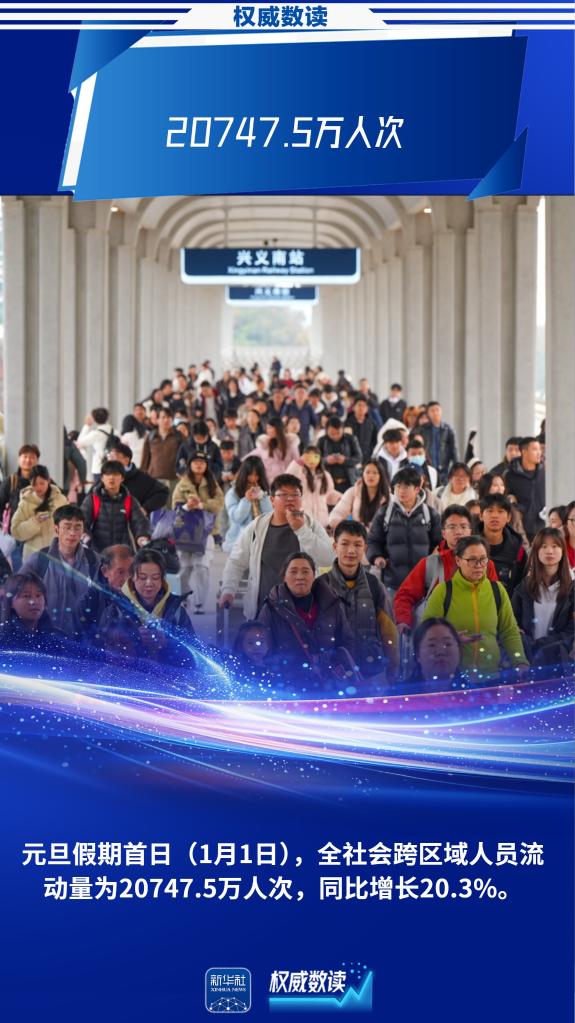
Group 1 - The total cross-regional personnel flow on January 1 reached 20,747.5 million trips, an increase of 20.3% year-on-year [1] - Road personnel flow amounted to 18,628 million trips, growing by 17.5% year-on-year, with non-commercial passenger vehicle trips accounting for 15,212 million trips, up 16.4% [1] - The railway passenger volume was 1,856 million trips, showing a significant increase of 67.9% year-on-year [1] - Waterway passenger volume reached 684,000 trips, reflecting a growth of 2.9% [1] - Civil aviation passenger volume was 1.951 million trips, experiencing a decline of 10.3% year-on-year [1] Group 2 - On January 1, the national postal industry collected 451 million packages and delivered 531 million packages [2]
权威数读丨元旦假期首日出行人数同比增两成 人次超2亿
Xin Hua Wang· 2026-01-02 10:19
Group 1 - The core point of the article is that on January 1st, the first day of the New Year holiday, the total inter-regional mobility of people reached 207.475 million, representing a year-on-year increase of 20.3% [1][3][6] Group 2 - The road mobility accounted for 186.28 million people, with a year-on-year increase of 17.5%. Among this, the non-commercial small passenger car travel on highways and ordinary national and provincial roads was 152.12 million, increasing by 16.4% year-on-year. The commercial road passenger transport volume was 34.16 million, showing a year-on-year growth of 22.4% [6] - The railway passenger volume was 18.56 million, with a significant year-on-year increase of 67.9%. The waterway passenger volume was 684 thousand, reflecting a year-on-year growth of 2.9% [9]
元旦假期首日 全社会跨区域人员流动量超2亿人次
Yang Shi Xin Wen Ke Hu Duan· 2026-01-02 07:46
Group 1 - The total inter-regional personnel flow reached 207.475 million trips on January 1, 2026, showing a month-on-month decrease of 0.1% but a year-on-year increase of 20.3% [1] - Railway passenger volume was 18.56 million trips, with a month-on-month increase of 11.3% and a year-on-year increase of 67.9% [1] - Road personnel flow, including both commercial and non-commercial passenger traffic, totaled 186.28 million trips, reflecting a month-on-month decrease of 1.1% and a year-on-year increase of 17.5% [1] Group 2 - The commercial road passenger volume was 34.16 million trips, showing a month-on-month decrease of 5.2% but a year-on-year increase of 22.4% [1] - The non-commercial passenger traffic on highways and ordinary national and provincial roads accounted for 152.12 million trips, with a month-on-month decrease of 0.1% and a year-on-year increase of 16.4% [1] - Waterway passenger volume reached 684,000 trips, with a month-on-month increase of 9.2% and a year-on-year increase of 2.9% [1] Group 3 - Civil aviation passenger volume was 1.951 million trips, reflecting a month-on-month increase of 11.2% but a year-on-year decrease of 10.3% [2]