纺织服装业

Search documents
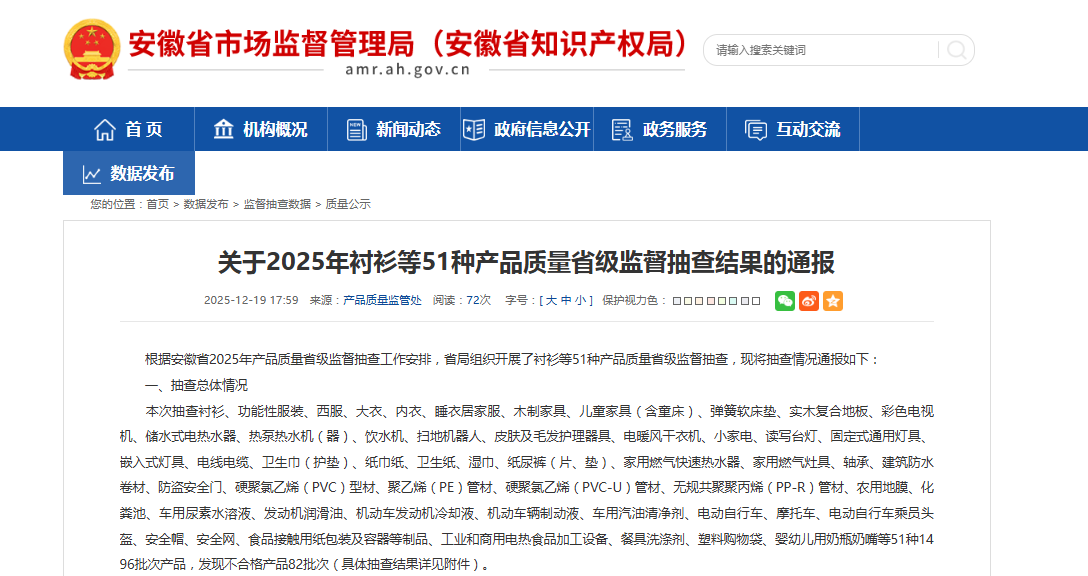
安徽省市场监管局发布2025年衬衫等51种产品质量省级监督抽查结果
Zhong Guo Zhi Liang Xin Wen Wang· 2025-12-22 08:31
Overall Summary - The Anhui Provincial Market Supervision Administration released the results of the provincial quality supervision sampling inspection for 51 products, including shirts, functional clothing, and various household items, revealing that 82 out of 1496 batches were found to be non-compliant [3][4]. Group 1: Product Categories with Non-compliance - Shirts: Out of 50 batches inspected, 3 batches were non-compliant due to fiber content [4]. - Functional Clothing: Among 112 batches, 3 batches failed due to fiber content and hydrostatic pressure after washing [4]. - Underwear: 1 out of 62 batches was non-compliant due to fiber content [5]. - Wooden Furniture: 2 out of 12 batches were non-compliant due to woodworking requirements [6]. - Spring Mattresses: 3 out of 12 batches failed due to appearance performance (zipper) [6]. - Electrical Appliances: Various categories such as skin and hair care devices, small appliances, and lighting fixtures showed multiple non-compliance issues related to safety and performance standards [13][14][21]. Group 2: Specific Non-compliance Issues - Skin and Hair Care Devices: 3 batches failed due to protection against live parts, input power and current, and radiation interference [13]. - Small Appliances: 1 batch was non-compliant due to stability and mechanical hazards, and power connection issues [13]. - Lighting Fixtures: 10 out of 27 batches of fixed general lighting and 8 out of 27 batches of embedded lighting were found non-compliant due to various electrical interference and efficiency standards [14][15]. - Electrical Cables: 1 out of 112 batches failed due to insulation thickness issues [21]. Group 3: Additional Product Categories - Children’s Furniture: No non-compliance was found in 12 batches inspected [6]. - Household Gas Appliances: No non-compliance was reported in 12 batches of gas water heaters and stoves [19][20]. - Disposable Hygiene Products: Categories such as sanitary napkins, tissues, and diapers showed no non-compliance in their respective batches [15][16][17][18].

报喜鸟:12月19日召开董事会会议
Mei Ri Jing Ji Xin Wen· 2025-12-19 09:53
Group 1 - The core point of the article is that Baoxiniang (SZ 002154) announced the establishment of a Sustainable Development Committee during its board meeting held on December 19, 2025 [1] - For the first half of 2025, Baoxiniang's revenue composition was 97.0% from the textile and apparel industry and 3.0% from other businesses [1] - As of the report date, Baoxiniang's market capitalization was 5.9 billion yuan [1]

威海高区税务局:税惠赋能,织就出海坦途
Qi Lu Wan Bao· 2025-12-17 08:42
Core Viewpoint - Shandong Lianqiao Group, the largest knitwear production and export enterprise in Northern China, is enhancing its global market presence through comprehensive tax support and guidance from local tax authorities, which is crucial for its innovation and international expansion [1][2] Group 1: Company Overview - Shandong Lianqiao Group exports over 40 million garments annually and has received multiple accolades, including "Top 100 Enterprises in China's Apparel Industry" and "National Textile Product Development Base" [1] - The company operates across the entire value chain of design, research and development, production, and sales, collaborating with international brands such as ARMANI and ZARA [1] Group 2: Tax Support and Guidance - The State Taxation Administration's Weihai Torch High-tech Industrial Development Zone Tax Bureau has established a "Taxation Think Tank" to provide targeted tax guidance to Lianqiao Group, addressing complex tax issues and ensuring the company fully benefits from tax incentives [1][2] - Tax officials focus on the garment export tax rebate policy, providing clear interpretations and practical case studies to help the company navigate compliance requirements and establish a robust tax risk management system [1] Group 3: Future Tax Services - The Weihai Tax Bureau plans to continue monitoring Lianqiao Group's digital and intelligent transformation, offering customized tax services to support its global supply chain and brand development [2] - The tax department's efficient guidance has alleviated tax-related challenges for Lianqiao Group, enhancing its international research and brand operations [2]
11月制造台企营收表现分化,lululemon北美仍承压、CEO将于26年1月卸任
GUOTAI HAITONG SECURITIES· 2025-12-14 07:01
Investment Rating - The report assigns an "Accumulate" rating for the industry [4]. Core Insights - The revenue performance of Taiwanese manufacturing companies in November showed divergence, with lululemon's Q3 performance exceeding expectations, particularly in the mainland China market, while the North American market remains under pressure. The CEO of lululemon will resign in January 2026, and it is expected that the proportion of new products for the spring season will reach 35% [2][5]. Summary by Sections Industry Overview - In November 2025, the revenue of Taiwanese manufacturers such as Yuanyuan, Fengtai, Yuchi, Zhiqiang, Laiyi, and Ruhong showed year-on-year changes of -2.4%, -11.8%, +6.6%, +3.1%, -5.8%, and +1.5% respectively. Cumulative revenue from January to November showed year-on-year changes of +0.9%, -4.9%, +21.2%, +14.7%, +6.2%, and +3.8% [5]. Company Performance - For lululemon's Q3 (ending November 2), revenue was $2.57 billion, a year-on-year increase of 7%, surpassing Bloomberg's consensus estimate of $2.48 billion. The net profit attributable to shareholders was $310 million, a year-on-year decrease of 12.8%, also exceeding expectations [5]. - In terms of regional performance, Q3 revenue in the Americas, mainland China, and other regions showed year-on-year changes of -2%, +47%, and +19% respectively [5]. Future Outlook - The report suggests that the performance of the export manufacturing sector is expected to recover in 2026 due to three main factors: the implementation of U.S. tariff policies, reduced burden of tariff costs shared with brands, and improved efficiency from optimized production line allocation [5]. - Recommended companies include Huayi Group, Jiuxing Holdings, Shenzhou International, and Chaoying International Holdings, with a focus on home textiles, luxury goods, and undervalued high-dividend companies [5].


MBMC观察:中国证监会截至11月30日公示境内企业美国发行证券与上市备案状况:达55家
Xin Lang Cai Jing· 2025-12-08 01:32
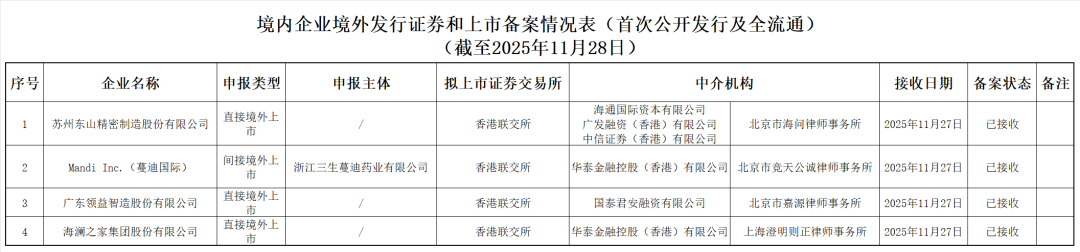
Summary of Key Points Core Viewpoint - As of November 28, 2025, a total of 346 domestic companies have registered for overseas securities issuance and listing, with 290 companies planning to list in Hong Kong, 55 in the United States, and 1 in Taiwan [1][6]. Group 1: Companies Registered for Overseas Listing - Four new companies have been added to the registration list, all planning to list in Hong Kong: Dongshan Precision, Mandi International, Lingyi Technology, and Hailan Home [2][6]. - The companies listed for Hong Kong include: - Suzhou Dongshan Precision Manufacturing Co., Ltd. (Direct listing) [2] - Mandi Inc. (Indirect listing) [2] - Guangdong Lingyi Technology Co., Ltd. (Direct listing) [2] - Hailan Home Group Co., Ltd. (Direct listing) [2] Group 2: Companies Planning to List in the United States - The 55 companies intending to list in the U.S. are all targeting the Nasdaq exchange [3][6]. - The registration includes various companies across different sectors, indicating a diverse interest in U.S. capital markets [3][6].


透视154个国家,南都发布湾区制造业国际竞争力指数报告
Nan Fang Du Shi Bao· 2025-12-01 15:33
Core Insights - The "Belt and Road" Bay Area Manufacturing International Competitiveness Index Report was released, highlighting the competitive advantages of the Guangdong-Hong Kong-Macao Greater Bay Area (GBA) manufacturing sector in the context of the Belt and Road Initiative [1][3] Group 1: Economic Performance - The GBA's manufacturing import and export total is projected to reach 5.68 trillion yuan in 2024, reflecting an 8.5% year-on-year growth, underscoring its role as a significant engine of China's openness [6] - The GBA's GDP is expected to exceed 14 trillion yuan in 2024, positioning it among the top global bay areas [4] Group 2: Competitive Analysis - The report employs a "four-dimensional evaluation model" based on 130,000 customs data entries and WTO databases, utilizing four core indicators: RCA index, TC index, TCI index, and MS index to assess the GBA's manufacturing competitiveness [4] - The RCA index indicates that the GBA's five major export products—automatic data processing equipment, electronic components, electrical equipment, household appliances, and textiles—have a significant comparative advantage, with RCA values exceeding 1 [6] Group 3: Market Opportunities - The GBA's manufacturing exports are heavily concentrated in five key products, which account for over 50% of total exports, with high-tech products making up nearly 50% of this share [6] - The TCI index reveals substantial cooperation potential with ASEAN, Middle East, and African markets, particularly with countries like Russia and Brazil for household appliances, and Indonesia and Vietnam for electronic components [6][7] Group 4: Strategic Recommendations - The report suggests enhancing local operations in high-complementarity markets such as ASEAN, particularly in Vietnam and Indonesia, while also managing political risks in the Middle East and Africa [7] - It emphasizes the importance of Hong Kong's role as a trade hub, noting that over one-third of GBA products are re-exported through Hong Kong, which can help reduce trade costs by 10%-15% [7] - Recommendations for high-quality development include promoting "institutional opening" at the government level and encouraging data-driven, precise market entry strategies at the enterprise level [7][8]

越南纺织业出口额预计达460亿美元,稳居全球第三
Shang Wu Bu Wang Zhan· 2025-11-29 04:47
Core Insights - Vietnam's textile and garment export revenue is projected to reach $46 billion by 2025, marking a year-on-year growth of 5.6% [2] - The industry maintains a significant trade surplus of $21 billion, reinforcing its critical role in Vietnam's trade balance [2] - The domestic value-added rate in the textile sector has reached approximately 52%, indicating an increasing reliance on local raw materials and supplies [2] Market Performance - Vietnamese textile and garment products are currently exported to 138 global markets, with the United States being the primary market [2] - Revenue from exports to the U.S. is expected to hit $18.6 billion, reflecting a year-on-year increase of 11.75% [2] - Many companies have orders booked until the end of Q1 2026 and are negotiating orders for Q2 2026, showcasing strong international market confidence in Vietnam [2] Industry Position - Vietnam continues to hold its position as the third-largest textile and garment exporter globally, following China and Bangladesh [2]
日本消费行业10月跟踪报告:内需分化,免税回暖
Haitong Securities International· 2025-11-28 14:56
Investment Rating - The report does not explicitly state an investment rating for the industry, but it suggests a focus on companies with optimistic profit improvement prospects. Core Insights - Domestic demand in Japan is diverging, with a rebound in duty-free sales driven by the National Day holiday and a weaker yen, marking the first positive growth in duty-free sales in eight months [3][15]. - Consumers are highly sensitive to prices for daily necessities, leading to increased average transaction values at discount and convenience stores, despite a decline in foot traffic [3][15]. - There is a trend of "downgrading" in dining and clothing consumption, with value brands like Saizeriya and Uniqlo seeing significant increases in customer traffic and same-store sales [3][15]. - Actual household entertainment spending has increased significantly, with travel and savings becoming preferred uses of disposable income, reflecting a mindset of enjoying life while prioritizing financial security amid economic uncertainty [3][15]. - The hotel industry continues to thrive due to a record number of inbound tourists and the depreciation of the yen, with strong demand for luxury goods and cosmetics from visitors [3][15]. Summary by Sections Macro Overview - The Japanese yen has depreciated, and inflationary pressures are rising, with the consumer confidence index slightly increasing to 35.8 in October from 35.3 in September [2][9]. - Real wages contracted by 1.4% year-on-year in September, continuing a nine-month trend of negative growth, while nominal wage growth was only 1.9%, significantly lagging behind inflation [2][9]. - The Producer Price Index (PPI) rose by 2.7% year-on-year in October, maintaining above 2% for four consecutive months, indicating persistent price pressures [2][13]. Essential Consumption - Retail sales in essential goods are showing steady growth despite high prices, with same-store sales for major retailers like Aeon and 7-Eleven increasing by 4.7% and 1.3% respectively in October [4][18]. - The demand for basic food and beverage items remains under pressure, with a year-on-year decline in retail sales for food and beverages recorded at approximately 35.56 billion yen in September [4][18]. Optional Consumption - There is a significant increase in demand for winter clothing, with same-store sales for Uniqlo rising by 25.1% in October, driven by strong sales of winter collections [5][32]. - The restaurant sector has seen same-store sales growth for major chains like Saizeriya and McDonald's, with increases of 16.9% and 8.1% respectively in October [5][28]. - Duty-free sales have turned positive for the first time in eight months, with a year-on-year growth of 7.5% in October, driven by increased tourist spending [5][36]. Stock Market Performance - The consumer sector saw most stocks rise from October 27 to November 27, with retail and food and beverage sectors gaining 5.6% and 4.7% respectively [6]. - Investment recommendations focus on companies like Mercari, which is expected to improve profitability, and Kirin Holdings, which has shown strong operational profit growth [6].
报喜鸟:吴志泽累计质押股数约为1.19亿股
Mei Ri Jing Ji Xin Wen· 2025-11-25 09:38
每经AI快讯,报喜鸟(SZ 002154,收盘价:4.04元)11月25日晚间发布公告称,截至本公告日,吴志 泽累计质押股数约为1.19亿股,占其所持股份比例为32.42%。吴婷婷累计质押股数为1160万股,占其所 持股份比例为6.25%。 截至发稿,报喜鸟市值为59亿元。 每经头条(nbdtoutiao)——688496,被证监会立案!刚上市业绩就变脸,亏损超1亿元;核心产品受重 创:第一大客户"自产自用",减少采购 (记者 曾健辉) 2025年1至6月份,报喜鸟的营业收入构成为:纺织服装业占比97.0%,其他业务占比3.0%。 ...
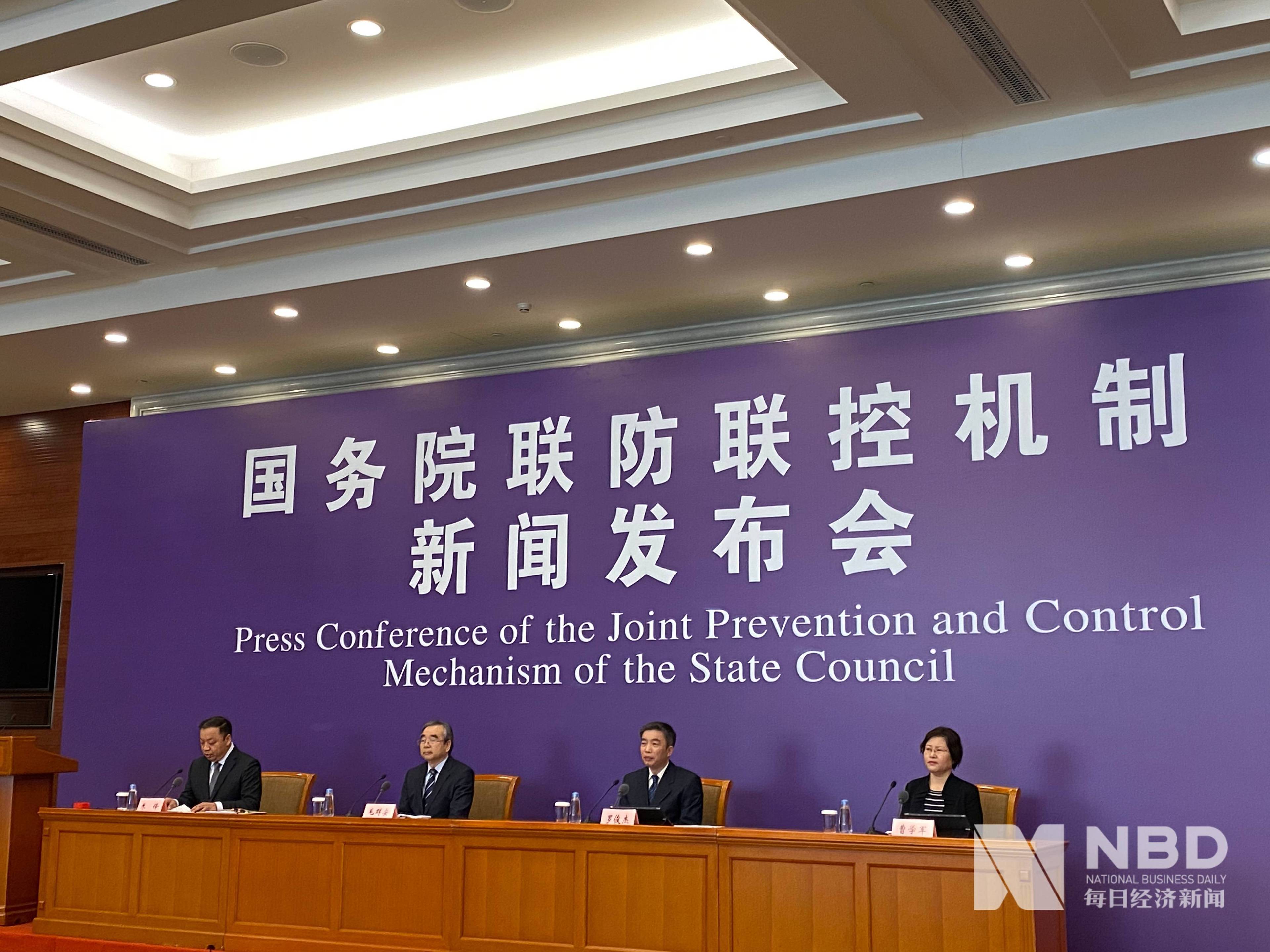
多国防护物资出现紧缺,工信部:鼓励防护服生产企业对接国外需求
Mei Ri Jing Ji Xin Wen· 2025-11-24 08:06
Core Viewpoint - The Chinese government is actively managing the production and supply of medical protective equipment, particularly protective clothing, in response to the COVID-19 pandemic, with a focus on meeting both domestic and international demand as the situation evolves [4][5]. Group 1: Production and Supply - Many factories in China that originally produced clothing have shifted to manufacturing protective clothing and other pandemic-related supplies, leading to a gradual increase in production capacity [4]. - The production and supply of protective clothing have transitioned from a state of severe shortage to one that can meet current demand, with daily coordination ensuring that 250,000 pieces are supplied to Hubei province, exceeding local needs for several consecutive days [4]. - The government emphasizes that despite the decline in confirmed cases nationwide, the production and supply of protective clothing should not be relaxed [4]. Group 2: Future Plans and Global Context - Moving forward, the government aims to ensure that while meeting the needs of Hubei, the production also addresses the requirements of other regions in China, enhancing production flexibility and ensuring quality [5]. - The global pandemic situation remains critical, with shortages of protective materials in various countries, prompting China to encourage domestic manufacturers to engage with international markets and produce according to relevant standards for export [5].