食品饮料业

Search documents
洛杉矶奥运会“向钱看”? 赞助商“露脸”机会大增
Di Yi Cai Jing· 2026-02-24 11:05
Group 1 - The core focus of the news is the evolving sponsorship landscape for the 2028 Los Angeles Olympics, with significant domestic sponsorship revenue already exceeding $2 billion, achieving 80% of the $2.5 billion target [1] - The Los Angeles Organizing Committee plans to introduce a new marketing structure that allows previously restricted advertising spaces, such as athlete preparation areas and scoreboards, to become opportunities for sponsors [1][2] - The International Olympic Committee (IOC) has shifted its strict "clean venue" policy, allowing sponsors' products to be more visibly presented during events, as seen in recent Olympic Games [2] Group 2 - The IOC's Olympic Partners Programme (TOP) currently has only 11 sponsors, the lowest since 2015, with several major companies exiting after the 2024 Paris Olympics, while TCL has joined as a new sponsor [2] - To enhance sponsor value, the 2028 Los Angeles Olympics will allow sponsors to purchase naming rights for official competition venues, with Honda and Comcast already securing rights for specific venues [4] - The Los Angeles Organizing Committee has seen a significant interest in ticket registrations, with 1.5 million people signing up within the first 24 hours of the ticket lottery opening [4]


特朗普暗示违法征收的关税不退了,美财长称今年关税收入将“基本保持不变”
Hua Er Jie Jian Wen· 2026-02-20 23:09
Core Viewpoint - The Trump administration is determined to maintain tariff barriers despite a Supreme Court ruling declaring most of the tariffs imposed last year illegal, indicating that the government will not refund the estimated $170 billion in tariffs collected [1][2][3]. Group 1: Tariff Policy Changes - President Trump announced plans to sign an executive order imposing a 10% import tariff on global goods, replacing the tariffs deemed illegal by the Supreme Court [1][3]. - Treasury Secretary Mnuchin stated that the government will utilize alternative legal powers under the Trade Act of 1974 and the Trade Expansion Act of 1962 to implement new tariffs [1][2]. Group 2: Financial Implications - Mnuchin emphasized that no reduction in tariff revenue is expected, projecting that tariff income will remain "basically unchanged" by 2026 [2]. - The government’s estimated tariff revenue is closer to $130 billion, contrary to the $175 billion suggested by some economic models [2][3]. Group 3: Refund Controversy - The Supreme Court's ruling has initiated a significant dispute over potential refunds, with over 30,000 importers affected and many companies, including Costco and Lululemon, seeking to reclaim paid tariffs [3][4]. - The refund process is expected to be complex and may take weeks to months, potentially exceeding a year [5][6]. Group 4: Industry Reactions - Retailers and manufacturers are preparing for the refund process, with some companies like Lalo and Ibis Cycles expressing hope for refunds but acknowledging uncertainty regarding timing [6][7]. - The National Retail Federation has called for a streamlined refund process, highlighting the potential economic boost from tariff reductions [5][6].
欧洲股市上涨 矿业股在美联储会议纪要发布前走强
Sou Hu Cai Jing· 2025-12-30 18:17
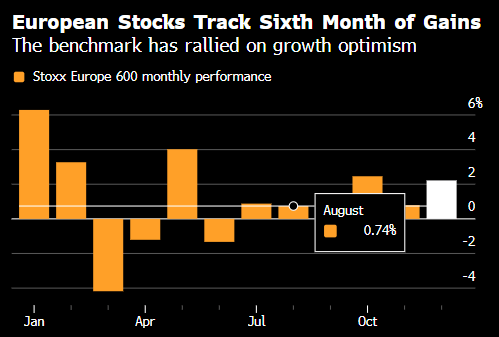
Group 1 - European stock markets rose on Tuesday, driven by mining stocks as commodity prices increased, with investors awaiting the release of the Federal Reserve's recent meeting minutes [1] - The Stoxx Europe 600 index closed up 0.6%, while the German DAX index also rose by 0.6%, achieving its largest annual gain since 2019 due to optimism surrounding substantial fiscal stimulus measures [1] - The Italian FTSE MIB index outperformed other major European indices, rising by 1.1% and recording a cumulative gain of 32% for the year 2025, marking its best annual performance since 1998 [1] Group 2 - The mining sector increased by 1.7%, with copper prices on track for the longest consecutive rise since 2017, indicating strong demand in the sector [1] - Blue-chip Stoxx 50 index rose by 0.8%, closing at a record high for the first time since November [1] - Fresnillo Plc saw a significant increase of 6.8% after Citigroup analysts raised the target price for the company while maintaining a buy rating, citing rising silver and gold prices as a key factor [1]

资本周期系列:从业绩变脸到价值修复
Guoxin Securities· 2025-12-30 06:28
Group 1 - The report identifies a U-shaped evolution of ROE growth for companies in the A-share market post-IPO, with an average turning point occurring around 9.32 years after listing [1][16][22] - A systematic "three-step" screening framework is proposed to identify industries and stocks with long-term investment value, extracting a sample pool of approximately 23% from over 5000 A-shares [1][3][17] - The individual stock dimension is crucial for accurately identifying the real phase of the cycle, as industries like banking and real estate show strong clustering effects, while sectors like power equipment and pharmaceuticals require individual stock analysis for precise judgment [1][3][17] Group 2 - The first step of empirical research involves using a quadratic function to identify stocks with significant U-shaped characteristics, resulting in 1273 stocks (about 23%) being classified into potential stocks (241) and performance stocks (1032) based on their lifecycle phases [2][18][19] - In the first phase (pressure period), industries such as media, utilities, and pharmaceuticals exhibit strong defensive resilience, while in the second phase (recovery period), sectors like power equipment, electronics, and home appliances show high elasticity in ROE recovery [3][34][35] - The report emphasizes the importance of micro-level selection within industries to identify stocks that outperform their industry benchmarks, ensuring selected stocks possess both industry support and superior alpha attributes [3][17][33] Group 3 - Case studies reveal that leading stocks in the first phase include media, utilities, and pharmaceuticals, while in the second phase, power equipment, electronics, and machinery dominate in terms of upward elasticity [4][36] - The banking sector demonstrates strong value blue-chip characteristics, with 40% of its stocks in the second phase, indicating high certainty in profit recovery and operational stability [27][41] - The food and beverage industry shows significant differentiation, with white liquor stocks like Guizhou Moutai in the first phase, while mass consumer goods have entered the second phase, indicating a recovery in operational efficiency [36][39]
利好!消费板块 集体拉升!
Zheng Quan Shi Bao· 2025-12-15 10:43
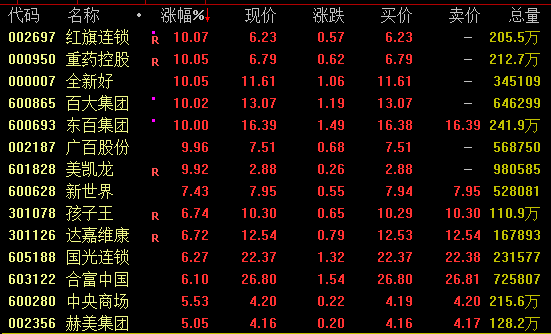
Market Overview - A-shares experienced a collective decline, with major indices such as the ChiNext and Sci-Tech 50 Index seeing significant drops, while the Hang Seng Index fell over 1% [1] - The Shanghai Composite Index closed down 0.55% at 3867.92 points, with the Shenzhen Component down 1.1%, and the ChiNext down 1.77% [1] - Total trading volume in the Shanghai and Shenzhen markets was 1.7945 trillion yuan, a decrease of over 320 billion yuan from the previous day [1] Sector Performance Semiconductor Sector - The semiconductor sector faced a pullback, with stocks like Chipone Technology dropping nearly 12% and Jiangbo Technology down over 8% [1] AI Industry Chain - AI-related stocks saw a significant decline, with companies like Tengjing Technology and Shijia Photon down over 10% [12] Insurance Sector - The insurance sector showed strength, with China Ping An rising approximately 5%, reaching a four-year high, and other major insurers like China Pacific Insurance and China Life Insurance also posting gains [4][5] - Analysts suggest that the insurance sector is entering a recovery phase, supported by regulatory policies and improving fundamentals [5] Retail Sector - The retail sector was notably active, with stocks such as Hongqi Chain and Baida Group hitting the daily limit up, and Baida Group achieving three consecutive days of limit-up trading [7][9] - The retail sales total for January to November increased by 4% year-on-year, indicating a positive trend in consumer spending [9] Dairy Industry - The dairy sector performed well, with stocks like Huanlejia and Huangshi Group reaching the daily limit up, driven by policy support and improving demand [10] - The industry is expected to benefit from a recovery in consumer confidence and demand, particularly in the infant formula segment [10] Conclusion - Overall, the market showed mixed performance across sectors, with notable declines in technology and AI stocks, while insurance and retail sectors demonstrated resilience and growth potential [1][5][9]



风险因子下调鼓励险资“买得进”“拿得住”
Jin Rong Shi Bao· 2025-12-10 02:03
Core Viewpoint - The adjustment of risk factors by the regulatory authority is a significant step in implementing the "long money, long investment" system, aimed at encouraging long-term and value investments in the market [1][7]. Group 1: Regulatory Changes - The Financial Regulatory Bureau issued a notice adjusting the risk factors for insurance companies investing in the CSI 300 index, the CSI Dividend Low Volatility 100 index, and stocks listed on the Sci-Tech Innovation Board [1][6]. - The risk factor for stocks held for over three years in the CSI 300 and CSI Dividend Low Volatility 100 indices has been reduced from 0.3 to 0.27, while for stocks held for over two years on the Sci-Tech Innovation Board, it has been reduced from 0.4 to 0.36 [2][4]. Group 2: Impact on Insurance Companies - The adjustment allows insurance companies to allocate more capital to stock investments, as lower risk factors mean less capital is required to cover potential risks [2][4]. - Analysts estimate that if the minimum capital is fully allocated to the CSI 300 stocks, it could release approximately 108.6 billion yuan [4]. Group 3: Long-term Investment Encouragement - The primary intention behind the notice is to guide insurance capital towards long-term holding rather than merely providing short-term capital relief [4][6]. - The regulatory authority aims to encourage insurance funds to not only invest but also hold onto their investments for longer periods, thereby reducing market volatility [4][7]. Group 4: Growth of Insurance Capital - As of September 2025, the total investment balance of insurance companies exceeded 37 trillion yuan, with stock and securities fund investments reaching 5.59 trillion yuan, accounting for 14.92% of total investments, up from 12.8% the previous year [7]. - The role of insurance capital in the capital market is expected to become increasingly significant, with projections indicating that new equity investments from insurance funds could remain around one trillion yuan in 2026 [7].
王均豪:以多元化布局筑牢高质量发展根基
Zhong Guo Jing Ying Bao· 2025-12-09 13:33
Core Insights - The conference "Starting New Paths for Steady and Long-term Development" highlighted the importance of diversification and high-quality development in business strategy, as emphasized by Wang Junhao, President of Junyao Group [1] Group 1: Business Strategy - Junyao Group adheres to a strategy of "diversified investment and specialized operation," believing that diversification is essential for long-term stability amid industry cyclicality [1] - The company maintains a strict principle of not using cash flow from its main business to fund diversified ventures, ensuring financial integrity [1] Group 2: Health Industry - Junyao Group entered the health sector in 1994 with Junyao Milk and successfully transformed during the 2008 milk crisis by focusing on probiotics, leading to the establishment of the "Junyao Health" brand [2] - The company has developed over 50,000 strains of bacteria through collaboration with universities and has received international patents, with products now sold in over 80 countries [2] Group 3: Technology and Manufacturing - The company has achieved international certification for its pilot simulator, matching the standards of Boeing 737 and 787, and has successfully exported to France [2] - In the electric vehicle sector, Junyao Group emphasizes a rational development approach, prioritizing quality over scale [2] Group 4: Aviation and Education - Junyao Group's airline, Junyao Airlines, operates over 100 aircraft and has established significant international competitiveness [3] - The education sector focuses on non-profit institutions, with a high percentage of graduates gaining admission to top global universities, and is integrating AI technology to enhance educational outcomes [3] Group 5: Cultural Initiatives - Junyao Group aims to promote Chinese culture globally, exemplified by hosting a guqin concert in Serbia and establishing a cultural exchange center for the ancient instrument [4] - The company emphasizes the importance of cultural heritage and aims to make Chinese civilization more accessible to the world [4]

日本消费行业10月跟踪报告:内需分化,免税回暖
Haitong Securities International· 2025-11-28 14:56
Investment Rating - The report does not explicitly state an investment rating for the industry, but it suggests a focus on companies with optimistic profit improvement prospects. Core Insights - Domestic demand in Japan is diverging, with a rebound in duty-free sales driven by the National Day holiday and a weaker yen, marking the first positive growth in duty-free sales in eight months [3][15]. - Consumers are highly sensitive to prices for daily necessities, leading to increased average transaction values at discount and convenience stores, despite a decline in foot traffic [3][15]. - There is a trend of "downgrading" in dining and clothing consumption, with value brands like Saizeriya and Uniqlo seeing significant increases in customer traffic and same-store sales [3][15]. - Actual household entertainment spending has increased significantly, with travel and savings becoming preferred uses of disposable income, reflecting a mindset of enjoying life while prioritizing financial security amid economic uncertainty [3][15]. - The hotel industry continues to thrive due to a record number of inbound tourists and the depreciation of the yen, with strong demand for luxury goods and cosmetics from visitors [3][15]. Summary by Sections Macro Overview - The Japanese yen has depreciated, and inflationary pressures are rising, with the consumer confidence index slightly increasing to 35.8 in October from 35.3 in September [2][9]. - Real wages contracted by 1.4% year-on-year in September, continuing a nine-month trend of negative growth, while nominal wage growth was only 1.9%, significantly lagging behind inflation [2][9]. - The Producer Price Index (PPI) rose by 2.7% year-on-year in October, maintaining above 2% for four consecutive months, indicating persistent price pressures [2][13]. Essential Consumption - Retail sales in essential goods are showing steady growth despite high prices, with same-store sales for major retailers like Aeon and 7-Eleven increasing by 4.7% and 1.3% respectively in October [4][18]. - The demand for basic food and beverage items remains under pressure, with a year-on-year decline in retail sales for food and beverages recorded at approximately 35.56 billion yen in September [4][18]. Optional Consumption - There is a significant increase in demand for winter clothing, with same-store sales for Uniqlo rising by 25.1% in October, driven by strong sales of winter collections [5][32]. - The restaurant sector has seen same-store sales growth for major chains like Saizeriya and McDonald's, with increases of 16.9% and 8.1% respectively in October [5][28]. - Duty-free sales have turned positive for the first time in eight months, with a year-on-year growth of 7.5% in October, driven by increased tourist spending [5][36]. Stock Market Performance - The consumer sector saw most stocks rise from October 27 to November 27, with retail and food and beverage sectors gaining 5.6% and 4.7% respectively [6]. - Investment recommendations focus on companies like Mercari, which is expected to improve profitability, and Kirin Holdings, which has shown strong operational profit growth [6].
图说中国宏观专题:近期宏中观体感温差
2025-11-26 14:15
Summary of Key Points from the Conference Call Industry Overview - The macroeconomic data for October indicates a slowdown across various sectors, including industrial production, services, investment, retail sales, exports, and real estate sales, with notable declines in industrial value-added growth to 4.9% year-on-year, down 1.6 percentage points from the previous month [2][26]. Core Insights and Arguments - **Industrial Production**: The industrial value-added growth rate fell to 4.9% in October, with manufacturing showing significant deceleration. The electricity and water industries saw slight increases, while sectors like food and beverage, as well as non-ferrous metals, experienced declines [1][3][4]. - **Investment Trends**: Fixed asset investment decreased by 1.7% year-on-year in October, with real estate development investment dropping to 18% of total fixed asset investment, the lowest since 2018. This indicates a reduced reliance on real estate within the economy [1][2][4]. - **Real Estate Market**: The real estate market remains under pressure, with declines in new construction, construction, and completion areas. The second-hand housing market also showed weakness, with both new and second-hand housing price indices reflecting fatigue [5][6]. - **Retail Sales**: Social retail sales grew by 2.9% year-on-year in October, slightly lower than September's 3%. However, offline consumption and service sector spending showed improvement, with retail sales excluding automobiles growing by 4% [6][9]. - **PMI Data**: The manufacturing PMI decreased to 49, indicating contraction, while the services PMI saw a slight increase, suggesting a lack of significant improvement in economic recovery [7][26]. - **Inflation Metrics**: The CPI rose to 0.2% year-on-year, driven by a low base effect from the previous year and supply reductions in certain categories. The PPI remained negative at -2.1%, although the decline was less severe than before [11][12]. Additional Important Insights - **Fiscal and Monetary Policy**: Fiscal spending saw a significant drop of 9.8% year-on-year, while tax revenues remained robust, particularly personal income tax, which grew by 27.26%. However, the overall fiscal policy appears insufficient to counteract the economic slowdown [22][24]. - **Consumer Behavior**: Despite a general decline in retail data, certain sectors like high-end services and overseas brands showed signs of recovery. The demand for services such as business travel and hotel stays remained stable [20][15]. - **Sectoral Disparities**: There is a noticeable divergence between different industries, with some sectors performing relatively well while others face greater challenges. This structural change in the economy necessitates close monitoring [27][26]. This summary encapsulates the key points from the conference call, highlighting the current state of the economy and various sectors, along with the implications for future investment opportunities and risks.
ETF今日收评 | 旅游ETF涨超5% 电池相关ETF跌超2%
Mei Ri Jing Ji Xin Wen· 2025-11-10 07:23
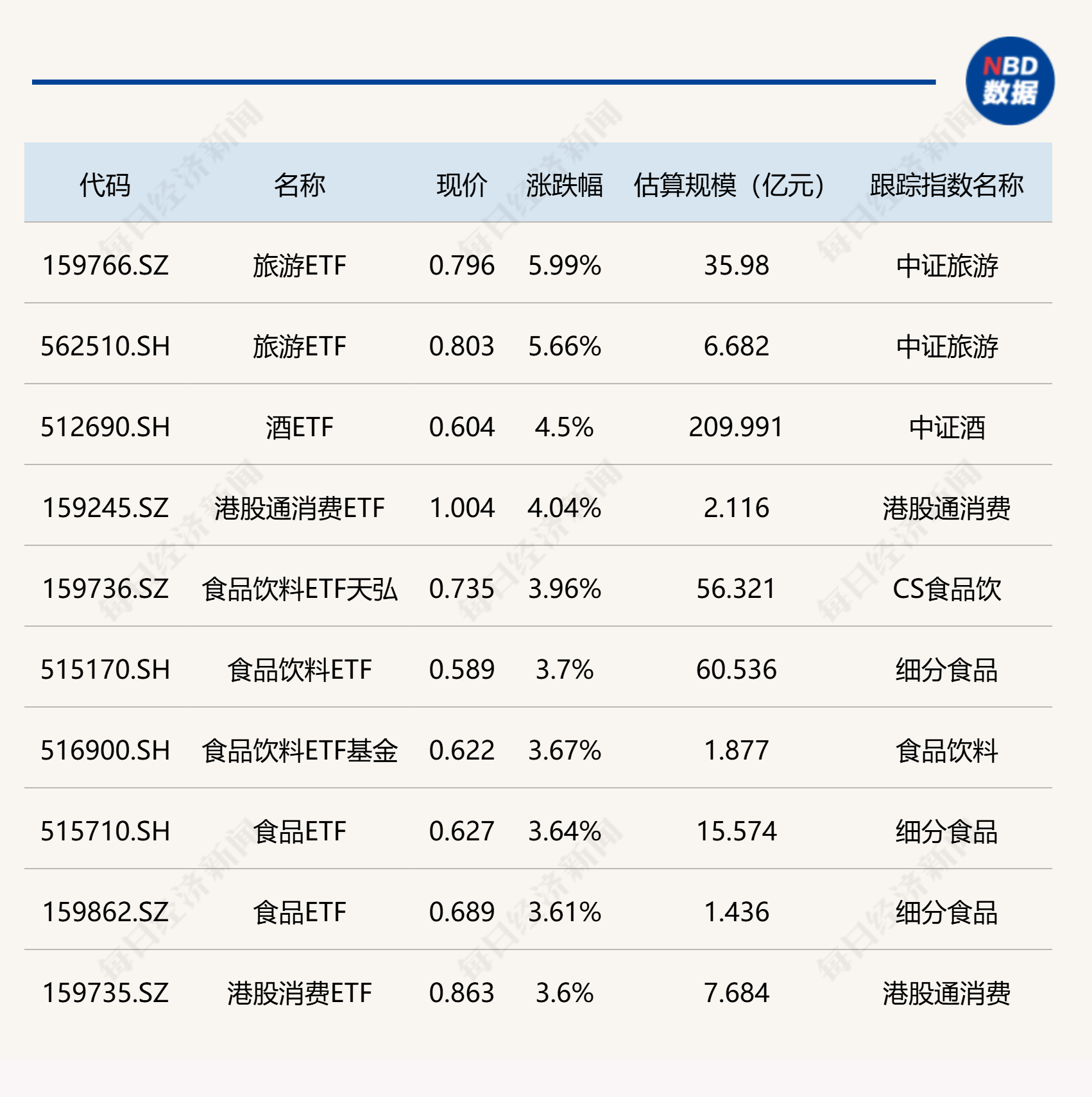
Market Overview - The market is experiencing a rebound with mixed performance across the three major indices, highlighting rapid rotation of market hotspots, particularly in the tourism and consumer sectors, while the humanoid robot concept is weakening [1] - The tourism ETF has surged over 5%, indicating strong investor interest in this sector [1] Tourism Sector - Various segments of the tourism industry, including scenic spots, hotels, travel agencies, and retail, are showing comprehensive recovery, supported by continuous government policies aimed at promoting high-quality development in tourism [3] - Upcoming holidays such as New Year's and an extended Spring Festival, along with increased interest in winter tourism and the introduction of duty-free and visa-free policies, have significantly boosted the tourism sector's momentum [3] ETF Performance - The tourism ETF (159766.SZ) rose by 5.99%, while other related ETFs such as the liquor ETF and consumer ETFs also showed positive performance, with increases ranging from 3.61% to 4.5% [2] - Conversely, several battery-related ETFs have seen declines exceeding 2%, indicating a downturn in that sector [4] Battery Technology - Solid-state batteries are advancing from laboratory research to commercialization, driven by their high energy density and safety advantages, alongside supportive policies and evolving market demands [5] - The global solid-state battery industry is at a critical stage of moving towards commercial viability, reflecting ongoing technological advancements [5]