航天制造

Search documents
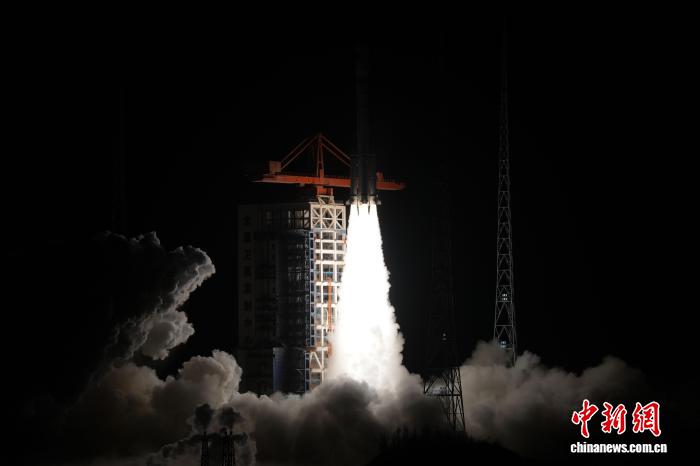
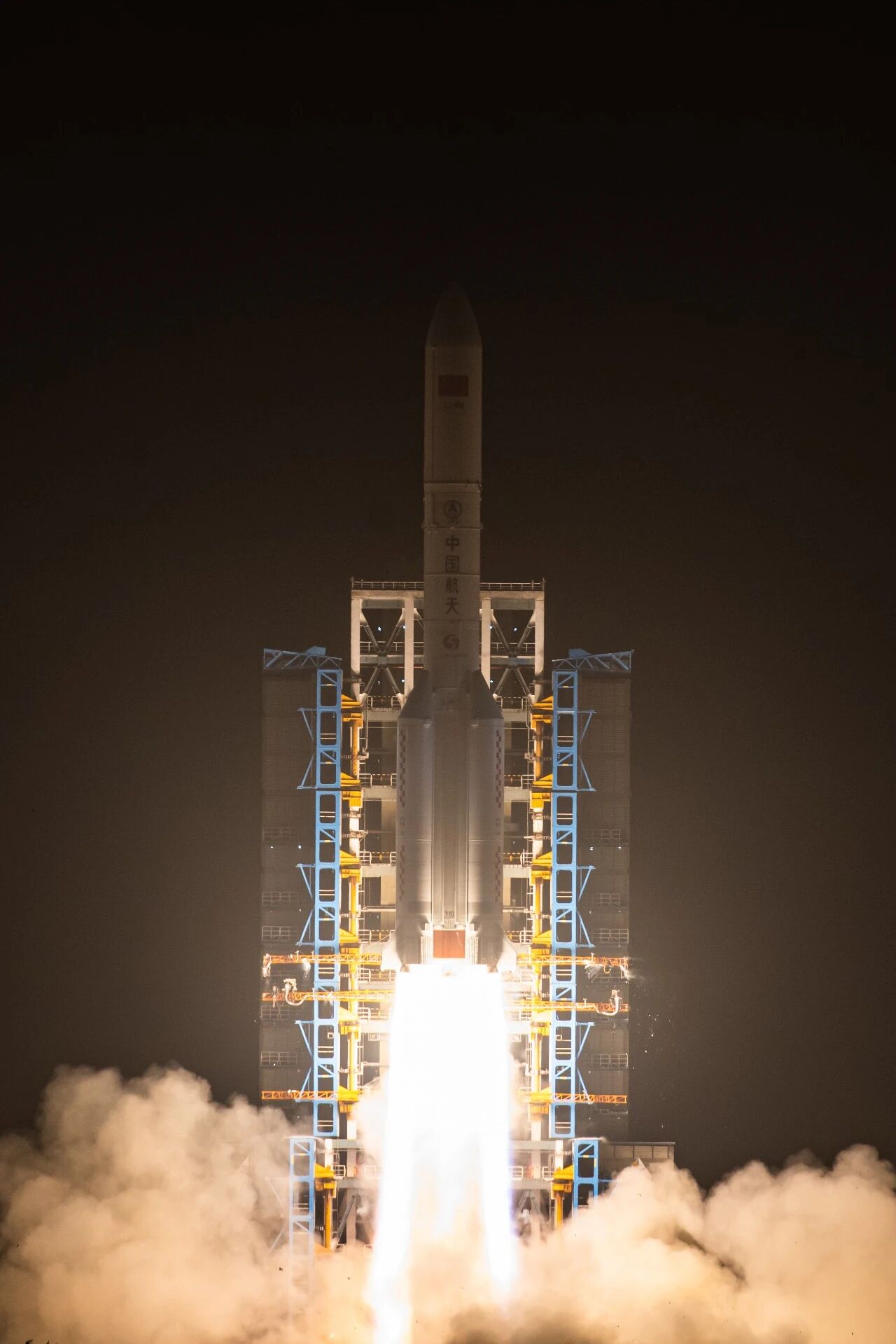
长征五号火箭成功发射通信技术试验卫星二十三号
Xin Lang Cai Jing· 2025-12-20 14:58
Core Viewpoint - The successful launch of the Long March 5 rocket marks a significant achievement in China's space exploration efforts, particularly in satellite communication technology validation [1][4]. Group 1: Launch Details - The Long March 5 rocket was launched on December 20 at 20:30 from the Wenchang Space Launch Site, successfully placing the Communication Technology Test Satellite No. 23 into its designated orbit [1]. - This launch represents the 618th mission of the Long March series of rockets, showcasing the ongoing capabilities and advancements in China's space launch technology [5]. Group 2: Satellite and Rocket Specifications - The Communication Technology Test Satellite No. 23 was developed by the China Aerospace Science and Technology Corporation's Fifth Academy, focusing on multi-band and high-speed satellite communication technology verification [4]. - The Long March 5 rocket, developed by the First Academy of the China Aerospace Science and Technology Corporation, features a two-and-a-half stage liquid launch vehicle design with a diameter of 5.2 meters and a height of 18.5 meters, enhancing its ability to meet the demands of large satellite platforms [4]. Group 3: Future Developments - The development team for the Long March 5 rocket will concentrate on high-density launches, optimizing the launch process, and advancing new rocket configurations and technology applications to better meet future launch requirements [4].

上大股份:公司与国内某主要半导体设备制造企业进行开发合作,产品验证进展顺利
Zheng Quan Ri Bao Wang· 2025-12-18 10:43
Core Viewpoint - The company has achieved certification from major commercial aerospace enterprises and is actively involved in the semiconductor sector through product development collaborations [1] Group 1: Aerospace Sector - The company has obtained qualification certifications from Aerospace Science and Technology Corporation and Aerospace Industry Group, as well as from key commercial aerospace companies such as Blue Arrow Aerospace and Jiuzhou Cloud Arrow [1] - The company is engaged in stable mass production and supply in the aerospace field [1] Group 2: Semiconductor Sector - The company has developed new material products for semiconductor equipment manufacturing [1] - The company is collaborating with a major domestic semiconductor equipment manufacturer, and the product validation is progressing smoothly [1]
斯瑞新材(688102.SH):客户覆盖蓝箭航天、九州云箭等
Ge Long Hui A P P· 2025-12-18 10:24
Core Viewpoint - The company, Srey New Materials (688102.SH), is experiencing significant growth in its liquid rocket engine thrust chamber business, driven by the rapid development of the global commercial space industry [1] Group 1: Financial Performance - In the first half of 2025, the company's revenue reached 772.15 million yuan, with the liquid rocket engine thrust chamber business contributing 23.29 million yuan [1] - Revenue from the liquid rocket engine thrust chamber products increased from 20.97 million yuan in 2022 to 30.16 million yuan in 2024, indicating a strong growth trajectory [1] Group 2: Business Development - The company has initiated a project for the industrialization of materials, parts, and components for liquid rocket engine thrust chambers in 2024, with an initial investment plan of 230 million yuan [1] - The first phase of the project is expected to achieve an annual production capacity of approximately 200 tons of forgings, 200 sets of rocket engine injector panels, and 500 sets of internal and external components for thrust chambers [1] Group 3: Investment and Capacity Building - As of June 30, 2025, the company has invested over 47 million yuan in capacity building, continuing to enhance its production capabilities [1]

潮涌自贸港 “天涯”共此时 海南改革开放新高地加速“蝶变”
Shang Hai Zheng Quan Bao· 2025-12-17 19:19
Core Viewpoint - Hainan Free Trade Port is undergoing a historic transformation with the implementation of full island closure operations, positioning itself as a new high ground for reform and opening up in China [3][4]. Industry Upgrades and Development - The Sanya Yazhou Bay Science and Technology City has evolved from a construction site to a hub for innovation, with over 3,100 seed industry enterprises established, and a projected output value of 18 billion yuan for the southern breeding industry in 2024 [6][8]. - The aerospace industry in Hainan is advancing with the establishment of China's first reusable rocket assembly and testing factory, capable of producing 24 rockets annually, and achieving a record of "seven launches in seven days" [6][8]. - Hainan aims to exceed 1 trillion yuan in marine production value by 2035, with the marine economy expected to account for over half of the province's total economic output [6]. Infrastructure Development - Significant infrastructure projects have been completed, including the Haikou New Sea Passenger Transport Hub and the expansion of Sanya Phoenix International Airport, enhancing connectivity and operational efficiency [9][11]. - The introduction of "non-sensory customs clearance" services has improved passenger and cargo processing efficiency by 60% and reduced average entry time for trucks by 25% [10][12]. Talent Attraction and Human Resources - Since 2018, Hainan has attracted 1.03 million talents, with over 90% being young professionals under 45, and plans to add another 1 million talents in the next five years through the "Million Talents Prosper Hainan" initiative [13][14]. - The province offers a 15% personal income tax incentive to enhance the sense of gain for talents, alongside clear career opportunities in the Yazhou Bay Science and Technology City [14].

上大股份:已取得蓝箭航天、九州云箭等资质认证 并长期稳定批产供货
Xin Lang Cai Jing· 2025-12-17 01:49
Core Viewpoint - The company has obtained certification from major commercial aerospace enterprises and is engaged in the production of critical components for space applications [1] Group 1: Company Achievements - The company has received qualification certifications from aerospace technology and aerospace industry groups, including Blue Arrow Aerospace and Jiuzhou Cloud Arrow [1] - The company has established a long-term stable production and supply chain for its products [1] Group 2: Product Applications - The company's products are primarily used in the manufacturing of solid rocket motor casings, liquid rocket engine hot-end components, rocket balance rudder shafts, and other high-temperature, high-strength critical components for spacecraft [1]
【早报】中央财办:扩大内需是明年排在首位的重点任务;财务造假?三六零回应来了
财联社· 2025-12-16 23:14
Macro News - The Central Financial Office stated that expanding domestic demand is the top priority for next year, emphasizing the need to boost consumption by addressing structural changes from both supply and demand sides [4] - The Ministry of Commerce proposed to impose anti-dumping duties on imported pork and pork products from the EU, effective from December 17, 2025, for a duration of five years [4] - The Social Security Fund emphasized the importance of leveraging long-term and patient capital to support national development needs and enhance the integration of technological and industrial innovation [4] Industry News - Reports indicate that the EU plans to abandon the ban on internal combustion engines by 2035, allowing certain plug-in hybrid vehicles and fuel-efficient electric vehicles to be sold [6] - The tungsten market has seen a significant price increase, with tungsten concentrate prices exceeding 400,000 yuan per ton and APT prices surpassing 600,000 yuan per ton [6] - The Ministry of Housing and Urban-Rural Development held a national conference on intelligent construction, focusing on promoting smart construction applications and enhancing policy coordination for high-quality development in the construction industry [6] Company News - 360 Group's founder Zhou Hongyi denied allegations of financial fraud, clarifying that the individuals mentioned never held core management positions during their tenure [8] - Wangzi New Materials announced the passing of its third-largest shareholder, Wang Xiaojun, with his shares being inherited by his children [8] - Jia Mei Packaging announced a change in its controlling shareholder to Zhuyue Hongzhi, with stock resuming trading [8] - Century Huatong completed the cancellation of 56.12 million repurchased shares [8] - Jiang Jian Co. announced that its controlling shareholder's shares have been judicially frozen [8] - Chang'an Automobile is expected to conduct L3-level autonomous driving trials in the first quarter of 2026 [8] - Zhongke Electric plans to invest approximately 7 billion yuan in a project to produce 300,000 tons of lithium-ion battery anode materials [8] - Xpeng Motors has obtained a road testing license for L3-level autonomous driving in Guangzhou and has initiated regular L3 road tests [8]



对标SpaceX星舰,火箭回收捕获臂全尺寸原型机交付
Xuan Gu Bao· 2025-12-16 15:11
*免责声明:文章内容仅供参考,不构成投资建议 *风险提示:股市有风险,入市需谨慎 中证报表示,中国可回收火箭技术的突破,不仅是航天产业内部的成本革命与技术升级,更是国家战略 安全、高端制造升级与全球竞争格局重塑的重要支点。短期来看,将利好航天制造、新材料、卫星应用 等产业链相关企业;长期来看,将推动我国从航天大国向航天强国跨越,为我国在新一轮科技革命与产 业变革中抢占先机提供重要支撑。 公司方面,据中证报表示,A股相关概念股有中新集团 、上大股份等。 据中证报报道,国内唯一采用"不锈钢火箭 + 捕获臂回收"方案的团队宇石空间宣布,近日完成了国内首 个百吨级全尺寸"筷子"捕获臂地面验证试验,标志着我国首个对标 SpaceX星舰回收模式的捕获臂全尺 寸原型机正式交付,进入地面联合试验阶段。宇石空间核心产品 AS-1火箭采用不锈钢结构+液氧甲烷动 力+捕获臂回收,目标将发射成本降至2万元/千克(回收后低至1万元/千克),仅为传统火箭的1/6。 ...
智驾板块,逆势走强
财联社· 2025-12-16 07:31
Market Overview - The A-share market experienced a day of volatility, with all three major indices opening lower and continuing to decline throughout the day [1] - The total trading volume in the Shanghai and Shenzhen markets was 1.72 trillion, a decrease of 49.3 billion compared to the previous trading day [1] - Over 4,300 stocks in the market saw declines [1] Sector Performance - The internet finance sector showed strength, with stocks like Hengbao Co. and Chuangshi Technology hitting the daily limit [1] - The commercial aerospace sector remained active, with Hualing Cable achieving four consecutive trading limit increases, and Aerospace Electronics and Tongyu Communication achieving two consecutive limit increases [1] - The retail sector was strong throughout the day, with Baida Group achieving four consecutive limit increases, and Hongqi Chain and Guangbai Co. both achieving two consecutive limit increases [1] - The intelligent driving concept saw a counter-trend rise, with stocks like Zhejiang Shibao and Suoling Co. hitting the daily limit [1] - Conversely, the film and television sector experienced a collective decline, with Bona Film Group facing two consecutive limit decreases [1][2] Index Performance - By the end of the trading session, the Shanghai Composite Index fell by 1.11%, the Shenzhen Component Index dropped by 1.51%, and the ChiNext Index decreased by 2.1% [3]

上大股份:公司产品主要用于固体火箭发动机壳体等结构件和其他航天器耐高温、高强度关键零部件的制造
Zheng Quan Ri Bao Zhi Sheng· 2025-12-10 08:41
(编辑 姚尧) 证券日报网讯 12月10日,上大股份在互动平台回答投资者提问时表示,在航天领域,公司产品主要用 于固体火箭发动机壳体、液体火箭发动机热端部件、火箭平衡舵轴等结构件和其他航天器耐高温、高强 度关键零部件的制造。 ...
中国成功发射卫星互联网低轨15组卫星
Zhong Guo Xin Wen Wang· 2025-12-09 02:18
Group 1 - China successfully launched a total of 15 low Earth orbit satellites for satellite internet on December 9, 2023, at 6:11 AM Beijing time from the Taiyuan Satellite Launch Center [1][3] - The launch was conducted using the Long March 6A modified rocket, which is a new generation medium-sized launch vehicle developed by the China Aerospace Science and Technology Corporation [2] - This mission marks the 19th launch of the Long March 6A rocket and the 613th flight of the Long March series of rockets [2] Group 2 - The Long March 6A rocket has a payload capacity of no less than 6.5 tons for sun-synchronous orbits at an altitude of 500 kilometers, accommodating various launch configurations [2] - The 15 satellites were developed by the China Aerospace Science and Technology Corporation's Fifth Academy [2]