Communications

Search documents
中兴通讯(000063.SZ):已与国内运营商、卫星公司合作,开展了多次NTN技术试验验证并取得突破
Ge Long Hui· 2026-01-06 09:30
Core Viewpoint - The company emphasizes its commitment to developing satellite communication technology, particularly focusing on the integration of satellite and terrestrial networks for 6G applications [1] Group 1: Company Initiatives - The company is recognized as a global leader in communication technology and is dedicated to building a satellite-ground integrated communication network [1] - The company has collaborated with domestic operators and satellite companies to conduct multiple NTN (Non-Terrestrial Network) technology trials, achieving significant breakthroughs [1] Group 2: Future Outlook - The company plans to leverage its leading position in the communication sector to offer comprehensive satellite payload products, aiding partners in building core competitiveness [1]

海南华铁等成立通讯科技公司,含AI软件开发业务
Qi Cha Cha· 2026-01-06 07:16
Group 1 - The core point of the article is the establishment of Hainan Qianyin Communication Technology Co., Ltd., which includes AI software development among its business activities [1] - The company has a registered capital of 30 million yuan, indicating a significant investment in the technology sector [1] - The business scope of the new company includes 5G communication technology services, IoT technology services, digital technology services, network and information security software development, and artificial intelligence application software development [1] Group 2 - Hainan Qianyin Communication Technology Co., Ltd. is jointly held by Hainan Huatie (603300) and other stakeholders, reflecting collaboration in the industry [1]

TELUS leadership, including Board of Directors and CEO, demonstrates confidence in the Company's future with share purchases
Prnewswire· 2026-01-05 11:45
Core Viewpoint - TELUS Corporation's leadership team and board members have demonstrated confidence in the company's value and growth prospects by acquiring additional shares, while the company is actively repurchasing shares as part of its normal course issuer bid (NCIB) to enhance shareholder value [1][3][4]. Group 1: Shareholder Actions - Several members of TELUS' board and executive leadership, including CEO Darren Entwistle, acquired a total of 357,090 TELUS shares in November and December, indicating strong confidence in the company's long-term growth [1]. - As of December 31, 2025, senior officers and board members collectively hold approximately 2.4 million TELUS common shares, with Darren Entwistle taking his entire salary in TELUS shares since 2024, reinforcing alignment with shareholder interests [2]. Group 2: Share Repurchase Program - TELUS has repurchased 2,299,753 common shares at an average price of $17.3932 per share, representing an 18% discount to the average share price over the past year, as part of a $500 million share buyback program initiated on December 17, 2025 [3][4]. - The share repurchases are part of TELUS' strategy to address the perceived undervaluation of its shares and are aligned with its deleveraging program, aiming for a net debt to adjusted EBITDA ratio of approximately 3.3 times by the end of 2026 [4]. Group 3: Financial Performance and Growth Targets - TELUS is committed to achieving a minimum 10% compounded annual growth rate in free cash flow through 2028, which supports its deleveraging efforts and overall financial health [4]. - The company is systematically stepping down its discounted dividend reinvestment plan (DRIP) starting in the first quarter of 2026, reflecting its strong operational and financial performance [4]. Group 4: Company Overview - TELUS operates in over 45 countries, generating more than $20 billion in annual revenue and serving over 20 million customer connections through its broadband services [7]. - The company is focused on leveraging technology for positive human outcomes and has made significant contributions to community initiatives, including over $6 million in bursaries to students in Canada [7].



40万字重磅品牌白皮书发布:深圳45年的超级进化论
Sou Hu Cai Jing· 2025-12-31 06:11
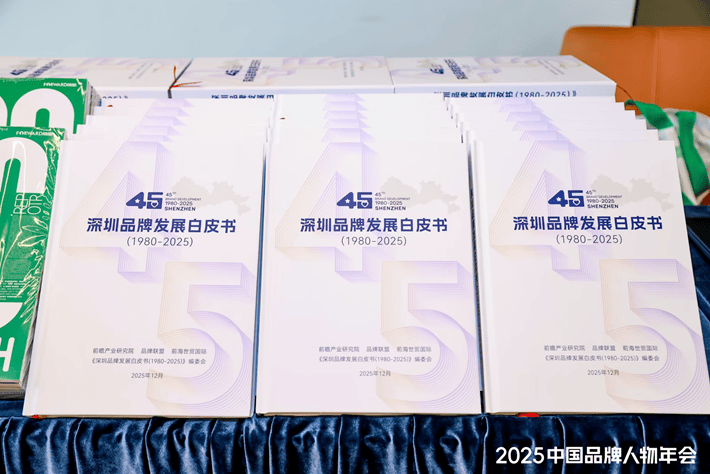
Core Insights - Shenzhen has produced a number of globally impactful companies, showcasing a shift from "Made in China" to "Created in China" [2] - The 45th anniversary of Shenzhen Special Economic Zone marks a significant milestone in its rapid modernization and brand development [2][3] - The "Shenzhen Brand Development White Paper (1980-2025)" outlines the evolution of Shenzhen's brands and their internal logic and success factors [3][5] Group 1: Brand Evolution - Shenzhen's brand journey reflects a transition from manufacturing to innovation, with key phases including the emergence of local brands in the 1980s and 1990s, and the rise of autonomous brands in the early 2000s [7][10] - The current phase is characterized by cluster upgrades, with companies like Tencent, BYD, and DJI leading in various sectors [8][10] - As of now, Shenzhen has cultivated 1,220 notable local brands, including 13 billion-level brands and 7 trillion-level brands, with Tencent, Ping An, and Huawei each exceeding a brand value of 490 billion [10][11] Group 2: Economic Contributions - The 1,220 notable brands contribute 47.97% of the city's sales, 42.05% of tax revenue, and 32.87% of exports, serving as the backbone of Shenzhen's high-quality economic development [11] - These brands span critical sectors such as electronics, renewable energy, biomedicine, high-end equipment, financial services, and digital economy, forming a robust industrial structure [11] Group 3: Brand Development Factors - Shenzhen's brand success is attributed to a unique ecosystem supported by policy innovation, technological advancement, and collaborative industrial frameworks [15][16][19] - The government has played a crucial role in creating a conducive environment for brand growth through targeted policies and regulatory frameworks [16] - Innovation drives brand competitiveness, with companies investing over 10% of their annual revenue in R&D, fostering a comprehensive innovation ecosystem [17] Group 4: Global Expansion and Responsibility - Shenzhen brands have established clear pathways for international expansion, evolving from processing trade to localized operations and global standardization [20] - Social responsibility is ingrained in the corporate strategy, enhancing brand value and sustainability through practices like tax compliance and community support [21] Group 5: Future Outlook - The release of the white paper is a significant step in documenting Shenzhen's brand journey and providing strategic guidance for future brand development [31] - Shenzhen's brands are expected to continue thriving in emerging sectors like digital and low-altitude economies, contributing to the global narrative of Chinese brands [33][34]



SOXX vs. FTEC: Are Investors Better Off With a Semiconductors ETF or Broad Tech Exposure?
The Motley Fool· 2025-12-30 22:48
Core Insights - The iShares Semiconductor ETF (SOXX) and Fidelity MSCI Information Technology Index ETF (FTEC) offer distinct investment opportunities based on sector focus, cost, and risk profiles, catering to different investor needs [1][2] Cost and Size Comparison - SOXX has an expense ratio of 0.34%, while FTEC has a significantly lower expense ratio of 0.08% [3] - As of December 30, 2025, SOXX reported a 1-year return of 37.57% compared to FTEC's 19.97% [3] - SOXX has a dividend yield of 0.55%, slightly higher than FTEC's 0.40% [3] - Both ETFs have similar assets under management, with SOXX at $16.70 billion and FTEC at $16.66 billion [3] Performance and Risk Comparison - Over the past five years, SOXX experienced a maximum drawdown of -45.75%, while FTEC had a lower maximum drawdown of -34.95% [4] - An investment of $1,000 in SOXX would have grown to $2,461 over five years, compared to $2,176 for FTEC [4] Portfolio Composition - FTEC holds 291 stocks across various sectors of the U.S. technology industry, including hardware, software, and communications, with major positions in Nvidia, Microsoft, and Apple [5] - SOXX is concentrated with only 30 holdings, focusing solely on semiconductor stocks, including top positions in Nvidia, Advanced Micro Devices, and Micron Technology [6] Investment Implications - FTEC's broader diversification may provide better stability during market volatility, while SOXX's focus on semiconductors has historically led to higher returns [8][9] - Investors must consider their risk tolerance and investment goals when choosing between SOXX and FTEC, as SOXX may experience more severe price swings due to its lack of diversification [9]

Ooma Completes Acquisition of Phone.com
Businesswire· 2025-12-29 13:01
Core Viewpoint - Ooma, Inc. has successfully acquired Phone.com for approximately $23.2 million in cash, enhancing its smart communications platform for businesses and consumers [1] Financial Impact - Phone.com is projected to generate annual revenue of $22-$23 million and adjusted EBITDA of $1.0-$1.5 million, contributing positively to Ooma's financials starting December 26, 2025 [2] - The acquisition is expected to be accretive to Ooma's Adjusted EBITDA and non-GAAP earnings per share [2] Company Overview - Phone.com, headquartered in Newark, New Jersey, serves small and medium-sized businesses with cloud communications and UCaaS solutions, catering to approximately 36,000 customers and 87,000 users across North America [3] - Ooma offers various communication services, including Ooma Office for businesses, Ooma AirDial for replacing traditional phone lines, and Ooma Telo for residential consumers [10]


Zoom Communications (ZM) is a Top-Ranked Growth Stock: Should You Buy?
ZACKS· 2025-12-23 15:46
Core Insights - Zacks Premium offers tools for investors to enhance their stock market engagement and confidence, including daily updates, research reports, and stock screens [1] Zacks Style Scores Overview - Zacks Style Scores are indicators that rate stocks based on value, growth, and momentum methodologies, helping investors identify stocks likely to outperform the market in the short term [2] Style Scores Breakdown - **Value Score**: Focuses on identifying undervalued stocks using ratios like P/E, PEG, and Price/Sales to find attractive investment opportunities [3] - **Growth Score**: Concentrates on a company's financial health and future outlook, analyzing projected and historical earnings, sales, and cash flow for sustainable growth [4] - **Momentum Score**: Targets stocks with upward or downward price trends, utilizing recent price changes and earnings estimate shifts to identify optimal buying times [5] - **VGM Score**: Combines all three Style Scores to provide a comprehensive rating, highlighting stocks with the best value, growth potential, and momentum [6] Zacks Rank Integration - The Zacks Rank model uses earnings estimate revisions to guide investors in building successful portfolios, with 1 (Strong Buy) stocks achieving an average annual return of +23.81% since 1988, significantly outperforming the S&P 500 [7][8] Stock Selection Strategy - To maximize returns, investors should focus on stocks with a Zacks Rank of 1 or 2 and Style Scores of A or B, while stocks with a 3 rank should also have favorable Style Scores to ensure potential upside [9][10] Company Spotlight: Zoom Video Communications - Zoom Video Communications is rated 2 (Buy) on the Zacks Rank and has a VGM Score of B, benefiting from increased demand for remote work solutions post-pandemic [11] - The company is projected to have year-over-year earnings growth of 7.6% for the current fiscal year, with upward revisions from analysts and a Zacks Consensus Estimate of $5.96 per share [12]


华西证券:太空新基建竞赛推动产业加速 空心光纤产业迭代演进关键窗口期
Zhi Tong Cai Jing· 2025-12-22 01:31
Core Viewpoint - The current market is expected to remain volatile due to global geopolitical conflicts, the US-China technology rivalry, and uncertainties regarding overseas AI investments, leading to a cautious and neutral allocation strategy. However, there is a long-term optimistic outlook on domestic AI computing power, optical modules, 6G industry trends, domestic substitution, self-control, and military industry growth, which could catalyze market opportunities in various sectors [1]. Group 1: Space Infrastructure and Satellite Communication - The space infrastructure competition is accelerating industry development, with the US government emphasizing the importance of maintaining "space superiority" through increased R&D and private sector investment. This sector is seen as a critical area in the US-China rivalry, with the domestic satellite constellation launches and commercial space development expected to expand market size [2]. - The issuance of satellite internet licenses in China marks a significant step towards commercial operation, which is anticipated to drive the entire industry chain towards large-scale acceleration. The development of satellite internet is progressing rapidly, with regular satellite launches expected to enhance communication capacity and reduce latency [2]. Group 2: Hollow Core Fiber and AI Applications - The demand for hollow core fibers is expected to benefit from AI catalysis, as these fibers offer low latency, wide spectrum, low loss, and low nonlinearity, addressing the physical limitations of traditional fibers. The current phase is critical for the rapid iteration and evolution of hollow core fibers, which are still in the early stages of commercialization [3]. - The unique characteristics of hollow core fibers are projected to meet the growing demands of AI large model applications, highlighting their potential value in internal interconnections, metropolitan data center interconnections, and wide-area interconnections. Beneficiary companies include Yangtze Optical Fibre (601869), Hengtong Optic-Electric (600487), FiberHome Technologies (600498), and Zhongtian Technology (600522) [3]. Group 3: Investment Recommendations - Beneficiary stocks in satellite communication and satellite IoT include companies involved in chip and T/R component industries such as Chengchang Technology, Guobo Electronics, Zhenlei Technology, Shanghai Huanxun, and Xinke Mobile. The terminal antenna supply chain includes Chengchang Technology, Tongyu Communication, Guobo Electronics, and Zhaoshengwei (300782) [4]. - Key players in terminal chips and core networks include China Mobile (600941), China Unicom (600050), China Telecom (601728), Haige Communication (002465), Huali Chuantong (300045), and Zhenyou Technology. Testing instrument companies include Kunheng Shunwei and Chuangyuan Xinke [4].





华为终端公司人事变动:余承东任董事长,孟晚舟、徐直军卸任董事
Sou Hu Cai Jing· 2025-12-16 12:40
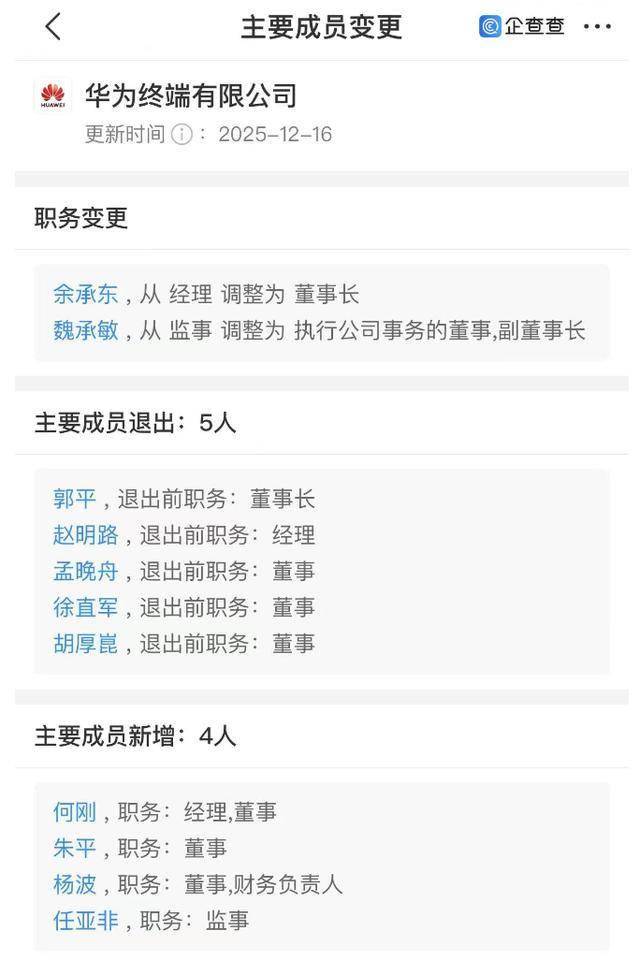
瑞财经 吴文婷12月16日,据企查查及国家企业信用信息公示系统,华为终端有限公司发生工商变更。 其中,郭平卸任董事长,由余承东接任,孟晚舟、徐直军等卸任董事,另有多位高管发生变更。 华为终端有限公司成立于2012年11月,注册资本6.06亿元,法定代表人为魏承敏,经营范围包括:开 发、生产、销售通信及电子产品、计算机、卫星电视接收天线、高频头、数字卫星电视接收机及前述产 品的配套产品,并提供技术咨询和售后服务等。 股东信息显示,目前,该公司由华为终端(深圳)有限公司100%持股。而后者由华为投资控股有限公 司、华为技术有限公司分别持股67.95%、32.05%。 ...
余承东任董事长,华为终端多位高管变更
Nan Fang Du Shi Bao· 2025-12-16 07:59
华为终端有限公司成立于2012年11月,法定代表人为魏承敏,注册资本6.06亿人民币,经营范围包括开发、生 产、销售通信及电子产品、计算机、卫星电视接收天线、高频头、数字卫星电视接收机及前述产品的配套产品, 并提供技术咨询和售后服务等。股东信息显示,该公司由华为终端(深圳)有限公司全资持股。 南方都市报(nddaily)报道 南都.湾财社记者程洋 ▊ 阅读更多(戳下方标题) 天眼查工商信息显示,近日,华为终端有限公司发生工商变更,余承东出任董事长,何刚、魏承敏、杨波任董 事,多位高管发生变更。 华为常务董事、产品投资委员会主任、终端BG董事长余承东 值得注意的是,此前9月29日,华为创始人任正非签发委任令,余承东任华为产品投资评审委员会(IRB)主任。据 悉,IRB是华为内部负责智能汽车等核心业务投资决策和资源调配的核心管理机构,主导技术研发方向与资源优 化配置。 余承东出生于1969年,毕业于清华大学,硕士。1993年加入华为,历任3G产品总监、无线产品行销副总裁、无线 产品线总裁、欧洲片区总裁、战略与Marketing总裁、终端BG CEO、智能汽车解决方案BU董事长等。现任华为常 务董事、终端BG董事长 ...