电池

Search documents
大行评级丨瑞银:宁德时代成本及技术等优势助多重增长机遇,目标价上调至660港元
Ge Long Hui· 2026-02-09 05:31
Core Viewpoint - UBS report indicates that CATL maintains a cost competitive advantage in both domestic and overseas production of batteries, including its Shenxing supercharging battery and Kirin battery [1] Group 1: Cost Analysis - The report estimates that the cost of producing similar batteries in Hungary may be $10 to $15 per kilowatt-hour higher than in China, but the operating profit margin of the Hungarian factory is expected to be similar to that of domestic factories [1] Group 2: Growth Opportunities - UBS believes that CATL's leadership in global costs, scale, and technology positions the company to benefit from multiple growth opportunities in the acceleration of electrification in electric vehicles, energy storage systems, and new application fields [1] Group 3: Financial Projections - UBS forecasts a compound annual growth rate (CAGR) of 20% for revenue and 25% for profit from 2024 to 2029; battery sales forecasts have been raised by 5% to 7% to 829 to 1,044 gigawatt-hours, and net profit forecasts have also been increased by 5% to 7% [1] - The target price has been raised from HKD 640 to HKD 660 based on unchanged price-to-earnings ratio for 2026, maintaining a "Buy" rating [1]

欣旺达动力与威睿电动达成和解,23.14亿元争议终结;全球第四大汽车巨头Stellantis电动化转型遇压力丨智能制造日报
创业邦· 2026-02-09 04:07
Group 1 - WeChat's HarmonyOS version still utilizes Huawei's system camera capabilities, with recent updates aimed at optimizing the photo-taking interface for a more streamlined user experience [2] - Xiaomi's CEO Lei Jun reviewed the battery pack vibration testing in their automotive lab, highlighting safety and reliability tests that simulate various driving conditions [2] - XINWANDA Power and Weir Electric reached a comprehensive settlement regarding a previous sales contract dispute involving approximately 2.314 billion yuan, with XINWANDA required to pay 608 million yuan in installments by 2030 [2] - Stellantis, the world's fourth-largest automaker, is facing pressure in its electrification strategy, with a 24% drop in stock price and an announcement of $26.2 billion in expenses due to a strategic shift away from plug-in hybrids [2]



英大证券晨会纪要-20260209
British Securities· 2026-02-09 03:13
Core Insights - The report indicates a cautious market sentiment ahead of the Spring Festival, with a focus on individual stock plays and structural rotations, suggesting that opportunities will arise from quick stock trading and sector rotations rather than a clear trend [1][13][14] - The market is expected to exhibit a "seek stability before the festival, rebound after" rhythm, with defensive sectors like consumption and dividend stocks likely to attract attention before the holiday, while post-holiday focus may shift to small-cap growth stocks and sectors with clear industrial catalysts [1][13][14] Market Overview - Last Friday, the three major indices in the A-share market opened lower but rebounded to close in the green during the morning session, only to fall back in the afternoon, continuing the recent adjustment trend [4][5] - The chemical, battery, and mining sectors showed strength, while consumer and AI-related stocks experienced a collective pullback, indicating a structural rotation in the market [1][4][13] Sector Performance - The report highlights that cyclical sectors like chemicals and energy metals have been active, driven by ongoing domestic policies aimed at stabilizing growth and improving economic supply-demand dynamics [7][8] - The new energy sector, particularly battery and photovoltaic stocks, has shown resilience, supported by global trends towards carbon neutrality and domestic policy reforms aimed at reducing competition in these fields [8][9] - Consumer stocks have also been active, with government policies aimed at stimulating consumption creating structural investment opportunities, particularly in sectors catering to demographic trends and service consumption upgrades [10][11] Investment Strategy - Investors are advised to balance stability and flexibility in their strategies, focusing on consumption and dividend stocks before the festival while preparing for potential growth opportunities post-festival [2][14] - The report emphasizes the importance of timing in the current volatile market, suggesting that investors should be ready to adapt to changing market rhythms [2][14]
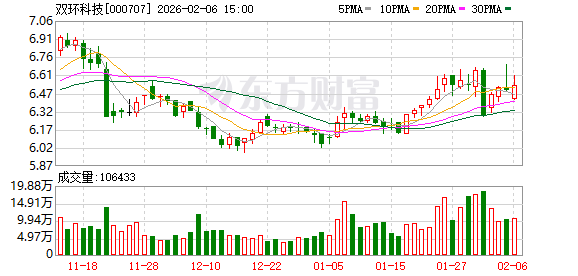
双环科技:公司投资建设的年产千吨级的钠离子电池正极材料的中试基地项目近期产出首批产品
Mei Ri Jing Ji Xin Wen· 2026-02-09 00:57
Core Viewpoint - The company has signed a strategic cooperation agreement with a leading domestic sodium battery manufacturer, and it is currently in the process of executing this agreement through the establishment of a pilot production base for sodium-ion battery cathode materials [2]. Group 1: Strategic Cooperation and Production - The company has recently established a pilot production base capable of producing 1,000 tons of sodium-ion battery cathode materials, which has begun to output its first batch of products [2]. - The pilot products will be sent to downstream customers for performance testing, which will influence the company's decision on whether to advance the industrialization of sodium-ion battery materials [2]. - The results of the performance tests from downstream manufacturers are currently uncertain, and the implementation of the company's sodium-ion battery materials industrialization project remains uncertain [2]. Group 2: Financial Impact - The pilot production base project, which has a capacity of 1,000 tons of cathode materials, is expected to have a minimal direct impact on the company's recent revenue and profits [2].

中际旭创替代宁德时代!如何看待公募基金第一大重仓股“魔咒”
Sou Hu Cai Jing· 2026-02-09 00:49
其一,从微观交易结构看,"登顶"往往意味着交易拥挤度提升,股价对边际资金变化的敏感性随之增 强。 来源:证券日报 近日,随着公募基金2025年四季报全部披露,中际旭创替代宁德时代,首次登顶公募基金第一大重仓 股。然而,自1月31日四季报披露完毕以来,2月份的前5个交易日,中际旭创股价累计下跌16.79%。这 一走势不仅引发了市场对公募基金第一大重仓股"魔咒"的关注,也加剧了投资者对人工智能相关板块后 续行情判断的分歧。 "魔咒"通常是指当某只个股成为公募基金第一大重仓股后,由于交易拥挤、预期提前透支等原因,该只 股票出现滞涨甚至回调的现象。例如,宁德时代在2021年第三季度末替代贵州茅台成为公募基金第一大 重仓股后,经历了长达两年左右的估值消化期。与此同时,新能源板块也经历了两年左右的回调。 但若简单将"登顶"与"下跌"画等号,显然有失偏颇。笔者认为,这一现象是交易结构、业绩兑现能力、 估值水平以及产业周期轮动等多重因素共同作用的结果,本质上是由市场规律驱动的。观察这一问题, 需要跳出短期涨跌的情绪干扰,以更加理性、辩证的视角加以审视。 这表明,"登顶"本身并非风险源头,真正的风险在于增长逻辑是否发生变化。若 ...

欣旺达:点评报告吉利诉讼和解落地,阴霾尽扫前路坦荡-20260209
ZHESHANG SECURITIES· 2026-02-09 00:25
Investment Rating - The investment rating for the company is "Buy" (maintained) [5] Core Insights - The lawsuit between Geely's Weirui and the company regarding battery cell quality issues has been resolved through a settlement, significantly reducing the financial impact on the company [3][4] - The settlement agreement stipulates that the company will pay a remaining amount of 608 million RMB, which is substantially lower than the initial claim of 2.314 billion RMB [2][3] - The resolution of the lawsuit is expected to positively influence the company's reputation and investor confidence, paving the way for future growth [3][4] Financial Summary - The company expects to report revenues of 68.88 billion RMB, 83.92 billion RMB, and 103.25 billion RMB for the years 2025, 2026, and 2027, respectively, with corresponding net profits of 2.10 billion RMB, 3.20 billion RMB, and 4.30 billion RMB [11] - The projected growth rates for net profit are 43.15%, 52.43%, and 34.08% for the years 2025, 2026, and 2027, respectively [11] - The company's earnings per share (EPS) are forecasted to be 1.14 RMB, 1.74 RMB, and 2.33 RMB for the years 2025, 2026, and 2027, respectively [13] Market Performance - The company's stock price closed at 24.10 RMB, with a total market capitalization of approximately 44.52 billion RMB [5] - The company has experienced significant fluctuations in stock price, including an 11.39% drop following the lawsuit announcement [3]
【财经早报】50亿元光伏项目,终止投建
Zhong Guo Zheng Quan Bao· 2026-02-08 23:05
Company News - Mingguan New Materials announced the termination of the investment agreement for the solar backplane and functional film production base project, with a total estimated investment of 5 billion yuan [4] - Shenjian Co. reported that its aerospace-related revenue for the third quarter of 2025 was 139 million yuan, accounting for 7.59% of total revenue, with an estimated commercial aerospace application revenue of 371,240 yuan by the end of 2025, representing less than 1% of total revenue [4] - Saisir signed a cooperation agreement with the Chongqing Shapingba District government to establish a target company through the divestment of existing assets related to blue electric vehicles, with the SPV holding approximately 33.5% of the shares [5][6] - Tiancheng Control announced that its subsidiary received a notification from a leading domestic automotive company to become a supplier of passenger car seats, with an expected project lifecycle total amount of 2.3 billion yuan [6] - Yongtai Technology plans to acquire a 25% stake in Yongtai High-tech held by CATL through a share issuance, with the stock expected to be suspended from trading starting February 9 [6] - Shanshan Co. signed a restructuring investment agreement that may lead to a change in control to Anhui State-owned Assets Supervision and Administration Commission if successful [7] Industry News - The 2026 China All-Solid-State Battery Collaborative Innovation Platform annual meeting focused on the development progress and key technical challenges of solid-state batteries, highlighting the need for significant breakthroughs in materials and interfaces [2] - The new medical insurance drug list was implemented nationwide on January 1, with 99 new drugs already available in over 12,000 designated medical institutions [1]
金十数据全球财经早餐 | 2026年2月9日
Jin Shi Shu Ju· 2026-02-08 23:03
男生普通话版 下载mp3 女声普通话版 下载mp3 粤语版 下载mp3 西南方言版 下载mp3 东北话版 下载mp3 上海话版 下载mp3 今日优选 五角大楼"披萨指数"激增 日本执政联盟获得过半数议席 泽连斯基:美方希望俄乌在6月前达成和平协议 丹麦:与美国就格陵兰岛谈判未达预期 白银暴跌之际散户仍在加码押注 贝森特淡化美联储快速缩表预期 中国央行连续第15个月增持黄金 临近春节多家银行上调存款利率 八部门发布虚拟货币监管新规 特斯拉将加大在华AI与能源投入 市场盘点 上周五,美元指数从两周高点回落,美盘前加速下跌,最终收跌0.29%,报97.678;基准的10年期美债收益率收报4.208%,对美联储政策利率敏感的2年期美 债收益率收报3.5%。 贵金属再度上演V型反转。芝商所第六次对金银期货上调保证金后, 现货黄金开盘走低,最低触及4655.57美元/盎司,随后持续上攻,较日低反弹超200美 元,最终收涨3.9%,报4965.79美元/盎司;现货白银波动更加剧烈,盘中一度暴跌近10%并逼近64美元/盎司,随后快速收复失地,最终收涨9.89%,报 77.798美元/盎司。 由于伊朗和美国在阿曼举行的间接谈判 ...

马斯克宣布干法电极规模化量产,4h储能系统半年均价上涨42%
ZHONGTAI SECURITIES· 2026-02-08 15:00
Investment Rating - The report maintains an "Overweight" rating for the electric power equipment industry [6] Core Insights - The report highlights significant developments in the lithium battery sector, including Elon Musk's announcement of the large-scale production of dry electrodes and CATL securing a 10GWh energy storage project [8][14][15] - The energy storage market shows strong demand, with January's procurement reaching 36.3GWh and a 42% increase in the average price of 4-hour storage systems over the past six months [25][26] - The report emphasizes the potential for performance and valuation improvements in the lithium battery and energy storage sectors, suggesting a favorable medium-term investment outlook [8] Summary by Sections Lithium Battery Sector - The battery industry index rose by 3.24%, outperforming the CSI 300 by 4.57 percentage points, with key stocks like Enjie and Wanrun New Energy showing significant gains [12] - Major events include the announcement of dry electrode mass production by Tesla and strategic partnerships in solid-state battery technology [14][16][18] Energy Storage Sector - January saw a procurement of 36.3GWh in energy storage, with a notable 42% increase in the average price of 4-hour systems [25][26] - The report notes strong demand in regions like Ningxia, which completed a procurement scale of 7.76GWh, the highest in the country [25] - The report identifies key companies in the energy storage sector, including Haibo Sichuang and Sungrow Power [8] Electric Power Equipment Sector - The report discusses the approval of significant high-voltage projects, including the "Mont Electricity into Shanghai" project, marking the start of substantial construction [29][30] - It highlights the ambitious "six AC and six DC" plan in Inner Mongolia, which aims to add 48 million kilowatts of high-voltage transmission capacity [30] Photovoltaic Sector - The report tracks the stability in silicon material prices and the decline in silicon wafer prices, indicating a cautious market outlook [33][36] - It notes the recent interest from Musk's team in Chinese photovoltaic companies, focusing on potential collaborations in solar technology [39] Wind Power Sector - The report outlines progress in offshore wind projects across various regions, with significant approvals and tenders being announced [42][44] - It emphasizes the expected growth in offshore wind capacity and the importance of supply chain developments in the sector [51][52]



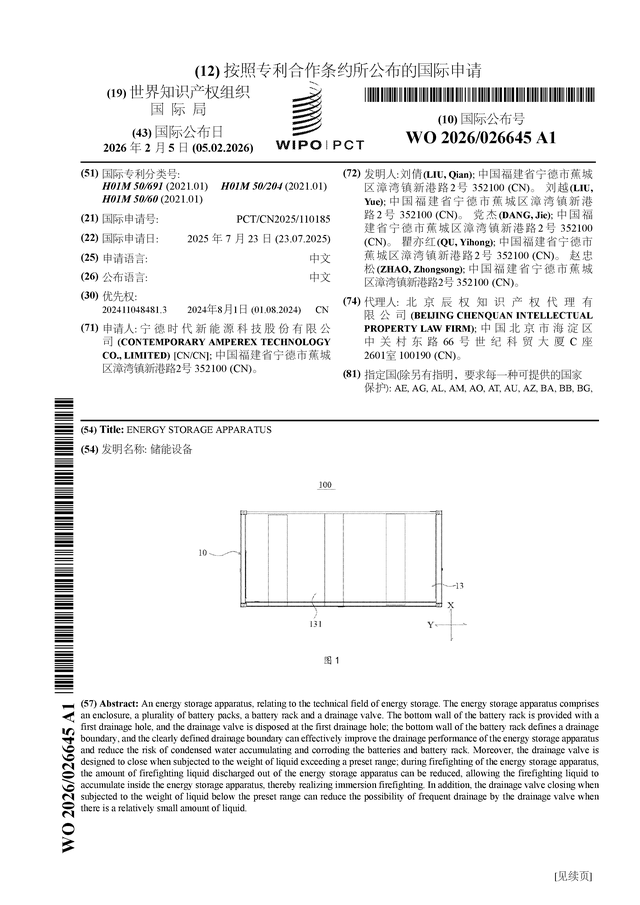
宁德时代公布国际专利申请:“储能设备”
Sou Hu Cai Jing· 2026-02-08 13:22
证券之星消息,根据企查查数据显示宁德时代(300750)公布了一项国际专利申请,专利名为"储能设备",专利申请号为PCT/CN2025/110185, 国际公布日为2026年2月5日。 专利详情如下: | (12)按照专利合作条约所公布的国际申请 | . 10000 ��������� ����� �������� ����� ���� ���� ���� ���� ����� ��� ����� ��� ���� | (19) 世界知识产权组织 | | | | | --- | --- | --- | --- | --- | --- | | 天 家 同 | (10)国际公布号 | (43) 国际公布日 | WO 2026/026645 A1 | | | | 2026年2月5日(05.02.2026) | (51) 国际专利分类号: | | | | | | (72)发明人:刘倩(LIU,Qian):中国福建省宁德市蕉城 | H01M 50/691 (2021.01) | H0IM 50/204 (2021.01) | 区漳湾镇新港路2号 352100(CN)。 | 刘越(LIU. | H01M 50/60 (2 ...