储能

Search documents
000151、000905,重要重组,同日获批
Zhong Guo Ji Jin Bao· 2026-02-14 07:59
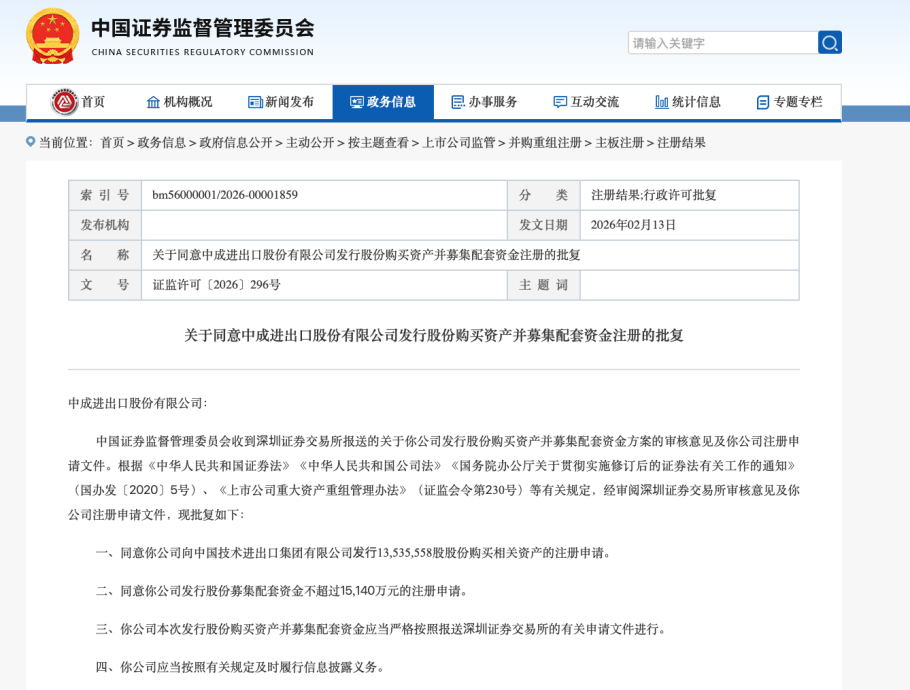
Group 1: Core Views - Two state-owned listed companies, Zhongcheng Co. and Xiamen Port, received approval for significant restructuring on the same day [1][7] Group 2: Zhongcheng Co. Restructuring - Zhongcheng Co. plans to acquire 100% of Zhongji Jiangsu Clean Energy Co. through a share issuance and raise up to 151 million yuan in supporting funds [3] - The China Securities Regulatory Commission (CSRC) approved the issuance of 13.5356 million shares for the acquisition and the fundraising [4] - The transaction aims to extend Zhongcheng Co.'s business into energy storage and green energy, improving its financial metrics [4] Group 3: Xiamen Port Restructuring - Xiamen Port intends to acquire 70% of Xiamen Container Terminal Group through share issuance and cash payment, with a fundraising cap of 3.5 billion yuan [8] - The CSRC approved the issuance of 797 million shares for the acquisition [11] - This restructuring is expected to enhance Xiamen Port's business structure, making it a comprehensive modern port logistics service provider [11] Group 4: Industry Trends - The trend of mergers and acquisitions among state-owned listed companies is supported by recent policies encouraging industry consolidation and transformation [15] - A report indicates that the total transaction volume in China's M&A market is expected to grow by 47% year-on-year by 2025, with state-owned enterprises leading many large transactions [16] - The focus of future mergers will be on strategic and specialized integration, particularly in key industries related to national security and public services [17]



000151、000905,重要重组,同日获批!
Zhong Guo Ji Jin Bao· 2026-02-14 06:49
Group 1: Core Views - The restructuring of two state-owned listed companies, Zhongcheng Co., Ltd. and Xiamen Port Authority, has been approved on the same day, indicating a significant move in the market [1][4]. Group 2: Zhongcheng Co., Ltd. Restructuring - Zhongcheng Co., Ltd. plans to acquire 100% of Zhongji Jiangsu Clean Energy Co., Ltd. through the issuance of 13.54 million shares and raise up to 151 million yuan in supporting funds [2]. - The company aims to extend its main business towards energy storage and green energy, aligning with sustainable development goals, which is expected to improve its total assets, net assets, and operating income [2]. Group 3: Xiamen Port Authority Restructuring - Xiamen Port Authority intends to acquire 70% of Xiamen Container Terminal Group through the issuance of 797 million shares and raise up to 3.5 billion yuan in supporting funds [4]. - This restructuring is expected to enhance the company's business structure, making it a comprehensive modern port logistics service provider covering multiple sectors, thereby improving its competitive strength and corporate value [7]. Group 4: Industry Trends - The trend of mergers and acquisitions among state-owned listed companies is on the rise, supported by government policies aimed at promoting industrial integration and transformation [11]. - A report indicates that the total transaction volume in China's M&A market is expected to grow by 47% year-on-year by 2025, with a significant portion of large transactions led by state-owned enterprises in strategic sectors [11]. - The focus for state-owned enterprises will be on strategic, professional restructuring and high-quality mergers, particularly in key industries related to national security and public services [12].
再造新汕尾 县域主官谈|访华侨管理区党委书记、管委会主任林永长
Xin Lang Cai Jing· 2026-02-14 05:05
Core Viewpoint - The article emphasizes the strategic goal of "Rebuilding a New Shanwei" as part of the city's development plan, highlighting the importance of collaboration and practical measures to achieve modernization and growth in the region [1]. Group 1: Industrial Development - The focus is on enhancing the agricultural sector by promoting local specialties, establishing leading enterprises, and developing a standardized production system for agricultural products [4]. - Projects such as food industrial parks and agricultural product logistics markets are being prioritized to create a high-quality agricultural supply chain [4]. - The development of new industries like renewable energy and new materials is also a key focus, aiming to build a modern industrial system unique to the area [4]. Group 2: Innovation and Technology - There is a strong push for the transformation and upgrading of traditional industries through green manufacturing and technological improvements [6]. - The establishment of a comprehensive quality tracking system for local agricultural products is being implemented to enhance productivity and efficiency [6]. - Talent recruitment initiatives are being expanded to support innovation and technological advancement in the region [6]. Group 3: Governance and Reforms - The article discusses the implementation of streamlined administrative processes to improve service efficiency for businesses and residents [7]. - Efforts are being made to integrate with the Guangdong-Hong Kong-Macao Greater Bay Area, facilitating industrial collaboration and resource sharing [7]. - The establishment of incubation bases for overseas Chinese enterprises is aimed at fostering deeper integration with local industries [7]. Group 4: Social Welfare and Community Development - There is a commitment to improving living conditions through infrastructure development, including waste management and water treatment facilities [8]. - Investments in education and healthcare are being prioritized to enhance service quality and community well-being [8]. - Cultural initiatives are being promoted to strengthen community ties and celebrate local heritage [8]. Group 5: Party Leadership and Governance - The article highlights the importance of strengthening grassroots party organizations to ensure effective governance and community engagement [8]. - Measures are being taken to enhance legal governance and public safety, contributing to a stable and secure environment for residents [8]. - The focus on a clean political atmosphere is emphasized to foster trust and cooperation within the community [8].
中国燃气携手宁德时代:确立2026-2028储能优先合作关系
中关村储能产业技术联盟· 2026-02-14 04:01
Group 1 - The core viewpoint of the article highlights the strategic cooperation agreement signed between China Gas and CATL, focusing on energy storage business from 2026 to 2028 [2] - The collaboration will prioritize the implementation of energy storage projects on the grid side and for commercial and industrial applications [2] - The partnership aims to leverage China Gas's extensive user network covering 200 million people and CATL's leading energy storage technology to accelerate the application of energy storage solutions in comprehensive energy projects [2] Group 2 - The cooperation will also explore opportunities in biomass energy and the expansion of overseas renewable energy markets [2] - The 14th International Energy Storage Summit and Exhibition (ESIE 2026) will take place from March 31 to April 3, 2026, in Beijing [3] - The event will serve as a platform for discussing key trends and developments in the energy storage industry [4]



豪鹏科技审议关联交易预计及定增预案,聚焦储能电芯与电池项目建设
Jing Ji Guan Cha Wang· 2026-02-14 03:16
Group 1 - The core focus of the recent events surrounding Haopeng Technology (001283) involves corporate governance and financing plans [1][2] - The company held a board meeting on February 12, 2026, to review proposals regarding expected daily related party transactions for the year 2026, which may impact the company's related party transaction arrangements for that year [1] Group 2 - The company announced a plan to issue A-shares to specific investors in 2026, aiming to raise no more than 800 million yuan, which will be allocated to the construction of a 3GWh energy storage cell project and a project for the annual production of 32 million steel shell laminated batteries, aligning with AI edge business and energy storage demands [2]
爱克股份股价上涨受业绩改善预期及业务转型推动
Jing Ji Guan Cha Wang· 2026-02-14 01:11
Core Viewpoint - The recent stock price increase of Aike Co., Ltd. (300889.SZ) is driven by expectations of improved performance, progress in business transformation, and market capital flow [1] Financial Performance - The company forecasts a significant reduction in losses for 2025, with expected net profit losses ranging from -62.72 million to -90.15 million yuan, narrowing by 16.10% to 41.63% compared to 2024's loss of -107 million yuan [2] - For the first three quarters of 2025, the company reported a revenue of 822 million yuan, representing a year-on-year growth of 29.56%, with an increasing revenue contribution from the new energy sector [2] Business Development - The company is strategically transforming towards the new energy sector through acquisitions, focusing on supporting the electric vehicle industry and energy storage, aiming for a "new energy-focused, lighting as a supplement" business model [3] - Although the traditional municipal landscape lighting business is contracting, the high-margin cultural tourism lighting segment is recovering, partially offsetting the decline in the main business [3] Capital and Technical Analysis - There has been significant fluctuation in net inflow of main funds over the past five trading days, indicating active short-term capital speculation [4] - The stock price broke through a key resistance level on February 13, reaching 25.68 yuan, with the MACD indicator showing a continuous upward trend, suggesting a strong short-term technical outlook [4] Market Environment - The company is part of the small-cap balanced, LED, and lithium battery sectors, which have gained attention in the current market environment favoring small-cap stocks, alongside favorable policies for new energy [5] - Despite still being in a loss position, the company's price-to-sales ratio (TTM) is approximately 4.7 times, lower than some peers, indicating potential market anticipation of successful transformation [5] Future Development - There remains uncertainty in the expansion of the company's new energy business, particularly regarding the expected growth in the charging pile market [6] - The high pledge ratio of the controlling shareholder (54.33%) raises concerns about liquidity risk [6] - The recent significant increase in stock price may lead to short-term correction pressure [6]
果下科技获纳入恒生综合指数 有望成为港股通标的
Zhi Tong Cai Jing· 2026-02-14 00:37
Group 1 - The Hang Seng Index Company announced the quarterly review results for the Hang Seng Index series as of December 31, 2025, with GuoXia Technology (02655) being included in the Hang Seng Composite Index [1] - The changes will be implemented after the market closes on March 6, 2026, and will take effect on March 9, 2026, with corresponding adjustments to the eligible stocks for the Hong Kong Stock Connect [1] - According to a report by CICC, GuoXia Technology may be included in the Hong Kong Stock Connect as it meets various criteria including market capitalization, liquidity, and listing duration [1] Group 2 - Recently, Shangneng Electric (300827) signed a strategic cooperation agreement with GuoXia Technology at Shangneng Electric's headquarters [1] - The agreement aims to further leverage each company's strengths based on past collaborations, focusing on market development and project promotion in the energy storage sector [1] - The partnership seeks to enhance global brand influence and promote a transition towards a greener and more sustainable energy structure worldwide [1]
特斯拉2026战略会纪要 储能总体毛利率20.1%
鑫椤储能· 2026-02-14 00:36
Core Viewpoint - Tesla is focusing on enhancing its autonomous driving capabilities and expanding its Robotaxi services, with significant capital investments planned for future growth and technological advancements [1][5][17]. Group 1: Autonomous Driving and Robotaxi - Tesla has initiated paid Robotaxi services in Austin without safety drivers or follow cars, with over 500 vehicles in operation and expected exponential growth [1][9]. - The company aims to expand its Full Self-Driving (FSD) capabilities, with a target of covering 25-50% of the U.S. by year-end, pending regulatory approval [1]. - FSD paid users have reached nearly 1.1 million, with 70% opting for a one-time purchase; the transition to a subscription model is expected to impact automotive gross margins in the short term [1][10]. Group 2: Capital Investment and Financial Outlook - Tesla plans to invest over $20 billion this year across six major factories and AI capabilities, with cash and investments exceeding $44 billion available for use [2][18]. - The company anticipates record revenue from its energy business, projecting $12.8 billion in annual income by 2025, a 26.6% year-over-year increase [10][11]. - Overall gross margin is reported at 20.1%, the highest in two years, despite challenges from tariffs and fixed cost absorption [13]. Group 3: Product Development and Future Plans - The upcoming Optimus 3 robot is expected to demonstrate advanced capabilities, including learning through observation and voice, with mass production starting later this year [1][16]. - Tesla is transitioning its Fremont factory's Model S/X production line to focus on manufacturing 1 million Optimus robots annually [8]. - The company is committed to a vision of "Amazing Abundance," emphasizing the potential of AI and robotics to create a future of universal high income [4]. Group 4: Competitive Landscape - China is identified as a strong competitor in manufacturing and AI, with its capabilities being underestimated by external observers [3].

华宝新能公布国际专利申请:“储能电源”
Sou Hu Cai Jing· 2026-02-13 21:59
Core Viewpoint - Huabao New Energy (301327) has filed an international patent application for a "Energy Storage Power Source" with the application number PCT/CN2025/072827, which is set to be published internationally on February 12, 2026 [1] Group 1: Patent Application - The company has announced a total of five international patent applications in 2023, representing a decrease of 44.44% compared to the same period last year [1] - The details of the patent application were sourced from the World Intellectual Property Organization (WIPO) [1] Group 2: R&D Investment - In the first half of 2025, the company invested 76.16 million yuan in research and development, which is a year-on-year decrease of 2.83% [1]

A股蛇年收官日三大指数下跌,两只湘股涨停
Sou Hu Cai Jing· 2026-02-13 12:54
Group 1 - The A-share market experienced a collective decline on the last trading day of the Year of the Snake, with the Shanghai Composite Index down by 1.26%, the Shenzhen Component Index down by 1.28%, and the ChiNext Index down by 1.57% [1] - The trading volume in the Shanghai and Shenzhen markets was 19,989 billion yuan, a decrease of 1,618 billion yuan compared to the previous day, with 1,537 stocks rising and 3,824 stocks falling [2] - The military equipment, paper-making, film and television, and semiconductor equipment sectors showed the highest gains, with stocks like Andavil, Yaxing Anchor Chain, and Aero Engine Corporation hitting the daily limit [2] Group 2 - In the Hunan stock market, the energy storage sector saw Tai Jia Co., Ltd. reach a 10% daily limit, focusing on a dual business model of "sawing + power supply" [3] - ST Jinhong also hit the daily limit with a 5.06% increase, as the company faces a pre-restructuring application from creditors, which could help mitigate debt risks if the restructuring is successful [3] - Other Hunan stocks such as Oke Yi, Boyun New Materials, Huashu High-Tech, and Aibulu also rose by over 3% [4]