储能电站

Search documents
2026年储能项目5大发展态势
行家说储能· 2026-03-09 10:39
Core Insights - The article emphasizes that 2026 will be a critical period for the transformation and optimization of existing energy storage assets, as many projects initiated around 2021 will reach the end of their warranty period, necessitating upgrades and compliance with stricter regulations [2][3] - The introduction of the capacity pricing mechanism marks the end of the era where energy storage relied on fixed income from policies, pushing the industry towards market-driven operations [2][3] - The focus is shifting from merely increasing installed capacity to enhancing the long-term value of energy storage projects, which now depend on their ability to generate sustainable revenue and meet compliance requirements [2][3] Industry Trends - The energy storage sector is transitioning from a scale-driven approach to a value-driven one, with a growing emphasis on the actual profitability of projects rather than just their installed capacity [3][4] - The diversification of energy storage applications is leading to a fragmented market, where companies are encouraged to establish competitive advantages in specific niches rather than competing solely on price [5][6] - The rise of virtual power plants is creating new pathways for energy storage to generate value by aggregating distributed resources and participating in market interactions [7][8] Project Evaluation Initiatives - The launch of the "2025-2026 New Energy Storage Excellent Project List" aims to identify and recognize exemplary projects that demonstrate compliance, durability, customer value, and industry significance [2][4] - Specific awards are being established to highlight top projects in various categories, including value benchmarks, segmented applications, digital operations, and core technology advancements [4][6][9] - The evaluation criteria for these awards focus on the projects' operational efficiency, adaptability to new power systems, and their ability to create value over their entire lifecycle [4][5][9] Technological Advancements - The article highlights the importance of core technologies in energy storage projects, noting that improvements in battery cell consistency and management systems can significantly impact project returns and safety [8][9] - The integration of digital technologies is becoming essential for optimizing operational performance and enhancing revenue generation capabilities in energy storage projects [6][9] - The industry is moving towards collaborative innovation in core components and overall system integration, which is crucial for achieving high-quality development in energy storage [8][9] Conclusion - The energy storage industry is entering a phase of rational prosperity, where the credibility of industry rankings will rely on professional insights, objective data, and deep understanding [10] - The call for participation in the "2025-2026 New Energy Storage Excellent Project List" reflects the industry's commitment to recognizing and promoting projects that exemplify excellence and innovation [10]


安徽100MW/200MWh储能电站项目EPC中标候选人公示
中关村储能产业技术联盟· 2026-03-02 05:58
Group 1 - The first candidate for the EPC bid of the 100MW/200MWh energy storage project in Changfeng County is China United Engineering Company, with a bid price of 14,797,776.77 yuan, equivalent to a unit price of 0.7399 yuan/Wh [2] - The second candidate is China Energy Engineering Group Guangxi Electric Power Design Institute, with a bid price of 14,696,066.77 yuan, equivalent to a unit price of 0.7348 yuan/Wh [2] - The scope of the tender includes various components such as energy storage systems, substations, communication engineering, and all necessary project management and testing works [3] Group 2 - The 14th International Energy Storage Summit and Exhibition (ESIE 2026) will take place from March 31 to April 3, 2026, at the Beijing Capital International Exhibition Center [3] - The event serves as a significant indicator for the development of the energy storage industry [3]

万里扬20260227
2026-03-01 17:22
Company and Industry Summary Company Overview - The company is engaged in the manufacturing of transmission systems, focusing on manual gearboxes for light trucks, heavy-duty truck gearboxes, agricultural machinery transmissions, and electric vehicle reducers. [2][3] Key Business Segments 1. Micro Truck Manual Gearbox - The micro truck manual gearbox business is stable and leads the domestic market, benefiting from the slight electrification trend, which is expected to optimize product structure and provide stable cash flow. [2] 2. Heavy-Duty Truck Gearbox - Heavy-duty truck gearboxes are a core growth driver, with mass production expected in 2025. The company aims for a 30% market share within five years, anticipating breakeven in 2026 and accelerated growth in 2027. [2][6] 3. Agricultural Machinery Transmission - The agricultural machinery transmission business focuses on medium to large horsepower products and CVT products, with a target market share of 20%-30% in China by 2026. [2][8] 4. New Energy Passenger Vehicle Reducers - Revenue from new energy passenger vehicle reducers doubled year-on-year in the first half of the year, with a mid-term goal of achieving a 20%-30% market share in five years. [2][9] 5. DCT Products for Fuel Vehicles - The company plans to introduce DCT products in 2026, primarily targeting export demand for fuel vehicles, with a production capacity of approximately 300,000 units per year by 2028. [2][10] 6. Robotics Business - The robotics business focuses on precision transmission technology, with plans to establish a subsidiary in 2025 and a production capacity of 450,000 units. [4][12] 7. Energy Storage Business - The energy storage business is centered on investment, construction, operation, and maintenance of energy storage power stations, with a revenue of 130 million yuan and a net profit of over 30 million yuan in the first half of 2025. [4][14] Growth Strategies and Market Position - The company has transitioned from traditional gearbox manufacturing to a multi-dimensional business structure, including transmission and drive systems, robotics components, and energy storage. [3] - The company expects to double its revenue in the next three years, aiming to reach a revenue level of 10 billion yuan. [3] Market Dynamics - The domestic heavy-duty truck market is approximately 1 million units, with growth driven by policy updates and export demand. [6] - The agricultural machinery market is about 500,000 units, with a growing trend towards larger machinery. [8] - The new energy vehicle market is experiencing strong demand, with the company positioned to capitalize on this trend. [9] Financial Performance and Projections - The company anticipates breakeven for the heavy-duty truck gearbox business in 2026, with significant profit contributions expected in 2027. [6] - The energy storage business has shown strong financial performance, with profits exceeding the company's average levels. [14] Customer Relationships and Collaborations - The company collaborates with major clients such as Foton, Dongfeng, and FAW in the heavy-duty truck sector, and with Geely, Dongfeng, Chery, and Wuling in the new energy vehicle sector. [6][9] - The company is also exploring international markets, particularly in Europe, Central Asia, the Middle East, South America, and Southeast Asia. [2][10] Conclusion - The company is well-positioned in the transmission and energy storage markets, with a clear strategy for growth and expansion into new segments. The focus on electrification and automation trends presents significant opportunities for future revenue growth. [3][4]

2月26日晚间公告 | 中无人机等多家公司扭亏;民德电子10亿加码功率半导体等项目
Xuan Gu Bao· 2026-02-26 12:17
Mergers and Acquisitions - Guotou Zhonglu plans to acquire 70% equity of Luochuan Lingxian Company for 74.87 million yuan, located in a region with abundant apple resources and high sugar content, which can effectively reduce raw material costs [1] External Investments and Daily Operations - Mindray Electronics intends to raise no more than 1 billion yuan through a private placement for high-power semiconductor devices and integrated circuit wafer foundry projects, as well as to supplement working capital [2] - China Merchants Energy reports that the international tanker market remains strong due to various factors affecting supply and demand, with tanker asset prices significantly rising; the BDI index has also exceeded industry expectations during the off-peak season [2] - Neusoft Carrier's subsidiary is investing in the construction of a new energy storage innovation center in Foshan, with a dynamic investment of 453 million yuan for a 200MW/400MWh independent energy storage power station [2] - ST Sunshine has applied to revoke the delisting risk warning for its stock [2] - ST Dali has signed a framework agreement for equipment procurement with a leading new energy company, with a contract amount of approximately 88.88 million yuan, accounting for 32.34% of the company's audited revenue for 2024 [2] Performance Changes - Fortune Trend expects a net profit of 315 million yuan in 2025, a year-on-year increase of 3.62% [3] - CanSino anticipates a net profit of 27.87 million yuan in 2025, recovering from a loss of 380 million yuan in the previous year [3] - Jingwei Hengrun forecasts a net profit of 99.54 million yuan in 2025, turning around from losses due to effective release of prior investments and R&D results [3] - Glacier Network expects a net profit of 479 million yuan in 2025, a significant year-on-year increase of 293.77% [3] - Zhongwu Drone anticipates a net profit of 88.57 million yuan in 2025, turning around from losses due to a substantial increase in product delivery and enhanced operational management [3] - Golden Dragon Fish expects a net profit of 3.15 billion yuan in 2025, a year-on-year increase of 26.01% [4] - BeiGene estimates its 2026 revenue to be between 43.6 billion yuan and 45 billion yuan, with a gross margin around 80% [4]

光大证券:今明两年国内装机量为锂电需求关注核心 龙头公司受益行业健康发展
智通财经网· 2026-02-25 07:07
Core Insights - The core variable for lithium battery demand assessment in 2026/2027 is the installed capacity of large-scale energy storage in China, which requires continuous observation of three indicators: regional coal power capacity pricing, the scale of energy storage project lists, and spot market price differentials [1] Group 1: Investment Principles - The release of Document No. 114 has accelerated the alignment of profitability models for energy storage projects, emphasizing the need for investment operators to carefully evaluate the Internal Rate of Return (IRR) of projects beyond just capacity pricing [1][2] - A capital IRR of 6.5% is used as a benchmark for assessing the investment value of energy storage projects, influenced by four key indicators: capacity pricing, spot market arbitrage price differentials, energy storage EPC costs, and the lifespan and cycle count of energy storage stations [2] Group 2: Financial Metrics - Under basic scenarios, the capital IRR for energy storage stations is estimated at 5.5%. If the coal power capacity price is set at 165 RMB/kW·year, the spot market arbitrage price differential reaching 0.36 RMB/kWh could push the IRR above 6.5%. A capacity price of 330 RMB/kW·year could result in an IRR of 15.4% [3] - The spot market arbitrage price differential is a critical factor affecting IRR; a 0.01 RMB/kWh increase in the differential could raise the project IRR by 1.4 percentage points, while increasing the daily full charge and discharge frequency by 0.1 could enhance the IRR by 4.4 percentage points [3] Group 3: Regional Analysis - In regions with continuous spot market operations in 2025, provinces such as Shanxi, Inner Mongolia, Shandong, and Gansu have capital IRRs exceeding 6.5%. Other provinces like Hainan, Jiangxi, Xinjiang, Liaoning, Yunnan, and Hebei also show IRRs above this threshold based on short-term data since the spot market's inception [4] - Key factors to monitor include monthly changes in electricity spot market price differentials across provinces, the pricing of coal power capacity in 2026, and fluctuations in raw material prices such as lithium carbonate [4]

储能行业跟踪报告:把握IRR测算:储能项目投资的核心抓手
EBSCN· 2026-02-24 14:04
Investment Rating - The report maintains a "Buy" rating for the energy storage sector [6] Core Insights - The investment in energy storage projects is returning to fundamental principles, focusing on capital IRR as a key metric for evaluating project value, with a threshold of 6.5% for good investment value [1][16] - The release of Document No. 114 has accelerated the alignment of profitability models for energy storage plants, shifting from a "strong allocation" to a market-driven economic model [14][15] Summary by Sections 1. Capital IRR Measurement - The capital IRR for energy storage projects is influenced by four core indicators: capacity price level, market arbitrage price difference, EPC costs, and lifespan of the storage station [2][17] - The basic scenario estimates a capital IRR of 5.5% under conservative assumptions, with potential increases based on variations in capacity pricing and market conditions [22][46] 2. Sensitivity Analysis - If the coal power capacity price is set at 330 CNY/kW·year, the capital IRR could reach 15.4% [23] - A 0.01 CNY/kWh increase in market arbitrage price can raise the project IRR by 1.4 percentage points, while a 0.1 increase in daily charge and discharge cycles can increase IRR by 4.4 percentage points [36][27] 3. Provincial Analysis - In 2025, provinces like Shanxi, Inner Mongolia, Shandong, and Gansu are projected to have capital IRR above 6.5% due to favorable market conditions [4][49] - The report emphasizes the need to monitor monthly changes in electricity market price differences and the pricing of coal power capacity in various provinces [4][49] 4. Investment Recommendations - The report suggests that the installed capacity of large-scale energy storage in 2026/2027 is a critical variable for lithium battery demand, with ongoing observation needed on capacity pricing, project lists, and market price changes [4][5] - The domestic energy storage industry is entering a healthy development phase, benefiting leading companies such as CATL, Sungrow, EVE Energy, and Haibo [4][5]



张掖储能如何应对政策“红包雨”
Guo Ji Jin Rong Bao· 2026-02-23 14:11
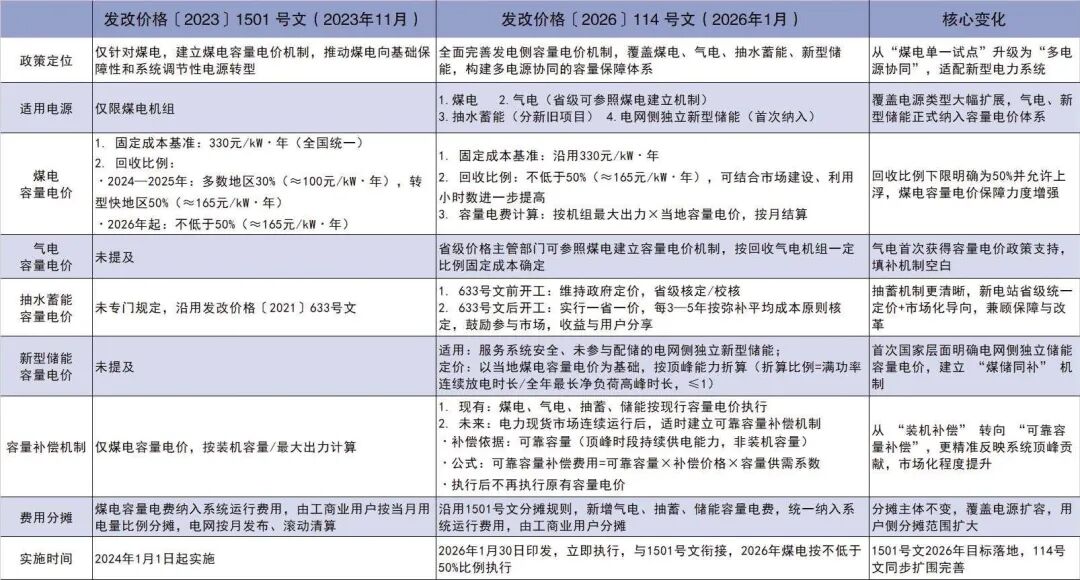
Core Viewpoint - The news highlights the significant developments in Zhangye's energy sector, particularly the potential of the Badanjilin Desert (Zhangye) project to transform the city into a key energy hub within the Belt and Road Initiative, focusing on renewable energy and innovative transmission models [1] Policy Developments - The introduction of the 114 document in January 2026 aims to enhance the capacity pricing mechanism for various power sources, including coal, gas, pumped storage, and new energy storage, marking a shift from a single pricing model to a dual-track compensation system [3][4] - The 114 document specifies that from 2026, the proportion of fixed costs recovered through capacity pricing will be no less than 50%, significantly increasing the financial support for coal power plants [4][5] Market Dynamics - Despite the favorable policies, Zhangye is focusing on controlling the number of new project registrations to avoid oversaturation in the energy storage market, which could dilute profitability for existing projects [6][7] - The city has shifted its focus from "heavy construction" to "heavy operation," emphasizing the importance of optimizing existing projects and ensuring sustainable profitability [7][8] Energy Storage Capacity - By 2025, Zhangye's total installed power capacity is expected to reach 10.27 million kW, with over 80% from renewable sources, and the city aims to have its energy storage capacity exceed 298,000 kW by the end of 2026 [9][10] - Zhangye has already established a competitive edge in the energy storage sector, with significant projects underway, including several large-scale independent storage stations [10][11] Financial Viability - The profitability of energy storage projects in Zhangye is supported by a combination of capacity compensation, market price differentials, and auxiliary service revenues, with projections indicating substantial returns on investment [12][14] - For instance, a 100 MW energy storage station could generate annual revenues of approximately 6.53 million yuan, with a payback period of around eight years, aligning with current market conditions [13][14] Employment and Economic Impact - The growth of the energy storage sector in Zhangye is expected to create numerous job opportunities, with significant investments from companies like Yisite, which plans to build a 200 MW energy storage station [15][16] - The development of a comprehensive energy storage industry chain is anticipated to benefit local employment, with thousands of jobs created across various projects [16]

三川智慧:公司参股公司上海储睿达智慧能源科技有限公司目前处于资不抵债状态,主要资产为两座小型储能电站
Mei Ri Jing Ji Xin Wen· 2026-02-12 03:36
Core Viewpoint - The company has no plans to inject capital into its subsidiary, Shanghai Churida Smart Energy Technology, which is currently in a state of insolvency and primarily holds two small-scale energy storage plants [1] Group 1: Company Information - The company is involved with Shanghai Churida Smart Energy Technology, which is facing financial difficulties [1] - The main assets of the subsidiary are two small energy storage plants [1] - The company currently does not plan to take control of the subsidiary through capital injection [1]

容量电价机制更新 储能电站从重规模走向重质量
经济观察报· 2026-02-07 07:24
Core Viewpoint - The inclusion of new energy storage in the capacity price mechanism marks the formation of a complete revenue landscape for independent new energy storage, with 2026 expected to be the year of market-oriented development for independent new energy storage [1][3]. Group 1: Capacity Price Mechanism - The National Development and Reform Commission and the National Energy Administration have introduced a new capacity price mechanism that includes new energy storage stations, allowing them to earn fixed revenue [2][3]. - A typical 100MW energy storage station can earn over 10 million yuan under the capacity price mechanism [4][16]. - The capacity price mechanism is shifting from a fixed income model to one that considers market dynamics, requiring energy storage stations to enhance operational capabilities and technology to maximize earnings [5][7][19]. Group 2: Market Dynamics and Competition - The energy storage industry has faced irrational price wars, leading to a focus on cost-cutting that jeopardizes long-term operational efficiency and safety [5][20]. - The new capacity price mechanism encourages energy storage companies to invest in research and development, transitioning the industry from a scale-driven model to one focused on technology and reliability [5][20]. - The demand for flexibility in the power system is increasing due to the rapid growth of renewable energy installations, necessitating a robust energy storage capacity [9][10]. Group 3: Future Projections and Requirements - By 2030, approximately 300GW of new energy storage capacity will be needed to meet the power system's requirements [10]. - The capacity price mechanism will evolve to reflect regional reliability capacity rather than a national benchmark, emphasizing the importance of stable power supply during peak periods [7][8]. - The quality of energy storage systems will be critical for earning capacity payments, with a focus on high-quality equipment and operational efficiency [18][20].

容量电价机制更新 储能电站从重规模走向重质量
Jing Ji Guan Cha Wang· 2026-02-07 05:29
Core Viewpoint - The introduction of the capacity price mechanism for new energy storage stations marks a significant shift in the industry, allowing these stations to earn fixed revenue and encouraging a transition from scale-based competition to quality and technology-driven development [2][3][17]. Group 1: Capacity Price Mechanism - The National Development and Reform Commission and the National Energy Administration have established a new capacity price mechanism that includes new energy storage stations, allowing them to receive fixed revenue based on their operational contributions to grid stability [2][5]. - A typical 100MW energy storage station could earn over 10 million yuan annually under this new mechanism [2][14]. - The capacity price mechanism is expected to evolve from a fixed cost model to one that reflects regional reliability and market conditions, promoting a competitive environment focused on stable power supply capabilities [5][10]. Group 2: Industry Challenges and Quality Focus - Industry experts indicate that the new regulations require energy storage stations to enhance their operational capabilities and technology to maximize profits, moving away from previous price wars that compromised quality [3][17]. - The mechanism emphasizes the need for higher quality products and better operational efficiency, which will drive companies to invest more in research and development [3][17]. - The introduction of a reliable capacity compensation mechanism will ensure that only those energy storage projects that meet quality standards will receive compensation, effectively filtering out lower-quality projects from the market [17]. Group 3: Market Dynamics and Future Projections - The rapid growth of renewable energy installations, particularly solar and wind, is creating new demand for flexible energy resources, necessitating an estimated 300GW of new energy storage capacity by 2030 to maintain system reliability [7][8]. - The market for energy storage is currently dominated by projects that are either independent or tied to renewable energy sources, with significant growth expected in these areas [11][12]. - Rising raw material costs, particularly lithium carbonate, are impacting the profitability of energy storage projects, necessitating a focus on efficiency and cost management [12][13].