
证券交易所

Search documents
市场定价预示美联储将再降息
Jin Tou Wang· 2025-09-26 03:54
伦敦证券交易所集团的数据显示,市场定价已体现出美联储在2025年底前,将有极大概率再度降息两 次。就在上周,美联储刚刚宣布将利率下调25个基点,这是其在2025年以来的首次降息。持续的降息预 期不仅影响着债券市场,也牵动着全球投资者的神经,未来美联储的政策走向将成为市场关注的焦点。 美元指数MACD显示DIFF为0.0899,DEA为0.0325,柱状值0.1149——正值但收敛,属于"温和看多、动 能放缓"的典型形态;若DIFF回落并与DEA死叉,易引发向中轨的均值回归。由此推导:若价格有效站 稳98.35并放量上穿98.5275的上轨,则将尝试挑战98.6330/98.7260/98.8290的结构阻力区;若回落跌破中 轨97.9696,则留意97.54—97.41的下沿带。 周五(9月26日)亚盘早盘,美元指数最新价报98.39,跌幅0.07%,开盘价为98.46。机构分析师在一份 报告中指出,市场对美联储将进一步降息的预期,可能会为债券市场带来提振作用。 ...
【锋行链盟】港交所并购上市核心要点
Sou Hu Cai Jing· 2025-09-26 00:54
Core Viewpoint - The Hong Kong Stock Exchange (HKEX) has a stringent regulatory framework for mergers and acquisitions (M&A) and listings, primarily outlined in the Listing Rules and related guidelines, focusing on preventing shell company abuse and ensuring market fairness [2][4]. Group 1: Reverse Takeover (RTO) Regulations - A reverse takeover is defined as a non-listed company acquiring control of a listed company (shell company) to achieve indirect listing [2]. - If deemed a reverse takeover, it will be treated as a new listing, requiring compliance with core IPO conditions such as profitability, market capitalization, and public shareholding [2][3]. - Key recognition criteria for RTO include significant changes in business operations, asset injection exceeding the shell company's original business, and issuance of new shares leading to a change in control [3]. Group 2: Mandatory Offer Rules - If a buyer's shareholding exceeds 30% of the target company's issued share capital, a mandatory offer must be initiated according to the Listing Rules and the Takeovers Code [3]. - The offer price must be the higher of the highest price paid for shares in the last six months or 90% of the average closing price over the last 30 trading days [3][5]. - A comprehensive offer is typically required for control changes, while partial offers must demonstrate no risk of delisting and align with shareholder interests [3]. Group 3: Information Disclosure and Trading Suspension - HKEX emphasizes timely and accurate disclosure during the M&A process to ensure market fairness [4]. - If material information is not disclosed and could affect stock prices, a trading suspension must be requested [5]. - Resumption of trading requires sufficient information to allow market assessment or termination of the transaction [5]. Group 4: Public Shareholding and Shareholder Distribution - Post-M&A, companies must maintain a public shareholding ratio of at least 25%, which can be reduced to 15% for companies with a market capitalization exceeding HKD 10 billion [4][5]. - A minimum of 300 public shareholders is required, with no single largest public shareholder holding more than 50% [5]. Group 5: Related Party Transactions and Independence Requirements - Related party transactions in M&A must comply with the Listing Rules, requiring independent shareholder approval and fairness opinions from independent financial advisors [4][5]. - Companies must maintain independence in operations, assets, finances, and personnel to avoid excessive reliance on related parties [5]. Group 6: SPAC M&A Listings - The HKEX introduced a SPAC regime in 2022, allowing blank check companies to acquire target companies within 18 months to achieve indirect listings [4]. - SPACs must raise at least HKD 1 billion, and only professional investors can subscribe [5]. - De-SPAC transactions must meet main board IPO standards, including profitability and market capitalization, and require independent financial advisors and valuation experts [5]. Group 7: Regulatory Approval and Compliance - M&A transactions may trigger additional regulatory processes beyond HKEX, including antitrust reviews and industry-specific approvals [4][5]. - Transactions involving over 25% market share in Hong Kong must be reported to the Competition Commission [5]. - National security reviews may apply to transactions in critical infrastructure and data security sectors under the National Security Law [5].


沪深北交易所 发布2025年国庆节中秋节休市安排
Zhong Guo Zheng Quan Bao· 2025-09-25 22:31
9月25日晚,沪深北交易所发布关于2025年国庆节、中秋节休市安排的公告。根据休市安排:10月1日 (星期三)至10月8日(星期三)休市,10月9日(星期四)起照常开市。另外,9月28日(星期日)、 10月11日(星期六)为周末休市。有关清算事宜将根据中国证券登记结算有限责任公司的安排进行。 (文章来源:中国证券报) ...
德勤预计港股市场今年将有逾80只新股上市,募集2500亿至2800亿港元,港交所将稳居全球IPO融资额榜首
Mei Ri Jing Ji Xin Wen· 2025-09-25 08:45
Group 1 - Deloitte announced that the number of IPOs in Hong Kong is expected to exceed 80 by 2025, with the fundraising forecast raised from approximately HKD 200 billion to between HKD 250 billion and HKD 280 billion [1] - As of September 23, 2023, the total IPO fundraising in Hong Kong for the first three quarters reached approximately HKD 180 billion, with highlights including the return of Chinese concept stocks and the expansion of ETF products [1][2] - The technology sector is anticipated to remain a focal point for the market, with expectations for continued valuation improvements [1][2] Group 2 - In the first three quarters of 2025, Hong Kong's IPO market saw a significant increase, with 66 new listings compared to 45 in the same period last year, marking a 47% growth [2] - The total fundraising amount reached HKD 1,823 billion, a 228% increase from HKD 556 billion in the previous year, with six large IPOs contributing approximately 60% of the total [2][5] - The Hong Kong Stock Exchange (HKEX) remains the global leader in IPO fundraising, with a significant gap of over HKD 60 billion compared to the second-ranked New York Stock Exchange [4][5] Group 3 - The top ten global IPOs in terms of fundraising saw a slight decline of 3% year-on-year, with four of them listed on the HKEX, including Ningde Times at the top with HKD 41 billion [3] - The number of listing applications received by HKEX increased significantly, with 283 applications in the first eight months of 2025, up 123% from 127 applications in the same period last year [4] - The average price-to-earnings ratio for the Hong Kong main board reached 15 times, returning to levels seen in Q4 2021, indicating a recovery in the market [5]

港交所行政总裁陈翊庭:丰富产品货架 承接全球资金多元化配置需求
Zhong Guo Zheng Quan Bao· 2025-09-25 00:43
Core Insights - The Hong Kong Stock Exchange (HKEX) is witnessing a significant shift in foreign investment sentiment towards Chinese assets, moving from a stance of avoidance to one of necessity, driven by China's policy stability and technological advancements [1][3] Group 1: Investment Trends - HKEX's CEO highlighted that global diversification needs and the attractiveness of Chinese assets are leading foreign capital to transition from "cannot invest" to "cannot miss investing" in China [1][3] - In the first half of the year, HKEX reported a new stock financing amount of HKD 1,094 billion, reclaiming the top position among global exchanges, with a daily average trading volume of HKD 2,402 billion, a year-on-year increase of 118% [2] - Foreign capital is significantly returning to the Hong Kong market, with foreign subscriptions accounting for 70-80% of certain IPOs, indicating a robust demand from long-term investors from regions such as Europe, the Middle East, and Southeast Asia [2][3] Group 2: Market Dynamics - The shift in foreign investment logic is attributed to geopolitical tensions and a reassessment of asset allocation strategies, leading to a search for new investment opportunities in Hong Kong's leading and high-potential companies [2][3] - The average daily trading volume of Hong Kong stocks is projected to rise from approximately HKD 1,000 billion in 2023 to HKD 1,300 billion in 2024, further increasing to HKD 2,402 billion in the first half of 2025, with foreign trading volume accounting for about 70% [3] Group 3: Institutional Innovation - HKEX is committed to optimizing its institutional framework to meet diverse financing needs, with recent innovations such as the introduction of Chapter 18A and 18C rules allowing biotech and specialized technology companies to list without prior revenue [4][5] - The successful implementation of these rules has led to increased market recognition and a growing number of applications from companies seeking to list under these provisions [5] Group 4: Market Connectivity - The rise in IPO activity is complemented by a positive interaction with the A-share market, with "A+H" listings creating a beneficial cycle between the two markets [6] - HKEX aims to enhance its product offerings in fixed income, foreign exchange, and commodities to better compete globally, addressing current gaps in its market [6][7] - Future plans include expanding the range of products available through the Stock Connect program, including ETFs and bonds, to facilitate greater access for international investors [6][7]
港交所行政总裁陈翊庭: 丰富产品货架 承接全球资金多元化配置需求
Zhong Guo Zheng Quan Bao· 2025-09-24 20:26
Core Viewpoint - The Hong Kong Stock Exchange (HKEX) is witnessing a significant shift in foreign investment sentiment towards Chinese assets, moving from a stance of avoidance to one of necessity, driven by China's policy stability and technological advancements [1][3]. Group 1: Investment Trends - Foreign capital is increasingly viewing Chinese assets as essential, with a notable change in investment logic from "Anything But China" to "Buy China" [3]. - In the first half of the year, HKEX reported a new stock financing amount of HKD 1,094 billion, reclaiming the top position among global exchanges [2]. - The average daily trading volume in the securities market reached HKD 2,402 billion, a year-on-year increase of 118% [2]. Group 2: Supply and Demand Dynamics - The supply side is robust, with over 200 companies currently processing IPO applications, nearly half of which are technology firms [2]. - A significant highlight on the demand side is the substantial return of foreign capital, with foreign investors participating in 70-80% of certain IPOs [2][3]. - The shift in global asset allocation strategies, influenced by geopolitical tensions and trade protectionism, is prompting investors to diversify away from USD assets towards Hong Kong stocks [2][3]. Group 3: Institutional Innovation - HKEX is committed to optimizing its institutional framework to meet diverse financing needs, exemplified by the introduction of the 18A and 18C listing rules, which allow biotech and specialized technology companies to go public [5]. - The 18C rule has already seen three companies listed and over ten applications submitted, indicating growing market acceptance [5]. Group 4: Market Connectivity - The "A+H" listing model has created a positive feedback loop, with average trading volume for "A+H" companies in A-shares increasing by approximately 15% this year [6]. - HKEX aims to enhance its product offerings in fixed income, foreign exchange, and commodities to better compete with global markets [6]. - Future plans include expanding the range of products available through the Stock Connect, including ETFs and bonds, to facilitate greater market integration [6][7].
丰富产品货架 承接全球资金多元化配置需求
Zhong Guo Zheng Quan Bao· 2025-09-24 20:18
Core Viewpoint - The Hong Kong Stock Exchange (HKEX) is witnessing a significant shift in foreign investment sentiment towards Chinese assets, driven by the increasing attractiveness of these assets and the demand for diversified global capital allocation [1][2][3] Group 1: Investment Trends - Foreign capital is transitioning from a passive to an active approach in investing in Chinese assets, with a notable increase in foreign participation in IPOs, exemplified by a large domestic company's IPO where foreign subscription reached 70-80% [2][3] - The global asset allocation logic is changing, with investors moving away from USD assets due to geopolitical tensions and trade protectionism, leading them to consider Hong Kong stocks as a viable alternative [2][3] - The investment logic for foreign capital is shifting from "Anything But China" to "Buy China," indicating a growing confidence in Chinese assets [2][3] Group 2: Market Performance - HKEX reported impressive performance in the first half of the year, with new stock financing reaching HKD 109.4 billion, reclaiming the top position among global exchanges, and an average daily trading volume of HKD 240.2 billion, up 118% year-on-year [1][2] - The average daily trading volume for Hong Kong stocks is projected to rise from approximately HKD 1 billion in 2023 to HKD 1.3 billion in 2024, and further to HKD 2.4 billion in the first half of 2025, with foreign capital accounting for about 70% of the trading volume [3][4] Group 3: Institutional Innovation - HKEX is committed to optimizing its institutional framework to meet the diverse needs of enterprises and investors, with recent innovations such as the introduction of Chapter 18A and 18C allowing biotech and specialized technology companies to list without prior revenue [4][5] - The introduction of these new listing rules reflects HKEX's proactive approach to align with long-term investor demands and support early-stage financing for innovative companies [5][6] Group 4: Market Connectivity - The IPO boom in Hong Kong is positively correlated with the A-share market, with "A+H" listings creating a virtuous cycle between the two markets [5][6] - HKEX aims to enhance its product offerings in fixed income, foreign exchange, and commodities to better compete globally, as current offerings are limited compared to US markets [6] - Future plans include expanding the range of products available through the Stock Connect program, such as ETFs and bonds, to facilitate greater access for foreign investors [6]
德勤:预计前三季度A股新股数量及融资额均增长
Guo Ji Jin Rong Bao· 2025-09-24 02:19
Core Insights - The report by Deloitte China highlights a slowdown in the global IPO market due to economic factors and geopolitical uncertainties, particularly the U.S. tariff policies, leading to a decrease in the financing scale of the top ten global IPOs compared to the previous year [1] - Despite global trends, Hong Kong is expected to maintain its position as the top global IPO financing hub, driven by six large IPOs during the period [1] - The A-share market in mainland China is showing steady growth in new listings and financing amounts, supported by the implementation of new policies aimed at enhancing the capital market [1] Group 1: A-share Market Performance - The A-share market is projected to have 78 new listings by September 30, 2025, with total financing reaching 77.1 billion yuan, marking a 13% increase in the number of new stocks and a 61% increase in financing compared to the same period last year [1] - The technology and innovation sectors are expected to remain hot spots for new listings in the A-share market, reflecting the government's support for these industries [1][2] - The steady rise in the A-share market index is seen as a positive outcome of the new policies being implemented [1] Group 2: Hong Kong Market Outlook - Hong Kong is anticipated to have 66 new listings in the first three quarters of the year, raising 1,823 million HKD, which is a 47% increase in the number of new stocks and a 228% increase in financing compared to the same period last year [2] - The presence of significant overseas capital inflow is boosting the Hong Kong stock market, leading to a recovery in valuations [3] - The forecast for the last quarter suggests that Hong Kong's IPO market will maintain strong momentum, with over 80 new listings expected for the entire year, and total financing projected between 250 billion to 280 billion HKD [3]
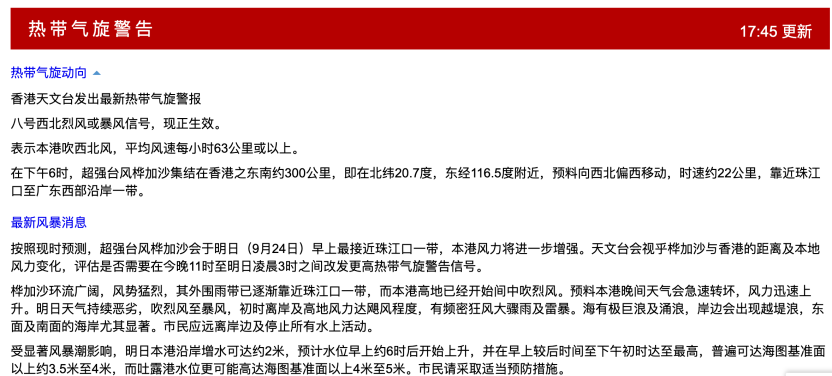
台风逼近!香港挂出“八号风球” 港交所:正常交易!
Zheng Quan Shi Bao· 2025-09-23 15:01
Core Viewpoint - The Hong Kong Stock Exchange (HKEX) will maintain normal trading operations despite the impending arrival of Typhoon Haikui, following the implementation of a "no trading halt during bad weather" policy a year ago [3][4]. Group 1: HKEX Operations - HKEX has received regulatory approval to implement trading during severe weather conditions since September 23, 2023, allowing the market to operate under adverse weather circumstances [3]. - The Financial Secretary of Hong Kong, Paul Chan, stated that the government is prepared for the typhoon and has activated a coordination center to ensure smooth financial market operations [3]. - HKEX has advised financial institutions to allocate resources and personnel in advance to ensure stable market operations during the typhoon [4]. Group 2: Weather Trading Arrangements - Under the bad weather trading arrangements, the securities and derivatives markets in Hong Kong will continue to operate during signal warnings of Typhoon No. 8 or above, black rainstorm warnings, or extreme situation warnings [4]. - HKEX has called on market participants to prepare for trading under adverse weather conditions and to refer to established operational arrangements [4]. Group 3: Recommendations for Market Participants - Securities brokers are advised to ensure that banking services and electronic transfer limits are sufficient for daily operations during bad weather trading days [5]. - Investors should familiarize themselves with the electronic trading platforms and transfer channels provided by their banks or brokers [6]. - Employees of securities firms or banks should be prepared for remote access to company systems and discuss work arrangements with employers in anticipation of potential weather changes [7].
德勤:港交所料登顶今年全球新股融资榜
Zhong Guo Xin Wen Wang· 2025-09-23 14:10
Group 1 - Deloitte's report predicts that Hong Kong will surpass the New York Stock Exchange and NASDAQ to become the top global IPO financing market in 2023 [1] - In the first three quarters of 2023, Hong Kong is expected to have 66 IPOs raising HKD 182.3 billion, a 228% increase from HKD 55.6 billion in the same period last year [1] - The NYSE and NASDAQ are projected to rank second and third globally, with IPO financing amounts of HKD 125.6 billion and HKD 114.6 billion, respectively [1] Group 2 - The influx of overseas capital into Hong Kong has significantly boosted market activity and valuations, driven by policies encouraging mainland leading companies to list in Hong Kong [1] - The report anticipates that with the Federal Reserve's interest rate cuts, more funds will flow into the Hong Kong stock market, with over five potential large IPOs expected [1] - For the mainland capital market, it is estimated that by September 30, 2023, there will be 78 IPOs in the A-share market raising RMB 77.1 billion, reflecting a year-on-year increase of 13% in the number of IPOs and 61% in total financing [1][2] Group 3 - The A-share market has shown steady growth in the first three quarters of 2023, supported by the implementation of new regulatory policies [2] - The focus on technology and innovation by the government is expected to keep sectors like technology and renewable energy as hotspots for new IPOs in the A-share market [2]