
脑机接口

Search documents
国海证券:Neuralink量产在即 国产脑机链有望充分受益
智通财经网· 2026-01-08 02:53
Core Viewpoint - Neuralink's announcement of mass production in 2026 marks a significant shift from laboratory research to commercial application in the brain-computer interface (BCI) sector, with strong potential benefits for China's BCI industry due to rigid medical demand and supportive policies [1] Group 1: Event Overview - Neuralink, founded by Elon Musk in 2016, plans to start large-scale production of brain-computer interfaces on January 1, 2026, transitioning to a more streamlined and fully automated surgical process [1] - The company has developed three main product lines: Telepathy for motor function disorders, Blindsight for visual reconstruction, and Deep for neurological regulation [2][3] Group 2: Market Potential - The global BCI market is projected to reach approximately $3.19 billion by 2025, with medical applications expected to grow to $40 billion by 2030 and $145 billion by 2040 [4] - In China, the BCI market is anticipated to exceed 3.8 billion yuan by 2025, with a compound annual growth rate of around 20%, reaching 6.14 billion yuan by 2028 [5] Group 3: Policy and Technological Support - China has established a comprehensive support system for the BCI industry, with policies aimed at fostering innovation and establishing a competitive ecosystem by 2030 [6][7] - Significant technological advancements have been made, including successful clinical trials and the development of high-performance BCI systems, indicating a transition from laboratory to large-scale application [7] Group 4: Related Companies - Key companies in the BCI sector include Yanshan Technology, Entropy Technology, Dineike, BGI, Linying Intelligent Manufacturing, Lens Technology, Hanwei Technology, Dongfang Zhongke, Pulite, and Puni Testing [7]

国海证券晨会纪要-20260108
Guohai Securities· 2026-01-08 02:42
Group 1: Lin Qingxuan Company Overview - Lin Qingxuan (2657.HK) is a high-end domestic skincare brand founded in 2003, known for its "oil-based skincare" concept and camellia oil facial essence, focusing on anti-wrinkle and firming skincare products [2][4] - The flagship product, camellia oil essence, has sold over 4.5 million bottles since its launch, accounting for 46% of revenue and 48% of gross profit in the first half of 2025 [2] - The company achieved a revenue of 1.05 billion yuan in the first half of 2025, representing a 98% year-on-year increase, with a net profit margin of 17.3% [2] Group 2: Market Trends and Growth Potential - The "oil-based skincare" market is rapidly growing, with a market size of 5.19 billion yuan in 2023, expected to exceed 11 billion yuan by 2025, driven by consumer awareness and the rise of new domestic brands [3] - The high-end segment of the market is expanding faster than lower price segments, with the market share of products priced above 500 yuan growing significantly [3] - Douyin (TikTok) is a key channel for sales, accounting for 72% of Lin Qingxuan's online sales, with a significant increase in gross merchandise volume (GMV) across various channels [3][4] Group 3: Neuralink and Brain-Computer Interface Industry - Neuralink, founded by Elon Musk, is set to begin large-scale production in 2026, focusing on automated surgical processes for brain-computer interfaces [5][6] - The company has developed three main product lines: Telepathy for motor function disorders, Blindsight for visual reconstruction, and Deep for neurological regulation [6][7] - The brain-computer interface market is projected to reach approximately $3.19 billion by 2025, with significant growth expected in medical applications, consumer electronics, and industrial uses [8][9] Group 4: Policy and Technological Developments - China's government has established a comprehensive support system for the brain-computer interface industry, aiming to create a competitive ecosystem by 2030 [10] - Significant technological advancements have been made, including successful clinical trials and the development of high-throughput wireless systems [11] - The domestic brain-computer interface market is expected to exceed 3.8 billion yuan by 2025, with a projected annual growth rate of around 20% [9]
心玮医疗成立脑机接口子公司 介入式脑机接口项目入选国家级“揭榜挂帅”名单
Zheng Quan Shi Bao Wang· 2026-01-08 02:37
Core Viewpoint - The establishment of Shanghai Weinao Intelligent Technology Co., Ltd. marks a significant step in the strategic deployment of Xinwei Medical in the brain-computer interface (BCI) sector, transitioning from planning to practical implementation [1][2] Group 1: Company Developments - Xinwei Medical's subsidiary, Weinao Intelligent, has completed its business registration and is now located in the Shanghai Brain-Computer Interface Future Industry Cluster [1] - The company aims to focus on the research and clinical application of BCI technology, facilitating the transition from basic research to clinical treatment [1][2] - The establishment of Weinao Intelligent signifies a new phase of independent and specialized operations for Xinwei Medical in the BCI business [2] Group 2: Technological Innovations - The BCI project submitted by Xinwei Medical utilizes an innovative minimally invasive approach, implanting electrode stents into brain blood vessels without the need for craniotomy, significantly reducing surgical trauma [2] - This new method effectively avoids complications associated with traditional invasive surgeries, such as intracranial infections and long-term rejection reactions [2] - The intravascular electrodes can closely adhere to blood vessel walls, achieving a balance between high-quality neural signal acquisition and long-term stability [2] Group 3: Strategic Initiatives - Xinwei Medical's BCI project was selected for the 2025 Artificial Intelligence Medical Device Innovation Task, highlighting its strong innovation capabilities and potential for technology transfer [1] - The initiative aims to promote breakthroughs in AI medical devices and facilitate the practical application of products, with 16 BCI projects being selected [1]
港股脑机接口概念股再度活跃 脑动极光大涨10% 心玮医疗涨1.45%
Jin Rong Jie· 2026-01-08 02:30
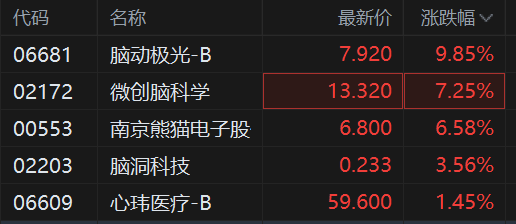
港股脑机接口概念股再度活跃,其中,脑动极光大涨10%领衔,微创脑科学涨7.25%,南京熊猫电子涨 6.58%,脑洞科技涨3.56%,心玮医疗涨1.45%。 本文源自:金融界AI电报 ...
脑机接口板块持续走强,爱朋医疗20cm涨停创新高
Xin Lang Cai Jing· 2026-01-08 02:25
脑机接口板块持续走强,爱朋医疗20cm涨停创新高,南京熊猫此前涨停录得4连板,创新医疗、岩山科 技、塞力医疗涨幅居前。 ...

港股异动丨脑机接口概念股再度活跃 脑动极光大涨10% 心玮医疗涨1.45%
Ge Long Hui· 2026-01-08 02:19
Group 1 - The core viewpoint of the news is that the brain-computer interface (BCI) sector is experiencing a surge in stock activity, driven by government support and industry events, with 2026 expected to be a pivotal year for commercialization [1][2] - The Ministry of Industry and Information Technology, along with eight other departments, has announced plans to accelerate the industrialization and commercialization of new terminal devices such as augmented reality/virtual reality (AR/VR) wearables and brain-computer interfaces [1] - The Brain-Computer Interface Industry Alliance and other organizations are set to hold the "2026 Brain-Computer Interface Developer Conference" in Tianjin on February 3-4, 2026, indicating a growing focus on this technology [1] Group 2 - Notable stock performances include Brain动极光 (up 9.85%), 微创脑科学 (up 7.25%), 南京熊猫电子 (up 6.58%), 脑洞科技 (up 3.56%), and 心玮医疗 (up 1.45%) [2] - The rapid increase in stock prices reflects a broader market enthusiasm for brain-computer interfaces, which were once considered a concept of science fiction but are now moving closer to reality [1]

心玮医疗20260107
2026-01-08 02:07
Summary of the Conference Call for Xinwei Medical Company Overview - **Company**: Xinwei Medical - **Industry**: Brain-Computer Interface (BCI) and Neurointervention Key Points and Arguments Product Development and Technology - Xinwei Medical employs a minimally invasive endovascular approach to implant electrode stents via the internal jugular vein to capture motor cortex signals, reducing the risks associated with open brain surgery and improving signal stability. Animal experiments show stable signals even after 18 months [2][3] - The company plans to complete the registration application for its brain-computer interface product by 2028 and finish human clinical trials by 2027, with an expected recruitment of 30-50 patients for motor function recovery [2][4][5] - A collaboration with J.T. Medical aims to develop a new endovascular brain-computer interface that addresses the issue of electrode displacement in traditional invasive systems. Xinwei Medical is responsible for the design and development of the stent [2][6] Financial and Operational Aspects - Xinwei Medical anticipates having nearly 800 million yuan in cash by the end of 2025, with operating cash flow exceeding 100 million yuan, sufficient to cover the R&D costs of the brain-computer interface project, estimated at several tens of millions [3][17] - The estimated cost for mass production of the electrode stent is around 3,000-4,000 yuan, with total costs expected to remain under 10,000 yuan, potentially decreasing to a few thousand yuan in the future [9] Clinical Trials and Regulatory Pathway - The clinical trial plan is not fully finalized but is expected to follow a model similar to that of Boruikang, which conducted approximately 32 human experiments. The first patient recruitment is set to begin in the second half of this year [5][12] - The company is in communication with regulatory bodies to establish industry standards for the registration process, with patient recruitment expected to start in 2026 [14] Market and Competitive Landscape - The company aims to collaborate with leading consumer electronics companies like Huawei and Xiaomi to develop software functionalities for their products once the new indications are established [11] - The invasive brain-computer interface is designed for specific applications, primarily targeting patients with motor function impairments, with potential future applications in vision, language, and emotional control [10][22] Team and Resource Allocation - Xinwei Medical currently has a team of about 10 people focused on the brain-computer interface project, with plans to expand the team, particularly in signal decoding [8][7] - The company is actively seeking partnerships with software teams, universities, and research institutions to enhance its capabilities in software development [8] Future Outlook - The company is optimistic about the future of the brain-computer interface market, with a positive sentiment reflected in recent financing activities in the sector [16] - Xinwei Medical's neurointervention business is expected to grow at an annual rate of 30%-35% in the coming years, contributing to overall revenue growth [22] Challenges and Considerations - The main challenges in patient recruitment include ensuring safety and acceptance of the new technology among medical professionals and potential patients, particularly those with severe motor function impairments [12][18] - The company is preparing for potential overseas market entry, contingent on successful domestic registration and compliance with international regulations [20][21] Additional Important Information - The company is focused on optimizing its product, with static samples already available and dynamic samples expected to be showcased soon [13] - The reimbursement policies for invasive procedures are still being defined, with expectations that insurance coverage could reach 70%-80% once the product proves its safety and efficacy [15]

开盘超3000只个股下跌
Di Yi Cai Jing Zi Xun· 2026-01-08 02:02
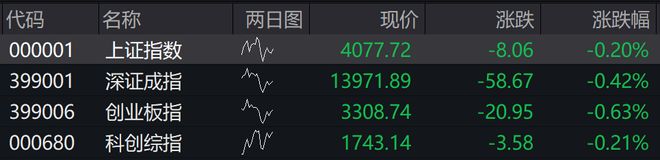
Market Overview - The A-share market opened lower with the Shanghai Composite Index down 0.20%, the Shenzhen Component down 0.42%, and the ChiNext Index down 0.63% [2][3] - Over 3,000 stocks declined in the market, with sectors such as brokerage, insurance, retail, and CPO experiencing significant drops [1] Sector Performance - The electronic gas sector saw a strong opening, with Sanfu Co. and Heyuan Gas hitting the daily limit up, while Jin Hong Gas, Huate Gas, Silane Technology, and Yake Technology also showed notable gains [1] - The brain-computer interface concept remained active, with companies like Prit and Innovation Medical achieving four consecutive trading limit ups [1] Notable Stocks - Zhongke Lanyun opened over 12% higher, projecting a net profit increase of 367%-377% year-on-year for 2025 [3] - Yijing Optoelectronics approached the daily limit down, announcing an expected negative net profit for the year 2025 [5] Hong Kong Market - The Hong Kong stock market opened lower, with the Hang Seng Index down 0.59% and the Hang Seng Tech Index down 0.44% [5][6] - Major stocks such as Tencent Music, Baidu Group, Alibaba, and Zijin Mining experienced significant declines, while China Shenhua, China Telecom, and China Merchants Bank showed strength [5]
脑机接口概念股多数上扬 行业受益“十五五”规划重点布局 海内外迎密集催化
Zhi Tong Cai Jing· 2026-01-08 01:54
消息面上,1月7日,工业和信息化部等八部门印发《"人工智能+制造"专项行动实施意见》,其中提 出,加速智能终端升级。聚焦工业巡检、远程医疗等重点场景,加快增强现实/虚拟显示(AR/VR)可穿戴 设备、脑机接口等新型终端的产业化、商业化进程。财信证券认为,脑机接口行业作为融合多学科前沿 技术的高成长赛道,在政策强力支持、医保支付落地与技术持续突破的驱动下,正迈向规模化应用关键 阶段。 国信证券指出,脑机接口已进入"技术突破向商业业化跃迁"的关键节点,锚定"政策+技术+场景"三重主 线。当前行业受益于"十五五"规划重点布局、医保赋码与医疗器械标准落地等政策红利,叠加Neuralik 量产预期与国内临床突破的催化,全球市场规模有望迎来爆发式增长。随着芯片、电极、算法等技术的 发展,法规标准的不断完善,预计未来几年脑机接口产品将迎来密集商业化。 脑机接口概念股多数上扬,截至发稿,脑洞极光-B(06681)涨7.91%,报7.78港元;微创脑科学(02172)涨 6.2%,报13.19港元;脑洞科技(02203)涨3.56%,报0.233港元。 ...
港股异动 | 脑机接口概念股多数上扬 行业受益“十五五”规划重点布局 海内外迎密集催化
智通财经网· 2026-01-08 01:54
Group 1 - The core viewpoint of the article highlights the upward trend in brain-computer interface (BCI) concept stocks, driven by supportive government policies and technological advancements [1] - As of the report, notable stock performances include Brainhole Aurora-B (06681) up 7.91% to HKD 7.78, Micron Brain Science (02172) up 6.2% to HKD 13.19, and Brainhole Technology (02203) up 3.56% to HKD 0.233 [1] - The Ministry of Industry and Information Technology, along with eight other departments, issued the "Implementation Opinions on the Special Action of 'Artificial Intelligence + Manufacturing'" on January 7, focusing on accelerating the upgrade of smart terminals and emphasizing the industrialization and commercialization of new terminals like AR/VR devices and BCIs [1] Group 2 - Financial analysts believe that the BCI industry is entering a critical phase of scaling applications, supported by strong policy backing, the implementation of medical insurance payments, and continuous technological breakthroughs [1] - Guosen Securities indicates that the BCI sector is at a pivotal point of transitioning from technological breakthroughs to commercialization, driven by a combination of policies, technology, and application scenarios [1] - The industry is expected to benefit from the "14th Five-Year Plan" focus, medical insurance coding, and the establishment of medical device standards, alongside anticipated mass production of Neuralik and breakthroughs in domestic clinical applications, leading to explosive growth in the global market [1]