
银行理财

Search documents
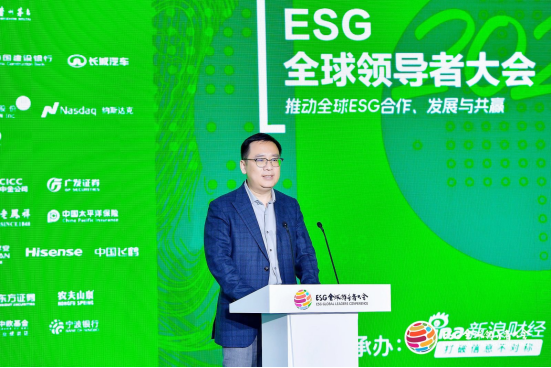
信银理财总裁董文赜:发展绿色金融是资管企业拥抱ESG的应有之义
Xin Hua Wang· 2025-08-12 06:11
Core Insights - The "2024 Global Leaders Conference on Environment, Social, and Governance (ESG)" was held in Shanghai, focusing on promoting global ESG cooperation, development, and win-win outcomes [1] - The importance of green finance as a necessary path for high-quality development was emphasized, with green finance being a key component of the financial sector's strategic initiatives [3] Group 1: ESG and Green Finance Development - ESG is widely recognized as a value concept and investment guideline essential for high-quality development [3] - The development of green finance is seen as an essential responsibility for asset management companies to embrace ESG [3] - Leading asset management institutions have been actively implementing sustainable development concepts, highlighting the significance of ESG governance in enhancing service levels and promoting overall industry development [3] Group 2: Role of Bank Wealth Management - Bank wealth management is identified as a crucial force in supporting the green transformation of the economy and society, serving as a vital tool for converting social wealth into green capital [3] - There is a preliminary formation of a multi-layered green finance product and market system in China, primarily consisting of green loans and green bonds, but there remains significant room for development in green asset management [3] Group 3: Challenges in Green Finance - Common challenges faced by bank wealth management in developing green finance include a relatively small overall market size for green financial products compared to other asset management products [4] - There is a need for increased innovation in green and ESG-themed financial products, as well as improvements in investment capabilities [4] - The establishment of a standardized ESG investment and product framework is still lacking, and investor awareness of the long-term value of green investments is insufficient [4] Group 4: Future Outlook - The future development of green wealth management is viewed optimistically, with bank wealth management companies actively responding to policy calls by issuing ESG, green, and low-carbon themed financial products [4] - As the green transformation of the economy deepens, wealth management companies are exploring product development, ESG investment strategies, and management system construction in the green finance sector, which is expected to lead to a steady increase in the scale of green financial products [4]

理财子规模增速现断层:两头部机构告负 跟随者快步露锋芒
Xin Hua Wang· 2025-08-12 06:10
Core Insights - The banking wealth management market is gradually recovering in 2024, with most wealth management companies showing year-on-year growth in product scale and net profit, despite some companies experiencing declines [1][2][3] Group 1: Performance Overview - As of April 10, 2024, 16 wealth management companies have reported their annual performance, with some companies achieving over 30% growth in scale and more than 158% growth in net profit [1] - The total scale of the banking wealth management market reached 29.95 trillion yuan, with total investment assets of 32.13 trillion yuan, reflecting a year-on-year growth of 10.56% [6] - The largest wealth management companies, such as 招银理财 and 兴银理财, reported scale reductions, with 招银理财's scale decreasing by 786.86 billion yuan to 2.47 trillion yuan [2][3] Group 2: Profitability Trends -浦银理财 reported the highest net profit growth of 158.57%, increasing to 11.61 billion yuan, while 渝农商理财 saw a 44.12% increase in net profit [4] - 招银理财, 兴银理财, and 信银理财 were among the companies with net profits exceeding 2 billion yuan, although 招银理财 experienced a 14.14% decline in net profit [3][4] Group 3: Investment Strategies - Wealth management companies are adjusting their investment logic to focus on diverse asset allocation and strategies, particularly in a low-interest-rate environment [1][10] - The shift towards equity markets is evident, with companies like 中银理财 launching over 20 equity index-linked products, reflecting a trend towards passive investment strategies [7][10] Group 4: Channel Expansion - Wealth management companies are actively expanding their distribution channels, particularly through third-party sales, with significant growth in off-bank sales channels [8][10] - 民生理财 reported a 137.02% increase in off-bank sales, while 青银理财 doubled its off-bank distribution institutions [8] Group 5: Challenges and Future Outlook - The wealth management industry faces challenges such as the need for improved equity investment capabilities and the difficulty in obtaining licenses for small banks [9][10] - Future competition in the wealth management sector is expected to focus on both channel expansion and product innovation, with a need for diversified product offerings to enhance market share [9][10]
超40只权益类银行理财,赚钱了
中国基金报· 2025-08-11 16:22
Core Viewpoint - The performance of equity-based wealth management products has significantly improved, with over 90% of such products yielding positive annualized returns, driven by a recovering capital market and supportive macro policies [2][4]. Group 1: Performance of Equity Wealth Management Products - As of August 3, there are 46 publicly offered equity wealth management products, with 43 showing positive returns, and 17 of these exceeding 10% annualized returns [2][4]. - The average net asset value growth rate for equity wealth management products this year is 5.82%, making them standout performers in the wealth management market [4]. - The average maximum drawdown for fixed income products is only 0.19%, while mixed products have a higher average maximum drawdown of 1.26% [4]. Group 2: Market and Policy Influences - The significant rise in equity wealth management product yields is attributed to the recovery of the capital market and macro policies that boost market confidence [6]. - A policy issued in January 2025 allows bank wealth management to participate more actively in the capital market, enhancing the allocation of wealth management funds to equity assets [6]. - The current low interest rate environment is pushing wealth management companies to diversify their asset allocations to meet client demands for higher returns [6]. Group 3: Market Size and Trends - Despite the strong performance of equity wealth management products, their market size remains relatively small, with the total wealth management market reaching 30.67 trillion yuan, where fixed income products dominate [7]. - Equity products account for only 0.07 trillion yuan of the total market, indicating a low proportion in the overall wealth management landscape [7]. - Analysts predict that as the preference for bond assets diminishes due to lower yields, there will be an increased allocation towards equity assets in the future [8].

王增武:一代企业家“家企分离”意识几乎为零,“法商”思维亟待加强|理财会客厅
Xin Lang Cai Jing· 2025-08-11 08:50
Core Insights - The central financial work conference emphasizes the importance of five key areas: technology finance, green finance, inclusive finance, pension finance, and digital finance, guiding the high-quality development of the financial sector [1] Group 1: Wealth Management Market Development - The wealth management market in China is transitioning to a more mature and stable phase following regulatory policies like the asset management new regulations [4] - The wealth management ecosystem should focus on "common prosperity," prioritizing fairness over mere efficiency [3] - The development of wealth management institutions varies, with some being significantly impacted by regulations while others remain relatively unaffected [4] Group 2: Entrepreneurial Perspectives - First-generation entrepreneurs exhibit minimal awareness of "separation of family and enterprise," often leading to ownership changes due to assets being registered under company names [2][6] - Second-generation entrepreneurs demonstrate a stronger risk-avoidance mindset and a better understanding of legal frameworks to mitigate risks [2][7] Group 3: Investment Strategies - Investors are advised to focus on "safe assets," suggesting a portfolio allocation of 30% in safe assets and the remaining 70% in protective products, equity products, or bank wealth management products [14] - High-net-worth clients tend to have a higher risk tolerance and are increasingly interested in sectors like technology, biotechnology, and artificial intelligence [5] Group 4: Financial Institutions' Role - Commercial banks are encouraged to enhance their core competitiveness, particularly in pricing and risk control capabilities, to achieve stable returns even in low-interest environments [13] - The structure of commercial banks should include a three-tier system to better promote business development in technology finance [10] Group 5: Family Office and Private Banking - Family offices are seen as a more advanced form of private banking, essential for matching effective supply and demand in financial services [8] - The private banking sector is transitioning from growth in scale to a focus on value cultivation, with no significant bottlenecks identified [7]
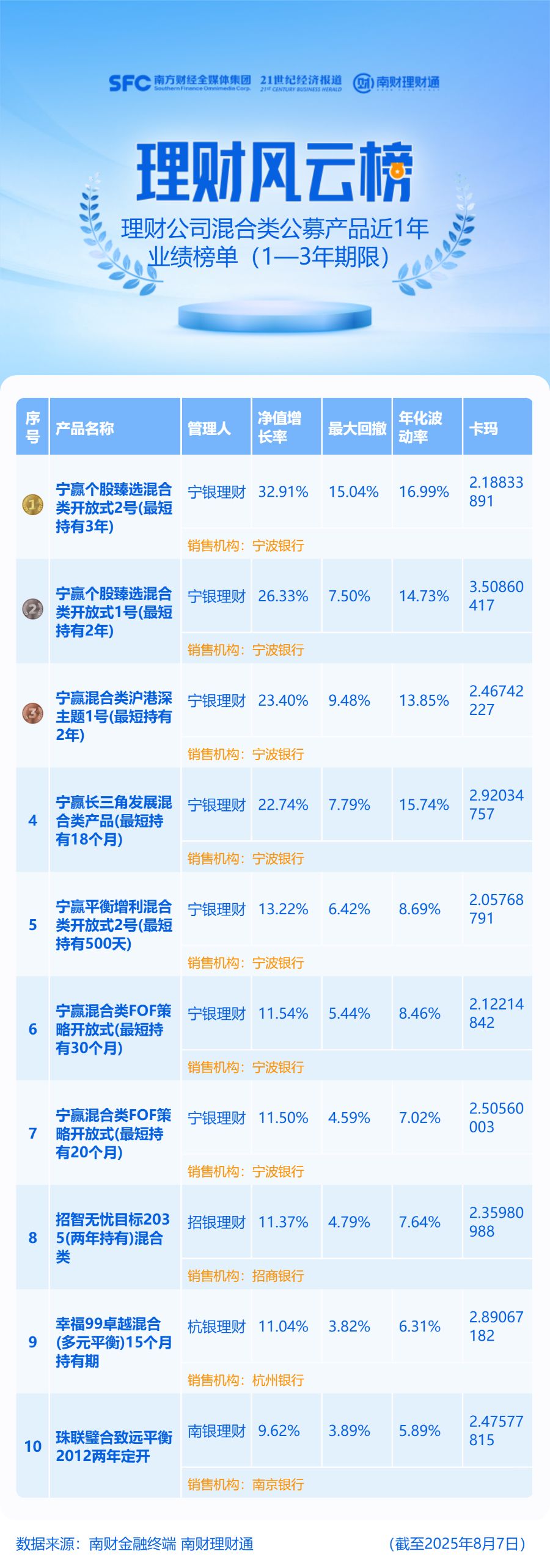
高含权混合类产品最高涨超30%,长封闭期限成规模掣肘
2 1 Shi Ji Jing Ji Bao Dao· 2025-08-11 08:49
Overall Performance - As of August 7, 2025, there are a total of 287 public mixed-asset products with an investment period of 1-3 years issued by wealth management companies, with notable products from Ningyin Wealth Management, Zhao Yin Wealth Management, Hang Yin Wealth Management, and Nan Yin Wealth Management making it to the top ten, particularly Ningyin Wealth Management which has seven products in the top seven positions [5] Highlighted Product Analysis - The "Individual Stock Selection No. 2" product has achieved a net value growth rate exceeding 30% in the past year, reaching 32.91%, while other products like "Individual Stock Selection No. 1," "Hong Kong and Shanghai Theme No. 1," and "Yangtze River Delta Development Mixed Product" also surpassed a 20% growth rate [6] - The top product, "Individual Stock Selection No. 2," has shown strong performance during market fluctuations, with annualized returns of 1.8% and -1.3% in 2022 and 2023 respectively, outperforming the CSI 300 index which had declines of -21.6% and -11.4% [6] - As of June 2025, the product's equity position exceeds 76.54%, primarily focused on Hong Kong stock investments, although the overall scale is relatively small due to the long investment period of three years [7]
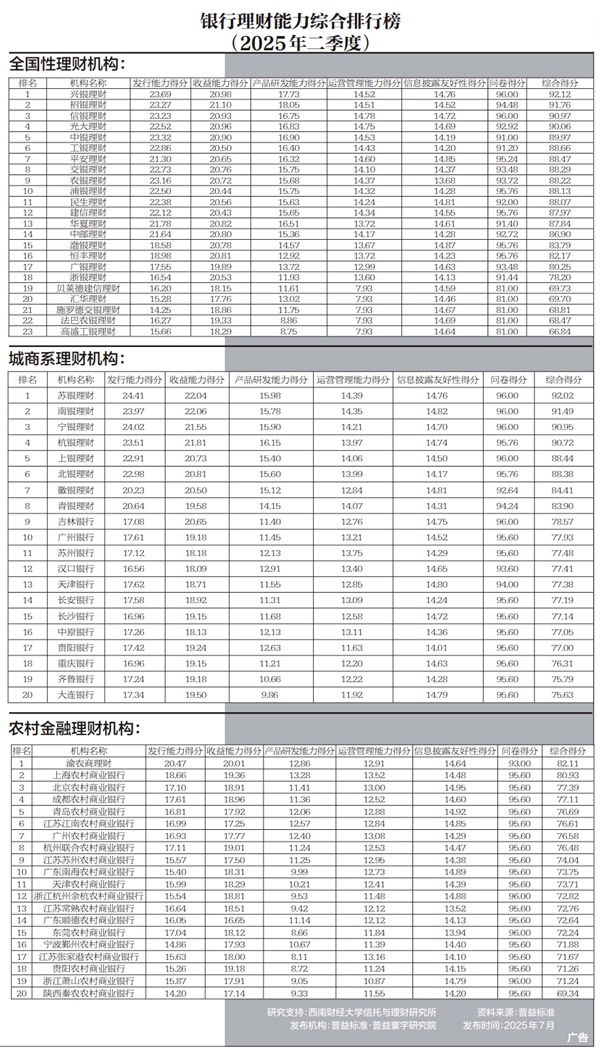
普益标准发布2025年二季度银行理财能力排名报告
Jin Rong Shi Bao· 2025-08-08 07:59
普益标准日前发布2025年二季度银行理财能力排名报告。报告显示,二季度,全市场银行理财机构 (不包括外资银行)净值型理财产品的存续数量为82245款,较2025年一季度增加5412款,环比上升 7.04%;净值型理财产品存续规模估计为30.33万亿元,环比上升5.50%。 兴银理财居全国性理财机构排名之首;苏银理财在城商系理财机构排名中位列第一;渝农商理财在 农村金融理财机构中表现突出 根据《普益标准·银行理财能力排名报告》,2025年二季度,全国性理财机构中,理财能力综合排 名前五的依次是兴银理财、招银理财、信银理财、光大理财、中银理财。 2025年2季度,城商系理财机构中,理财能力综合排名前十的依次是苏银理财、南银理财、宁银理 财、杭银理财、上银理财、北银理财、徽银理财、青银理财、吉林银行、广州银行。 2025年二季度,农村金融理财机构中,理财能力综合排名前十的依次是渝农商理财、上海农商银 行、北京农商银行、成都农商银行、青岛农商银行、江苏江南农商银行、广州农商银行、杭州联合农商 银行、江苏苏州农商银行、广东南海农商银行。 发行能力: 兴银理财排名居全国性理财机构首位;苏银理财在城商系理财机构中表现突出; ...
下半年配什么?理财公司看好这两类资产
Zhong Guo Zheng Quan Bao· 2025-08-08 07:20
Core Viewpoint - The traditional asset allocation logic of the banking wealth management industry is facing challenges due to a low interest rate environment and increased volatility, prompting a shift towards diversified strategies and alternative assets [1][2]. Group 1: Market Environment - The current market is characterized by "low interest rates and high volatility," with a general decline in asset yields. As of May 20, the 1-year and 5-year LPR have decreased by 10 basis points, and the 10-year government bond yield is fluctuating between 1.6% and 1.7% [2]. - The volatility in the asset sector is increasing, complicating asset allocation strategies [2]. Group 2: Strategic Shifts - Financial institutions are transitioning from single asset investments to diversified strategies, focusing on major asset allocation to broaden income sources. The emphasis for the second half of the year will be on alternative and equity assets [1][2]. - Companies like Xinyin Wealth Management are adopting a core strategy of major asset allocation, with a focus on enhancing returns through diversified fixed income and equity assets, while controlling risks [2][3]. Group 3: Asset Class Outlook - Industry insiders are optimistic about the performance of alternative and equity assets in the second half of the year. A balanced allocation of stocks, bonds, and gold is seen as advantageous, with expectations of continued upward movement in asset prices due to low inflation and ample liquidity [3][4]. - Specific sectors such as technology and dividend strategies are expected to remain advantageous, with new consumption driven by policy potentially becoming a source of excess returns [4].
银行理财子公司“试水”浮动费率产品 加速净值化转型
Zheng Quan Ri Bao· 2025-08-08 07:19
Core Viewpoint - The introduction of floating management fee rate products by bank wealth management subsidiaries marks a shift from fixed fee models, promoting a positive alignment between managers' performance and investors' returns, thus fostering healthy competition and development in the wealth management industry [1][5]. Group 1: Product Innovation - The "Zhaozhi Ruiyuan Balanced (Anying Youxuan) 68th Phase" floating management fee product launched by China Merchants Bank on July 8 features a fixed management fee of 0.25%, significantly lower than the typical 0.4% to 0.6% for similar products, with a performance-linked fee structure [2][3]. - The product allows for a maximum annual management fee of 0.5% if the annualized return exceeds 4%, thus directly linking management fees to product performance [2][3]. - The product sold out on its first day, indicating high investor interest [4]. Group 2: Market Dynamics - Experts believe that floating management fee models can alleviate the fixed fee burden on investors during poor market performance while allowing managers to earn higher rewards during strong performance, thus aligning interests [5][6]. - Such products are particularly attractive in volatile or structural market conditions, helping wealth management subsidiaries expand their management scale and incentivize research teams to enhance performance [5][6]. Group 3: Industry Implications - The floating management fee model represents a significant exploration in the transition to net value-based operations, pushing the industry from a scale-oriented approach to a performance-oriented one, enhancing investor satisfaction [5][6]. - The model is especially suitable for high-volatility, high-return products, as it allows for a more direct correlation between management compensation and actual investment capabilities [5][6]. Group 4: Operational Requirements - Bank wealth management subsidiaries must enhance their investment research capabilities, particularly in equity investments, to achieve excess returns that support floating fees [6]. - There is a need for refined risk management to balance the pursuit of high fees with the avoidance of excessive risk, especially during market fluctuations [6]. - Effective operational systems and continuous communication with investors are essential to manage expectations regarding fee structures and performance [6].
【金融头条】银行理财寻路2024
Jing Ji Guan Cha Wang· 2025-08-08 04:36
Core Insights - The development of bank wealth management has lagged behind, with public fund scale surpassing bank wealth management for the first time by June 2023, indicating a shift in competitive advantages [2] - The bank wealth management industry is undergoing a reassessment of its service clientele, operational models, and positioning to regain competitiveness [2][4] - The industry is expected to transition towards professional asset management companies in 2024, enhancing risk preference, product structure, and investment research capabilities [2][4] Industry Challenges - The year 2023 has been challenging for the industry, with both scale and performance under pressure, leading to adjustments in product performance benchmarks and fee structures to attract investors [4][5] - Bank wealth management scale fluctuated significantly, increasing from 23.4 trillion yuan at the end of 2019 to 25.34 trillion yuan by mid-2023, but saw a notable decrease compared to 2022 due to declining product yields [4][5] - The low risk tolerance of clients and the contradiction with the net value of wealth management products have led to increased volatility in product scale, complicating investment strategies [5] Strategic Shifts - The investment environment for bank wealth management has undergone five key changes, including more rational market expectations, low client confidence recovery, and a shift towards stable asset structures [8] - The focus for 2024 will be on maintaining a balanced approach to asset allocation, emphasizing safety and supporting national strategies while managing risks effectively [11] - There is a need for bank wealth management companies to diversify their product offerings, including cash and short-term debt products, while also exploring higher volatility products to create a more comprehensive product system [9][10] Future Outlook - The bank wealth management sector is projected to achieve a 10% growth in scale in 2024, with total assets expected to reach between 31 trillion and 32 trillion yuan [13] - The performance benchmark for wealth management products is anticipated to stabilize and potentially rise, which could support growth in the sector [13] - The asset allocation strategy will continue to follow the "80-20 rule," with a focus on maintaining a balance between safe assets and higher-yielding investments [13]

网下打新开闸近半年 银行理财为何仍是“沉默的大多数”?三大核心难题需克服
智通财经网· 2025-08-08 03:40
今年7、8月份,宁银理财多次参与线下打新,引发市场各界高度关注。 往前回溯,今年1月,中央金融办、中国证监会等六部门联合印发《关于推动中长期资金入市工作的实 施方案》,明确"允许公募基金、商业保险资金、基本养老保险基金、企(职)业年金基金、银行理财等 作为战略投资者参与上市公司定增",并"在参与新股申购、上市公司定增、举牌认定标准方面,给予银 行理财、保险资管与公募基金同等政策待遇"。 3月28日,中国证监会正式发布《关于修改〈证券发行与承销管理办法〉的决定》,首次将银行理财产 品纳入IPO优先配售对象范围。同日,沪深交易所同步修订了《深圳证券交易所首次公开发行证券发行 与承销业务实施细则》、《深圳证券交易所上市公司证券发行与承销业务实施细则》,新增理财子公司 作为IPO网下投资者主体资格。彼时,市场一片欢腾,认为将会为资本市场带来海量资金。 但值得注意的是,自从3月份有关部门为理财子线下打新"开闸"以来,截至目前只有两家理财子有过尝 试。连日来,从智通财经记者调研多家头部理财子的情况来看,机构对于参与线下打新均持谨慎态 度,"近期没有相关计划"。 "开闸近半年,32家公司仅2家尝试" 依据公开信息,目前32 ...