
理财

Search documents
在“净值2.0时代”锻造理财“韧性收益力” ——专访平安理财首席固收投资官王阳
Zhong Guo Zheng Quan Bao· 2025-08-07 23:19
Core Viewpoint - The definition of stability in bank wealth management needs to be redefined in the context of decreasing ticket yields and valuation adjustments, focusing on achieving higher long-term performance while strictly controlling drawdowns [1][2][7] Group 1: Market Environment and Challenges - The reduction in ticket yields has led to increased volatility in wealth management product returns, as the protective buffer has thinned significantly [2][3] - The transition to a "Net Value 2.0 Era" is characterized by more pronounced net value fluctuations, but this does not imply a departure from the inherent stability of bank wealth management [2][3] Group 2: Investment Strategy and Focus - The core investment logic of the company is to create products with a high Calmar ratio, which emphasizes maximizing long-term performance while controlling drawdowns [3][4] - The company positions itself as an investment strategy-driven firm rather than an asset-driven one, reducing reliance on single asset supply and maintaining competitive yield rates [4][5] Group 3: Risk Management and Dynamic Strategies - The investment strategies include dynamic defensive logic to mitigate market risks, allowing for quick adjustments in response to market volatility [5][6] - The company is expanding its investment strategy framework to include multi-asset and multi-strategy approaches, adapting to the low-interest-rate environment [4][5] Group 4: Client Adaptation and Trust Building - The company emphasizes precise matching of product lines to client risk preferences, categorizing products into low, medium-low, and medium risk levels [6][7] - Building long-term trust with clients is crucial, involving regular product reporting, client education, and training for sales personnel to ensure informed decision-making [6][7]
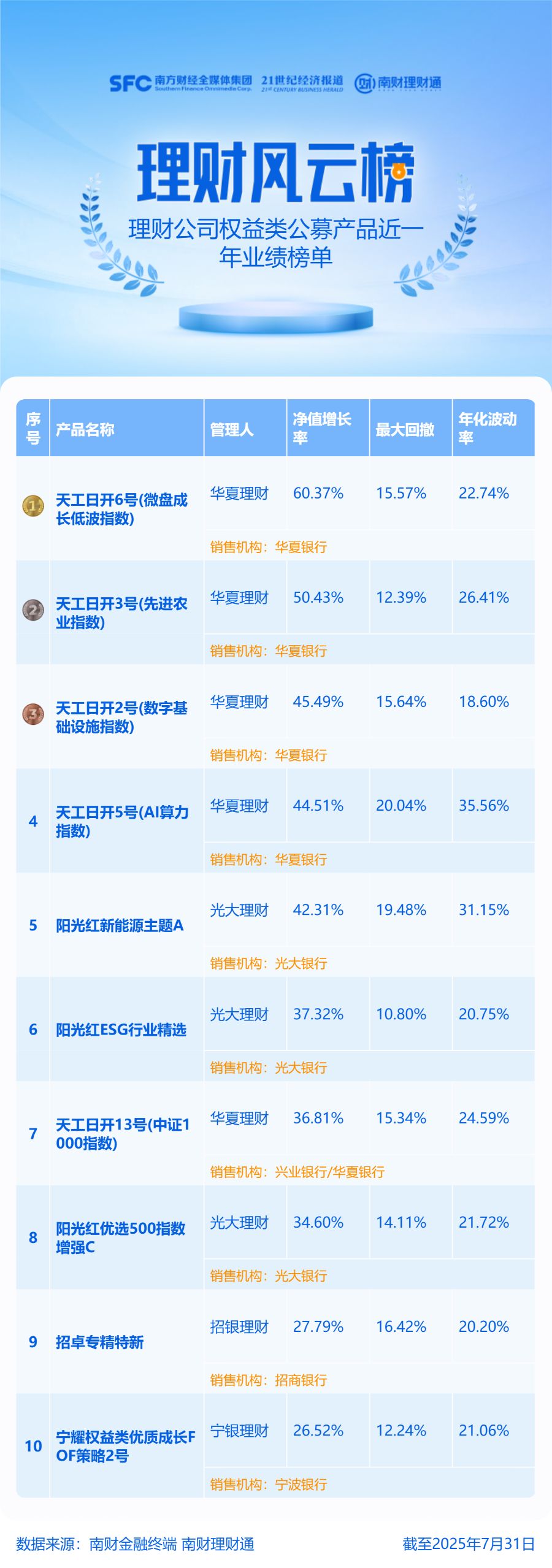
权益类理财产品近一年收益率均值超20%,榜首超60%!
2 1 Shi Ji Jing Ji Bao Dao· 2025-08-07 11:20
Core Insights - The report highlights the performance of equity public wealth management products, with a focus on net value growth rates and maximum drawdowns over the past year [5]. Group 1: Performance Metrics - The average net value growth rate for equity public wealth management products over the past year is 24.18%, while the average maximum drawdown is 13.01% [5]. - Among the 35 sample products, only two, "阳光红卫生安全主题精选" from 光大理财 and "工银财富系列工银量化理财-恒盛配置" from 工银理财, reported negative net value growth rates [5]. Group 2: Top Performing Products - "天工日开6号(微盛成长低波指数)" from 华夏理财 leads the ranking with a net value growth rate of 60.37% [3]. - Other notable products include "天工日开3号(先进农业指数)" and "天工日开2号(数字基础设施指数)" with growth rates of 50.43% and 45.49%, respectively [5]. - 华夏理财's index strategy equity products dominate the top four positions in the ranking [5].

苏银理财恒源目标盈56期8月7日起发行,业绩比较基准2.6%-3.6%
Cai Jing Wang· 2025-08-07 06:13
Group 1 - The company SuYin Wealth Management has announced the issuance of a fixed-income financial product named Hengyuan Target Earnings Phase 56, with a total scale of 1 billion units [1] - The subscription period for the product is from August 7, 2025, to August 13, 2025, with a minimum investment amount of 1 yuan per investor [1] - The product has a duration of 756 days and an internal risk rating of level two, with a performance benchmark of an annualized return between 2.60% and 3.60% [1]
高盛工银理财·盛景封闭式固收美元188期8月7日起发行,A份额业绩比较基准3.25%-3.55%
Cai Jing Wang· 2025-08-07 06:08
8月7日,据高盛工银理财披露,该公司发行的盛景封闭式固定收益类美元理财产品188期募集期为2025 年8月7日-2025年8月13日,募集期内产品计划募集规模1.1亿美元,A类份额首次认购1美元起购,B类份 额首次认购2000美元起购。产品为固定收益类,内部风险评级为PR1低风险,产品期限363天,A类份额 业绩比较基准3.25%-3.55%(年化);B类份额业绩比较基准3.30%-3.60%(年化)。 注:业绩比较基准不是预期收益率,不代表产品的未来表现和实际收益,不构成对产品收益的承诺。 以上理财产品信息仅供参考,具体应以《产品说明书》等销售文件为准。本文不构成任何投资建议,投 资者据此操作,风险自担。 ...
汇华理财趋势指南封闭式固定收益类25181期8月7日起发行,业绩比较基准2.8%-3.2%
Cai Jing Wang· 2025-08-07 06:08
8月7日,据汇华理财披露,该公司发行的趋势指南封闭式固定收益类理财产品25181期认购期2025年8月 7日至2025年8月13日,募集规模上限人民币50亿元,认购起点金额人民币1元。产品类型为固定收益 类,风险评级为PR2,存续期限378天,业绩比较基准为2.80%-3.20%(年化)。 注:业绩比较基准不是预期收益率,不代表产品的未来表现和实际收益,不构成对产品收益的承诺。 以上理财产品信息仅供参考,具体应以《产品说明书》等销售文件为准。本文不构成任何投资建议,投 资者据此操作,风险自担。 ...
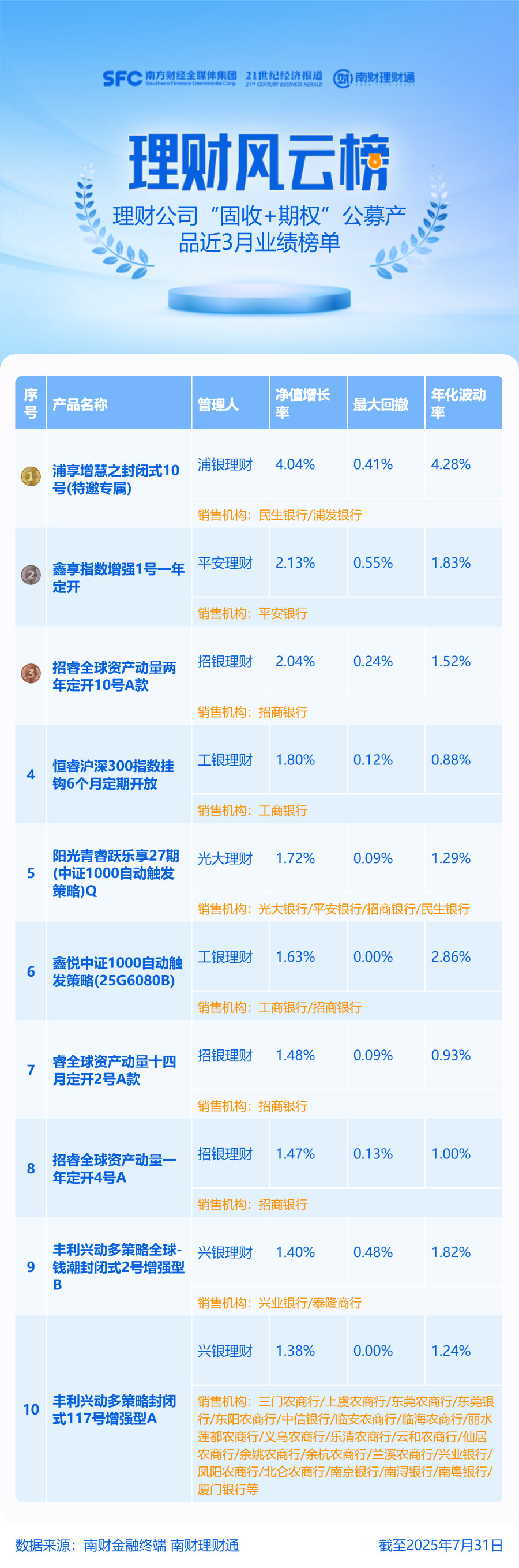
挂钩股市的“固收+期权”产品表现亮眼,榜首近3个月飙涨4%
2 1 Shi Ji Jing Ji Bao Dao· 2025-08-06 09:01
Overall Performance - The average net value growth rate of public "fixed income + options" wealth management products over the past three months is 0.9%, with only one product showing a negative net value growth [6] - In the ranking of the top products, Zhaoyin Wealth Management has three products listed, while Xingyin Wealth Management and ICBC Wealth Management have two each, and Ping An Wealth Management, Puyin Wealth Management, and Everbright Wealth Management each have one product listed [6] Highlighted Product Analysis - Puyin Wealth Management's "Puxiang Zenghui Closed-end No. 10 (Exclusive)" ranks first with a net value growth rate of 4.04% over the past three months, and its full-year yield for 2024 is 3.04% [7] - The product exhibits high volatility, with an annualized volatility of 4.28% over the past three months, but has shown a rapid increase in net value since April 10, exceeding the expected net value upper limit based on the performance benchmark of 4.60% [7] - The product is linked to the CSI 1000 Index, featuring a "shark fin" structure, which triggers an early termination if the closing price of the index on any observation day is greater than or equal to 108% of the initial price [9]
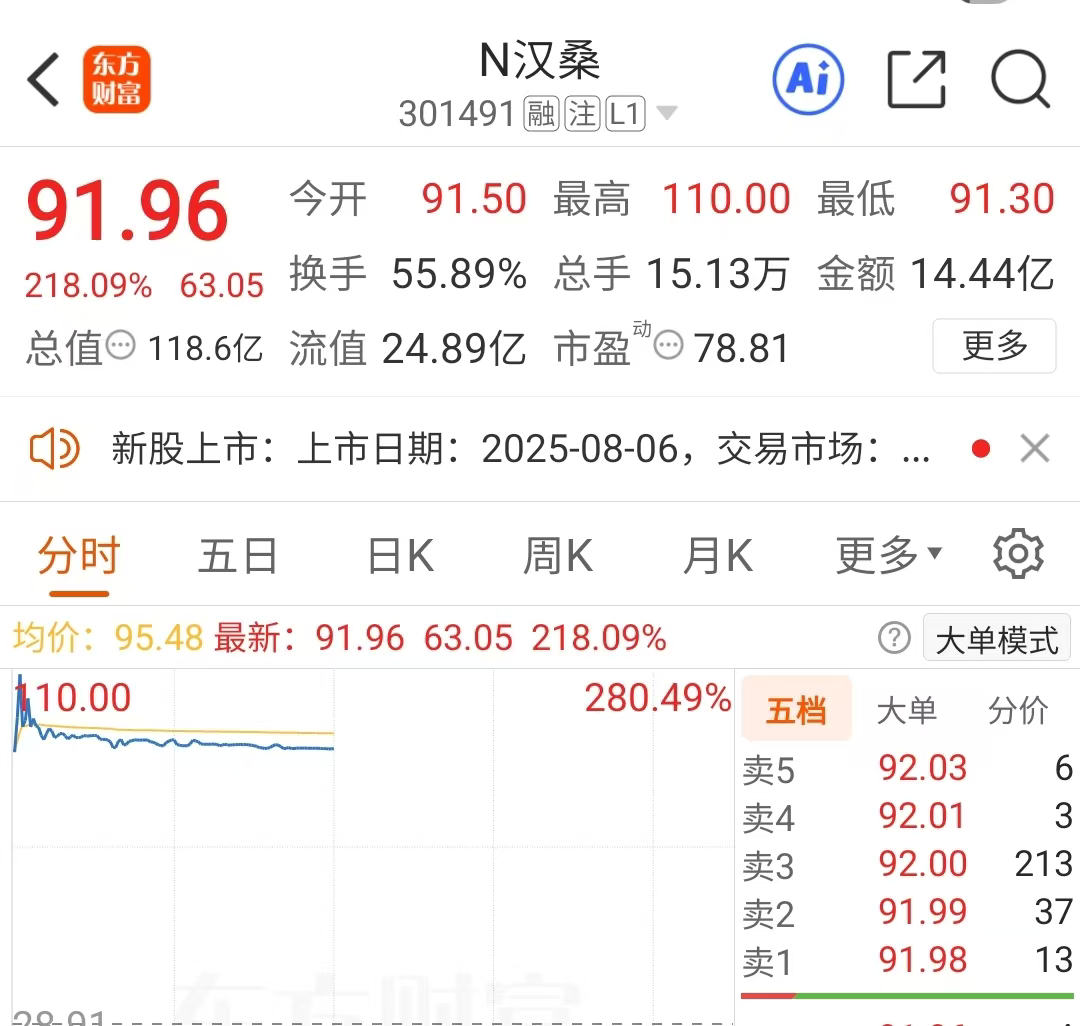
汉桑科技上市首日涨幅超200%,这家理财公司参与打新
Huan Qiu Wang· 2025-08-06 05:13
Core Viewpoint - The article highlights the increasing involvement of wealth management companies in IPO subscriptions, particularly focusing on the participation of Ningyin Wealth Management in the subscription of new shares for Hansa Technology and other companies, following recent regulatory changes that favor wealth management products as priority allocation investors in IPOs [2] Group 1: Participation in IPOs - Ningyin Wealth Management has included two of its products in the subscription list for Hansa Technology, with a subscription price of 29.3 yuan and a total application of 9 million shares [2] - In addition to Hansa Technology, Ningyin Wealth Management has also participated in the IPO subscription for Tianfu Long, with three products applying for 10 million shares, 12.6 million shares, and 12.6 million shares at a price of 25.14 yuan [2] - Furthermore, two products from Ningyin Wealth Management have been submitted for the IPO subscription of Guangdong Jianke, with an application for 30 million shares at a price of 7.36 yuan [2] Group 2: Regulatory Changes - On March 28, the China Securities Regulatory Commission, along with other financial authorities, revised several regulatory documents, including the "Securities Issuance and Underwriting Management Measures" and the "Implementation Rules for Initial Public Offerings" [2] - The revisions explicitly include bank wealth management products and insurance asset management products as priority allocation objects for IPOs, categorizing wealth management companies as Class A investors and granting them the same policy treatment as public funds [2] - Currently, there are nine registered wealth management companies on the offline investor list of the China Securities Association [2]
普邦股份: 关于使用自有资金购买理财产品的进展公告
Zheng Quan Zhi Xing· 2025-08-05 16:20
Core Viewpoint - Guangzhou Pubang Garden Co., Ltd. plans to use up to RMB 800 million of its own funds to invest in financial products, with a rolling usage period of 12 months from the board's approval date [1][4]. Group 1: Financial Product Investment - The company has approved the purchase of various financial products, including a single asset management plan from CITIC Securities with an investment of RMB 40 million, which has an annualized return of 2.5% [1]. - Other investments include RMB 30 million in a closed fixed-income financial product from Huizhong Wealth with an annualized return of 2.25%, and RMB 30 million in a dual-debt strategy from Bank of China with an annualized return of 2.4% to 3.4% [1]. - The company also plans to invest RMB 20 million in a private asset management plan from Haitong Securities, which has a minimum holding period of 180 days [1]. Group 2: Current Financial Product Status - As of the announcement date, the company and its subsidiaries have a total of RMB 555.938 million in outstanding financial products [4]. - The investment in financial products is within the authorized limits set by the board and will not affect the company's daily operational cash flow or main business activities [3][4]. Group 3: Risk Management - The company will conduct prudent evaluations of the financial products and ensure that investments are made in products with good liquidity and high safety, with risk levels not exceeding R3 [3]. - Independent directors will oversee the usage of funds, and the company will disclose the purchase and profit/loss status of financial products in regular reports as per the regulations of the Shenzhen Stock Exchange [3].

扎堆“落袋为安”,美元理财上半年收益率现逐月下滑
Hua Xia Shi Bao· 2025-08-05 11:04
Core Insights - The article discusses the recent trend of early profit-taking in USD wealth management products, highlighting that several institutions have triggered early termination due to achieving target yields [2][3]. Group 1: Early Profit-Taking Trends - Since July, multiple USD wealth management products have experienced early profit-taking, with 招银理财 reporting four products that achieved yields of 4.28%, 4.46%, 5.03%, and 4.58% [3]. - The recent product that triggered early termination was the "US Treasury QDII (USD) Target Profit Closed No. 9," which was originally set for a 739-day duration but ended after only 194 days due to reaching the target yield [3]. Group 2: Market Conditions and Product Design - The early profit-taking phenomenon is attributed to the combination of product design and changing market conditions, with many recent products being "target profit" types that include clauses to lock in gains for investors [3]. - The average annualized yield for USD wealth management products has been declining, with a reported average of 3.96% at the end of June, down nearly 70 basis points from the previous year [4]. Group 3: Investor Sentiment and Actual Returns - Despite the declining yields, there remains strong market enthusiasm for new USD wealth management products, with the total scale surpassing 500 billion yuan, an increase of over 200 billion yuan since the end of last year [4]. - Investors are cautioned that actual returns may not be as high as expected due to currency exchange rate fluctuations, which can significantly impact the final returns when converting back to local currency [5]. Group 4: Future Outlook - Analysts predict that the overall trend for USD wealth management products will continue to decline in yield due to expectations of interest rate cuts by the Federal Reserve and the depreciation of the USD index [6].

金融圈重塑行业竞争链
Jing Ji Wang· 2025-08-05 05:48
Core Viewpoint - The financial industry is facing a significant challenge of "involution," characterized by price wars and homogeneous competition, necessitating a shift towards quality and innovation to escape the current predicament [1][2][3]. Group 1: Involution and Competition - Involution in the financial sector is defined as irrational price competition that sacrifices product quality and service to gain market share, leading to a low-level repetitive competition and a lack of high-quality supply [2][3][5]. - Regulatory bodies are increasingly addressing involution through negative lists and self-regulatory agreements to curb unfair competition practices [2][10]. - The competition is marked by severe price wars, with institutions frequently undercutting each other on loan rates and insurance premiums, which compresses profit margins and accumulates industry risks [2][4][6]. Group 2: Structural Issues - Many financial institutions are overly focused on scale and rankings, neglecting risk management and long-term value creation, resulting in a "land grab" mentality [3][6]. - The lack of innovation and differentiation in products has led to a homogenization of offerings, where most banks and insurance companies provide similar products with minimal differentiation [6][7]. - The performance evaluation metrics within institutions often emphasize short-term growth, leading to a focus on quantity over quality, which hinders strategic transformation [6][9]. Group 3: Regulatory and Industry Responses - Experts suggest that regulatory authorities should enhance negative lists and establish clear regulatory boundaries to combat malicious price wars and false advertising [9][10]. - Financial institutions are encouraged to focus on technological and business model innovations, aiming for differentiated services in areas like inclusive finance, green finance, and digital finance [9][10]. - The industry is urged to adjust performance evaluation structures to prioritize long-term value creation, risk management, and customer satisfaction over short-term scale expansion [9][10]. Group 4: Future Directions - To break the cycle of involution, financial institutions must create value through differentiated positioning and innovative supply, transitioning from price competition to value competition [8][9]. - There is a call for a multi-dimensional supply system and enhanced service frameworks to address the challenges of homogenization and improve overall industry health [8][9]. - The recent regulatory actions, such as setting a 3% interest rate floor for consumer loans, aim to eliminate previous practices that masked true investment capabilities, promoting genuine competition based on actual performance [11].