电力

Search documents
国家电网发布服务新能源高质量发展十项举措
Jing Ji Guan Cha Wang· 2026-02-28 03:25
Group 1 - The article emphasizes the importance of the State Grid Corporation of China in accelerating the development of a new energy system and achieving national energy goals [1] - The company aims to enhance collaboration and planning with relevant departments and power generation enterprises to ensure the integration of renewable energy into the grid [1] - The company plans to increase its investment in power grid construction, aiming for a 35% improvement in cross-provincial transmission capacity and doubling the flexible interconnection capacity between regions [1][2] Group 2 - The company will ensure that the process for connecting renewable energy projects to the grid is fully transparent and conducted online, with a target of increasing repurchase investment by over 50% by 2026 [2] - The company is committed to expanding the capacity for distributed energy sources, with a goal of accommodating over 60 million kilowatts of new distributed grid connections annually [2] - The company will support the development of new business models and facilitate the establishment of zero-carbon parks, with the first batch of 40 parks expected to be completed on schedule [2] Group 3 - The company is accelerating the construction of pumped storage power stations, with new installations expected to exceed 30 million kilowatts, aiming for a total of over 120 million kilowatts in operation or under construction by 2030 [2][3] - The company plans to enhance the scheduling capabilities of the power system to ensure maximum utilization of renewable energy, targeting a 25% share of renewable energy generation in its operational area by 2026 and over 30% by 2030 [3] - The company aims to expand the consumption of green electricity and promote renewable energy trading, with a focus on meeting the electricity demand primarily through renewable sources by 2030 [3] Group 4 - The company will leverage technological innovation to support energy transition, collaborating with power generation and equipment enterprises to develop key technologies for renewable energy integration and enhance the digitalization of the power grid [3]

现货环境下的电力中长期交易
广东电力交易中心· 2026-02-28 03:20
Investment Rating - The report does not explicitly state an investment rating for the electricity mid-to-long term market. Core Insights - The electricity mid-to-long term market is designed to provide adequate market liquidity while mitigating risks associated with price fluctuations in the spot market. It aims to align with the actual production needs of the electricity industry and facilitate the stable operation of enterprises [12][74]. Summary by Sections Overview of the Electricity Mid-to-Long Term Market - The market is categorized by trading cycles: multi-year, annual, monthly, and weekly markets, allowing users to respond to price fluctuations effectively [11]. - The market is also classified by trading objects, including energy markets, capacity markets, ancillary service markets, and financial transmission rights markets [11]. Design Principles of the Electricity Mid-to-Long Term Market - The design reflects the unique attributes of electricity commodities and serves the development of the real economy [12]. - It aims to achieve a good connection with the spot market to avoid risks from price volatility [12]. Basic Requirements of the Electricity Mid-to-Long Term Market - Market participants include various electricity enterprises (generation, grid, and supply companies), consumers, and market managers [13][15]. - The market contract elements include delivery methods (physical and financial), delivery times, trading prices, and trading curves [19][23]. Trading Mechanisms and Products - The market employs various trading mechanisms, including bilateral negotiations, centralized bidding, and listing trading [26][43]. - Centralized bidding allows for a unified price that reflects market supply and demand, while bilateral negotiations offer flexibility [47]. Risk Management in the Market - The report discusses market price risks, credit risks, and market power risks, emphasizing the need for effective risk management strategies [50][52][61]. - Measures include price review for mid-to-long term contracts and establishing a credit management system to minimize default risks [52][54]. Comparison with International Markets - The report compares the domestic market with international counterparts like the US PJM and Nordic markets, highlighting differences in contract types and trading mechanisms [66][68]. - It notes that most international mid-to-long term contracts are physical, while domestic contracts are primarily financial [68]. Trading Frequency and Types - The report outlines various trading types and their frequencies, including annual, monthly, and weekly centralized competitive trading, as well as bilateral negotiations [80][84]. - It emphasizes the importance of diverse trading products to enhance market participation and liquidity [80].
山东临朐:筑牢安全防线 护航复工复产
Zhong Guo Fa Zhan Wang· 2026-02-28 03:17
Core Viewpoint - The article emphasizes the importance of safety production in the electric power and oil and gas long-distance pipeline sectors, highlighting the need for comprehensive training and responsibility among enterprises to ensure stable operations during the post-holiday resumption of work [1][2]. Group 1: Safety Training and Awareness - A meeting was organized by the Development and Reform Bureau of Linqu County, Shandong Province, involving 12 enterprise leaders to promote safety production and training for the resumption of work [1]. - Participants engaged in safety warning education and specialized training, focusing on case analysis, policy interpretation, and key point explanations to enhance safety management and risk prevention capabilities [1]. Group 2: Responsibility and Implementation - Enterprises are required to implement the "Five Musts" for safety training, which includes mandatory education for all employees, immediate organization of training at the start of operations, and conducting risk assessments [1]. - Companies expressed commitment to swiftly implement the meeting's spirit by conducting comprehensive safety training and self-inspections to ensure the stability of operations in the electric power and oil and gas pipeline sectors [2].
电力市场政策规则学习笔记-电力中长期市场基本规则
随处一顾· 2026-02-28 03:15
Investment Rating - The report does not explicitly state an investment rating for the industry. Core Insights - The report emphasizes the need for a unified national electricity market to enhance the efficiency and effectiveness of electricity trading, particularly in the context of new energy integration and the emergence of new market participants [7][15][40]. - It highlights the importance of establishing clear rights and obligations for various market participants, including traditional and new energy entities, to ensure fair competition and compliance with market regulations [40][45]. - The report outlines the necessity of improving the transaction processes and market information timeliness to enhance market transparency and reduce operational costs [40][88]. Summary by Sections Purpose and Background - The rules aim to accelerate the construction of a unified national electricity market, standardize long-term electricity trading behaviors, and adapt to the needs of electricity reform and development [7][15]. Overall Content Overview - The rules cover the entire process of the national long-term electricity market, including registration, trading, and settlement, with a focus on unified standards and open competition [30][40]. Changes in Overall Rules - New chapters have been added to address overall requirements and market technical support systems, while existing chapters have been merged or restructured for clarity and coherence [35][40]. Specific Rule Analysis - The report details the rights and obligations of market participants, including power generation companies, electricity users, and new business entities, ensuring that all parties adhere to the established market rules [45][49]. - It emphasizes the need for a robust risk management framework to address various market risks, including supply-demand imbalances and price fluctuations [30][40]. - The report also discusses the integration of green electricity trading into the long-term market, enhancing the flexibility and traceability of green energy transactions [40][54]. Learning Outlook - The report suggests that ongoing adjustments and improvements will be necessary to adapt to the evolving energy landscape, particularly with the increasing role of renewable energy sources and new market participants [40][88].
绿色债券周度数据跟踪-20260228
Soochow Securities· 2026-02-28 03:03
Group 1: Report Industry Investment Rating - No relevant information provided Group 2: Core Viewpoints of the Report - This week (20260224 - 20260227), the primary market saw 2 new green bonds issued in the inter - bank and exchange markets, with a total issuance scale of about 750 million yuan, a decrease of 3.251 billion yuan from last week. The secondary market had a total green bond turnover of 51.4 billion yuan, a decrease of 5.6 billion yuan from last week. The overall valuation deviation of green bonds' weekly average trading price was not large, with the discount trading amplitude smaller than the premium trading, and the discount trading ratio less than the premium trading [1][2][3] Group 3: Summary by Related Catalogs Primary Market Issuance - This week, 2 new green bonds were issued, with a total scale of about 750 million yuan. The issuance term was 3 years, the issuer was a local state - owned enterprise, the subject rating was AAA, the issuer regions were Jiangsu and Fujian, and the bond types were private placement notes and medium - term notes [1][5] Secondary Market Transaction - The total weekly turnover of green bonds was 5.14 billion yuan, a decrease of 560 million yuan from last week. By bond type, the top three in trading volume were non - financial corporate credit bonds, financial institution bonds, and interest - rate bonds, with 2.47 billion yuan, 1.95 billion yuan, and 640 million yuan respectively. By issuance term, green bonds with a term of less than 3 years had the highest trading volume, accounting for about 85.40%. By issuer industry, the top three industries in trading volume were finance, public utilities, and transportation equipment, with 2.21 billion yuan, 1.26 billion yuan, and 200 million yuan respectively. By issuer region, the top three regions in trading volume were Beijing, Guangdong, and Hubei, with 1.59 billion yuan, 540 million yuan, and 430 million yuan respectively [2] Valuation Deviation of the Top 30 Individual Bonds - **Discount Bonds**: The top three discount - rate bonds were 25 Puyang G1 (- 0.8235%), 25 Puzhi G3 (- 0.6151%), and 25 Heying Weineng ABN001BC Priority A1 (Sci - tech) (- 0.2975%). The subject industries were mainly finance, transportation, and public utilities, the ChinaBond implicit ratings were mainly AA, AA +, and AAA -, and the regional distributions were mainly in Beijing, Chongqing, and Shandong [3][13] - **Premium Bonds**: The top three premium - rate bonds were 25 Shuineng G1 (0.8064%), 26 Jiaozi G1 (0.3285%), and 20 Guangdong Bond 05 (0.2891%). The subject industries were mainly finance, public utilities, and transportation equipment, the ChinaBond implicit ratings were mainly AAA -, AA +, and AA, and the regional distributions were mainly in Guangdong, Fujian, and Beijing [3][14]
未知机构:上证综合指数SHCOMP017-20260228
未知机构· 2026-02-28 02:45
Summary of Key Points from Conference Call Records Industry Overview - The conference call discusses the performance of various stock indices in the Chinese market, including the Shanghai Composite Index (SHCOMP), SSE 50, CSI 300, STAR50, ChiNext, and CSI 500, indicating a mixed performance with the ChiNext index down by 1.46% and CSI 500 up by 0.19% [1][1][1]. Core Insights and Arguments - The overall market showed volatility with the SHCOMP hovering around the flat line before slightly declining near midday [1]. - The semiconductor sector underperformed in the morning session, although specific stocks like Cambrian (688256.SH) and Weir (688521.SZ) managed to gain, with increases of 1.17% and 5.63% respectively [1]. - The optical module (CPO) and PCB sectors experienced a pullback influenced by the weakness in US tech stocks, with companies like Zhongji Xuchuang (300308.SZ) and Shenghong Technology (300476.SZ) declining by 6.4% and 5.41% respectively [2]. - The rare earth sector gained attention due to reports of supply shortages affecting US aerospace and semiconductor suppliers, resulting in an approximate 6% increase in this sector [2]. - The software sector saw significant capital inflow, particularly benefiting cloud computing stocks [2]. - The electric power sector remains in focus, especially following reports of demands from Trump for tech giants to self-power AI data centers [2]. - Conversely, the beverage sector faced setbacks after Bloomberg reported potential higher taxes on high-sugar drinks, leading to a decline of 5.96% for Dongpeng Beverage (605499.SH) [2]. Additional Important Content - The overall selling pressure in the market was noted to be 1.4 times greater than buying pressure, indicating a bearish sentiment [3]. - Investment strategies were outlined, with a focus on buying in the electrical equipment, consumer electronics, and gaming sectors, while selling was recommended in AI data centers, semiconductors, and beverages [3].
上海电力承装修试一级延期公司哪家专业推荐,年底要用的抓紧了
Sou Hu Cai Jing· 2026-02-28 02:43
Core Insights - The upcoming deadline for the renewal of the Class I Electric Power Facility Installation, Repair, and Testing License is causing anxiety among many electric construction companies in Shanghai due to the extensive documentation and stringent requirements involved in the process [1][2]. Group 1: License Renewal Challenges - The Class I qualification represents the highest entry threshold in the electric power industry, requiring companies to meet detailed asset, personnel, and performance criteria [1]. - Companies must submit renewal applications at least 30 days before the license expiration, but waiting until the last moment can lead to complications that may result in license expiration [2]. - The maintenance of electric power qualifications is a long-term and meticulous task, with strict requirements for the number and qualifications of technical personnel [2]. Group 2: Importance of Professional Assistance - Many companies are recognizing the value of professional consulting agencies, which can reduce the processing time for license renewal by approximately 30% due to their expertise in policy interpretation [4]. - The success rate for renewing Class I qualifications is currently over 98%, emphasizing the importance of addressing potential compliance risks before application submission [5]. - Companies with insufficient personnel can still meet deadlines by utilizing professional talent pools, which can provide emergency response plans quickly [5]. Group 3: Common Issues and Requirements - New technical leaders must possess a Class I construction engineer certification and at least 15 years of relevant management experience, with qualifications verified through social security records [7]. - Performance verification for the new regulations requires that projects be traceable through the national construction market regulatory platform, increasing the likelihood of scrutiny for unverified projects [7]. - The variety of required testing equipment must have valid calibration certificates, and any expired or missing documentation can hinder the approval process [7]. Group 4: Strategic Recommendations - Companies should not pursue low-cost agents blindly, as mistakes in the qualification process can lead to significant financial losses and damage to reputation [9]. - It is crucial for companies to conduct self-checks on personnel social security contributions, completeness of performance documentation, and the validity of testing equipment before the renewal application [9]. - Early identification of issues allows for more time to resolve them, positioning companies favorably for the competitive landscape in 2026 [9].


国家能源局:2026年强化对“沙戈荒”方案落实、光伏行业竞争秩序等情况监管
Zhong Guo Dian Li Bao· 2026-02-28 02:43
Core Viewpoint - The article emphasizes the need to reshape the electricity market construction and regulatory framework to support the development of a strong energy nation, aligning with the goals set forth in the 14th Five-Year Plan and the upcoming 15th Five-Year Plan [1][3][9]. Group 1: Regulatory Framework and Goals - The National Energy Administration's Market Supervision Department aims to enhance regulatory effectiveness and adapt to the energy development needs, ensuring alignment with the central government's directives [3][11]. - The department will focus on monitoring energy supply and demand, addressing issues in the renewable energy sector, and ensuring fair competition in the electricity market [11]. Group 2: Achievements and Progress - In 2025, significant progress was made in establishing a unified national electricity market, with market transactions reaching 6.6 trillion kilowatt-hours, more than doubling since the end of the 13th Five-Year Plan, and increasing the market share of electricity transactions by 21.7 percentage points [5]. - The department has implemented strict regulatory measures, resulting in a rise in the number of cases punished from 133 to 751, with fines exceeding 100 million yuan for three consecutive years [6]. Group 3: Future Directions and Innovations - The focus will be on deepening the integration of the electricity market, enhancing cross-regional trading mechanisms, and promoting the use of digital technologies in regulatory practices [10][11]. - The department plans to implement a new round of comprehensive regulation in the electricity sector, addressing deep-seated issues and improving the quality and effectiveness of regulatory actions [11][12].
未知机构:上午盘面结构综述一盘面最强主线国产链有色二连板结构梳理-20260228
未知机构· 2026-02-28 02:40
Summary of Conference Call Notes Industry Overview - The strongest market themes identified are **domestic supply chains** and **non-ferrous metals** [1] Key Market Structures - **Continuous Board Structures**: - **Power Generation and Fuel Cells**: - Longyuan Donggu, Shunhua Power, Beijing Keri, Huayin Power (2 boards) - Yunnan Energy Holdings (7 boards), Gan Energy (2 boards) [1] - **Computing Power**: - Yunnan Energy Holdings (7 boards) [1] - **Non-ferrous Metals**: - Zhangyuan Tungsten (3 boards) [1] Thematic Sector Analysis 1. **Domestic Computing Power**: - Key players include: - TaiJia Co., Huasen Technology, TuoWei Information, Zhongcheng Technology, Shengke Communication, High-tech Development [1] 2. **Cloud Computing**: - Notable companies: - Yunnan Energy Holdings, Capital Online, Hangang Co., Shunwang Technology, Qingyun Technology, Yunsai Zhili, Chengdi Xiangjiang, Litong Electronics, Wangsu Technology [1] 3. **Aerospace**: - Key companies: - Mingzhi Technology, Feiwo Technology, Guanglian Aviation, Hailanxin, Electric Science and Technology Blue Sky [1] - **Space Photovoltaics**: - Key players include: - Aggregated Materials, Junda Co., Shuangliang Energy Saving, Yijing Photovoltaics [1] 4. **Electric Power**: - Key companies: - Yunnan Energy Holdings, Gan Energy, Huayin Power, Jinkai New Energy, Jiawei New Energy, Fuling Power [1] 5. **AI Programming**: - Companies involved in this sector were mentioned but not specified in detail [1] Additional Insights - The conference call highlighted a strong focus on domestic supply chains and the non-ferrous metals sector, indicating potential investment opportunities in these areas [1] - The continuous board structures suggest a robust market interest in power generation and computing technologies, which may present further investment avenues [1]


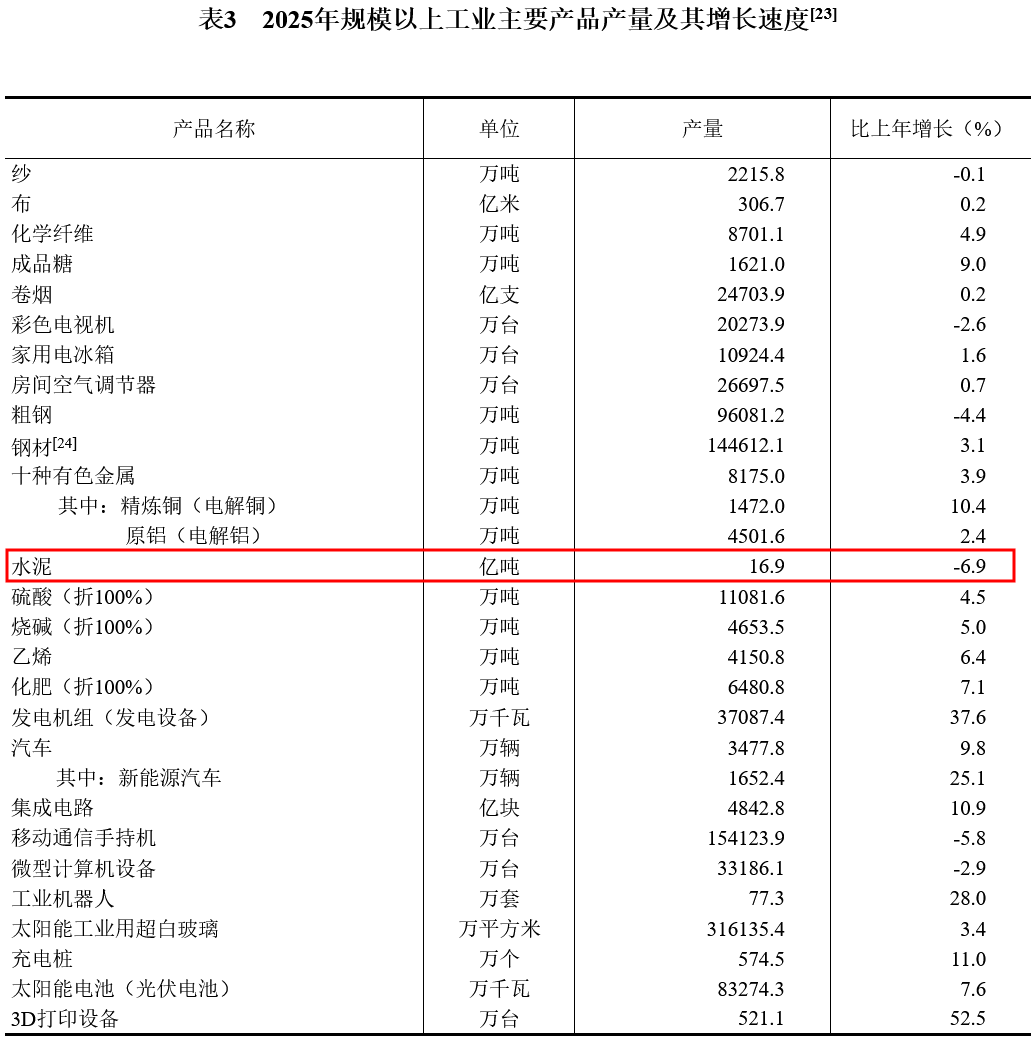
国家统计局:2025年中国水泥产量16.9亿吨
Guo Jia Tong Ji Ju· 2026-02-28 02:08
Group 1 - The National Bureau of Statistics of China released the "Statistical Bulletin on National Economic and Social Development for 2025," highlighting various industrial growth rates [1] - The agricultural and sideline food processing industry saw an increase in value added by 5.6% compared to the previous year [1] - The automotive manufacturing industry experienced significant growth of 11.5%, while the electrical machinery and equipment manufacturing sector grew by 9.2% [1] Group 2 - The cement production in China reached 1.69 billion tons in 2025, marking a decline of 6.9% year-on-year [1][3] - The textile industry reported a growth of 3.0%, while the chemical raw materials and chemical products manufacturing industry grew by 7.8% [1] - The production of new energy vehicles surged by 25.1%, indicating a strong trend towards sustainable transportation [3]