航天科研

Search documents
嫦娥六号月壤四项研究成果发布——首次揭开月球背面演化历史
Qi Lu Wan Bao· 2025-08-04 03:40
Core Insights - The recent findings from China's Chang'e 6 mission have significantly advanced the understanding of the Moon's far side, revealing new insights into its geological history and evolution [1][2] Group 1: Research Findings - Four major research outcomes from the Chang'e 6 lunar samples were published in the journal Nature, highlighting the far side's volcanic activity, ancient magnetic field, water content in the mantle, and mantle evolution characteristics [1] - The far side of the Moon exhibited two distinct periods of basaltic volcanic activity approximately 4.2 billion and 2.8 billion years ago, indicating sustained volcanic activity [2] - The ancient magnetic field data suggests that the Moon's magnetic field strength may have increased around 2.8 billion years ago, challenging the traditional view of a monotonous decline in lunar activity [2] - The water content in the far side's mantle was found to be significantly lower than that of the near side, indicating a "bipolarity" in the Moon's internal water distribution [2] - The basalt on the far side originates from a highly depleted source, which may indicate extreme depletion of the primordial lunar mantle or be a result of large impact events affecting the evolution of the Moon's deep layers [2] Group 2: Implications for Lunar Science - The successful outcomes of the Chang'e program exemplify the deep integration of science and engineering, marking a shift in China's planetary science from a following role to a more competitive and potentially leading position in certain fields [2]
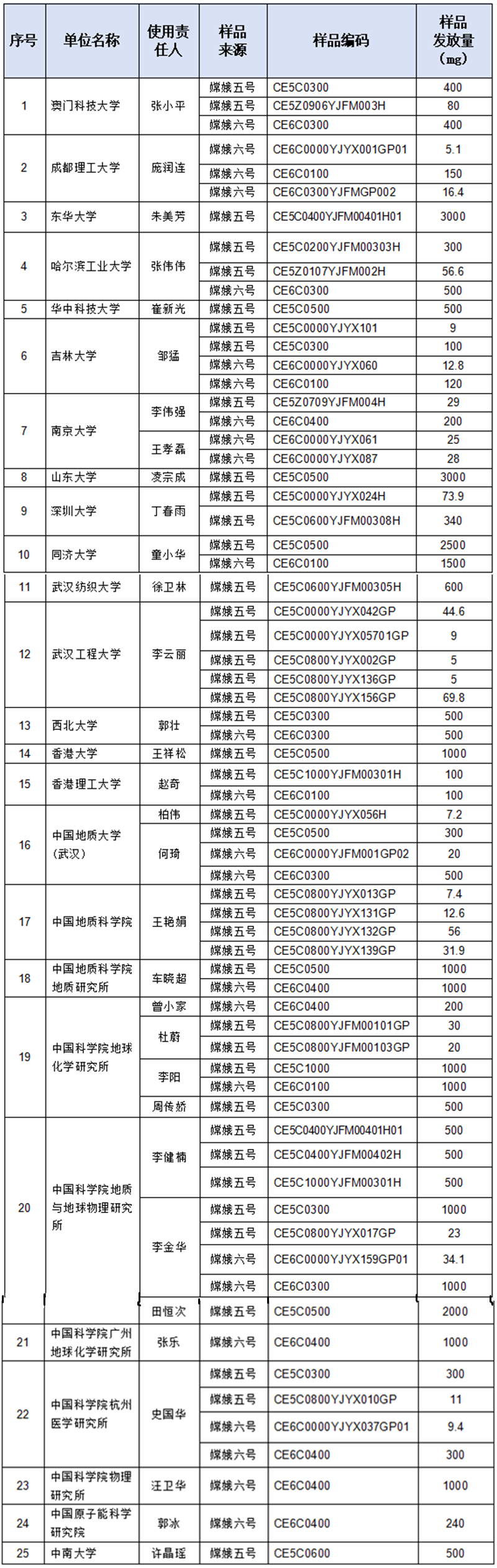
第九批月球科研样品都发放给了谁?名单来了
Xin Lang Cai Jing· 2025-08-02 00:47
Core Points - The Chinese lunar exploration program announced the issuance of the ninth batch of lunar research samples, with a total of 30,881.8 mg distributed to 25 research institutions [1] - The review meeting for the sample borrowing applications was held in July 2025, and the applications were approved by the National Space Administration [1] Group 1: Sample Distribution - A total of 67 applications were approved, corresponding to 32 responsible users [1] - The samples were sourced from various missions, including Chang'e 5 and Chang'e 6, with specific sample codes and quantities listed for each institution [2][3][4] - Notable allocations include 3,000 mg to Donghua University and 2,500 mg to Tongji University, among others [2][3][4] Group 2: Research Institutions - Institutions such as Macau University of Science and Technology, Chengdu University of Technology, and Harbin Institute of Technology received samples for their research [2][3][4] - The distribution includes a variety of sample types, with specific codes indicating their origin and intended research use [2][3][4]

NASA拟裁员数千人
Bei Jing Shang Bao· 2025-07-27 15:24
Group 1 - NASA is expected to see approximately 20% of its workforce, around 3,870 employees, leave the agency, reducing the total number of employees to about 14,000 [1] - A letter titled "Voyager Declaration" from hundreds of current and former employees warns that the layoffs could jeopardize mission safety and execution efficiency [1] - The agency emphasizes that safety remains its top priority while striving for organizational efficiency and maintaining capabilities for key missions, including lunar and Mars exploration [1] Group 2 - The Trump administration has left the NASA leadership position vacant for over six months, with the temporary appointment of Transportation Secretary Sean Duffy following the withdrawal of Jared Isaacman’s nomination [2] - NASA has faced significant challenges due to budget cuts, leading to personnel reductions and an aging workforce, with 40% of scientists and engineers over the age of 55 [2] - The agency experiences a 6% annual employee turnover rate, primarily due to retirements, and faces competition from private space companies for skilled talent [2] Group 3 - The Jet Propulsion Laboratory (JPL) is facing unprecedented budget constraints in 2024, leading to layoffs, hiring freezes, and spending cuts [3] - JPL had to conduct layoffs affecting about 8% of its workforce due to funding losses in the Mars Sample Return project, impacting 532 full-time employees and at least 100 contractors [3] - NASA has canceled the VIPER lunar rover mission, which had already incurred over $400 million in expenses, as part of its budgetary measures [3] Group 4 - NASA's largest expenditure area is deep space exploration, with a budget request of $7.618 billion for fiscal year 2025, focusing on lunar and Mars missions [4] - The Mars Sample Return mission faces risks of being halted due to severe budget overruns and delays, with estimated costs ranging from $8 billion to $11 billion [4] - An independent review group has indicated that the original Mars Sample Return plan is unfeasible and has urged NASA to keep the total cost below $5.3 billion to protect other scientific missions [4]
NASA计划裁掉超2000名高级别员工
news flash· 2025-07-10 07:55
Core Points - NASA plans to lay off at least 2,145 senior employees, offering options for early retirement and buyouts [1] - The layoffs are part of a broader trend of personnel and budget cuts under the Trump administration, which will result in the cancellation of several scientific projects [1] Summary by Category Company Actions - NASA is implementing significant workforce reductions, specifically targeting senior-level staff with a plan to cut over 2,000 positions [1] - The agency is providing options for affected employees, including early retirement and buyout packages [1] Industry Impact - The layoffs and budget cuts at NASA are indicative of a larger trend affecting the aerospace and scientific research sectors, potentially leading to the cancellation of numerous scientific projects [1]
由于预算削减,NASA将失去2000名高级工作人员
news flash· 2025-07-10 00:19
Core Points - NASA is facing a significant loss of talent due to budget cuts proposed by the Trump administration, with over 2,000 senior employees preparing to leave the agency [1] - Among those leaving, approximately 875 hold management or professional positions at the highest levels of government [1] - More than 1,800 employees involved in scientific and human spaceflight missions are among the majority of the 2,694 civil servants who have agreed to leave NASA [1]
美媒:NASA经费被削减,美国正在扼杀寻找外星生命的希望
Huan Qiu Shi Bao· 2025-07-07 22:26
Core Viewpoint - The article discusses the significant funding cuts proposed for NASA, which threaten the agency's ability to explore extraterrestrial life and maintain its technological advancements in space science [1][2][3]. Funding Cuts and Implications - NASA is facing a nearly 25% budget cut in the proposed 2026 budget, which would reduce its funding to levels comparable to 1961, as described by the Planetary Society as a "catastrophic event" [1][3]. - The budget cuts will severely impact NASA's ability to fulfill its current responsibilities, including maintaining the International Space Station and monitoring potential Earth-threatening asteroids [2]. Impact on Scientific Missions - The Science Mission Directorate, responsible for significant projects like the Hubble and James Webb Space Telescopes, faces nearly a 50% budget reduction, jeopardizing future discoveries related to extraterrestrial life [3][4]. - The "Habitable Worlds Observatory," a major project aimed at searching for extraterrestrial life, has seen its budget slashed by 80%, from $17 million in 2024 to just $3 million in 2026 [3][4]. Loss of Core Technology and Expertise - If the budget cuts are enacted, one-third of NASA's high-tech workforce could lose their jobs, resulting in a significant loss of core technological expertise accumulated over decades [5]. - The potential loss of experienced personnel may hinder NASA's ability to launch and operate deep-space missions, affecting the agency's long-term capabilities in space exploration [5].
俄公布国家航天项目计划
Huan Qiu Wang Zi Xun· 2025-06-29 23:31
Group 1 - The core viewpoint of the article is that the Russian Academy of Sciences has announced new national projects in the field of space exploration, with funding to begin this year [1][4][6] - The projects aim to maintain Russia's position as one of the top three space powers globally, focusing on areas such as astronomy, planetary research, and biomedical projects [4][7] - Significant projects include the deployment of the world's first 10-meter cooled telescope for terahertz radiation observation and the launch of various space telescopes for studying cosmic phenomena [4][5][6] Group 2 - The Russian space program includes comprehensive missions to Venus, Mars, and the Moon, with specific goals such as searching for signs of life and analyzing lunar soil [5][6] - The funding for lunar exploration will begin this year, with estimates suggesting over 1 trillion rubles will be allocated in the next three years and approximately 4.5 trillion rubles by 2036 [6][7] - The new national projects are currently in the final approval stage by the government, with expectations for rapid implementation following presidential approval [7][8]

记者手记:从零跃迁向深空进发
Xin Hua She· 2025-06-08 13:45
Core Insights - The Deep Space Exploration Laboratory, established through collaboration between the National Space Administration, Anhui Province, and the University of Science and Technology of China, has been operational for three years, focusing on innovative technologies for space exploration [1][2][3] Group 1: Laboratory Achievements - The laboratory has developed a lunar regolith in-situ 3D printing system, enabling the construction of lunar base components using local materials, which is crucial for the International Lunar Research Station [2] - Significant technological advancements have been made, including the Tian Duo 1 and 2 lunar communication test satellites, which are conducting multiple in-orbit technology trials [1][2] Group 2: Research and Collaboration - The laboratory is home to a team of high-profile scientists, including seven academicians and over fifty core personnel, focusing on key technological challenges and promoting innovation in space exploration [2][3] - It has established partnerships with 64 international research institutions, enhancing global collaboration in deep space exploration [2] Group 3: Operational Framework - The laboratory operates under a new governance model that grants it substantial autonomy, fostering a conducive environment for innovation through a unique funding management and talent incentive system [3] - It aims to contribute to China's goal of becoming a space power, showcasing rapid advancements and innovative capabilities in the field of deep space exploration [3]

中俄就共建月球核电站签署合作备忘录
Guan Cha Zhe Wang· 2025-05-14 04:01
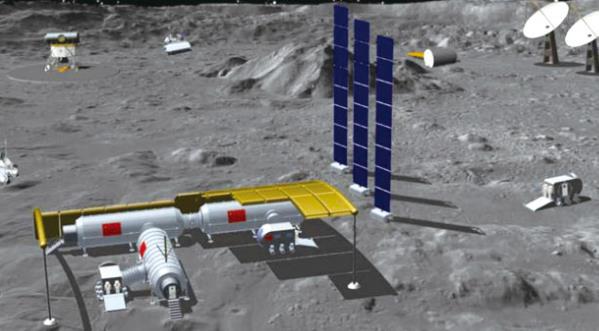
Group 1 - The core point of the news is the signing of a memorandum between Russia's Roscosmos and China's CNSA to build a lunar nuclear power station, which will significantly contribute to the International Lunar Research Station (ILRS) project expected to be completed by 2036 [1][3] - The lunar nuclear power station aims to address the critical issue of power supply for the ILRS, with Russia being recognized for its leading position in space nuclear technology [1][3] - Previous discussions on space reactors between the two countries had minimal progress, but there is hope for successful deployment of a nuclear reactor on the moon [1][3] Group 2 - The ILRS will be developed in three phases, with a basic model expected to be completed by 2028 for lunar environment exploration and resource utilization tests [4] - By 2040, a more advanced model will be established to conduct space environment research and scientific experiments, supporting manned lunar missions and deep space exploration [5] - The collaboration between China and Russia aims to promote sustainable development of international space activities, adhering to the principles of consultation, construction, and sharing [5]
英方拿到了,“简直像在平行宇宙,中国太超前了”
Guan Cha Zhe Wang· 2025-05-09 06:44
Core Insights - The China National Space Administration announced the results of international applications for lunar sample borrowing from the Chang'e 5 mission, with 7 institutions from 6 countries approved to borrow samples [1] - The samples were received by Professor Mahesh Anand from the UK, who emphasized their immense value, stating they are "more precious than gold" [1][3] - The samples are currently stored in a high-security safe at the Open University in Milton Keynes, UK, and were personally transported by Anand to ensure their safety [1][3] Group 1 - The research team has implemented strict contamination prevention measures in the laboratory, requiring all personnel to undergo rigorous decontamination processes before entering the core testing area [3] - The lunar soil samples consist of three containers, each containing a small vial of lunar regolith, with a total sample weight not exceeding 60 milligrams [3][4] - Anand's team aims to conduct micro-level research to uncover significant scientific insights, believing that the small samples hold immense scientific value [3][6] Group 2 - The research will utilize a custom-built machine capable of heating lunar soil to 1400°C to extract carbon, nitrogen, and inert gas components, which is a key reason for the selection of Anand's laboratory [4][6] - The team has one year to complete their research, focusing on questions regarding the formation of the Moon and the early history of Earth [6] - The Chang'e 5 mission marked China as the third country to collect samples from the Moon, following the US and the former Soviet Union, and the Chang'e 6 mission made China the first to return samples from the far side of the Moon [6][7] Group 3 - The China National Space Administration emphasizes principles of equality, mutual benefit, peaceful use, and win-win cooperation in sharing lunar research samples with the international community [6][7] - Anand expressed hope that this collaboration will lead to long-term partnerships between China and the international scientific community, continuing the tradition of international cooperation established by the Apollo missions [7]