Smartphones

Search documents
小米第三!2025Q1全球前六大手机品牌产量排名出炉
WitsView睿智显示· 2025-06-12 09:05
Core Viewpoint - TrendForce's latest survey indicates that global smartphone production is expected to reach 289 million units in Q1 2025, a decrease of approximately 3% compared to the same period in 2024, although production performance across brands remains relatively stable [1]. Summary by Sections Overall Market Performance - In China, Q1 sales benefited from policy incentives, leading to a slight growth in sales. However, due to uncertainties in the international landscape, market demand is expected to be suppressed, with production performance across brands projected to remain flat compared to Q1 [2]. Major Brand Performances - **Samsung**: In Q1, Samsung's smartphone production approached 64 million units, a quarter-on-quarter increase of about 21%, reclaiming the top position globally [5]. - **Apple**: Apple's production decreased by 40% in Q1, falling to 48 million units, ranking second. The decline is attributed to its products not being included in China's subsidy program and intense competition in the market [7]. - **Xiaomi**: Xiaomi produced nearly 42 million units in Q1, maintaining its third position. The brand's comprehensive product range and the boost from subsidy policies contributed to its strong performance [8]. - **OPPO**: OPPO's production was approximately 27 million units in Q1, a decrease of 26% quarter-on-quarter and a 19% decline year-on-year, primarily due to inventory adjustments [9]. - **Vivo**: Vivo's production totaled 24 million units in Q1, ranking fifth. The brand's sales are mainly driven by the Chinese market, benefiting from subsidy policies [10]. - **Transsion**: Transsion's production was close to 22 million units in Q1, a decrease of 20%. The brand primarily focuses on emerging markets outside of China and has not benefited from consumer subsidy incentives [11].



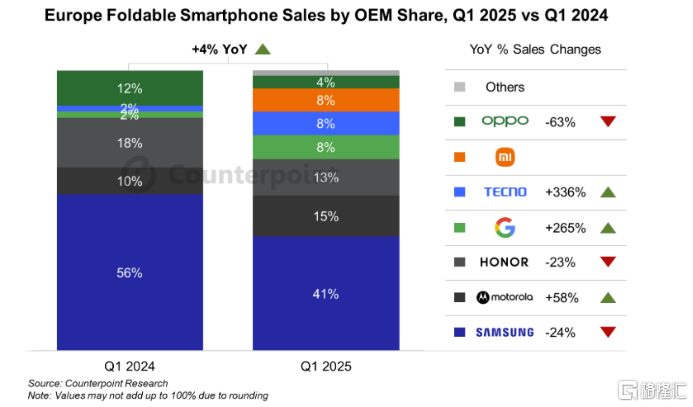
联想摩托罗拉超越HONOR成欧洲第二大折叠屏手机品牌
Ge Long Hui· 2025-06-12 07:38
此前,在CounterPoint发布的另一份报告显示,2024 年摩托罗拉智能手机出货量同比增长 23%,创下历 史新高,成功跻身全球第七大智能手机品牌。 报告称,尽管 2024 年全球智能手机市场出货量仍低于 2020 年水平,但摩托罗拉表现亮眼,出货量比 2020 年高出 75% ,年均复合增长率(CAGR)达 15%。 从区域市场来看,摩托罗拉在多个地区取得显著进展。拉丁美洲(LATAM)占据其全球出货量近一半, 巴西和墨西哥成为主要驱动力。在巴西,2024 年摩托罗拉智能手机市场份额同比增长至 31.0%,2020 - 2024 年复合年增长率(CAGR)为 7% ;墨西哥 2024 年市场份额虽有小幅下滑至 16.7%,但 CAGR 也有 2%。北美市场展现出强劲的复苏态势,美国市场 2024 年市场份额同比增长至 11.2% ,CAGR 达 20%。 而印度成为突破性市场,出货量同比增长高达 82%,2024 年占摩托罗拉全球出货量的 13%,市场份额 同比增长至 5.0% ,CAGR 更是高达 62%。此外,在哥伦比亚、智利、秘鲁、沙特阿拉伯、阿联酋等市 场,摩托罗拉的市场份额也有不同程度的增长 ...
重回“堆料”,是华为Pura80系列最让人兴奋之处
3 6 Ke· 2025-06-12 01:27
Core Viewpoint - Huawei's Pura80 series marks a significant return to hardware emphasis in smartphone imaging, showcasing advanced sensor configurations and a commitment to high-quality photography [9][22][28] Group 1: Product Development and Features - The Pura80 series includes four models, with the Pro, Pro+, and Ultra versions featuring a combination of 40MP ultra-wide, 50MP 1-inch wide, and 48MP/50MP periscope telephoto sensors [9][11] - The Pura80 Ultra introduces a unique "dual-lens" periscope telephoto system, utilizing a 1/1.28-inch sensor to support both medium and ultra-long focal lengths, setting a new standard in the industry [16] - The series aims to evoke nostalgia for previous successful models like the P30 and P40, indicating a strategic shift back to hardware-centric design [17] Group 2: Market Position and Strategy - The pricing of the Pura80 Ultra is competitive with other top-tier models, reflecting Huawei's improved supply chain capabilities compared to previous years [19][20] - The emphasis on hardware in the Pura80 series signals a positive shift in product design philosophy, appealing to younger consumers who prioritize specifications [22] - Huawei continues to integrate computational photography features alongside hardware improvements, indicating a balanced approach to smartphone imaging technology [23] Group 3: Technological Innovations - The introduction of a customizable "color card" feature allows users to create and share personalized photo filters, enhancing user engagement [25] - The Pura80 series suggests potential improvements in Huawei's self-developed SoC, as it competes with flagship products from other manufacturers [28]
机构:预计2025年全球智能手机制造产量将同比下降1%
news flash· 2025-06-12 01:24
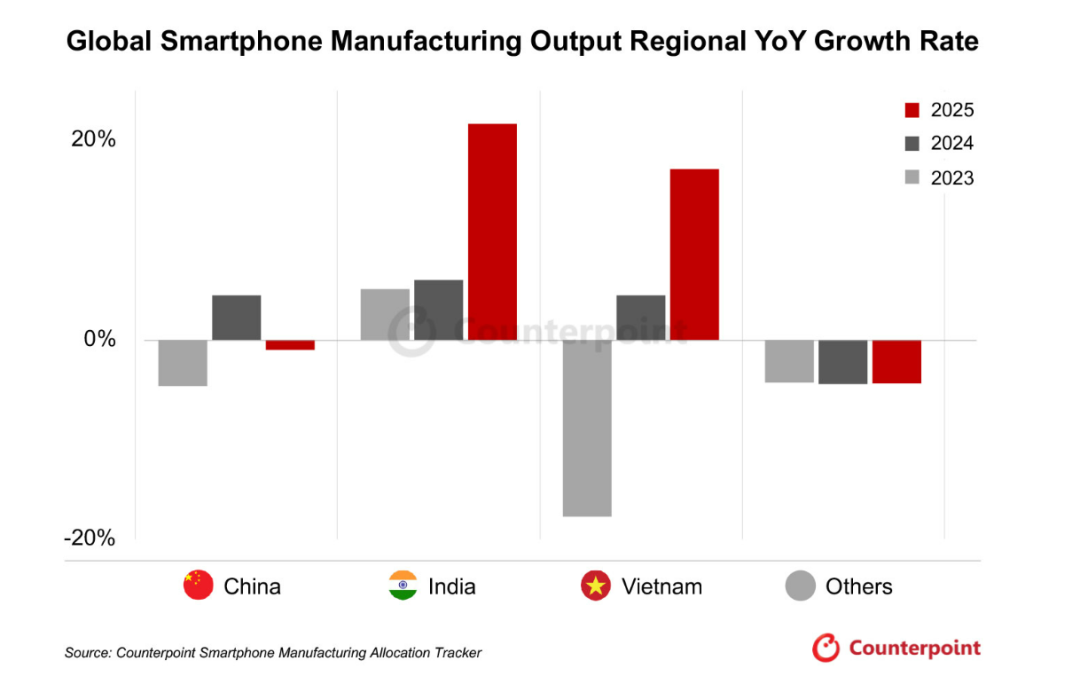
6月12日,根据Counterpoint Research最新报告,受关税影响及行业整体发展放缓的冲击,2025年全球智 能手机制造产量预计将同比下降1%,2024年产量则同比增长4%。报告指出,各国制造产量在2025年预 计呈现分化态势。印度预计成为最大受益者,2025年制造产量预计实现两位数百分比增长,达到全球总 产量的20%,创下新高。 ...
Counterpoint Research:2025年全球智能手机制造产量预计会减少1%
智通财经网· 2025-06-12 01:13
全球智能手机制造总产量各地区同比占比 智通财经APP获悉,根据Counterpoint Research最新的《全球智能手机制造分布追踪报告》,受关税影响及行业整体发展放缓的冲击,2025年全球智能手 机制造产量预计将同比下降1%,相较于2024年产量4%的同比增长,不难看出市场情况不容乐观。2024年,中国、印度和越南共持有全球智能手机总产量 的90%以上,其中印度增速最快。但是各国制造产量在2025年预计呈现分化态势。 印度预计成为最大受益者,2025年制造产量预计实现两位数百分比增长,达到全球总产量的20%,创下新高。这主要得益于Apple和Samsung持续的生产和 出口需求。与此同时,越南作为全球制造与出口枢纽,在Samsung和Motorola增加生产的情况下,产量预计也能实现稳健增长。 Counterpoint Research资深分析师Prachir Singh指出:"随着全球传统电子制造服务(EMS)巨头持续投资印度,加之本土EMS企业积极参与,印度本土制 造能力经过近十年的发展已经显著提升,完全能够满足要求更高的生产需求。同时,印度整体制造业生态体系持续扩张,本土制造在良率与工艺复杂度方 ...
Pura 80系列发布,双旗舰策略显效,华为高端手机市场份额攀升
Guang Zhou Ri Bao· 2025-06-11 15:46
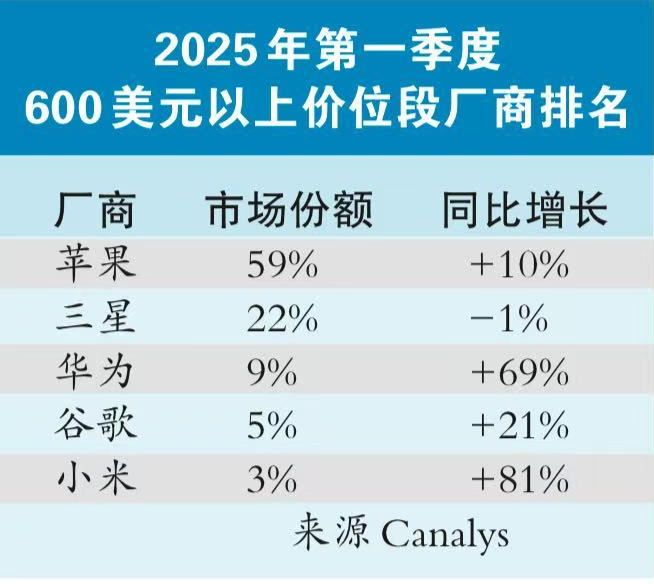
Group 1 - Huawei officially launched the Pura 80 series on June 11, which is one of its "dual-flagship" models, solidifying its position in the high-end market in China [1] - The Pura 80 series features the HarmonyOS 5.1 operating system, which is expected to accelerate the maturity of the Harmony ecosystem as it becomes more prevalent in flagship devices [1] - The Pura 80 series has received nearly 280,000 reservations since its pre-order began on June 5, indicating strong consumer interest [1] Group 2 - According to Canalys, the global smartphone market grew by 0.2% year-on-year in Q1 2025, while the high-end smartphone segment (priced above $600) saw a 12% increase in shipment volume [2] - Huawei's market share in the high-end segment increased by 69% year-on-year, reaching 9% of the global market, positioning it as the third-largest player [2][3] - Analyst Li Huaibin from Nanfus predicts that the sales of the Pura 80 series could reach around 10 million units [2] Group 3 - Huawei has invested over 1.2 trillion yuan in R&D over the past decade, with R&D expenses projected to reach 179.7 billion yuan in 2024, accounting for 20.8% of its total revenue [1] - The company holds a total of 150,000 valid global patents [1] - HarmonyOS is experiencing rapid growth, with over 400 application updates daily, and the HarmonyOS 5.1 upgrade is set to begin in July [2]
搭载“史上最昂贵相机模组”!华为新品又为手机影像加了什么“猛料”?
Mei Ri Jing Ji Xin Wen· 2025-06-11 10:40
Core Insights - The technology sector is experiencing significant activity in June, highlighted by the simultaneous product launches from Apple and Huawei, with Apple's WWDC focusing on software upgrades and Huawei's Pura 80 series emphasizing hardware advancements [1] Company Developments - Huawei's Pura series, launched in 2024, continues the legacy of the P series, particularly in mobile imaging technology, which has been a focal point since the P8 to P10 models [1] - The Pura 80 series features advanced camera capabilities, including a dual-focus long-zoom structure that combines a 3.7x medium-long focus lens with a 9.4x super-long focus lens, enhancing image quality [1][2] - Huawei's innovative "one base dual long-focus" camera structure, which allows for optical path switching between long and super-long focus, was first introduced in the Pura 80 series [2] Industry Trends - The imaging technology sector is a critical battleground for smartphone manufacturers aiming to differentiate themselves in the mid-to-high-end market, with significant R&D investments reaching ten-digit figures annually [2][3] - Apple maintains a dominant position in the global high-end smartphone market, holding a 59% share in the $600+ price segment, while Huawei ranks third with a 9% share [4] - In the Chinese high-end market, Apple leads with a 43% share, followed closely by Huawei at 38%, indicating a competitive landscape as Huawei seeks to regain market presence [4]
高盛:ASIC 人工智能服务器及组件强劲增长;2025 年第三季度机型转换
Goldman Sachs· 2025-06-11 02:16
Investment Rating - The report assigns a "Buy" rating to several companies within the Taiwan Technology sector, including Wiwynn, Wistron, Hon Hai, Gigabyte, and various AI server components [25]. Core Insights - The Taiwan Technology sector is experiencing strong growth in ASIC AI servers and related components, with notable revenue increases reported by key players such as Wiwynn (+187% YoY) and Gigabyte (+108% YoY) [1][8]. - The report highlights a transition in server models expected in 3Q25, with a cautious outlook on rack-level AI server shipments due to macro uncertainties [9]. - The demand for components like liquid cooling, silicon photonics, rail kits, and chassis is anticipated to rise, driven by specification upgrades and the increasing adoption of AI technologies [9][10]. Summary by Sections ASIC AI Servers and Components - ASIC AI servers are showing robust growth, with Wiwynn's revenues up 187% YoY, significantly exceeding estimates [1][8]. - Baseboard-based AI servers also demonstrate strong performance, with Gigabyte achieving 108% YoY revenue growth [1][8]. - Liquid cooling solutions are gaining traction, with AVC reporting 87% YoY revenue growth [1][8]. Market Outlook - The report expresses caution regarding rack-level AI server shipments in the second half of 2025, while maintaining a positive outlook for ASIC and baseboard-based AI servers [9]. - The global market for AI servers is projected to reach 19,000 racks by 2025, indicating a significant growth opportunity [9]. Non-AI Sector Insights - The smartphone supply chain is expected to strengthen in 3Q25, with new high-end models being prepared for launch [10]. - AI PCs are anticipated to see continued penetration, with brands like ASUS and Lenovo leading the charge [10]. Investment Opportunities - Recommended investments include AI server ODMs and brands such as Wiwynn, Wistron, Hon Hai, and Gigabyte, as well as components like AVC, Fositek, and LandMark [11].
Warren Buffett Has 23% of Berkshire Hathaway's Portfolio Invested in 2 AI Stocks Up 600% and 900% in the Last Decade
The Motley Fool· 2025-06-10 09:12
Group 1: Berkshire Hathaway's Portfolio Allocation - Warren Buffett has nearly 23% of Berkshire Hathaway's portfolio invested in two AI stocks: 21.8% in Apple and 0.8% in Amazon [1] Group 2: Apple Investment Thesis - Apple is the global leader in smartphone sales, benefiting from a strong brand moat and significant pricing power [3] - The company aims to monetize its installed base of over 2.35 billion devices through services like iCloud, Apple Care, and subscription products [4] - Apple introduced Apple Intelligence, a suite of AI features, which may eventually be monetized through subscriptions [5] - iPhone sales have been flat over the last six months, partly due to the lack of significant upgrades to Siri [6] - Internal data suggests Apple is behind competitors in developing a ChatGPT competitor, with delays in Siri upgrades [7] - Apple plans to open its AI models to third-party developers, potentially increasing AI-powered applications in the App Store [8] - Wall Street has revised earnings growth estimates for Apple to 6% annually through fiscal 2026, making its current valuation appear expensive [9] Group 3: Amazon Investment Thesis - Amazon holds a strong position in three industries: e-commerce, retail advertising, and cloud computing, with significant market shares [10] - The company is leveraging AI to enhance efficiency and margins in its retail business, with plans to develop around 1,000 generative AI applications [11] - In cloud computing, Amazon has created custom semiconductors for AI and introduced a generative AI development platform called Bedrock [12] - CEO Andy Jassy views AI as a major technological shift, with the AI business having a multibillion-dollar annual revenue run rate [13] - Wall Street estimates Amazon's earnings will grow at 10% annually through 2026, with a current valuation of 35 times earnings, which may be underestimated [14]


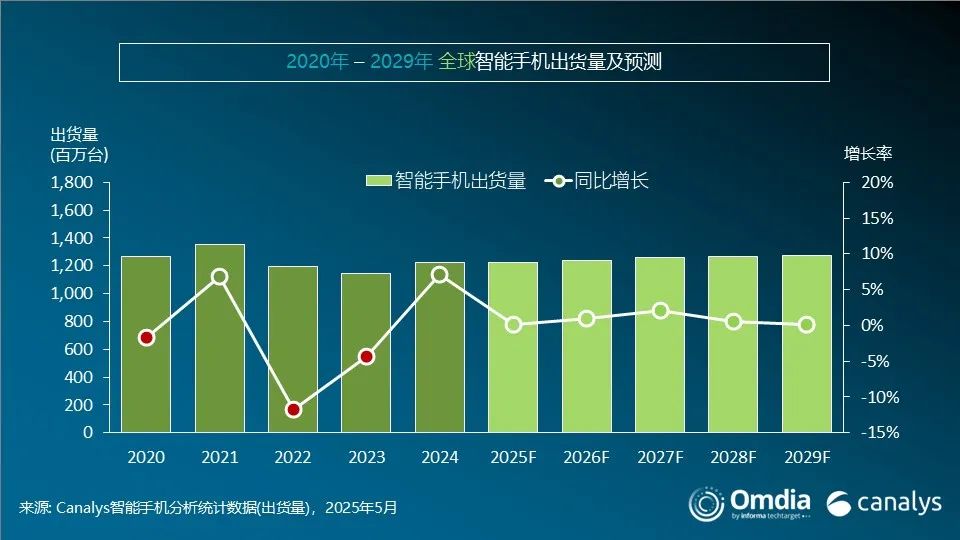
Canalys:2025年全球智能手机出货量预计为12.2亿台 同比上升0.1%
智通财经网· 2025-06-09 06:42
Global Smartphone Market Overview - The global smartphone market is expected to see a year-on-year growth of 0.2% in Q1 2025, indicating a recovery phase [1] - The total global smartphone shipments are projected to reach 1.22 billion units in 2025, reflecting a slight increase of 0.1% compared to the previous year [1] - The market is anticipated to grow at a modest compound annual growth rate (CAGR) of 1% from 2025 to 2029, facing challenges from low-end replacement demand and geopolitical uncertainties [1] High-End Smartphone Market Insights - The high-end smartphone segment (priced above $600) experienced a year-on-year shipment increase of 12% in Q1 2025, driven by manufacturers' commitment to premium offerings and advancements in AI technology [4] - Apple leads the high-end market with a 59% share, showing a 10% growth year-on-year [5] - Huawei's high-end segment grew by 69%, capturing a 9% market share, while Google and Xiaomi also reported significant growths of 21% and 81% respectively [4][5] Regional Market Performance - In the Asia-Pacific region (excluding Greater China), Apple holds a 61% market share in the high-end segment, with a 12% year-on-year growth [7] - In North America and Latin America, Apple dominates with a 71% market share, reflecting an 18% increase [7] - In Europe, the Middle East, and Africa, Apple maintains a 55% share with a 15% growth, while Samsung follows with a 37% share and a 13% increase [9] AI Smartphone Projections - The penetration rate of AI smartphones is expected to reach 34% by 2025, supported by advancements in chip capabilities and model efficiency [9] - Apple leads the global AI smartphone market with a shipment of 43.6 million units, accounting for 58% of the market [12] - In mainland China, Apple also leads with a 40% market share in AI smartphones, followed by Xiaomi with 26% [16] Foldable Smartphone Forecast - The foldable smartphone market is projected to achieve only a 0.1% year-on-year growth in 2025, with major manufacturers attempting to stimulate demand through price reductions and SKU expansions [24] - 2026 is anticipated to be a pivotal year for the foldable market, potentially revitalized by Apple's rumored foldable product [24] 5G Smartphone Outlook - The penetration of 5G smartphones is expected to continue growing, with projections indicating that by 2029, 88% of smartphone shipments will be 5G-enabled [26]