
采矿业

Search documents
国家统计局:前三季度中国GDP同比增长5.2% 高质量发展取得积极成效
Guo Jia Tong Ji Ju· 2025-10-20 02:10
Core Viewpoint - China's GDP for the first three quarters of 2025 reached 10,150.36 billion yuan, with a year-on-year growth of 5.2% at constant prices [2] Economic Performance - The economy demonstrated resilience and vitality, with stable production and supply, overall employment and price stability, and steady growth of new drivers [2] - GDP growth rates by quarter: Q1 at 5.4%, Q2 at 5.2%, and Q3 at 4.8% [2] Agricultural Sector - Agricultural value added grew by 3.6%, with summer grain and early rice production totaling 178.25 million tons, a slight increase of 0.1% [3] - Livestock production increased by 3.8%, with pork, beef, and poultry production rising by 3.0%, 3.3%, and 7.2% respectively [3] Industrial Sector - Industrial value added for large enterprises grew by 6.2%, with manufacturing up by 6.8% and high-tech manufacturing by 9.6% [4] - Notable growth in 3D printing equipment (40.5%), industrial robots (29.8%), and new energy vehicles (29.7%) [4] Service Sector - Service sector value added increased by 5.4%, with significant growth in information technology services (11.2%) and leasing services (9.2%) [5] - The service industry production index rose by 5.6% in September [5][6] Retail and Consumption - Total retail sales of consumer goods reached 3,658.77 billion yuan, growing by 4.5% [7] - Online retail sales amounted to 1,128.30 billion yuan, a 9.8% increase, with physical goods online sales at 915.28 billion yuan, growing by 6.5% [7] Investment Trends - Fixed asset investment (excluding rural households) was 3,715.35 billion yuan, down by 0.5%, while manufacturing investment grew by 4.0% [8] - High-tech industries saw significant investment growth, particularly in information services (33.1%) and aerospace manufacturing (20.6%) [8] Trade Performance - Total goods import and export reached 3,360.78 billion yuan, with exports growing by 7.1% [9] - Private enterprises accounted for 57.0% of total trade, reflecting a 2.0 percentage point increase from the previous year [9] Price Trends - The national CPI decreased by 0.1%, with food prices down by 0.8% [10][11] - Core CPI, excluding food and energy, rose by 0.6%, indicating a slight increase in inflationary pressures [11] Employment and Income - The urban unemployment rate averaged 5.2%, with a slight decrease in September [12] - Per capita disposable income reached 32,509 yuan, with rural income growth outpacing urban income [13]
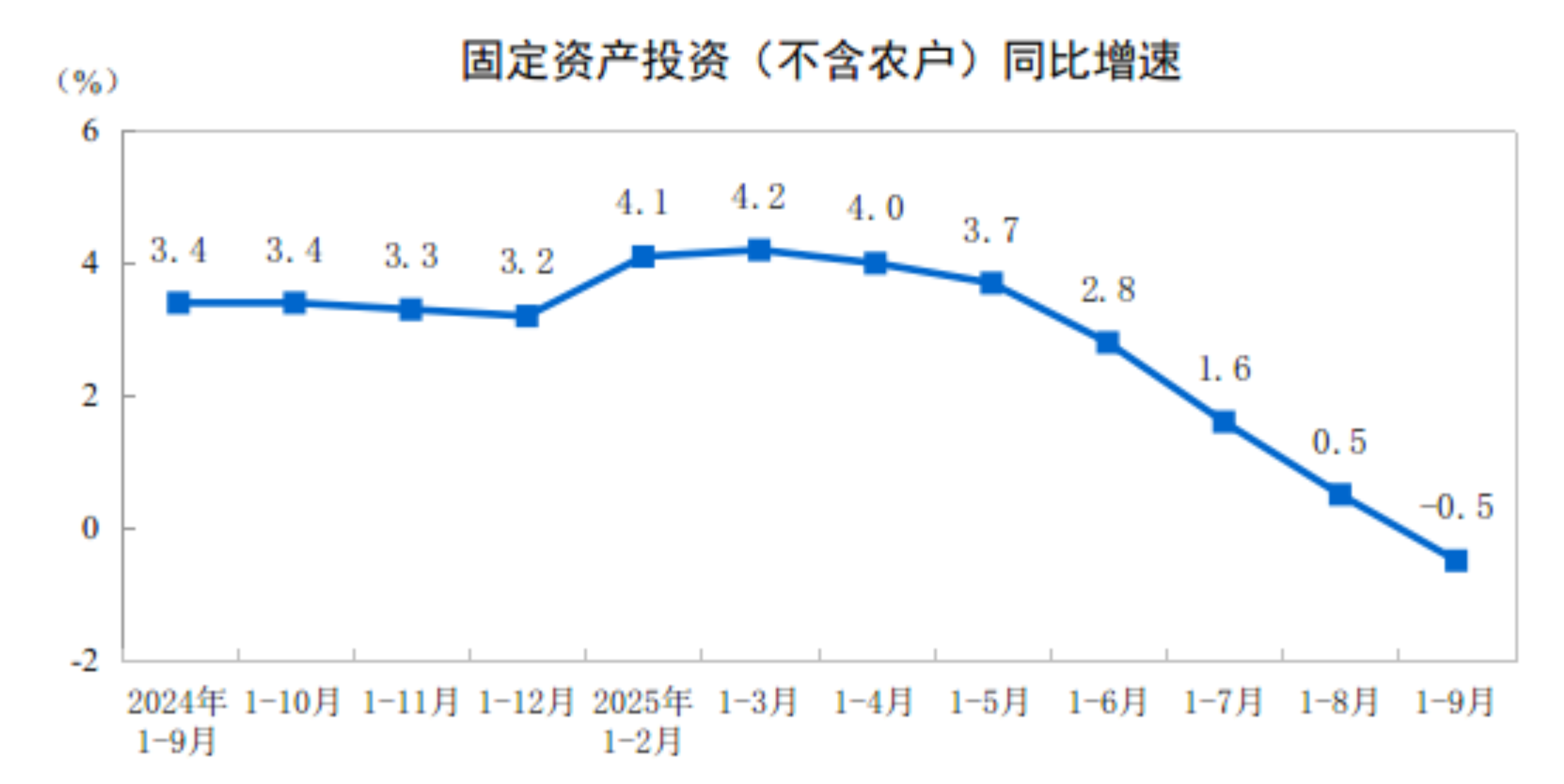
1-9月份,全国固定资产投资同比下降0.5%
Hua Er Jie Jian Wen· 2025-10-20 02:05
2025年1—9月份,全国固定资产投资(不含农户)371535亿元,同比下降0.5%。其中,民间固定资产投资同比下降3.1%。从环比看,9月份固定资产投资 (不含农户)下降0.07%。 分登记注册类型看,内资企业固定资产投资同比下降0.6%,港澳台企业固定资产投资下降0.3%,外商企业固定资产投资下降12.6%。 | 指 标 | 同比增长(%) | | --- | --- | | 固定资产投资(不含农户) | -0.5 | | 其中:国有控股 | 1.0 | | 其中:民间投资 | -3.1 | | 按构成分 | | | 建筑安装工程 | -4.1 | | 设备工器具购置 | 14.0 | | 其他费用 | -0.2 | | 分产业 | | | 第一产业 | 4.6 | | 第二产业 | 6.3 | | 第三产业 | -4.3 | | 分行业 | | | 农林牧渔业 | 3.6 | | 采矿业 | 3.7 | | 制造业 | 4.0 | | 其中:农副食品加工业 | 14.3 | | 食品制造业 | 10.8 | | 纺织业 | 11.2 | | 化学原料和化学制品制造业 | -5.6 | | 医药制造业 | ...

2025年9月份规模以上工业增加值增长6.5%
Guo Jia Tong Ji Ju· 2025-10-20 02:01
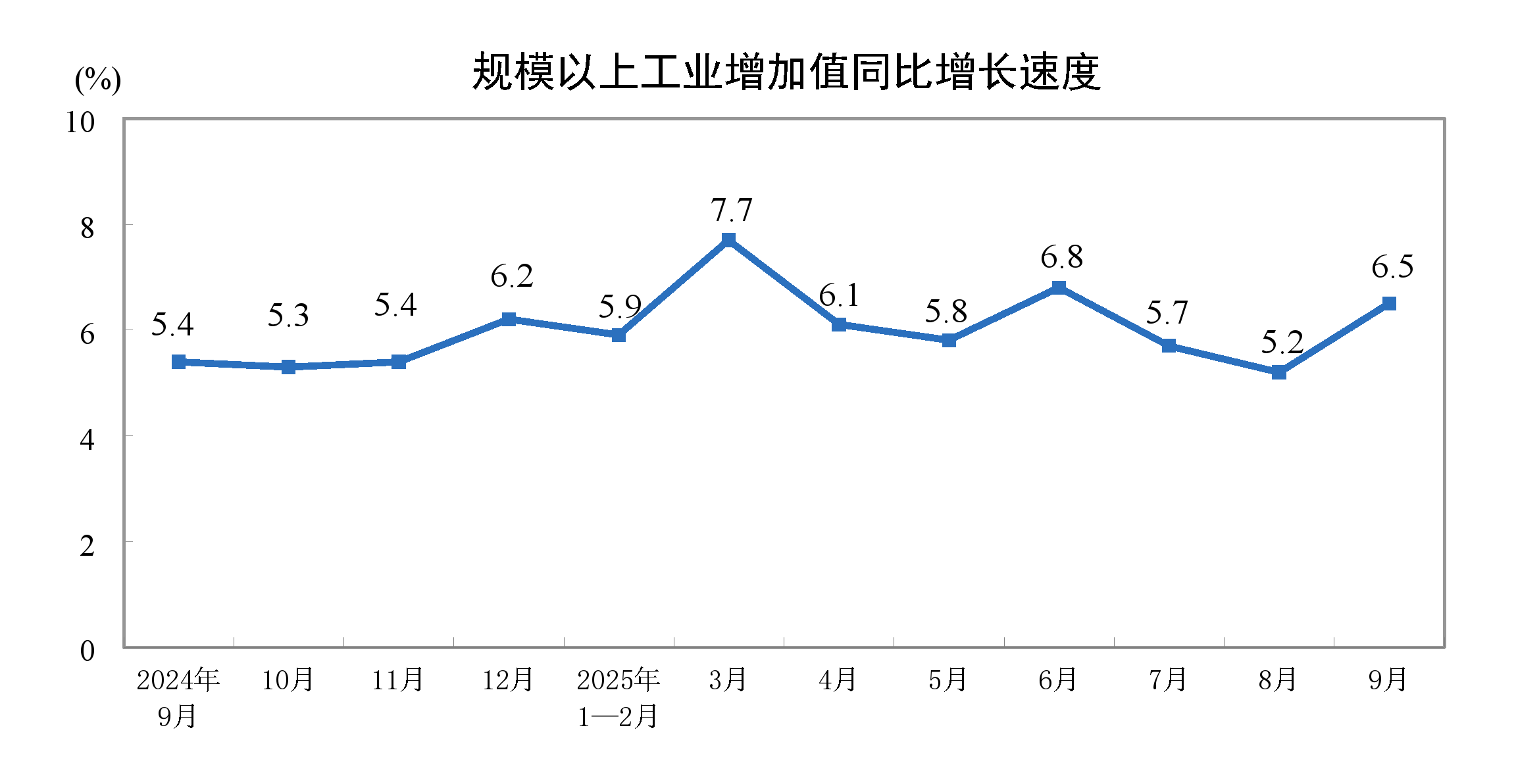
Core Insights - In September, the industrial value added of major industries showed positive growth, with mining increasing by 6.4%, manufacturing by 7.3%, and electricity, heat, gas, and water production and supply by 0.6% [2] - The overall industrial value added for September increased by 6.5% year-on-year, with state-owned enterprises growing by 6.5%, joint-stock enterprises by 6.8%, foreign and Hong Kong, Macao, and Taiwan-invested enterprises by 5.8%, and private enterprises by 4.6% [5] - Among 41 major industries, 36 reported year-on-year growth in value added, with notable increases in coal mining (6.4%), oil and gas extraction (8.9%), and automotive manufacturing (16.0%) [2][5] By Industry - Mining industry value added increased by 6.4% in September, while manufacturing saw a growth of 7.3% [2][5] - High-tech manufacturing grew by 10.3%, indicating a strong performance in this sector [5] - The automotive manufacturing sector experienced significant growth of 16.0%, with new energy vehicles rising by 20.3% [3][5] By Product - In September, out of 623 industrial products, 362 saw year-on-year production growth, including steel (12.421 million tons, up 5.1%) and automobiles (3.227 million units, up 13.7%) [3][4] - The production of new energy vehicles reached 1.58 million units, marking a 20.3% increase [3][5] - Cement production, however, declined by 8.6% to 15.444 million tons [3][5] Sales and Exports - The sales rate of products from large-scale industrial enterprises was 96.7%, an increase of 0.6 percentage points year-on-year [4] - The export delivery value for large-scale industrial enterprises reached 1.476 trillion yuan, a nominal increase of 3.8% year-on-year [4][5]
2025年三季度全国规模以上工业产能利用率为74.6%
Guo Jia Tong Ji Ju· 2025-10-20 02:01
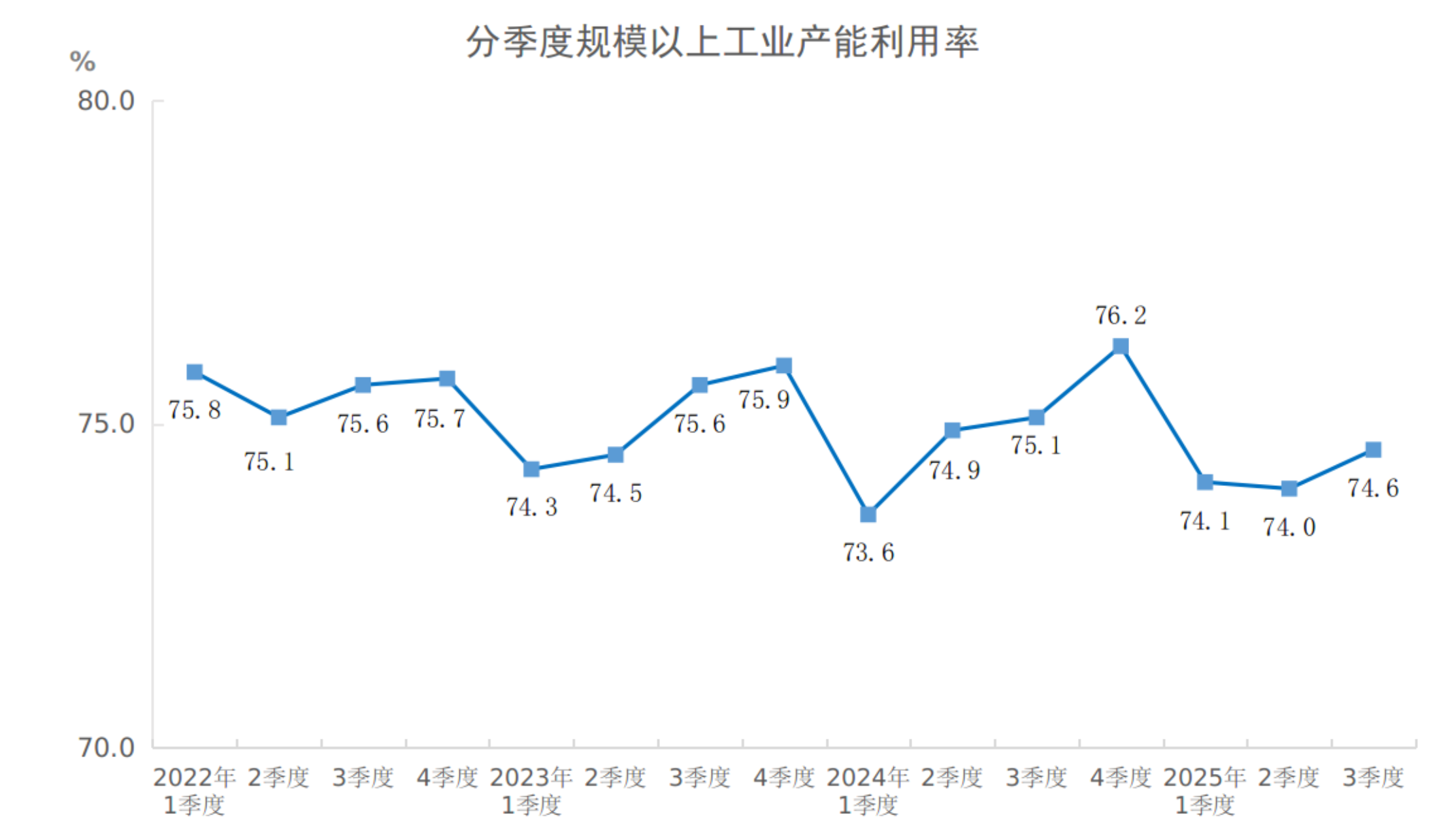
Core Insights - The industrial capacity utilization rate for Q3 2025 is reported at 74.6%, showing a decrease of 0.5 percentage points compared to the same period last year [4] - The mining industry has a capacity utilization rate of 72.5%, down by 2.1 percentage points year-on-year [4] - The manufacturing sector's capacity utilization stands at 74.8%, reflecting a decline of 0.4 percentage points from the previous year [4] - The electricity, heat, gas, and water production and supply industry maintains a capacity utilization rate of 74.3%, unchanged from the previous year [4] Industry Breakdown - In the mining sector, coal mining and washing have a capacity utilization rate of 68.9%, down 3.8 percentage points year-on-year [4] - The oil and gas extraction industry shows a high capacity utilization rate of 91.2%, an increase of 1.0 percentage points from the previous year [4] - The food manufacturing industry has a capacity utilization rate of 70.1%, decreasing by 0.6 percentage points [4] - The textile industry reports a capacity utilization of 77.2%, down by 0.7 percentage points [4] - The chemical raw materials and products manufacturing industry has a capacity utilization rate of 72.5%, down 3.5 percentage points [4] - The black metal smelting and rolling industry shows a strong capacity utilization rate of 80.1%, up by 2.7 percentage points [4] - The non-metallic mineral products industry has a low capacity utilization rate of 62.0%, slightly up by 0.3 percentage points [4] - The automotive manufacturing industry reports a capacity utilization of 73.3%, with a minor increase of 0.1 percentage points [4] - The computer, communication, and other electronic equipment manufacturing industry has a capacity utilization rate of 79.0%, up by 1.1 percentage points [4]
2025年1—9月份全国固定资产投资基本情况
Guo Jia Tong Ji Ju· 2025-10-20 02:01
2025年1—9月份,全国固定资产投资(不含农户)371535亿元,同比下降0.5%(按可比口径计算,详见附注7)。其中,民间固定资产投资同比下降3.1%。 从环比看,9月份固定资产投资(不含农户)下降0.07%。 分产业看,第一产业投资7344亿元,同比增长4.6%;第二产业投资134063亿元,增长6.3%;第三产业投资230128亿元,下降4.3%。 第二产业中,工业投资同比增长6.4%。其中,采矿业投资增长3.7%,制造业投资增长4.0%,电力、热力、燃气及水生产和供应业投资增长15.3%。 第三产业中,基础设施投资(不含电力、热力、燃气及水生产和供应业)同比增长1.1%。其中,水上运输业投资增长12.8%,铁路运输业投资增长4.2%,水 利管理业投资增长3.0%。 分地区看,东部地区投资同比下降4.5%,中部地区投资增长1.5%,西部地区投资增长1.5%,东北地区投资下降8.4%。 分登记注册类型看,内资企业固定资产投资同比下降0.6%,港澳台企业固定资产投资下降0.3%,外商企业固定资产投资下降12.6%。 2025年1—9月份固定资产投资(不含农户)主要数据 | | 指 标 同比增长(%) | ...
山东金岭矿业股份有限公司关于公开挂牌转让持有的塔什库尔干县金钢矿业有限责任公司100%股权及债权的进展公告
Zhong Guo Zheng Quan Bao - Zhong Zheng Wang· 2025-10-19 06:25
登录新浪财经APP 搜索【信披】查看更多考评等级 本公司及董事会全体成员保证信息披露的内容真实、准确、完整,没有虚假记载、误导性陈述或重大遗 漏。 截至2025年10月16日,公司第二次公开挂牌阶段公告期满,未能征集到符合条件的意向受让方。 经公司研究,决定暂停该项目挂牌,若恢复挂牌或采取其他方式交易,公司将及时履行相应决策程序和 信息披露义务,敬请广大投资者注意投资风险。 董事会 山东金岭矿业股份有限公司(以下简称"公司")分别于2025年5月15日和5月28日召开了第十届董事会第 七次会议(临时)和2024年度股东会,审议通过了《关于公开挂牌转让持有的塔什库尔干县金钢矿业有 限责任公司100%股权及债权的议案》,同意在山东产权交易中心公开挂牌转让塔什库尔干县金钢矿业 有限责任公司(以下简称"金钢矿业")100%股权及债权。具体内容详见公司于2025年5月16日、5月29 日、6月28日和7月26日在《中国证券报》《证券日报》《证券时报》和巨潮资讯网 (https://www.cninfo.com.cn)披露的《第十届董事会第七次会议(临时)决议公告》(公告编号: 2025-021)、《关于公开挂牌转让持有 ...

弘海高新资源(00065.HK)完成配售4092万股 总筹1370万港元
Ge Long Hui· 2025-10-17 11:36
Core Viewpoint - 弘海高新资源 has successfully completed a placement of 40.92 million shares at an adjusted price of HKD 0.335 per share, raising approximately HKD 13.7 million in total proceeds, with a net amount of about HKD 13.5 million after expenses [1] Group 1: Placement Details - The placement represents approximately 20.00% of the company's issued share capital prior to completion and about 16.67% after the issuance of the placement shares [1] - The net issue price for each placement share is approximately HKD 0.329 [1] Group 2: Use of Proceeds - Approximately HKD 3 million of the net proceeds will be allocated for exploration expenses, technical personnel costs, professional fees, and other related expenses for potential investment opportunities in the mining industry [1] - About HKD 10.5 million will be used for general working capital, including legal and professional fees necessary for business development, as well as daily operational expenses such as employee costs and other corporate expenditures [1]
安徽铜陵:废弃矿坑“蝶变”文旅“金山”
Zhong Guo Qing Nian Bao· 2025-10-17 10:55
Core Insights - The article highlights the transformation of Yongquan Town in Tongling, Anhui Province, from a mining village to a thriving tourist destination, showcasing the balance between ecological restoration and economic development [1][3][5]. Group 1: Tourism Development - During the recent National Day and Mid-Autumn Festival holiday, Yongquan Town received 202,000 visitors, generating ticket revenue of 9.9 million yuan, with an expected annual visitor count of 2 million and revenue surpassing 200 million yuan [1]. - The town has become a popular "internet celebrity" destination, featuring a cultural street with over 150 local delicacies and interactive activities that enhance visitor engagement [7]. Group 2: Ecological Restoration - The initial challenge of transforming the area involved ecological restoration, with a commitment to prioritize ecology over cost, leading to the planting of over 20,000 trees and the creation of scenic spots from former mining sites [5][6]. - The largest abandoned mine pit was transformed into "Mandarin Duck Lake," and the area was developed into a scenic spot that integrates local history and culture [5]. Group 3: Community Impact - The development has positively impacted the local community, with the establishment of over 20 pollution-free farming bases, generating more than 20 million yuan in annual agricultural orders, directly benefiting local farmers [7]. - The initiative has created job opportunities for over 600 villagers and has positively influenced more than 2,000 households, with an average annual income increase of over 50,000 yuan per household [7].
粤桂股份:老天爷追着喂饭,硫资源价值凸显
市值风云· 2025-10-17 10:10
Core Viewpoint - The article highlights the significant growth potential of Yuegui Co., Ltd. (粤桂股份) driven by its unique sulfur resources and the increasing demand for solid-state battery technology, particularly in the context of the evolving sulfur chemical industry [1][12]. Financial Performance - Yuegui Co., Ltd. expects a net profit of 420 million to 470 million yuan for Q3, representing a year-on-year growth of 86.87% to 109.11%, attributed to cost reduction and rising prices of ore products [4]. - The company achieved a revenue of 1.359 billion yuan in the first half of 2025, a slight increase of 1.29% year-on-year, with mining and chemical industries being the main growth drivers [14][16]. - The gross margin for sulfur concentrate reached 63.75% in the first half of 2025, up 11.26 percentage points year-on-year, significantly outperforming other segments like sugar and paper [9][17]. Business Segments - The company operates in three main segments: sugar, paper, and sulfur chemical, with the sulfur chemical segment being the core profit driver due to its high-quality sulfur iron ore resources [8][11]. - The sulfur iron ore mine owned by Yuegui is the largest in Asia, with proven reserves of 208 million tons and a sulfur grade of 31.04%, solidifying its position in the industry [8][11]. Market Position and Strategic Value - Yuegui Co., Ltd. holds 85% of the national sulfur resource reserves and has an annual raw ore production capacity of approximately 3 million tons, making it a key player in the domestic sulfur resource market [11]. - The increasing focus on solid-state battery technology, particularly the sulfide route, enhances the strategic value of Yuegui's sulfur resources, as major players like CATL and BYD are prioritizing this technology [12][13]. New Business Developments - The company has initiated new projects in the materials sector, including a silver powder project that generated 31.26 million yuan in sales in the first half of 2025, indicating diversification efforts [19]. - The production of amino sulfonic acid has also commenced, contributing additional revenue, while the company is expanding its quartz material mining and processing capabilities [20]. Operational Efficiency - Despite stable revenue, management expenses have increased, with employee compensation rising by 22%, indicating potential challenges in operational efficiency [22][24]. - The company maintains a decent dividend level, with a dividend payout ratio of 35% for 2024, reflecting a commitment to returning value to shareholders [26].


2025年1-8月采矿业企业有12732个,同比增长1.32%
Chan Ye Xin Xi Wang· 2025-10-17 03:13
上市公司:甘肃能化(000552),新大洲A(000571),冀中能源(000937),蓝焰控股(000968), 山西焦煤(000983),电投能源(002128),首华燃气(300483),郑州煤电(600121),兰花科创 (600123),兖矿能源(600188),晋控煤业(601001),中国神华(601088),昊华能源 (601101),陕西煤业(601225) 2019-2025年1-8月采矿业企业数统计图 数据来源:国家统计局,智研咨询整理 相关报告:智研咨询发布的《2025-2031年中国采矿业市场竞争态势及投资方向分析报告》 2025年1-8月,采矿业企业数(以下数据涉及的企业,均为规模以上工业企业,从2011年起,规模以上 工业企业起点标准由原来的年主营业务收入500万元提高到年主营业务收入2000万元)为12732个,和上 年同期相比,增加了166个,同比增长1.32%,占工业总企业的比重为2.44%。 知前沿,问智研。智研咨询是中国一流产业咨询机构,十数年持续深耕产业研究领域,提供深度产业研 究报告、商业计划书、可行性研究报告及定制服务等一站式产业咨询服务。专业的角度、品质化的服 ...
