Semiconductors

Search documents
One of Wall Street's Largest Banks Just Downgraded U.S. Stocks. Here Are 3 Reasons Why.
Yahoo Finance· 2026-03-26 15:35
Core Viewpoint - The U.S. stock market may soon lose its competitive edge, with American stocks expected to perform at "benchmark" levels according to UBS Group's global equity strategy head Andrew Garthwaite [1] Group 1: Structural Changes in U.S. Equities - U.S. equities have enjoyed structural advantages that are now diminishing, as highlighted by UBS [2] - The current administration's policies, including trade tariffs and scrutiny on drug pricing, create an unpredictable business environment [4] - Companies are likely to reduce investments when they cannot plan effectively, which could lead to a decline in earnings growth that supports premium valuations [5] Group 2: Key Forces Impacting U.S. Stocks - The dollar is expected to weaken against global currencies, historically linked to U.S. stock performance; a 10% fall in the dollar's trade-weighted index has led to about a 4% underperformance in U.S. stocks [6] - Share buybacks, which have been a distinguishing factor for U.S. companies, are now less attractive as the combined shareholder yield from dividends and buybacks in the U.S. is roughly half that of Europe [6] - Valuations for U.S. stocks are significantly higher, with the industry-adjusted P/E ratio being 35% above that of international peers, compared to just a 4% premium in 2010 [6]

Nvidia vs Palantir: Which AI Stock is a Long-Term Buy?
247Wallst· 2026-03-26 15:24
Core Viewpoint - The article compares Nvidia and Palantir as potential long-term investments in the AI sector, highlighting their financial performance and growth prospects. Financial Performance - Nvidia reported Q4 FY2026 revenue of $68.13 billion, a 73% increase year-over-year, with Data Center revenue at $62.31 billion (up 75% YoY) and Data Center Networking revenue surging 263% to $10.98 billion [2][6][7]. - Palantir posted Q4 2025 revenue of $1.41 billion, a 70% increase year-over-year, with U.S. commercial revenue reaching $507 million (up 137% YoY) and total contract value at a record $4.26 billion (up 138% YoY) [3][8]. Growth Drivers - Nvidia's growth is primarily driven by its Blackwell Data Center architecture, which constitutes 91.5% of its total revenue [7]. - Palantir's growth is fueled by its U.S. commercial segment, which is accelerating significantly, prompting analysts to reassess the company's potential [8]. Valuation Metrics - Nvidia has a forward P/E ratio of approximately 22x, supported by a robust annual free cash flow of $96.58 billion [12][15]. - Palantir's forward P/E ratio stands at about 116x, reflecting high expectations for sustained growth, particularly in U.S. commercial revenue [12][15]. Future Guidance - Nvidia anticipates Q1 FY2027 revenue to be around $78 billion, excluding certain revenue from China [10]. - Palantir projects U.S. commercial revenue to exceed $3.14 billion in FY2026, implying at least 115% growth, which is considered an ambitious target [13]. Risk and Execution - Nvidia's diversified demand and strong free cash flow generation provide a more stable investment profile compared to Palantir, which faces challenges related to stock-based compensation and execution risks [11][14][15]. - Palantir's commercial pivot shows promise, but its high valuation may pose risks for investors seeking lower volatility [16].



KG: Iran Responds to U.S. 15-Point Plan & Commodity Impacts on AI Chips, Materials
Youtube· 2026-03-26 15:20
Geopolitical Developments - The market is cautiously optimistic due to reports of potential ceasefire talks between the US and Iran, which may influence energy prices [3][4] - The US's ceasefire proposal has been described as not serious, but ongoing discussions are providing some market support [4] Treasury Auctions - Recent Treasury auctions, particularly the two-year and five-year, have shown weak demand, marking some of the worst results in the last three to four years [5][6] - A lack of participation from direct bidders, including domestic financial institutions, raises concerns about future auctions, particularly the upcoming 10-year auction [7][8] Inflation and Economic Indicators - The OECD has projected an increase in inflation, with a notable rise to 4.2% compared to 2.6% the previous year, which may impact market expectations [9] - Job data shows a headline increase of 210K, indicating some positive economic momentum [9] Commodity Insights - Helium shortages are affecting tech supply chains, with the US being the largest producer, and companies like Linde and Air Products benefiting from this situation [11][12] - The semiconductor industry relies on helium for cooling and cleaning processes, and any supply disruptions could lead to production challenges [14] Energy and Recycling Markets - Taiwan's energy vulnerability is a concern, as it may impact silicon production and the semiconductor supply chain [16] - The recycling market could see increased demand if geopolitical tensions escalate, with companies like Waste Management and Republic Services potentially benefiting [23][24] Metals and Commodities - The aluminum market is experiencing high prices in Japan, indicating localized demand pressures [19] - Elevated copper inventory levels suggest a potential pullback in industrial metals if global economic growth slows [21]

Sandisk Falls 8%, Micron Drops 5%: Are Analysts Right to Stay Bullish on Memory Stocks?
247Wallst· 2026-03-26 15:19
Core Viewpoint - SanDisk and Micron Technology stocks have recently experienced significant declines, with SanDisk falling 8% to $623 and Micron dropping 5% to $364, despite both companies reporting strong earnings and maintaining bullish analyst ratings. The market's reaction raises questions about underlying risks that analysts may not be fully accounting for [2][5][6]. Company Performance - SanDisk's stock has dropped 18% over the past five trading days, while Micron's stock has also shed 18%. This decline occurs despite both companies posting strong earnings and having bullish analyst ratings, indicating potential market concerns that are not reflected in analyst optimism [6]. - SanDisk's free cash flow for Q2 fiscal 2026 was reported at $980 million, which has raised investor concerns regarding the timing of its recent $1 billion investment in Nanya Technology, a Taiwanese DRAM supplier [10][11]. - Micron's cloud memory business generated $5.3 billion in revenue with a gross margin of 66% last quarter, despite elevated capital expenditure guidance [3][15]. Analyst Sentiment - The analyst consensus remains bullish, with 38 analysts rating Micron as a buy or strong buy, and 14 analysts rating SanDisk similarly. The average price target for Micron is $525, while for SanDisk it is $770, indicating significant upside potential from current trading levels [8]. - Analysts argue that the structural demand for memory remains strong, citing ongoing supply shortages and customer prepayments for large memory deals as indicators of future demand [7][14]. Market Concerns - The introduction of Google's TurboQuant algorithm, which reduces memory requirements for AI workloads by at least 6x, has raised concerns about future demand for memory products, potentially overshadowing the positive earnings reports from both companies [4][6]. - Additional risks include SK Hynix's potential $14 billion U.S. listing, which could increase competitive pressure in the memory market, and the capital-intensive nature of SanDisk's recent investment [13][16]. Future Outlook - Analysts believe that the current market sentiment may be overly cautious, as the demand for AI infrastructure is expected to require substantial memory resources, and the prepayment behavior of customers suggests confidence in future demand [14]. - The resolution of these uncertainties will likely become clearer as data on AI infrastructure spending is released throughout 2026 [17].


Nvidia Faces Class Action Over Alleged Crypto Mining Revenue Disclosure Gaps
Yahoo Finance· 2026-03-26 15:14
Core Viewpoint - A class action lawsuit has been revived against Nvidia Corporation, alleging misclassification of GPU revenue from crypto mining and misrepresentation of its gaming segment to investors during a volatile period in digital asset markets [1][2]. Group 1: Legal Allegations - The lawsuit, originally filed as In re NVIDIA Corp. Securities Litigation, claims violations of Section 10(b) of the Securities Exchange Act of 1934 and includes control-person liability claims against CEO Jensen Huang under Section 20(a) [2]. - The refiled action was reinstated on January 15, 2026, after earlier dismissals on procedural grounds in 2022 [2]. Group 2: Impact on Nvidia and Industry - The lawsuit's revival may lead to increased scrutiny of how hardware companies with significant crypto exposure report their segment-level disclosures, a regulatory question that remains unresolved [3]. - The allegations raise a structural question regarding whether bundling crypto-driven hardware sales under consumer gaming labels constitutes a material misrepresentation, which could have implications beyond Nvidia's earnings cycle from 2017-2018 [4]. Group 3: Specific Allegations and Financial Data - The complaint focuses on Nvidia's earnings reporting during late 2017 to early 2018, a period marked by high demand for GPUs driven by cryptocurrency mining, particularly Ethereum [5]. - Plaintiffs allege that Nvidia characterized a significant portion of this demand as gaming revenue instead of isolating it as mining revenue, thus presenting a misleadingly stable revenue picture [5]. - Internal data reportedly identified approximately $155 million in mining-attributable GPU sales during Q4 2017 that were not disclosed separately, with the company's acknowledgment of "elevated" mining demand being described as deliberately vague [6].
Micron's Future Hinges on 2 Emerging Challenges
247Wallst· 2026-03-26 15:05
Core Viewpoint - Micron Technology reported a strong Q1 FY2026 performance with revenue of $13.64 billion, exceeding estimates by 5.91%, and a significant earnings increase of 771%, alongside gross margins expanding to 56.0% from 38.4% year-over-year. However, two emerging challenges could impact Micron's long-term growth narrative: the introduction of Google's TurboQuant algorithms and the listing of SK Hynix on U.S. exchanges [2][4][5]. Group 1: Financial Performance - Micron's Q1 FY2026 revenue reached $13.64 billion, surpassing estimates by 5.91% [2][4]. - Earnings surged by 771%, with GAAP gross margins increasing to 56.0% from 38.4% year-over-year [2][4]. Group 2: Emerging Challenges - **Challenge One: Google TurboQuant** Google introduced TurboQuant algorithms that can compress AI model memory requirements by 6× without losing accuracy, potentially weakening long-term demand for DRAM and HBM, which are critical for Micron's growth [3][5]. - **Challenge Two: SK Hynix Listing** SK Hynix is set to list on U.S. exchanges, providing American investors with an alternative to Micron in the memory-chip market. This move is significant as SK Hynix is a leading HBM supplier and has secured an $8 billion EUV order from ASML, indicating aggressive capacity expansion [7][8]. Group 3: Market Position and Outlook - Micron's CEO emphasized the company's unique position as the only U.S.-based memory manufacturer, which could capitalize on AI opportunities. However, the competitive landscape may shift with SK Hynix's U.S. listing [8][10]. - Despite the challenges, Micron's Q2 FY2026 guidance projects revenue of $18.70 billion and non-GAAP EPS of $8.42, indicating strong near-term earnings potential [9].
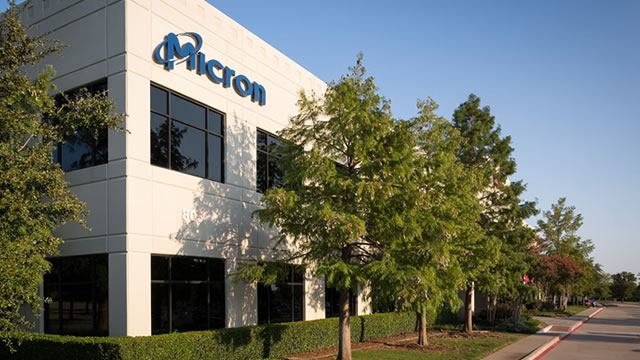
Micron’s Future Hinges on 2 Emerging Challenges
Yahoo Finance· 2026-03-26 15:05
Core Viewpoint - Micron Technology reported a remarkable quarter with a 771% increase in earnings and revenue of $13.64 billion for Q1 FY2026, surpassing estimates by 5.91%, but faces long-term challenges from structural changes in the memory market [2][7]. Group 1: Financial Performance - Micron's revenue for Q1 FY2026 reached $13.64 billion, exceeding estimates by 5.91% [2][7]. - Earnings surged by 771% year-over-year, with GAAP gross margins increasing to 56.0% from 38.4% [2][7]. Group 2: Market Challenges - Google introduced TurboQuant, advanced algorithms that reduce memory requirements for AI models by at least 6× without losing accuracy, potentially weakening long-term demand for high-bandwidth memory (HBM) and DRAM [3][7]. - The introduction of TurboQuant raises concerns about the sustainability of high component prices in the memory market, as AI efficiency improvements could limit future memory demand [4]. - SK Hynix plans to list its stock in the U.S., providing American investors with an alternative to Micron and signaling aggressive capacity investments with an $8 billion EUV order from ASML [6][7].
Is NVDA's Networking Unit Becoming a Core Growth Engine Amid AI Boom?
ZACKS· 2026-03-26 15:01
Core Insights - NVIDIA's networking business is becoming a vital component of the AI boom, with networking revenues reaching approximately $11 billion in Q4 FY26, a year-over-year increase of over 3.5 times, and full-year sales soaring 142% to around $31 billion [2][11] Group 1: Networking Business Growth - The demand for NVIDIA's networking products, such as NVLink, InfiniBand, and Spectrum-X Ethernet, is increasing as AI models become larger and more complex, necessitating faster connections between processors [3] - Cloud service providers and AI-focused data center operators are building large clusters that require high-speed interconnects, benefiting NVIDIA due to the tight integration of its networking hardware with its compute platforms [4] - The integrated approach of NVIDIA's systems enhances margins, as high-performance switches and interconnects are sold at attractive prices, particularly when part of a larger AI system [5] Group 2: Future Revenue Projections - The AI networking segment is well-positioned for NVIDIA's growth, with the Zacks Consensus Estimate projecting networking revenues to reach $48.68 billion in FY27, indicating a year-over-year growth of approximately 55% [6] Group 3: Competitive Landscape - NVIDIA faces competition from Broadcom and Arista Networks in the AI networking space, with Broadcom being a leader in Ethernet switching and custom silicon solutions, and Arista Networks specializing in high-speed Ethernet switches [7][8] Group 4: Financial Performance and Valuation - NVIDIA's shares have increased by around 56.8% over the past year, outperforming the Zacks Semiconductor – General industry's gain of 49.9% [9] - The company trades at a forward price-to-earnings ratio of 21.51, which is below the industry's average of 23.27 [13] - Earnings estimates for fiscal 2027 and 2028 imply year-over-year increases of approximately 66.7% and 30.6%, respectively, with recent revisions indicating slight downward adjustments for FY27 and upward adjustments for FY28 [16][17]

AMD EPYC 9005 CPUs excel in HPC - Finite Element Analysis
AMD· 2026-03-26 15:00
Finite Element Analysis simulations are a key piece to every automotive engineering project. Did you know that AMD EPYC 9005 CPUs are the ideal choice for the job? AMD EPYC™ 9755 achieves up to 1.33X the accelerated time to market on Altair® Radioss® and up 1.35X on Ansys LS-DYNA® compared to Intel® Xeon® Platinum 6980P. Learn more about AMD EPYC 9005 CPUs: https://www.amd.com/en/products/processors/server/epyc/9005-series.html *** Subscribe: https://bit.ly/Subscribe_to_AMD Join the AMD Gaming Discord Serve ...


MRVL's Data Center Revenues Hit $6.1B: Can the Momentum Continue?
ZACKS· 2026-03-26 14:50
Core Insights - Marvell Technology (MRVL) reported strong fiscal 2026 results, with 74.4% of revenues from the data center business, totaling $6.1 billion, reflecting a year-over-year growth rate of 46.5% [1][10] Data Center Business Performance - The data center segment is driven by increased AI spending from large cloud customers, leading to a demand for faster and more reliable networking solutions [2] - MRVL anticipates its interconnect business will grow over 50% in fiscal 2027, supported by the ongoing trend in AI investments [2] - Custom AI silicon products and next-generation switch offerings are also performing well, with data center switching revenues exceeding $300 million in fiscal 2026 and custom silicon reaching $1.5 billion [3] Future Outlook - MRVL projects switching revenues to exceed $600 million and custom silicon to grow by 20% year-over-year in fiscal 2027 [4] - The company expects AEC and retimers to double in fiscal 2027, further bolstering the data center business [4] - The Zacks Consensus Estimate for MRVL's revenues in fiscal 2027 indicates a year-over-year increase of 34.2% [5] Competitive Landscape - MRVL competes with Broadcom (AVGO) and Credo Technology (CRDO) in the connectivity market, with Credo experiencing strong growth in its AEC business and Broadcom maintaining a stronghold in carrier Ethernet and telecom optical interconnects [6][7] Valuation and Performance - MRVL shares have increased by 47.5% over the past year, compared to the Zacks Electronics - Semiconductors industry's growth of 72.9% [8] - The company trades at a forward price-to-sales ratio of 7.50X, slightly below the industry's average of 7.57X [12] - The Zacks Consensus Estimate for MRVL's earnings implies year-over-year growth of 33.1% for fiscal 2027 and 38.6% for fiscal 2028, with recent upward revisions in estimates [15]