有色金属

Search documents
安徽鑫科新材料股份有限公司十届四次董事会决议公告
Shang Hai Zheng Quan Bao· 2026-02-27 20:52
Core Viewpoint - The company, Anhui Xinke New Materials Co., Ltd., has approved a capital increase for its wholly-owned subsidiary in Hong Kong, aiming to enhance its operational capabilities and respond to market demands [2][10]. Group 1: Board Meeting and Decision - The board meeting was held on February 27, 2026, with all seven directors present, and the decision to increase capital was unanimously approved [1][4]. - The proposal for the capital increase was reviewed and approved by the Strategic Committee prior to the board meeting [3]. Group 2: Capital Increase Details - The investment amount for the capital increase is HKD 100 million, equivalent to approximately RMB 88.48 million based on the exchange rate on February 27, 2026 [7]. - Following the capital increase, the registered capital of the Hong Kong subsidiary will rise from HKD 100 million to HKD 200 million [8][10]. - The capital increase does not involve related party transactions and does not constitute a major asset restructuring as per regulations [8]. Group 3: Impact and Strategic Alignment - The capital increase aims to enhance the management of import and export operations, improve the subsidiary's operational capabilities, and facilitate the company's international market expansion [10]. - The company asserts that the capital increase will not adversely affect its financial status or the interests of shareholders, as the subsidiary remains wholly owned [11].

资源股与科技股双线开花A股三大股指马年首周收涨
Zhong Guo Zheng Quan Bao· 2026-02-27 20:43
Market Overview - The A-share market experienced a collective rise in the first trading week after the Spring Festival, with the three major indices closing higher as of February 27, 2023 [1][2] - The daily trading volume remained active, with an average daily turnover exceeding 2.2 trillion yuan, reflecting a more than 15% increase compared to the previous week [2][3] Sector Performance - Resource and technology sectors were the main focus, with significant gains observed in steel, non-ferrous metals, communication, and electronics [1][3] - The steel sector led with a weekly increase of 12.27%, while non-ferrous metals and basic chemicals also showed strong performance [3] Capital Flow - There was a notable inflow of funds into both resource and technology sectors, with the electronic sector seeing a net inflow of nearly 60 billion yuan over five trading days, the highest among all sectors [4] - Non-ferrous metals followed closely with a net inflow of 43.11 billion yuan [4] Price Trends and Market Sentiment - Price increases are viewed as a key driver for market sentiment and sector performance, with expectations that this trend will continue into March and April [5][6] - Analysts suggest that the market's focus may shift towards cyclical stocks and value stocks as the year progresses, driven by improving corporate earnings and price trends [5][6] Investment Recommendations - Investors are advised to focus on growth and cyclical sectors, particularly in oil and gas, non-ferrous metals, electric grid equipment, energy storage, and petrochemicals [1][7] - Specific areas of interest include AI-related sectors, human-shaped robots, and industries benefiting from rising commodity prices [7]
收评:A股涨跌不一,金属板块大爆发,不出所料,下周行情这样走
Sou Hu Cai Jing· 2026-02-27 19:14
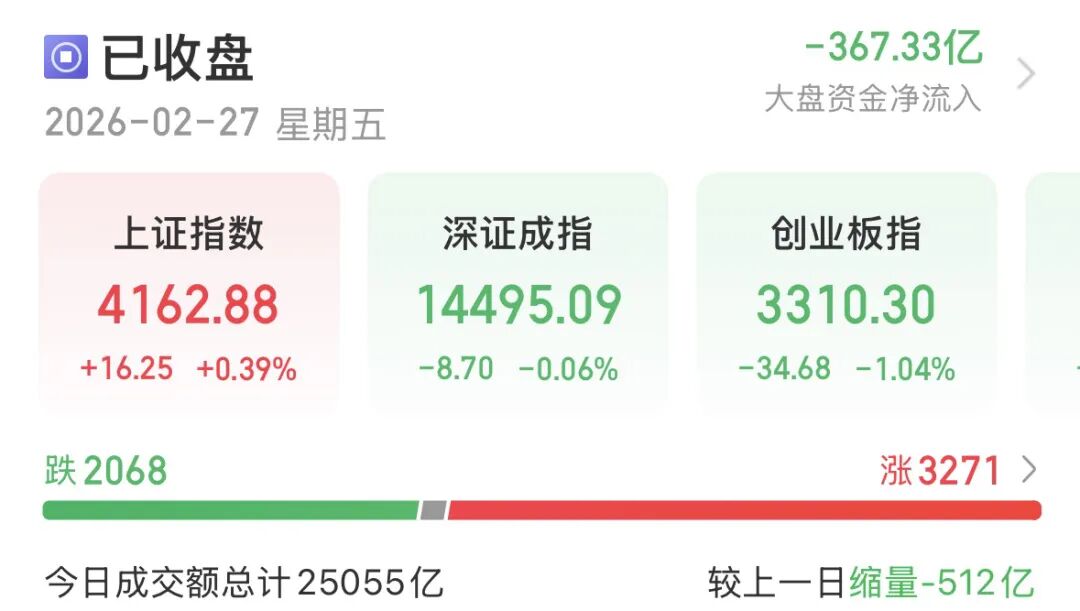
Market Overview - On February 27, 2026, A-shares exhibited extreme divergence, with the Shanghai Composite Index rising by 0.39% to close at 4162 points, while the ChiNext Index fell by 1.04% [1][3] - The market's profit-making effect was concentrated in the metal sector, particularly small metals, rare earths, and non-ferrous metals, which saw a surge in stock prices [3][5] Metal Sector Performance - The small metals sector experienced significant gains, with an overall increase exceeding 7%, and multiple stocks such as Xiamen Tungsten and Zhongtung High-tech hitting the daily limit [5][6] - Tungsten powder prices surpassed 1800 RMB per kilogram, marking a nearly 470% increase compared to early 2025, while ammonium paratungstate reached a historical high of 1.1 million RMB per ton, up over 400% year-on-year [6][9] Supply and Demand Dynamics - The supply constraints in the tungsten market are attributed to reduced mining quotas and stricter environmental checks in China, alongside limited overseas production increases [11][13] - The demand for tungsten is surging in emerging sectors such as photovoltaics and new energy, further tightening the market [11][13] International Political Factors - A report indicated that the Trump administration is planning to use an AI model developed by the Department of Defense to set global reference prices for strategic minerals, including tungsten, which could intensify the competition for resource pricing power [9][13] - China's dominance in the production and processing of key minerals, holding over 70% of heavy rare earth production and 90% of separation processing capacity, positions it as a critical player in this geopolitical landscape [9][13] Capital Flow and Market Sentiment - Despite the strong performance of certain sectors, there was a net outflow of approximately 200 billion RMB from the market, indicating a cautious stance among major investors [11] - The market sentiment remains cautiously optimistic, with a structural shift in capital flow from technology stocks to the rising metal resource sector, driven by commodity price trends and geopolitical factors [13]

两融余额“三连增”杠杆资金回归科技主线
Shang Hai Zheng Quan Bao· 2026-02-27 19:04
Group 1 - The core viewpoint of the articles highlights a significant increase in margin trading balances in the Chinese stock market, indicating a return of leveraged funds to the technology sector after the Spring Festival [1][2][3] - The total margin trading balance across the Shanghai, Shenzhen, and North markets reached 26,670.4 billion yuan, with an increase of 789.15 billion yuan over three consecutive trading days [1] - The increase in margin trading is attributed to the resolution of uncertainties post-holiday and a recovery in market sentiment, with northbound capital inflows contributing to a heightened risk appetite [1][2] Group 2 - Data shows that from February 24 to 26, 29 out of 31 primary industries experienced net buying of financing, with the electronics sector leading at a net purchase of 155.04 billion yuan [1] - Specific industries such as non-ferrous metals, power equipment, and computers also saw significant net buying, each exceeding 50 billion yuan, while industries like coal and comprehensive sectors faced reductions in financing [1][2] - Individual stocks such as Cambrian, Northern Rare Earth, and Zhongji Xuchuang saw substantial net purchases, indicating a clear focus on sectors related to computing power, semiconductors, and high-end manufacturing [2] Group 3 - The outlook suggests that the margin trading balance is expected to continue its upward trend, approaching pre-holiday highs, driven by incomplete capital replenishment and a generally loose liquidity environment [3] - The future market performance will depend on the actual effects of policy implementations, the profitability of listed companies, and changes in liquidity constraints and external environments [3]


2/27财经夜宵:得知基金净值排名及选基策略,赶紧告知大家
Sou Hu Cai Jing· 2026-02-27 15:46
Group 1 - The article provides an overview of the top-performing and bottom-performing funds based on their net asset values as of February 27, 2026 [2][3] - The top 10 funds with the highest net value growth include Qianhai Kaiyuan Hong Kong and Shanghai Core Resource Mixed Fund C, Qianhai Kaiyuan Hong Kong and Shanghai Core Resource Mixed Fund A, and Dongfang Innovation Growth Mixed Fund A, among others [2] - The bottom 10 funds with the lowest net value growth include Caitong Quality Selection Mixed Fund C, Caitong Quality Selection Mixed Fund A, and Caitong Integrated Circuit Industry Stock C, among others [3] Group 2 - The Shanghai Composite Index opened lower but closed higher, while the ChiNext Index experienced sideways movement, with a total trading volume of 2.50 trillion [5] - The leading sectors included hotel and catering, and non-ferrous metals, both showing gains of over 3% [5] - The fund with the fastest net value growth is Qianhai Kaiyuan Hong Kong and Shanghai Core Resource Mixed Fund C, which focuses on the non-ferrous metals sector [6] Group 3 - The top holdings of the Qianhai Kaiyuan fund include Zijin Mining, Xiamen Tungsten Industry, and Xingye Silver Tin, with a concentration of 62.30% in the non-ferrous metals industry [6] - The fund's net value has outperformed the market, indicating a strong position in the scarce resources sector [6] - The fund with the poorest performance, Caitong Quality Selection Mixed Fund C, has a high concentration of 94.20% in the artificial intelligence sector, with significant declines in its top holdings [7]

资源主题ETF开年领跑 机构热议配置价值
Xin Lang Cai Jing· 2026-02-27 15:22
Group 1: Market Overview - The global market has seen increased demand for safe-haven assets due to geopolitical tensions and rising international oil prices, leading to significant inflows into resource-themed ETFs such as oil, rare earths, and precious metals [1][2] - Institutions generally hold a bullish view on commodities like oil, non-ferrous metals, and precious metals, anticipating a "cycle revaluation and structural differentiation" in the market [1] Group 2: Performance of Resource ETFs - Several resource-themed ETFs have shown strong performance post-Spring Festival, with oil and gas ETFs like Huatai-PB and Yinhua rising over 9%, and rare metal ETFs increasing by more than 8.4% [2] - The total scale of oil and gas ETFs has increased significantly, with the Guotai Zhongzheng Oil and Gas Industry ETF growing by over 38.4 million yuan and the Penghua National Oil and Gas ETF increasing by over 14 million yuan [2] Group 3: Oil Market Insights - The oil market is now driven by geopolitical risks, with expectations of high volatility in oil prices over the next month [3] - Companies with oil and gas resources and those in offshore oil and gas service engineering are recommended for investment due to their potential benefits from high industry demand [3] Group 4: Precious Metals Market - Gold and silver prices have rebounded after experiencing volatility, with gold prices reaching 5200 USD/oz and silver prices surpassing 90 USD/oz [4] - Significant growth in gold ETFs has been observed, with the Huaan Fund's gold ETF increasing by over 4.3 billion yuan, leading the market [4] Group 5: Future Price Predictions - Analysts predict that gold prices could rise further, potentially reaching 6200 USD/oz in the coming months due to persistent geopolitical risks and continued support from monetary easing policies [6] - The demand for gold is expected to increase, driven by strong investment interest and central bank purchases [6]
全球资源民族主义来袭,有色狂飙!
格隆汇APP· 2026-02-27 15:10
Core Viewpoint - The article discusses the rise of resource nationalism globally and its impact on the metals and mining sector, particularly in the context of ETFs and investment opportunities in this space [2] Group 1: Resource Nationalism - Resource nationalism is gaining momentum worldwide, leading to increased government control over natural resources [2] - Countries are implementing policies that favor local industries and restrict foreign investments in resource extraction [2] Group 2: Metals and Mining Sector - The article highlights a significant surge in the prices of non-ferrous metals, driven by supply constraints and increased demand [2] - Investment in ETFs related to metals is becoming more attractive as investors seek to capitalize on the rising prices and potential shortages [2] Group 3: Investment Opportunities - The current market conditions present unique investment opportunities in the metals sector, particularly for ETFs that focus on non-ferrous metals [2] - Investors are encouraged to consider the implications of resource nationalism when making investment decisions in the mining industry [2]
\十五五\蓝图绘就,宏观政策协同发力:策略点评报告:2026年2月政治局会议精神学习点评
Huafu Securities· 2026-02-27 14:25
Group 1 - The report highlights the significance of the February 27 meeting of the Central Political Bureau, which discussed the draft outline of the "14th Five-Year Plan" and the "Government Work Report," marking a critical transition from the "14th Five-Year" to the "15th Five-Year" period [1][7] - The meeting established the "15th Five-Year" period as a key phase for solidifying the foundation and comprehensively advancing the goal of achieving socialist modernization, emphasizing a more proactive fiscal policy and moderately loose monetary policy [1][9] - The report suggests that the macroeconomic environment's certainty will significantly increase, leading to the emergence of structural investment opportunities in various sectors [1][9] Group 2 - The "15th Five-Year" strategy focuses on high-quality development rather than mere quantitative expansion, aiming for qualitative improvements and reasonable growth, particularly in areas related to "new productive forces" and "technological self-reliance" [1][8] - The report indicates that fiscal policy will likely see a notable increase in the fiscal deficit ratio and local government special bond quotas, with an emphasis on enhancing the effectiveness of fiscal spending [1][9] - The monetary policy is expected to maintain a moderately loose stance, allowing for potential reductions in policy interest rates and structural tool rates to lower financing costs for the real economy, especially in technology innovation and green development [1][9] Group 3 - The report emphasizes the importance of expanding domestic demand and optimizing supply, with a focus on innovative supply-side measures to create demand, particularly in service consumption sectors [1][12] - It highlights the significance of technological innovation and the development of a unified national market, with policies favoring hard technology sectors such as artificial intelligence and biomanufacturing [1][13] - The report stresses the need for risk prevention and mitigation in key areas, with a focus on stabilizing employment, enterprises, and market expectations, while also promoting green transformation and improving public welfare [1][14] Group 4 - Investment strategies should focus on sectors aligned with the "new productive forces," including advanced technologies such as nuclear fusion, artificial intelligence, and solid-state batteries, as well as indices reflecting national industrial development [1][17]
两会政策预期升温,A股3月何去何从?
Guo Ji Jin Rong Bao· 2026-02-27 13:59
Group 1 - The market is experiencing structural fluctuations as policy expectations intensify ahead of the Two Sessions, with potential adjustments in high-valuation sectors if performance diverges from valuations [2][12][13] - Resource stocks, particularly steel, coal, and non-ferrous metals, are leading the market, while technology stocks are experiencing a pullback due to previous gains and profit-taking [3][11][12] - The trading volume in the three markets has decreased by 504 billion, reaching 2.51 trillion, indicating a shift in market sentiment [3][11] Group 2 - The A-share market is showing signs of rotation between resource and technology sectors, with resource stocks benefiting from improved supply-demand dynamics and government policies supporting industrial metal demand [11][12] - The upcoming month of March is expected to see a "first rise then fall" trend, influenced by policy expectations from the Two Sessions and the release of annual reports [13][14] - Investment strategies should focus on balancing offense and defense, with attention on sectors like commercial aerospace, AI applications, and resource price increases [15]
行业ETF风向标丨恒生科技ETF半日成交近35亿元 4只稀土ETF半日涨幅超2.5%
Mei Ri Jing Ji Xin Wen· 2026-02-27 13:52
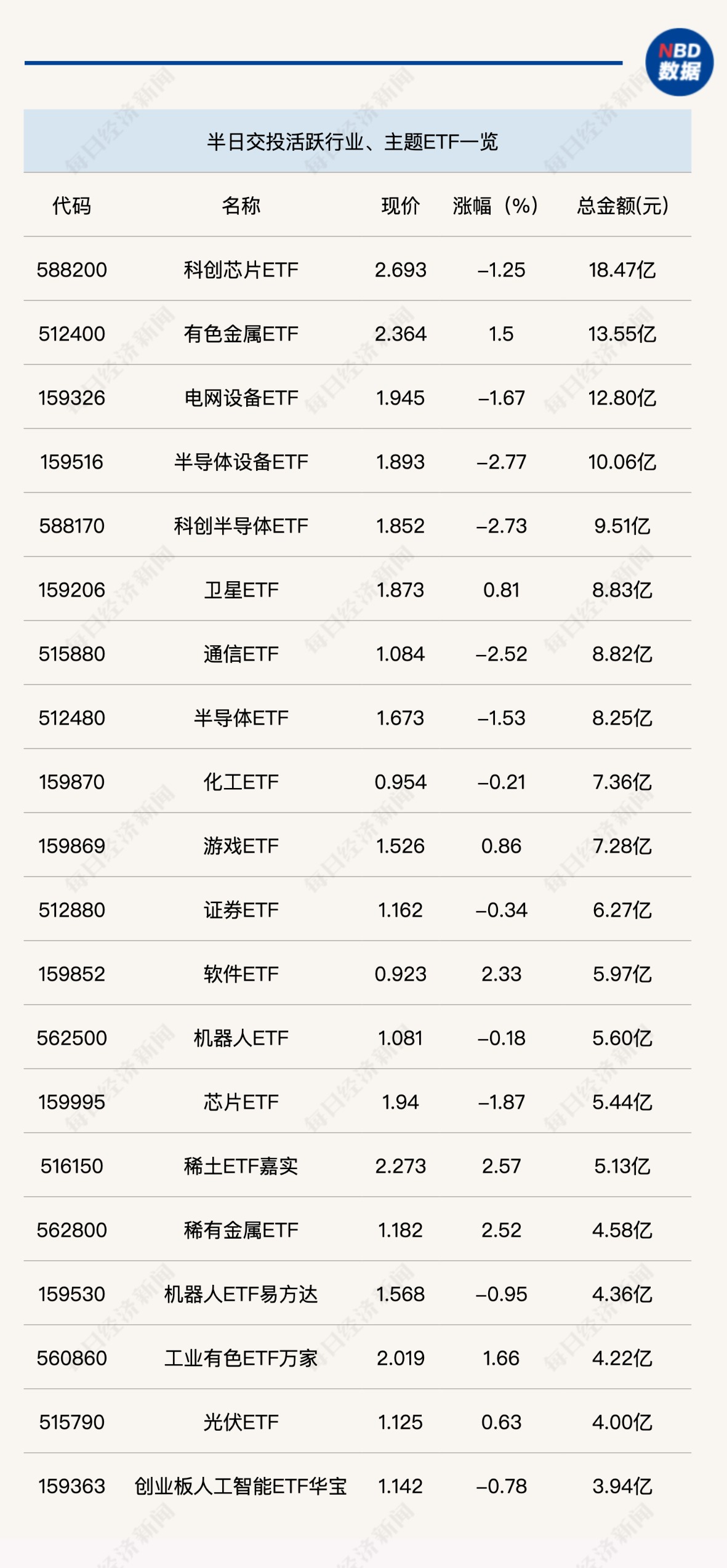
Core Viewpoint - The trading activity of various ETFs, particularly in the technology and materials sectors, remains robust, with significant transaction volumes reported for both domestic and cross-border ETFs. Group 1: Domestic ETFs - The active trading of domestic ETFs includes the following: - Sci-Tech Chip ETF (588200) with a trading volume of 1.847 billion yuan and a price decrease of 1.25% [2] - Nonferrous Metals ETF (512400) showing a trading volume of 1.355 billion yuan and a price increase of 1.5% [2] - Power Grid Equipment ETF (159326) with a trading volume of 1.280 billion yuan and a price decrease of 1.67% [2] - Other notable ETFs include Semiconductor Equipment ETF (159516) with a trading volume of 1.006 billion yuan and a price decrease of 2.77% [2], and Sci-Tech Semiconductor ETF (588170) with a trading volume of 0.951 billion yuan and a price decrease of 2.73% [2]. Group 2: Cross-Border ETFs - The cross-border ETF market shows significant activity, particularly: - Hang Seng Technology ETF (513130) with a trading volume of 3.451 billion yuan and no price change [4] - Hang Seng Technology Index ETF (513180) with a trading volume of 2.749 billion yuan and a price increase of 0.15% [4] - Hong Kong Securities ETF (513090) with a trading volume of 2.158 billion yuan and a price decrease of 1.06% [4]. Group 3: Rare Earth ETFs - Rare Earth ETFs are experiencing notable performance: - Rare Earth ETF (159713) increased by 2.7% with a trading volume of 0.173 billion yuan [6] - The ETF tracks the China Securities Rare Earth Industry Index, which reflects a high concentration of companies involved in rare earth mining, processing, and trading [7]. - The index's major constituents include: - Northern Rare Earth (600111) with a weight of 14.90% [8] - Goldwind Technology (002202) with a weight of 7.08% [8] - Xiamen Tungsten (600549) with a weight of 6.81% [8].