信托

Search documents
建元信托:董事任职资格获监管机构核准
Zheng Quan Ri Bao Zhi Sheng· 2025-11-05 13:07
Core Points - Jian Yuan Trust announced the approval of Mr. Yao Jun's qualification as a director by the Shanghai Bureau of the National Financial Regulatory Administration [1] Group 1 - Jian Yuan Trust received a formal notice regarding the appointment of Mr. Yao Jun as a director [1]

10月6家银行收到超千万罚单 行长任职资格罕见被否
2 1 Shi Ji Jing Ji Bao Dao· 2025-11-05 09:25
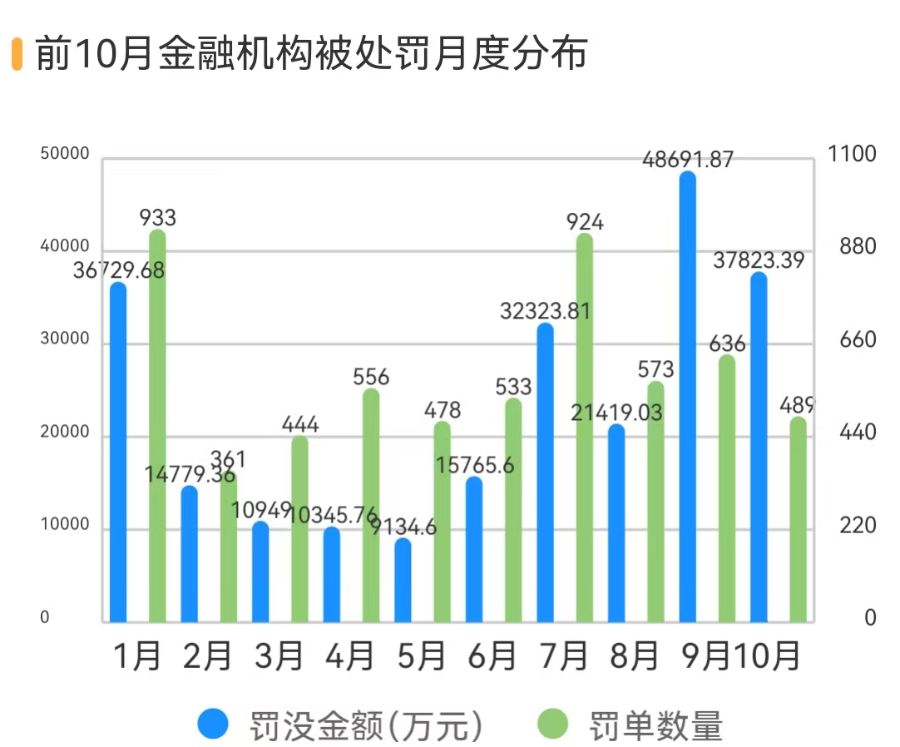
Core Insights - In October, financial institutions received 489 fines, a year-on-year decrease of 2.59%, but the total penalty amount reached 378 million yuan, a significant increase of 223.08% compared to the previous year [1][3] Summary by Categories Penalty Overview - The number of fines issued in October decreased compared to the first three months of the year, but the total penalty amount remains substantial, with October being the second highest for penalties this year, following September [1][3] Institution-Specific Penalties - Banks received 310 fines, a month-on-month decrease of 24.39% - Insurance companies received 108 fines, a month-on-month decrease of 16.92% - Securities firms received 16 fines, a month-on-month decrease of 42.86% - Futures and private equity fines also decreased, while insurance asset management companies remained stable compared to the previous month [5] Major Fines - Six fines in October exceeded 10 million yuan, with the largest fines against banks for issues related to corporate governance, loans, interbank transactions, and asset quality management [8][9] Compliance Cases - Five major compliance cases were highlighted, including: 1. Wenkang Securities faced criticism for issuing incorrect bond rates and results due to improper management of the issuance process [10] 2. Jintou Futures was ordered to rectify its operations after significant losses due to ineffective risk management [11] 3. A rare case of a bank president's qualification being denied due to non-compliance with regulatory requirements [13] Compliance Trends - There was a notable increase in penalties for improper loan issuance, with 19 fines issued, reflecting a year-on-year increase of 111.11% [14] - Penalties related to internal control management also rose, with 32 fines issued, a month-on-month increase of 52.38% [15] Penalty Rankings - China Agricultural Development Bank had the highest penalty amount in October, continuing its trend from the third quarter [18] - Zhongcheng Trust received the largest penalty among non-bank institutions, totaling 6.6 million yuan for various compliance violations [21]




10月6家银行收到超千万罚单,行长任职资格罕见被否
2 1 Shi Ji Jing Ji Bao Dao· 2025-11-05 08:59
Core Insights - In October, financial institutions received a total of 489 fines, with a total penalty amount of 378 million yuan, marking a year-on-year increase of 223.08% [1] Group 1: Penalty Overview - The number of fines in October decreased compared to the previous three months, but the total penalty amount remains significant, with October being the second highest this year after September [2] - The number of fines issued by various regulatory bodies, including the National Financial Regulatory Administration, the Central Bank, the Securities Regulatory Commission, and the Foreign Exchange Administration, all saw a decrease in October [3] Group 2: Major Penalties - Six fines in October exceeded 10 million yuan, primarily due to issues related to corporate governance, loans, interbank transactions, bills, asset quality, and the management of non-performing assets [4] Group 3: Compliance Cases - Minmetals Securities faced criticism from the Shanghai Stock Exchange for publishing incorrect coupon rates and issuance results due to improper management of the bond issuance process [5][6] - Tianjin Investment Futures was ordered to rectify its operations after significant losses from proprietary investments due to ineffective risk management and failure to comply with internal control procedures [7] - A rare case occurred where the qualification of a bank president was denied due to non-compliance with regulatory requirements, highlighting increased scrutiny on corporate governance in small and medium-sized banks [8][9] Group 4: Compliance Trends - There was a significant increase in penalties for improper loan issuance, with 19 fines issued in October, reflecting a year-on-year increase of 111.11% [10] - The number of fines related to internal control management also rose, with 32 fines issued in October, a 52.38% increase from September [11] Group 5: Penalty Rankings - China Agricultural Development Bank had the highest penalty amount in October, while Zhongcheng Trust was the only trust company fined, receiving a penalty of 6.6 million yuan for various violations [12][13]
陕国投A:公司向特定对象发行A股股票方案已经公司董事会、股东会审议通过
Zheng Quan Ri Bao· 2025-11-05 08:04
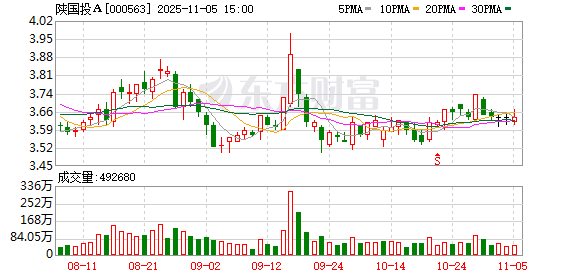
Core Viewpoint - The company has received approval from its board and shareholders for a specific issuance of A-shares, pending further regulatory approvals [2] Group 1 - The company has passed the plan for a specific issuance of A-shares through its board and shareholders [2] - The issuance has been approved by the Shaanxi Provincial Department of Finance [2] - The company is actively promoting the issuance and will provide updates through designated information disclosure media [2]

月度支付型产品周年“交卷”:华宝证券积极探索家庭理财新范式
中国基金报· 2025-11-05 04:53
Core Viewpoint - The monthly payment products developed by Huabao Securities, in collaboration with various trust institutions, have surpassed a scale of 400 million yuan, showcasing their unique value in family financial planning amidst low interest rates and increasing retirement needs [2]. Group 1: Product Design and Logic - The traditional investment approach of "compound reinvestment" is shifting towards cash flow planning due to the persistent low interest rate environment and changing demographic structures, leading to a heightened demand for certainty and liquidity among investors [4]. - Huabao Securities has positioned its monthly payment products to emphasize cash flow management rather than solely focusing on investment appreciation, allowing investors to receive fixed cash flows monthly, independent of current investment performance [4]. Group 2: Operational Strategy and Industry Collaboration - The core challenge for high-frequency cash flow products is balancing long-term asset appreciation with short-term cash payment pressures. Huabao Securities employs a diversified asset allocation strategy to ensure stable long-term returns for monthly cash payments [6]. - The successful operation of these products relies on close collaboration with various institutions, with Huabao Securities providing professional investment advisory services while partners like Caixin Trust and Guotong Trust contribute to product creation, operation support, and market promotion [6]. Group 3: Evolution and Future Directions - After a year of market validation, the monthly payment products are transitioning from concept verification to large-scale operation, with plans to explore three dimensions: scenario expansion, functional deepening, and strategy evolution [8]. - The products are naturally aligned with retirement planning, and there is potential to innovate by combining stable cash flows with professional health and wellness services, creating comprehensive retirement solutions [8]. - The positioning of the products is evolving from a single cash flow tool to a multi-scenario financial solution, integrating with family trusts, education funds, and wealth transfer strategies [8]. - Continuous enrichment of underlying strategies is crucial for the product's longevity, with future strategies potentially including dividend index enhancement to provide diverse income sources [8].

月度支付型产品周年“交卷”:华宝证券积极探索家庭理财新范式
Zhong Guo Ji Jin Bao· 2025-11-05 03:17
Core Insights - The monthly payment product series developed by Huabao Securities and several partners has surpassed a scale of 400 million yuan, demonstrating its unique value in family financial planning amidst low interest rates and aging demands [1] Group 1: Product Design and Logic - The product shifts from traditional "compound interest reinvestment" to a focus on cash flow planning, addressing the growing demand for certainty and liquidity in a low interest rate environment [2] - Unlike traditional dividend products, the monthly payment product guarantees fixed cash flow distribution at predetermined times and ratios, independent of current investment performance, making it suitable for regular cash flow needs such as retirement and education [2] Group 2: Strategy and Industry Collaboration - The monthly payment product employs the "Time Traveler" multi-asset allocation strategy, focusing on low correlation assets to balance long-term asset appreciation with short-term cash payment pressures [3] - Successful operation relies on close collaboration with industry partners, with Huabao Securities providing investment advisory while partners like Caixin Trust and GuoTong Trust contribute to product creation, operation support, and market promotion [3] - Educational initiatives, such as the "Talking about Monthly Payments" column, help investors understand product characteristics and applicable scenarios [3] Group 3: Evolution and Future Directions - After a year of market testing, the monthly payment product has transitioned from concept validation to large-scale operation, with plans for future exploration in three dimensions: scenario expansion, functional deepening, and strategy evolution [4] - The product is naturally aligned with retirement planning, with potential to innovate by combining stable cash flow with professional care services, offering differentiated solutions for various customer segments [4] - The product's role is evolving from a cash flow tool to a comprehensive wealth management solution, integrating with family trusts, education planning, and wealth transfer [4] - Continuous enrichment of underlying strategies is crucial for the product's longevity, with future strategies potentially including dividend index enhancement to provide diverse income sources [4] Group 4: Commitment to Innovation - Huabao Securities aims to deepen innovative exploration with partners, continuously expanding application scenarios and optimizing product design to meet actual wealth management needs [5]
深圳市名家汇科技股份有限公司关于与重整财务投资人签署重整投资协议及补充协议的公告
Shang Hai Zheng Quan Bao· 2025-11-04 19:06
Company Restructuring Overview - Shenzhen Mingjia Hui Technology Co., Ltd. has entered a restructuring process initiated by creditors due to its inability to repay debts and lack of repayment capacity, despite having restructuring value [3] - The Guangdong High People's Court has accepted the restructuring application and appointed a management company to oversee the process [4] Investment Agreement Details - The company signed a restructuring investment agreement with Newyu Lingjiu Investment Management Center and 11 financial investors, committing a total investment of CNY 1.20344 billion (approximately USD 173 million) [54] - The investment will result in the issuance of 664 million new shares, with Newyu Lingjiu contributing CNY 294 million for 200 million shares, while financial investors will contribute CNY 909.44 million for 464 million shares [54] Financial Investors' Information - The financial investors include Chongqing International Trust Co., Ltd., Shenzhen Zhaoping Huanzhe Investment Partnership, and others, with no related party relationships among them [5][6][9] - Each investor's funding sources are primarily from their own capital or specific trust plans [10][13][18] Share Capital Increase Plan - The restructuring plan involves a capital increase based on the existing total share capital of 695,596,569 shares, with a proposed ratio of 10 shares for every 10.5 shares, resulting in an additional 730 million shares [55][61] - After the restructuring, Newyu Lingjiu is expected to hold 14.03% of the company, while financial investors will collectively hold 32.55% [61] Lock-up Period and Share Transfer - Financial investors will face a lock-up period of 12 months for the newly issued shares following the restructuring [62] - The agreement stipulates that the investors cannot reduce their holdings through any means during this period, with certain exceptions for transfers within the same controlling entity [57] Impact of the Restructuring Agreement - The signing of the restructuring investment agreement is a crucial step in the company's restructuring process, aimed at improving its financial structure and resolving its debt crisis [63] - Successful completion of the restructuring may lead to changes in company control, with potential new major shareholders emerging [63]

约120家金融机构已披露助贷合作“白名单” 互金协会倡议:应便于金融消费者查看
Mei Ri Jing Ji Xin Wen· 2025-11-04 15:56
Core Insights - The implementation of new regulations for self-service loans has shown significant results, with approximately 120 financial institutions disclosing their internet loan assistance business partners by the end of October, involving over 500 technology companies and other entities [1][3] Group 1: Disclosure Issues - Despite the progress, there are issues with the disclosure format, including hidden locations and lack of search functionality, making it difficult for consumers to find information [1] - The titles of disclosures are often generic, such as "announcement," and do not indicate the update time or are not sorted chronologically [1][2] - Some institutions have displayed inaccurate names of partner organizations, only showing the group name or failing to update for entities that have changed names or been deregistered [1][3] Group 2: Recommendations for Improvement - Financial institutions are encouraged to disclose information in a manner that is easy for consumers to access, such as placing it prominently on their official websites [2] - Accurate names of partner organizations should be provided, along with additional details like the type of partnership, product names, and contract periods [2] - Updates to disclosures should not simply overwrite previous announcements but should maintain a record of changes [3] Group 3: Regulatory Background - The new regulations stem from a notification issued by the National Financial Supervision Administration in April 2023, aimed at enhancing the management of internet loan assistance by commercial banks [3] - The regulations highlight the rapid growth of internet loan assistance services, which, while improving efficiency, have also revealed issues such as inadequate management, misaligned responsibilities, and insufficient consumer protection [3]
以财务顾问费形式收取信托报酬且未公开,吉林信托被罚30万元
Bei Jing Shang Bao· 2025-11-04 14:21
北京商报讯(记者 廖蒙)11月4日,国家金融监督管理总局吉林监管局披露的行政处罚信息公示表显 示,因以财务顾问费形式收取信托报酬,且收取财务顾问费未向受益人公开,吉林省信托有限责任公司 被罚款30万元,相关责任人李建光被警告。 ...
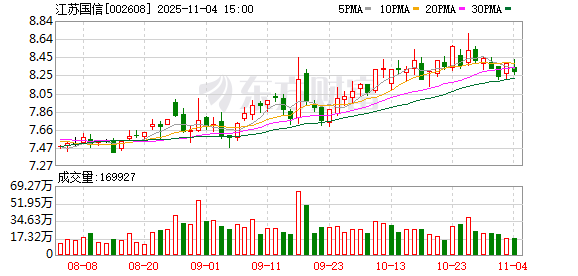
江苏国信:前三季度归母净利润较上年同期增长10.52%
Zheng Quan Ri Bao· 2025-11-04 13:38
Core Insights - Jiangsu Guoxin reported a 23.74% year-on-year increase in net profit attributable to shareholders for the third quarter of 2025 [2] - For the first three quarters of 2025, the net profit attributable to shareholders grew by 10.52% compared to the same period last year [2] Financial Performance - The net profit growth for Q3 2025 indicates strong financial performance and operational efficiency [2] - The cumulative growth in net profit for the first three quarters suggests a positive trend in the company's profitability [2]