
丝绸

Search documents
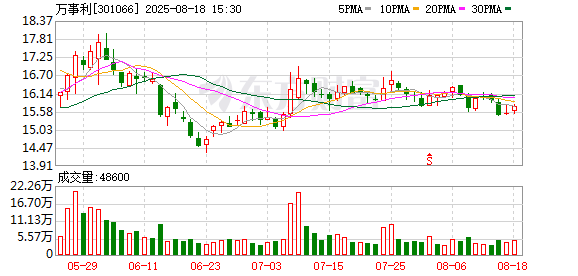
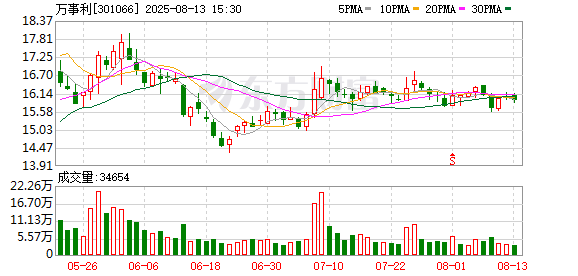
万事利8月25日获融资买入1246.37万元,融资余额7828.94万元
Xin Lang Cai Jing· 2025-08-26 02:00
Group 1 - The core viewpoint of the news is that Wanshili's stock performance and financing activities indicate a mixed outlook, with a slight decline in stock price and notable financing activities [1] - On August 25, Wanshili's stock price fell by 0.25%, with a trading volume of 101 million yuan, and a net financing outflow of 326.98 million yuan [1] - As of August 25, the total balance of margin trading for Wanshili was 78.29 million yuan, accounting for 2.59% of its market capitalization, which is above the 50th percentile level over the past year [1] Group 2 - As of March 31, Wanshili had 12,600 shareholders, a decrease of 10.74% from the previous period, while the average circulating shares per person increased by 12.03% to 14,992 shares [2] - For the first quarter of 2025, Wanshili reported a revenue of 178 million yuan, representing a year-on-year growth of 9.72%, but the net profit attributable to shareholders decreased by 12.95% to 11.42 million yuan [2] - Since its A-share listing, Wanshili has distributed a total of 45.12 million yuan in dividends, with 31.67 million yuan distributed over the past three years [2]

嘉欣丝绸:控股子公司及孙公司为控股孙公司提供担保不超过3000万元
Mei Ri Jing Ji Xin Wen· 2025-08-22 09:54
Group 1 - The company announced that its subsidiaries will provide a guarantee for its consolidated subsidiary Guangxi Jiaxin Pawn Co., Ltd. with a maximum guarantee amount of RMB 30 million [1] - The guarantee will be in the form of joint liability and can be used in a revolving manner within the authorized limit, with the actual guarantee balance not exceeding RMB 30 million at any time [1] - As of the announcement date, the total external guarantee amount for the company and its subsidiaries is capped at RMB 700 million, with an actual guarantee balance of approximately RMB 17.3 million, accounting for 8.68% of the latest audited net assets attributable to the parent company [1] Group 2 - The external guarantee balance for entities outside the consolidated statements is RMB 52.18 million, representing 2.62% of the latest audited net assets attributable to the parent company [1] - There are no overdue guarantee amounts, amounts involved in litigation, or losses due to guarantees resulting in adverse judgments [1]

万事利: 关于开立募集资金现金管理专用结算账户的公告
Zheng Quan Zhi Xing· 2025-08-22 08:13
Core Viewpoint - Hangzhou Wanshili Silk Culture Co., Ltd. has approved the use of idle raised funds and self-owned funds for cash management, with a total limit of RMB 9.16 billion [1][2]. Group 1: Financial Management - The company has agreed to use up to RMB 316 million of idle raised funds and up to RMB 600 million of self-owned funds for cash management [1]. - The usage period for these funds is valid for 12 months from the date of approval by the first extraordinary general meeting of shareholders in 2025 [1]. - The funds can be used in a rolling manner within the specified limits and time frame [1]. Group 2: Regulatory Compliance - A dedicated settlement account for idle raised funds has been opened at China Construction Bank, specifically for cash management purposes [1]. - The account will only be used for temporarily idle raised funds and will not be used for non-raised funds or other purposes, in accordance with relevant laws and regulations [1].
万事利:关于签订募集资金四方监管协议补充协议的公告
Zheng Quan Ri Bao· 2025-08-18 13:36
Group 1 - The core point of the article is that Wanshili has signed a supplementary agreement regarding the supervision of raised funds with multiple parties to optimize the use of these funds for business needs [2] Group 2 - The agreement involves Wanshili Silk Culture Co., Ltd., Wanshili Intelligent Technology Co., Ltd., China CITIC Bank Hangzhou Branch, and Guosen Securities Co., Ltd. [2] - The supplementary agreement is aimed at further optimizing the processes related to the use of raised funds [2] - The announcement was made on the evening of August 18, 2023, indicating a strategic move by the company [2]


杭州提供怎样的求职前景?
Hang Zhou Ri Bao· 2025-08-15 02:30
Group 1 - Hangzhou hosted the "Talent Night Market" recruitment fair on August 13, 2023, featuring 80 companies offering over 1,000 job positions, including well-known enterprises like Wanshili [1] - Zhejiang Weibo New Materials Technology Co., Ltd. is seeking foreign trade salespersons with monthly salaries ranging from 8,000 to 20,000 yuan, emphasizing the need for strong communication skills and English proficiency [1] - Wanshili Group is looking for embedded software development engineers with salaries between 18,000 and 30,000 yuan, as the company is upgrading its silk production processes using AI technology [1] Group 2 - The recruitment fair attracted a diverse group of job seekers, including international candidates like Ahmed, who has a PhD from Zhejiang University and is looking for opportunities in the chemical or international trade sectors [2] - The booming cross-border e-commerce sector in Hangzhou is drawing many job seekers interested in foreign trade, with companies like Weibo New Materials actively recruiting recent graduates [2] - Various attractive job positions were available, such as a pension plan planner with a salary over 10,000 yuan and a拆卡主播 (card拆主播) position with a potential salary of 12,000 yuan, targeting young professionals and recent graduates [2] Group 3 - Hangzhou plans to hold additional recruitment events for unemployed graduates, providing ongoing opportunities for job seekers to find relevant positions [3]
万事利:2025年第一次临时股东大会决议公告
Zheng Quan Ri Bao· 2025-08-13 13:38
Group 1 - The company announced the convening of its first extraordinary general meeting of shareholders in 2025 on August 13, 2025 [2] - The meeting will review the proposal regarding the use of part of the idle raised funds and self-owned funds for cash management [2]
北交所半年报启幕,三家公司净利润同比增长
Huan Qiu Wang· 2025-08-04 02:01
Group 1: Core Insights - The 2025 semi-annual report of the Beijing Stock Exchange reveals significant net profit growth for three companies, driven by computing power services, new energy materials, and smart consumption [1] Group 2: Company Performance - Minshida reported a revenue of 237 million yuan, a year-on-year increase of 27.91%, and a net profit of approximately 63.03 million yuan, up 42.28%, with a gross margin of 40.38%, an increase of 2.8 percentage points [3] - Binhang Technology achieved a revenue of about 458 million yuan, a substantial year-on-year increase of 69.27%, and a net profit of approximately 5.08 million yuan, up 20.05% [3] - Taihu Snow reported a revenue of 281 million yuan, a year-on-year increase of 17.75%, and a net profit of approximately 18.98 million yuan, up 69.77%, with a non-recurring net profit growth of 106.96% [3] Group 3: Sector Trends - Binhang Technology, recognized as the "first stock of computing power services" on the Beijing Stock Exchange, reported computing power service revenue of about 442 million yuan, accounting for 96.51% of total revenue, with a year-on-year growth of 70.51% [3] - Minshida noted that the rapid development of domestic new energy sectors has driven market demand growth, alongside the expansion of transformer demand due to upgrades in European and American power grids and increased computing power needs [3] Group 4: Sales Channels and Innovations - Taihu Snow's silk business growth is attributed to channel innovation, with online channel revenue increasing by 29.19%, surpassing offline growth [4] - The company has developed a "full-domain live broadcast" strategy, implementing a collaborative approach between "brand self-broadcasting" and "influencer broadcasting," enhancing its overseas social media presence [4] - Revenue from WeChat stores surged by 813.46%, while revenue from Douyin and JD.com grew by 59.62% and 47.42%, respectively [4]

北交所首批半年报披露 企业发力前沿赛道
Zhong Guo Zheng Quan Bao· 2025-08-03 23:10
Core Insights - The 2025 semi-annual report disclosure for the Beijing Stock Exchange has commenced, with companies such as Minshida, Taihu Snow, and Parallel Technology showing significant profit growth in the first half of the year, driven by computing power services, new energy materials, and smart consumption [1][2][4] Group 1: Company Performance - Minshida reported a revenue of 237 million yuan, a year-on-year increase of 27.91%, and a net profit of 63.03 million yuan, up 42.28% [2] - Parallel Technology achieved a revenue of approximately 458 million yuan, a substantial increase of 69.27%, and a net profit of about 5.08 million yuan, growing by 20.05% [2] - Taihu Snow's revenue reached 281 million yuan, reflecting a 17.75% year-on-year growth, with a net profit of 18.98 million yuan, up 69.77% [3] Group 2: Industry Trends - The performance of these companies is attributed to their alignment with emerging trends in AI computing power and energy transformation, showcasing their strategic positioning in response to new market demands [1][4] - Parallel Technology, as the "first stock of computing power services" on the Beijing Stock Exchange, reported computing power service revenue of approximately 442 million yuan, accounting for 96.51% of its total revenue, with a year-on-year growth of 70.51% [4] - Minshida's core product, aramid paper, has seen increased demand in sectors such as new energy vehicles, wind power, and AI data centers, contributing to its revenue growth [5] Group 3: Innovation and Digital Transformation - Taihu Snow's revenue growth is significantly driven by channel innovation, with online channel revenue increasing by 29.19%, surpassing offline growth [6] - The company has implemented a comprehensive digital marketing strategy, enhancing its presence on platforms like Xiaohongshu and Douyin, leading to substantial revenue increases across various online channels [6][7] - Taihu Snow is also embracing AI advancements, achieving notable results in information security, data integration, and product design efficiency [7]
北交所首批半年报披露企业发力前沿赛道
Zhong Guo Zheng Quan Bao· 2025-08-03 21:12
Core Insights - The 2025 semi-annual report disclosure for the Beijing Stock Exchange has commenced, with companies such as Minshida, Taihu Snow, and Parallel Technology showing significant profit growth, driven by demand in computing services, new energy materials, and smart consumption [1][2][3] Group 1: Company Performance - Minshida reported a revenue of 237 million yuan, a year-on-year increase of 27.91%, and a net profit of approximately 63 million yuan, up 42.28% [1] - Parallel Technology achieved a revenue of about 458 million yuan, a substantial increase of 69.27%, and a net profit of approximately 508,000 yuan, up 20.05% [2] - Taihu Snow's revenue reached 281 million yuan, a year-on-year growth of 17.75%, with a net profit of approximately 19 million yuan, up 69.77% [2] Group 2: Industry Trends - The performance of these companies reflects a strategic alignment with emerging trends in AI computing and energy transformation, showcasing their resilience and growth potential [1][3] - Parallel Technology, as the "first stock of computing services" on the Beijing Stock Exchange, reported computing service revenue of approximately 442 million yuan, accounting for 96.51% of its total revenue, with a year-on-year growth of 70.51% [3] - Minshida's core product, aramid paper, has seen increased demand in sectors such as new energy vehicles, wind power, and AI data centers, contributing to its revenue growth [4][6] Group 3: Innovation and Digital Transformation - Taihu Snow's revenue growth is attributed to channel innovation, with online channel revenue increasing by 29.19%, surpassing offline growth [5] - The company has implemented a "full-domain live broadcast" marketing strategy, enhancing its global brand reach through social media [5][6] - Taihu Snow has also focused on digital transformation, achieving significant results in information security, data integration, and AI application, particularly in design [6]
外贸增势展现苏州经济韧性
Su Zhou Ri Bao· 2025-08-01 23:00
Group 1: Trade Performance - Suzhou achieved a record high in foreign trade with total imports and exports reaching 1,295.88 billion yuan, a year-on-year increase of 5.7% [1] - The growth is attributed to the improvement in export product quality, rapid growth in emerging markets, and effective measures taken to stabilize orders and develop new markets [1] Group 2: Support for Enterprises - Suzhou established a "Stabilizing Foreign Trade" task force, consisting of 43 professionals from 24 departments, to provide 24-hour support for enterprises [2] - The task force has served 1,660 key enterprises, achieving a 95.2% resolution rate for their requests [2][3] Group 3: Market Expansion Initiatives - The "Hundred Groups and Thousand Enterprises Going Abroad" initiative has successfully organized nearly 20 trade delegations, helping around 300 enterprises explore new markets in Europe, the Middle East, South America, and Southeast Asia [4] - Suzhou's textile industry has also made significant strides in North Africa, securing approximately 3 million USD in intended orders during a recent trade exhibition [5] Group 4: New Business Models and Technologies - Suzhou's cross-border e-commerce imports and exports surged by 185.3% in the first half of the year, with a focus on innovative products and new technologies [7] - Key export products such as integrated circuits and lithium-ion batteries saw substantial growth, with increases of 25.3% and 44.3% respectively [7] Group 5: Innovation and Competitiveness - Companies like Kafei Mei have significantly increased their R&D investment, leading to improved product longevity and a sixfold increase in revenue since 2021 [7][8] - Fast Home Intelligent Technology secured six project orders in Saudi Arabia, demonstrating the competitive edge gained through AIoT solutions and a strong focus on innovation [8]