汽车经销

Search documents
策略日报:反者道之动-20250623
Tai Ping Yang Zheng Quan· 2025-06-23 14:41
Group 1: Investment Strategy Overview - The report emphasizes that the stock market is at a technical support level, but volatility has reached a new low since 2024, indicating that a trend change may be imminent [5][21]. - The A-share market's trading volume reached 1.12 trillion, an increase of 54.9 billion compared to the previous trading day, with market focus on stablecoins, port shipping, and solid-state batteries [21]. - The report suggests that the probability of an upward trend in the index is low, and managing positions is the best strategy [21]. Group 2: Bond Market Insights - The bond market is expected to benefit from inflows of risk-averse capital, as the overall market remains volatile with a lack of positive news [18][8]. - The report notes that the bond market may regain upward momentum due to increased demand for safe-haven assets [8]. Group 3: Foreign Exchange Market Analysis - The onshore RMB against the USD was reported at 7.1876, an increase of 91 basis points from the previous close, indicating a potential strengthening of the RMB [33]. - Despite short-term fluctuations, the long-term trend for the USD remains bearish [33]. Group 4: Commodity Market Trends - The Wenhua Commodity Index fell by 0.13%, with strong performance in the energy sector but poor performance in agricultural and chemical products [38]. - The report advises caution for investors who have not participated at lower levels, suggesting a wait-and-see approach due to high volatility in oil and related products [38].
汽车反“内卷”第二枪打响:车企承诺“60天返利”治理拖延症
Bei Ke Cai Jing· 2025-06-19 01:17
Core Viewpoint - The automotive industry is experiencing a severe "price war," prompting dealers to optimize operations and seek survival and transformation opportunities [1] Group 1: Industry Developments - In June, 17 automakers publicly committed to a "60-day payment term" for suppliers, marking the beginning of a response to internal competition [2] - GAC Group announced a commitment to ensure "60-day rebate payment" to dealers, responding to the call for healthy industry development [5] - Several major manufacturers, including GAC Group, BMW, and others, have pledged to complete rebate payments to dealers within 60 days [3][4] Group 2: Dealer Conditions - A survey of 10 dealerships revealed a stark contrast in operational conditions, with 6 facing difficulties and some having closed, while 4 reported better performance [3][9] - Dealers are experiencing a significant decline in profitability, with some reporting annual losses between 6 million to 10 million yuan [10][18] - The traditional profit model for dealers, heavily reliant on new car sales and after-sales services, is becoming unsustainable due to increased competition and price transparency [18] Group 3: Inventory and Financial Management - High inventory levels are a pressing issue, with some brands having stock that exceeds three months, leading to financial strain on dealers [20][24] - The average inventory turnover days for several major dealer groups have increased, indicating a growing challenge in managing stock [22] - A significant percentage of dealers (84.4%) are facing price inversion, with 60.4% experiencing a price drop of over 15%, severely impacting cash flow [31] Group 4: Strategic Responses - Dealers are urged to prioritize cash flow management, seek timely rebates from manufacturers, and optimize inventory structures to avoid financial collapse [32] - The industry is expected to undergo a "Matthew effect," with weaker brands and inefficient stores likely to exit the market, while stronger dealer groups may expand through acquisitions [33] - The Ministry of Commerce is taking steps to address the "involution" in the automotive sector, aiming to maintain fair competition and support the industry [34]

经销商抢搭中国汽车大航海时代的快船
Zhong Guo Qi Che Bao Wang· 2025-06-18 01:18
Core Viewpoint - 2025 is a pivotal year for the globalization of Chinese automotive brands and the expansion of automotive dealers' export businesses, driven by the need for high-quality development and the search for new profit growth points due to intense domestic market competition [2] Group 1: Export Business Growth - Nearly 88% of surveyed dealer groups are engaged in automotive export business, a 27% increase from 2023 [3] - 40% of dealers maintain export volumes below 500 units, but more groups are crossing the 1,000-unit threshold [3] - The majority of dealers have export business accounting for less than 10% of their total operations, with zero-kilometer used cars being the mainstay of overseas business, which has seen a 13% increase compared to two years ago [3] Group 2: Market Focus and Strategies - Dealers primarily target markets in the Middle East, Central Asia, and Africa, with over 60% of dealers operating in these regions [3] - The export of electric vehicles has significantly decreased, while the proportion of dealers exporting fuel vehicles has rapidly increased, with traditional joint venture brands dominating the export market [3] Group 3: Localization and Operational Strategies - Domestic dealers emphasize localization in overseas operations, often collaborating with local dealers and employing local marketing teams [4] - 30% of surveyed dealers have initiated customized modification export businesses for overseas markets [4] Group 4: Challenges in Overseas Expansion - High tariffs, compliance processes, and fluctuating currency exchange rates pose significant challenges to dealers expanding overseas [5] - The complex and dynamic policy environment, along with regional demand fluctuations, adds to the operational difficulties faced by dealers [5] Group 5: Long-term Strategies for Success - Establishing pre-positioned logistics nodes and localized modifications can help mitigate tariff impacts and enhance compliance [6] - Dealers should build localized operational strategies, including hiring local teams and collaborating with local industry associations [6] Group 6: Profitability and Future Outlook - 70% of dealers expect export business gross margins to be below 5% in 2025, with many not planning to establish overseas stores [7] - There is a growing interest in long-distance used car exports, which are expected to surpass zero-kilometer used car exports in five years [7] Group 7: Market Entry Models - Three main export models are identified: complete vehicle export, KD assembly, and local production [10] - The KD assembly model is anticipated to become a future trend due to its ability to circumvent trade barriers and reduce costs [11]

经销商活不下去了,呼吁停止“价格战”
Xi Niu Cai Jing· 2025-06-10 06:46
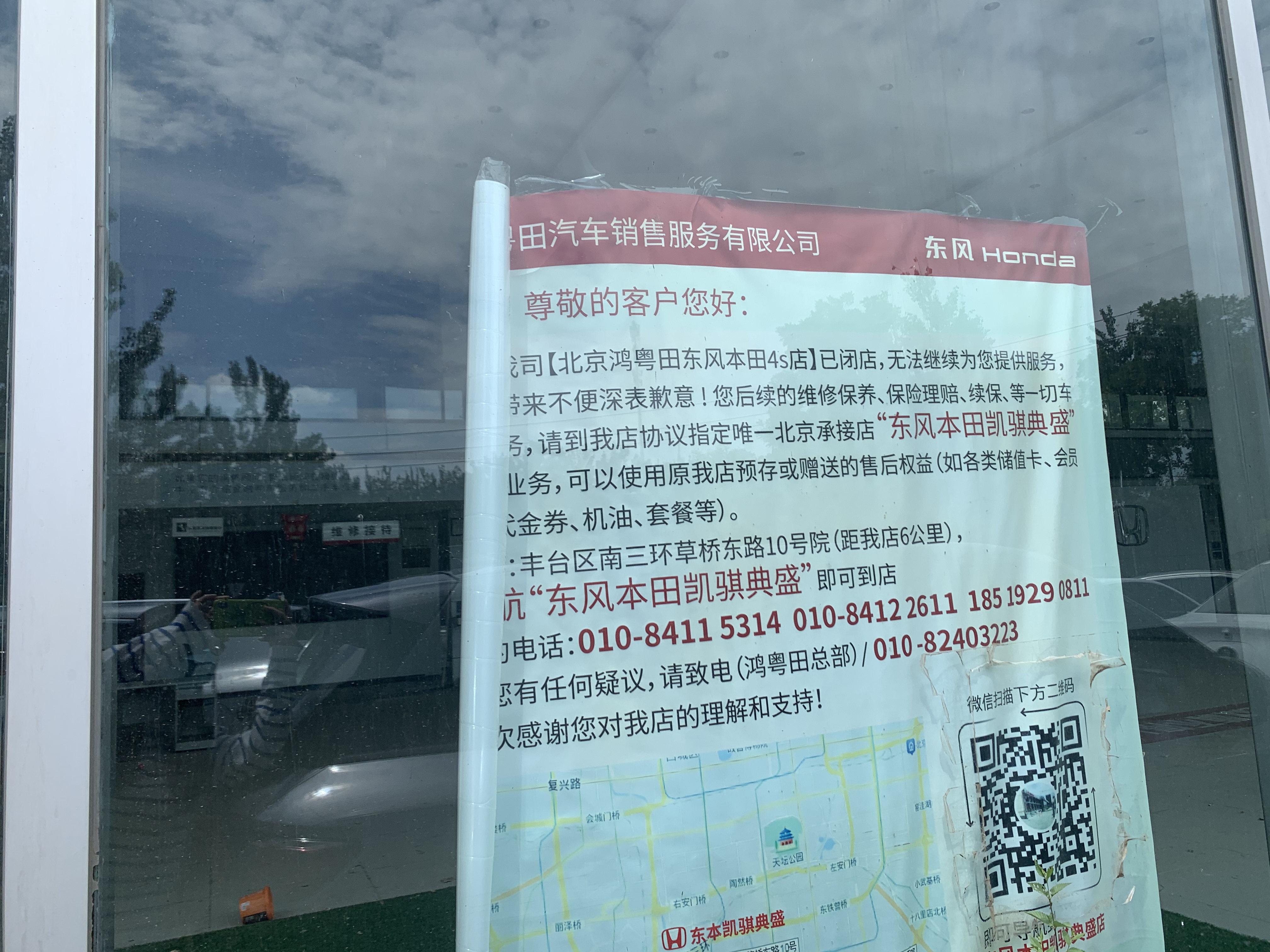
近日,全国工商联汽车经销商商会发布《关于反对"内卷式"竞争 促进汽车经销行业高质量发展的倡议》,呼吁全行业严格遵守公平竞争原则,坚决抵制 以"价格战"为主要形式的"内卷式"竞争行为。 近年来,国内汽车市场"价格战"愈演愈烈,汽车经销们普遍到了生死存亡的时刻。数据显示,2024年汽车行业利润率仅为4.3%,低于整个下游工业利润率及 2023年水平。因价格战,汽车行业新车市场整体零售累计损失接近2000亿元。2025年一季度,中国汽车行业利润率进一步下滑至3.9%,远低于下游工业企 业5.6%的平均利润率。 在这样的背景之下,汽车经销商的生存状况越来越艰难。中国汽车流通协会数据显示,部分品牌经销商库存超过2个月,整体库存处于高位。2024年度经销 商盈利比例仅为39.3%,持平比例为19%,亏损比例高达41.7%。新车业务亏损是经销商陷入困境的重要原因,84.4%的经销商存在不同程度的价格倒挂, 60.4%的经销商价格倒挂幅度在15%以上。利润被蚕食,不少经销商都被迫退网。数据显示,截至2024年年底,全国汽车4S店网络规模同比缩减约2.7%,退 网数量为4419家。 为应对这一困境,全国工商联汽车经销商商会提出 ...

越卖越亏,经销商库存持续拉响警报!全国工商联称“坚决抵制”
第一财经· 2025-06-03 15:21
2025.06. 03 本文字数:1919,阅读时长大约3分钟 作者 | 第一财经 武子晔 6月3日,全国工商联汽车经销商商会发布的《关于反对"内卷式"竞争,促进汽车经销行业高质量发 展的倡议》。而几天前,中国汽车工业协会、工信部纷纷发声表示反对汽车价格战。 而汽车行业的价格战从2022年下半年开始,多个品牌的产品售价开始大幅度下降。2024年以来,汽 车价格战蔓延,涉及车型范围更广,持续时间也较长。在此背景下,汽车经销商盈利能力进一步减 弱,新车销售亏损是最大挑战之一。面临激烈的市场竞争,厂家与经销商纷纷采取"以价换量"的策 略,不遗余力地争夺市场份额,因此出现增量不增收,增收不增利的状况,多数品牌价格倒挂加剧。 中国汽车流通调查报告显示,2024年度汽车经销商盈利比例为39.3%,持平比例为19%,亏损比例 为41.7%。 "价格战非常卷,这导致经销商每辆车进销差加大,而厂家给的返利又存在一定的滞后性。"某汽车 销售公司管理层人士在接受记者采访时表示,在亏钱卖车的情况下,4S店通常会通过售后、厂家返 点等方式来实现盈利。同时,主机厂会给经销商设定多种商务政策,包括销售返利、金融贴息、月度 促销、季度促销等 ...
全国工商联汽车经销商商会发布倡议:反对“内卷式”竞争
Zhong Guo Xin Wen Wang· 2025-06-03 14:40
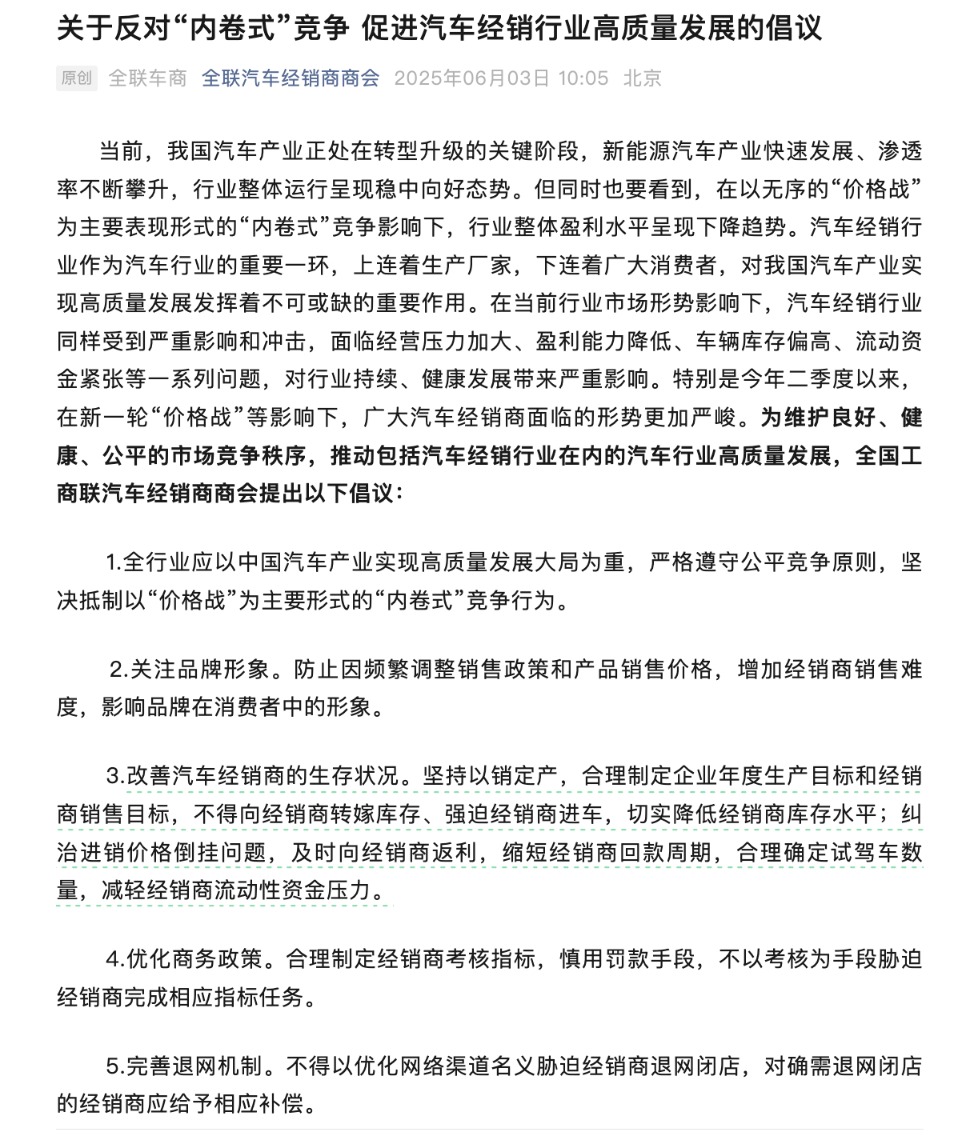
中新网6月3日电(吴家驹)又一汽车组织发布倡议,反对"内卷式"竞争。 6月3日,全国工商联汽车经销商商会发布《关于反对"内卷式"竞争促进汽车经销行业高质量发展的倡议》。 为维护良好、健康、公平的市场竞争秩序,推动包括汽车经销行业在内的汽车行业高质量发展,全国工商联汽车经销商商会倡议,全行业 应以中国汽车产业实现高质量发展大局为重,严格遵守公平竞争原则,坚决抵制以"价格战"为主要形式的"内卷式"竞争行为。 同时,全国工商联汽车经销商商会,还提出关注品牌形象、改善汽车经销商的生存状况、优化商务政策、完善退网机制几方面倡议。 图自全联汽车经销商商会公众号 此前,中国汽车工业协会发布《关于维护公平竞争秩序,促进行业健康发展的倡议》,提出所有企业严格遵从公平竞争原则,依法依规开 展经营活动。 在中国汽车工业协会的倡议发布后,工业和信息化部相关负责人在回答记者问题时表示,我们赞同并支持中国汽车工业协会提出的"维护 公平竞争秩序促进行业健康发展的倡议"。车企之间"价格战",给汽车企业正常的生产经营带来较大冲击,危及行业健康、可持续发展。 工业和信息化部将加大汽车行业"内卷式"竞争整治力度,推动产业结构优化调整,加强产品一致 ...
越卖越亏,经销商库存持续拉响警报!全国工商联称“坚决抵制”
Di Yi Cai Jing· 2025-06-03 12:09
在当前行业市场形势影响下,汽车经销行业同样受到严重影响和冲击,多部门密集抵制价格战。 为维护良好、健康、公平的市场竞争秩序,推动包括汽车经销行业在内的汽车行业高质量发展,全国工 商联汽车经销商商会提出多项倡议: 1、全行业应以中国汽车产业实现高质量发展大局为重,严格遵守公平竞争原则,坚决抵制以"价格 战"为主要形式的"内卷式"竞争行为。 6月3日,全国工商联汽车经销商商会发布的《关于反对"内卷式"竞争,促进汽车经销行业高质量发展的 倡议》。而几天前,中国汽车工业协会、工信部纷纷发声表示反对汽车价格战。 全国工商联汽车经销商商会提到,以无序的"价格战"为主要表现形式的"内卷式"竞争影响下,行业整体 盈利水平呈现下降趋势。汽车经销行业作为汽车行业的重要一环,上连着生产厂家,下连着广大消费 者,对我国汽车产业实现高质量发展发挥着不可或缺的重要作用。在当前行业市场形势影响下,汽车经 销行业同样受到严重影响和冲击,面临经营压力加大、盈利能力降低、车辆库存偏高、流动资金紧张等 一系列问题,对行业持续、健康发展带来严重影响。特别是今年二季度以来,在新一轮"价格战"等影响 下,广大汽车经销商面临的形势更加严峻。 今年5月22 ...


收评:沪指涨0.43% 美容护理及免疫治疗板块涨幅靠前
Xin Hua Cai Jing· 2025-06-03 07:22
Market Performance - Major stock indices in Shanghai and Shenzhen opened lower on June 3 but experienced upward fluctuations during the morning session, with the Shanghai Composite Index and ChiNext Index consolidating at relatively high levels in the afternoon [1] - By the close, the Shanghai Composite Index was at 3361.98 points, up 0.43%, with a trading volume of approximately 468.3 billion; the Shenzhen Component Index closed at 10057.17 points, up 0.16%, with a trading volume of about 673.1 billion; the ChiNext Index ended at 2002.70 points, up 0.48%, with a trading volume of around 307.1 billion [1] Sector Performance - The beauty care and immunotherapy sectors saw significant gains, while other sectors such as precious metals, innovative drugs, CRO concepts, cultivated diamonds, COVID-19 drug concepts, pet economy, weight loss drugs, gaming, dairy, and small banks also experienced notable increases [1] - Conversely, sectors like steel, home appliances, and coal faced declines, although the overall drop was not substantial [1] Institutional Insights - Jifeng Investment Advisory noted that the market is gradually finding a bottom, with medium to long-term investment opportunities emerging, particularly in sectors benefiting from policy support such as consumer goods, semiconductors, and robotics [2] - Guojin Securities highlighted opportunities in gold and innovative drugs, emphasizing the potential for margin improvement and revenue growth in the pharmaceutical sector due to policy guidance [2] - Dongwu Securities recommended focusing on technology growth sectors, thematic catalysts, and areas with improving fundamentals, such as innovative drugs and military electronics [3] Industry Developments - The National Federation of Automobile Dealers Association called for a resistance against "involution-style" competition primarily driven by price wars, advocating for high-quality development in the automotive industry [4] - The National Energy Administration announced measures to optimize the electricity market access environment and enhance the effectiveness of qualification management, including exemptions for new business models in distributed energy [5]
全国工商联汽车经销商商会:坚决抵制“内卷式”竞争
Zheng Quan Shi Bao· 2025-06-03 04:53
(原标题:全国工商联汽车经销商商会:坚决抵制"内卷式"竞争) 坚决抵制以"价格战"为主要形式的"内卷式"竞争行为。 6月3日,全国工商联汽车经销商商会发布《关于反对"内卷式"竞争 促进汽车经销行业高质量发展的倡 议》(简称《倡议》)。 据了解,5月31日,中国汽车工业协会发布《关于维护公平竞争秩序 促进行业健康发展的倡议》,提出 四点倡议: 1.所有企业严格遵从公平竞争原则,依法依规开展经营活动; 为维护良好、健康、公平的市场竞争秩序,推动包括汽车经销行业在内的汽车行业高质量发展,全国工 商联汽车经销商商会提出以下倡议: 1.全行业应以中国汽车产业实现高质量发展大局为重,严格遵守公平竞争原则,坚决抵制以"价格战"为 主要形式的"内卷式"竞争行为。 2.关注品牌形象。防止因频繁调整销售政策和产品销售价格,增加经销商销售难度,影响品牌在消费者 中的形象。 3.改善汽车经销商的生存状况。坚持以销定产,合理制定企业年度生产目标和经销商销售目标,不得向 经销商转嫁库存、强迫经销商进车,切实降低经销商库存水平;纠治进销价格倒挂问题,及时向经销商 返利,缩短经销商回款周期,合理确定试驾车数量,减轻经销商流动性资金压力。 4 ...
全国工商联汽车经销商商会:坚决抵制“内卷式”竞争
证券时报· 2025-06-03 04:19
坚决抵制以"价格战"为主要形式的"内卷式"竞争行为。 6月3日,全国工商联汽车经销商商会发布《关于反对"内卷式"竞争 促进汽车经销行业高质量发展的倡议》(简 称《倡议》)。 为维护良好、健康、公平的市场竞争秩序,推动包括汽车经销行业在内的汽车行业高质量发展,全国工商联汽 车经销商商会提出以下倡议: 1.全行业应以中国汽车产业实现高质量发展大局为重,严格遵守公平竞争原则,坚决抵制以"价格战"为主要形 式的"内卷式"竞争行为。 2.关注品牌形象。防止因频繁调整销售政策和产品销售价格,增加经销商销售难度,影响品牌在消费者中的形 象。 3.改善汽车经销商的生存状况。坚持以销定产,合理制定企业年度生产目标和经销商销售目标,不得向经销商 转嫁库存、强迫经销商进车,切实降低经销商库存水平;纠治进销价格倒挂问题,及时向经销商返利,缩短经 销商回款周期,合理确定试驾车数量,减轻经销商流动性资金压力。 4.优化商务政策。合理制定经销商考核指标,慎用罚款手段,不以考核为手段胁迫经销商完成相应指标任务。 5.完善退网机制。不得以优化网络渠道名义胁迫经销商退网闭店,对确需退网闭店的经销商应给予相应补偿。 全国工商联汽车经销商商会是所有 ...