
渔业

Search documents
稻浪千重“慧”种 蔗海万顷“智”理
Guang Xi Ri Bao· 2025-11-11 02:09
Core Insights - The event "Intelligent Gathering in Ba Gui: Academics and Experts' Visit for High-Quality Development of Characteristic Agriculture in Guangxi" aims to enhance the agricultural sector in Guangxi through smart technology and expert guidance [1] - The focus is on achieving food security and improving grain production capacity through smart agriculture, with the first unmanned rice farm in Guangxi demonstrating significant yield [2] - The integration of AI in agriculture is expected to attract younger generations to the sector by addressing labor shortages and improving production efficiency [2] Group 1: Smart Agriculture Initiatives - The first unmanned rice farm in Guangxi achieved a yield of 1,051.89 kg per mu, with the "Wei Liang You 8612" variety consistently exceeding 1,000 kg per mu for two consecutive years [2] - The farm utilizes a range of smart equipment, including unmanned tractors and drones, to manage the entire rice production process digitally [2] - Experts emphasize the importance of smart technology in addressing rural labor shortages and enhancing agricultural productivity [2] Group 2: Aquaculture and Smart Technology - Smart aquaculture is being developed in Guangxi, with real-time monitoring of water quality in modern fish farming facilities [3] - The system alerts farmers when water quality exceeds safe limits, promoting a shift towards ecological farming practices [3] - Collaboration between research teams and local enterprises aims to enhance the entire fish farming process through smart technology [3] Group 3: Sugarcane Production Challenges - The hilly terrain in Guangxi poses challenges for mechanization and smart technology in sugarcane production [3] - Experts recommend improving land suitability for machinery through terrain modification and developing specialized equipment for hilly areas [3] - The promotion of a "step-by-step harvesting" model is being implemented to address harvesting difficulties in small and sloped fields [3] Group 4: Agricultural Technology Exchange - Guangxi is positioned as a potential agricultural technology export hub to ASEAN countries facing similar agricultural challenges [4] - The region can enhance economic cooperation through technology transfer, product exports, and skills training [4] - The integration of traditional breeding methods with modern technology is seen as a way to enhance the competitiveness of local crop varieties [4] Group 5: AI in Breeding and Crop Management - AI technology is being utilized to improve breeding efficiency and shorten breeding cycles for rice and vegetable varieties [5] - Experts suggest focusing on quality improvement in crop varieties, particularly for high-temperature and high-humidity conditions in Guangxi [5] - AI models can also optimize field management by predicting pest and disease outbreaks based on climate data [5] Group 6: Events and Expert Engagement - The event included various activities such as the 2025 Smart Agriculture Expo and the closing ceremony of the Smart Agriculture Innovation Competition, facilitating exchanges between experts and local agricultural representatives [6] - The insights and recommendations from experts are expected to drive the transformation and upgrading of Guangxi's agricultural sector [6]
液氮加工技术赋能脆肉鲩流通打破地理限制
Zheng Quan Shi Bao· 2025-11-10 18:34
Core Viewpoint - The introduction of liquid nitrogen processing technology significantly enhances the preservation of fish, addressing many pain points of traditional live fish circulation by locking in freshness and nutritional value [1][2]. Group 1: Liquid Nitrogen Processing Advantages - Liquid nitrogen processing allows for ultra-fast freezing at -196℃, preventing the formation of ice crystals that damage fish texture during traditional slow freezing [1]. - The technology preserves essential nutrients such as DHA, EPA, and proteins, which are often lost in traditional freezing methods [2]. - It effectively eliminates the risk of parasites in freshwater fish by instantly killing all live bacteria and eggs at ultra-low temperatures [2]. Group 2: Market Expansion and Supply Chain Improvements - Liquid nitrogen processing breaks geographical limitations, allowing fish products to have a shelf life of up to 2 years at -18℃ to -20℃, enabling distribution across the country [2]. - The technology facilitates exports, as it simplifies logistics and regulatory processes, allowing for bulk shipments to overseas markets [2]. - Seasonal supply issues are mitigated by freezing fish during peak seasons for later sale, stabilizing prices throughout the year [3]. Group 3: Product Innovation and Value Addition - The technology enables the creation of diverse consumer products, such as thinly sliced fish for grilling and ready-to-eat meals, enhancing consumer convenience [3]. - The deep processing approach promotes "whole fish utilization," turning by-products like fish heads and bones into valuable products, thereby increasing overall profitability [3].
液氮加工技术赋能 脆肉鲩流通打破地理限制
Zheng Quan Shi Bao· 2025-11-10 18:18
Core Insights - The core advantage of liquid nitrogen processing technology is its ability to preserve the original taste and nutrition of fish, particularly the crispy meat fish, by achieving extreme freshness through rapid freezing at -196°C [1][2] Group 1: Liquid Nitrogen Processing Benefits - Liquid nitrogen processing prevents the formation of ice crystals that damage fish cells during freezing, which is a common issue with traditional slow freezing methods [1] - The rapid freezing process locks in moisture, ensuring that the fish retains its juicy and tender qualities even after cooking [1] - Nutritional components such as DHA, EPA, proteins, and minerals are preserved during the quick freezing process, unlike traditional methods that can lead to nutrient loss [2] Group 2: Market Expansion and Supply Chain Improvements - Liquid nitrogen processing eliminates geographical limitations, allowing for a shelf life of up to 2 years under stable low-temperature conditions, enabling distribution across the country [2] - The technology facilitates exports by simplifying logistics and reducing the complexity of shipping processes, leading to increased demand in overseas markets [2] Group 3: Seasonal Supply Management - The technology allows for the storage of fish during peak seasons, enabling companies to manage supply and pricing effectively throughout the year [3] - The deep processing industry in Zhongshan has developed a certain scale, with multiple processing enterprises contributing to the market [3] Group 4: Product Innovation and Waste Utilization - Liquid nitrogen processing has diversified consumption scenarios, allowing for the creation of various products such as pre-prepared dishes and thinly sliced fish for grilling [3] - The industry is exploring ways to enhance the value of by-products like fish bones and heads, contributing to a more competitive deep processing model [3]
渔业板块11月10日涨1.47%,国联水产领涨,主力资金净流出1416.21万元
Zheng Xing Xing Ye Ri Bao· 2025-11-10 08:42
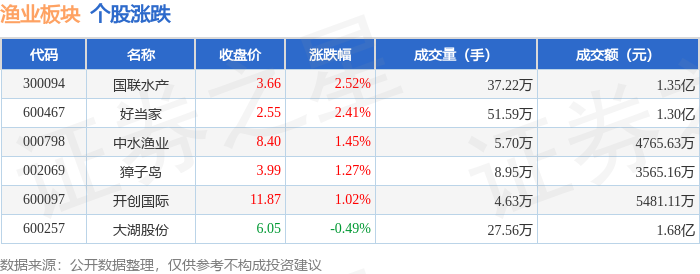
Core Insights - The fishery sector experienced a rise of 1.47% on November 10, with Guolian Aquatic leading the gains [1] - The Shanghai Composite Index closed at 4018.6, up 0.53%, while the Shenzhen Component Index closed at 13427.61, up 0.18% [1] Fishery Sector Performance - Guolian Aquatic (300094) closed at 3.66, with a gain of 2.52% and a trading volume of 372,200 shares, amounting to 135 million yuan [1] - Haodangjia (600467) closed at 2.55, up 2.41%, with a trading volume of 515,900 shares, totaling 130 million yuan [1] - Zhongshui Fishery (000798) closed at 8.40, increasing by 1.45%, with a trading volume of 57,000 shares, amounting to approximately 47.66 million yuan [1] - Zhangzini (002069) closed at 66.0, up 1.27%, with a trading volume of 89,500 shares, totaling about 35.65 million yuan [1] - Kaichuang International (600097) closed at 11.87, with a gain of 1.02%, trading 46,300 shares for about 54.81 million yuan [1] - Dahuhua (600257) closed at 6.05, down 0.49%, with a trading volume of 275,600 shares, totaling approximately 168 million yuan [1] Capital Flow Analysis - The fishery sector saw a net outflow of 14.16 million yuan from institutional investors and a net outflow of 6.35 million yuan from speculative funds, while retail investors had a net inflow of 20.51 million yuan [1] - Haodangjia (600467) had a net inflow of 11.06 million yuan from institutional investors, while it experienced a net outflow of 6.66 million yuan from speculative funds [2] - Zhongshui Fishery (000798) saw a net inflow of 0.57 million yuan from institutional investors, with a net outflow of 2.05 million yuan from speculative funds [2] - Guolian Aquatic (300094) experienced a net outflow of 2.89 million yuan from institutional investors, but a net inflow of 3.06 million yuan from speculative funds [2] - Dahuhua (600257) faced a significant net outflow of 17.96 million yuan from institutional investors, while retail investors contributed a net inflow of 16.84 million yuan [2]


对话挪威海产局中国总监毕思明:中国有望成为挪威海产第一大市场
2 1 Shi Ji Jing Ji Bao Dao· 2025-11-10 07:38
Core Insights - The China International Import Expo (CIIE) serves as a significant platform for Norwegian seafood companies to expand their public and government relations, as well as to explore macro-level cooperation opportunities [1] - China has rapidly become the third-largest market for Norwegian seafood exports, a significant increase from its previous position as the tenth-largest market in 2020 [1][2] - The growth of Norwegian seafood exports to China is primarily driven by salmon, with a projected continued increase in the Chinese salmon market [2] Group 1: Market Growth - In the first three quarters of this year, Norwegian seafood exports to China grew by 42%, with salmon being the largest contributor [2] - From January to September 2025, Norway exported 69,376 tons of salmon to China, generating 6.19 billion Norwegian Krone, representing year-on-year increases of 112.1% and 66.5% respectively [2] - Norway's market share of fresh whole salmon in China increased from 43% last year to 65% this year, making China the fifth-largest market for Norwegian salmon globally [2] Group 2: Emerging Products - The Arctic sweet shrimp from Norway has seen rapid growth in the Chinese market, with market share rising to 27% as of August this year [3] - In the first three quarters of 2025, Norway exported 7,482 tons of Arctic sweet shrimp to China, with an export value of nearly 400 million Norwegian Krone, reflecting year-on-year growth of 484% and 560% respectively [3] Group 3: Sales Channels and Strategies - The Norwegian Seafood Council is leveraging e-commerce and new retail channels to reach a broader consumer base in China, with online sales channels identified as the fastest-growing segment [4] - The Council's autumn promotional activities included collaborations with delivery platforms like Meituan and Taobao, marking a pilot initiative to explore new retail channels [5] - The expected export value of Norwegian seafood to China is projected to exceed 12.5 billion Norwegian Krone this year, with a planned 70% increase in market budget for the next year [5] Group 4: Future Collaboration - There is significant potential for cooperation between China and Norway in sustainable seafood and aquaculture, with numerous successful past collaborations [5] - Both countries have complementary roles in the seafood industry, with Norway needing China and vice versa, creating opportunities for mutual cooperation [5]
行进的海岸线丨渤海湾畔“渔旅融合” 小渔村启动蓝色新引擎
Yang Guang Wang· 2025-11-10 02:28
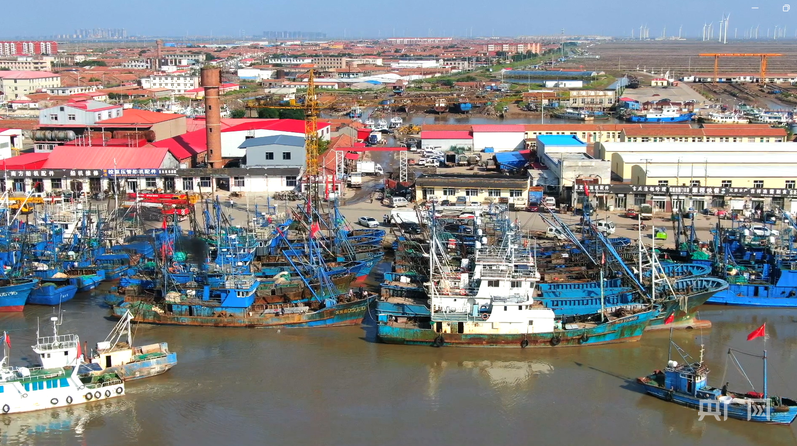
Core Insights - The article highlights the transformation of the fishing village of Nanpaihe Town in Cangzhou, Hebei Province, from a traditional fishing economy to a combined fishing and tourism model, driven by the need for diversification in response to fluctuating marine resources [3][11]. Group 1: Economic Transformation - Nanpaihe Town, with a coastline of 65.8 kilometers, is heavily reliant on fishing, but local leaders recognize the need to diversify beyond traditional fishing practices due to resource volatility [3][11]. - The town has embraced a "fishing + tourism" strategy, attracting visitors to enjoy coastal scenery, local cuisine, and hands-on fishing experiences, thereby establishing leisure fishing as a dominant industry [3][11]. Group 2: Tourism Development - The local fishing community has adapted by offering tourism services, such as boat tours where visitors can participate in fishing activities and enjoy freshly prepared seafood [8][11]. - The number of local homestays has increased significantly, with dozens of establishments catering to tourists, indicating a shift towards a tourism-driven economy [11]. Group 3: Marine Resources and Economic Impact - Nanpaihe Town is known for its rich marine biodiversity, with over 400 fishing vessels and an annual seafood catch exceeding 70,000 tons, contributing to a unique marine economy [8][11]. - The town is developing a tourism route that integrates various local resources and cultural elements, enhancing the overall tourist experience while supporting local fishermen in their transition to tourism [11][12].
海南 “五向图强”协同共进
Jing Ji Ri Bao· 2025-11-08 22:19
Core Insights - Hainan Province is China's only tropical province with deep-sea resources, recognized as the largest economic special zone and the only provincial international tourism island, and designated as a free trade port by the State Council [1] Industry Development - Hainan is advancing in five key sectors: agriculture, deep-sea, aerospace, digital economy, and green initiatives, focusing on enhancing its unique production capabilities [1] - The "South Breeding Silicon Valley" has established 20 research platforms, with agricultural output increasing by over 50% year-on-year, and over 2,800 innovative agricultural enterprises in Hainan [2] - The deep-sea sector is thriving with the launch of China's first self-developed deep-sea multifunctional research vessel and the production of the first deep-sea high-pressure gas field, leading to a 10.4% increase in marine production value [3] - In the aerospace sector, the completion of the first phase of the Star Glory rocket assembly plant marks a significant advancement in commercial aerospace infrastructure, with over 700 aerospace companies now in Wenchang International Aerospace City [3] - The digital economy is also growing, with a core industry revenue increase of 8% year-on-year, and the launch of various digital platforms [3] Policy Empowerment - The Fengjiawan Modern Fishing Industry Park is pioneering a multi-layered aquaculture model, attracting 55 research institutions and enterprises with a total investment of 7.9 billion yuan since 2020 [4][5] - Hainan has introduced innovative policies to enhance land resource allocation and asset revitalization, including the first national guidelines for state-owned agricultural land transfer [5] - The province has developed 173 institutional innovation results to support the construction of the Hainan Free Trade Port [5] Low-Carbon Transition - Hainan is driving ecological protection and industrial upgrading through technological innovation, aiming for high-quality green development [6] - As of August this year, Hainan's clean energy installed capacity reached 83.6%, with carbon reduction tools leading to a reduction of nearly 2 million tons of carbon emissions [7] - The province has the highest penetration rate of new energy vehicles in the country at 66.5%, with a total of 483,700 electric vehicles [7]
每周股票复盘:开创国际(600097)增补杨霖为独立董事获98.8856%同意票
Sou Hu Cai Jing· 2025-11-08 21:09
Core Points - The stock price of Kaichuang International (600097) increased by 2.8% to 11.75 yuan as of November 7, 2025, with a market capitalization of 2.831 billion yuan [1] - The company held its 21st temporary board meeting on November 3, 2025, where the board's nomination committee was adjusted, and the new chairman is Song Liming [1] - A second temporary shareholders' meeting was held on November 3, 2025, where Yang Lin was elected as an independent director with 98.8856% approval from attending shareholders [2][3] Company Announcements - The board of directors approved the adjustment of the nomination committee, with Song Liming appointed as the chairman [1][3] - The shareholders' meeting confirmed the election of Yang Lin as an independent director, with 106,738,252 shares voting in favor [2][3] - The company also approved the "Asset Impairment Provision and Financial Write-off Management Measures" [3]
辽宁丹东:耕海牧渔向深蓝
Liao Ning Ri Bao· 2025-11-08 05:47
Core Insights - The article discusses the development of a modern marine ranching project by China Communications Construction Company (CCCC) in Dandong, Liaoning, with a total planned investment of 5.2 billion yuan [1] - The project aligns with China's strategy to strengthen marine development and utilization, focusing on marine resource development and ecological protection [1] Group 1: Project Overview - The marine ranch is located in a prime fishing area at latitude 39°, characterized by low-temperature, clear waters, and strong self-purification capabilities, closely resembling the natural habitat of wild fish [2] - The project aims to cultivate large yellow croaker and greenfin horse mackerel, achieving a significant breakthrough in "southern fish raised in the north" [2] - The farming density is controlled at approximately 3 kg per cubic meter, allowing fish to grow in a more natural environment, resulting in firmer meat and a shape closer to wild fish [2] Group 2: Technological Integration - The project incorporates a "deep sea + land" collaborative monitoring system to collect real-time data on water temperature and salinity, optimizing feeding and maintenance strategies [2] - The large yellow croaker produced in this marine ranch exhibits rich nutritional content and firm meat, showcasing the integration of ecological farming and smart technology [2] Group 3: Government Support and Investment - Dandong City provides comprehensive support for the project through specialized services, marine area planning, and infrastructure development, ensuring successful implementation and operation [2] - The first phase of the marine ranch plans to invest 589 million yuan, with the construction of 27 gravity net cages and two intelligent farming platforms [2] - Over 100 million yuan has already been invested this year, resulting in the completion of seven gravity net cages, with future plans for artificial reefs to enhance fish habitats and support marine ecological restoration [2] Group 4: Future Prospects - The company aims to accelerate investment during the 14th Five-Year Plan period, with plans to start building framework net cages and artificial reefs by the end of the year to expand farming scale [3] - The estimated revenue for the marine ranch this year is expected to reach 30 million yuan [3]

越南打击IUU渔业捕捞
Shang Wu Bu Wang Zhan· 2025-11-07 16:11
Core Viewpoint - The Vietnamese government is intensifying efforts to combat illegal, unreported, and unregulated (IUU) fishing, focusing on the southern region and targeting unregistered fishing vessels [1] Group 1: Government Actions - The Prime Minister of Vietnam, Pham Minh Chinh, chaired the 20th meeting of the National Steering Committee on IUU fishing, emphasizing the need for a special action plan against IUU fishing [1] - The government has mandated that industry associations prohibit the purchase and processing of seafood products sourced from IUU fishing [1] Group 2: Industry Statistics - As of October 31, nearly 80,000 fishing vessels are registered in the national fisheries database, with 79,800 vessels (99.8%) updated, leaving 141 vessels unregistered (0.2%) [1]