
消费品制造

Search documents
轻工制造行业快评报告:多个消费品制造细分行业利润端有所改善
Wanlian Securities· 2025-05-06 05:51
Investment Rating - The industry investment rating is "Outperform the Market" with an expected relative increase of over 10% in the industry index compared to the market over the next six months [7]. Core Insights - The profits of large-scale industrial enterprises in China showed improvement in March 2025, with total profits reaching 15,093.6 billion yuan, a year-on-year increase of 0.8%, and a month-on-month increase of 1.1 percentage points [1]. - In the consumer goods manufacturing sector, five out of thirteen major categories experienced profit growth, with agricultural and sideline food processing profits increasing by 40.3% year-on-year [2]. - The report suggests focusing on sectors such as food and beverage, cosmetics, gold and jewelry, and home appliances, highlighting the resilience of essential consumer goods [3]. Summary by Sections Industrial Profit Trends - In the first quarter of 2025, large-scale industrial enterprises achieved a total revenue of 321,395.9 billion yuan, reflecting a year-on-year growth of 3.4% [1]. - March 2025 saw a revenue increase of 4.2% year-on-year, indicating a positive trend in industrial performance [1]. Consumer Goods Manufacturing - The report identifies a narrowing of profit declines in several consumer goods manufacturing sectors, with notable growth in agricultural and sideline food processing and textiles [2]. - The wearable smart device manufacturing, electric vehicle manufacturing, and kitchen appliance sectors saw significant profit increases of 78.8%, 65.8%, and 21.7% respectively due to supportive policies [2]. Investment Recommendations - The report recommends focusing on resilient sectors such as food and beverage, cosmetics, gold and jewelry, and home appliances, with specific attention to leading companies in these areas [3].
4月制造业PMI回落,生产经营预期指数继续位于扩张区间
Di Yi Cai Jing· 2025-04-30 07:18
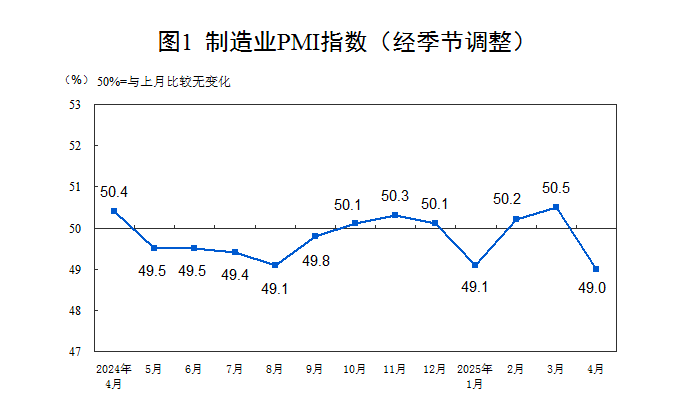
Group 1 - The manufacturing PMI for April dropped to 49.0%, down 1.5 percentage points from the previous month, indicating a contraction after two months of expansion [1] - The production activity expectation index remains optimistic at 52.1%, with certain industries like food and beverage, automotive, and aerospace showing strong confidence, all above 58.0% [1] - The new orders index fell to 49.2%, down 2.6 percentage points, while the new export orders index decreased to 44.7%, down 4.3 percentage points, reflecting a contraction in demand [4] Group 2 - The production index for April was 49.8%, a decline of 2.8 percentage points from the previous month, with decreases noted across major manufacturing sectors [3] - The purchasing price index for raw materials dropped to 47%, down 2.8 percentage points, indicating weakened support for raw material prices [4] - The government plans to implement measures to stabilize employment and the economy, focusing on effective investment and consumption promotion [5]

突然!日本宣布“救市”!出台紧急方案应对美国关税政策
Zheng Quan Shi Bao Wang· 2025-04-30 02:58
Group 1: Japan's Emergency Measures - The Japanese government announced an emergency plan on April 25 to mitigate the negative impacts of U.S. tariff policies on Japanese businesses and consumers [1][3] - The plan includes improving corporate consultation systems, enhancing financing support for businesses, maintaining employment, stimulating domestic consumption, transforming industrial structures, and increasing competitiveness [1][3] - Specific measures involve lowering gasoline prices, providing subsidies for electricity and gas, and easing conditions for companies to receive employment adjustment subsidies without layoffs [3] Group 2: Impact on Japanese Economy and Monetary Policy - Bank of Japan Governor Kazuo Ueda indicated that if Japan's core inflation approaches the 2% target, the central bank will continue to raise interest rates [2][5] - Analysts warn that the impact of U.S. tariff policies will be a significant factor in the Bank of Japan's future policy decisions [2][6] - The Bank of Japan is expected to maintain interest rates at 0.5% during the upcoming policy meeting, with a potential downward revision of growth forecasts due to the complexities introduced by U.S. tariffs [6] Group 3: U.S. Corporate Earnings Warnings - Major U.S. companies, including Procter & Gamble, PepsiCo, Delta Air Lines, AT&T, and NextEra Energy, have issued profit warnings due to the impact of tariffs [7][8] - Over 90% of S&P 500 companies mentioned tariff impacts during their Q1 earnings calls, with mentions of "recession" rising from under 3% to 44% [7] - Procter & Gamble attributed its lowered guidance to tighter consumer spending and the impact of tariffs on its cost structure [8] Group 4: Sector-Specific Concerns - In the airline industry, executives from American Airlines and Delta Air Lines expressed concerns over rising aircraft costs due to tariffs, leading to the withdrawal of financial guidance [8][9] - Telecommunications companies AT&T and Verizon warned that tariffs could increase prices for mobile phones and routers, with Verizon stating it would not absorb the high costs [9] - Medical device manufacturer Boston Scientific projected a $200 million loss this year due to tariffs, while Johnson & Johnson highlighted a $400 million cost impact from medical device tariffs [9]


