矿产资源

Search documents
美国政府停摆3周后,美联储出手救市!贝森特信口开河:稀土管制是“对抗全世界”
Sou Hu Cai Jing· 2025-10-16 02:25
Core Viewpoint - The ongoing government shutdown in the U.S. is causing significant economic distress, with over 800,000 federal employees on unpaid leave and disruptions in various sectors, including air travel [1] Group 1: Economic Impact - The government shutdown has led to a rise in unemployment and increased layoffs, indicating a cooling job market [3] - The Federal Reserve plans to lower interest rates by 0.25 percentage points to stimulate the economy, but this may only serve as a temporary relief rather than a long-term solution [3] - Financial markets are reacting to the Fed's easing expectations, with a weakening dollar and declining U.S. Treasury yields, while safe-haven assets like gold and Bitcoin are gaining popularity [5] Group 2: Political Dynamics - The political standoff between the Democratic and Republican parties is intensifying, with President Trump suggesting that the shutdown could be beneficial for eliminating Democratic legacies [1] - Treasury Secretary Mnuchin has shifted focus to international issues, accusing China of disrupting global supply chains through its control of rare earth exports, which may be a distraction from domestic problems [3][5] - The U.S. is attempting to regain control over strategic resources by attacking China, despite China's significant role in the global rare earth market, producing nearly 60% of the world's supply and processing 90% [5] Group 3: Future Outlook - The resolution of the government shutdown and the future of U.S.-China trade relations will be critical in determining the economic landscape [7] - A collaborative approach with other nations is necessary for the U.S. to find sustainable solutions to global supply chain and economic challenges, rather than relying solely on isolationist tactics [7]


年入近30亿,这家公司北交所IPO提交注册五个月后,拟终止!
Sou Hu Cai Jing· 2025-10-03 08:43
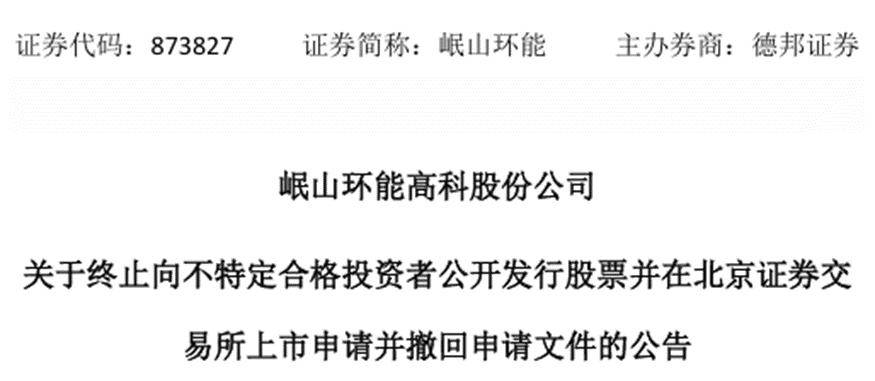
Core Viewpoint - Company Minshan Environmental Energy has decided to terminate its application for public stock issuance and listing on the Beijing Stock Exchange, as announced on September 30, 2025 [1][10]. Group 1: Company Financial Performance - In the fiscal years 2022, 2023, and 2024, the company's operating revenues were CNY 2,599.01 million, CNY 2,939.72 million, and CNY 2,895.02 million, respectively [5]. - The net profit attributable to the parent company for the same years was CNY 46.12 million, CNY 61.25 million, and CNY 72.99 million, showing a consistent growth trend [5]. - For the first half of 2025, the company reported operating revenue of CNY 168.84 million, a year-on-year increase of 27.16%, and a net profit of CNY 41.26 million, up 13.72% [6][7]. Group 2: Assets and Liabilities - As of December 31, 2024, the total assets amounted to CNY 1,453.17 million, with total equity of CNY 739.65 million [6]. - The company's debt-to-asset ratio was 50.47% as of December 31, 2024, indicating a stable financial structure [6]. Group 3: IPO and Future Projects - The company submitted its application for public stock issuance on December 1, 2023, and the application was officially accepted by the Beijing Stock Exchange on December 8, 2023 [4]. - The planned fundraising amount for the IPO is CNY 295 million, which will be allocated to several projects, including a user-side electrochemical energy storage station and a retired battery recycling project [8][9]. Group 4: Shareholder Structure - The actual controllers of the company, He Qiunan, He Aiyun, and He Zhanyuan, collectively hold 59.61% of the voting rights at the shareholders' meeting [9].
“三原则”应对造假行为,矿产资源储量报告新规出台
Di Yi Cai Jing· 2025-10-03 02:26
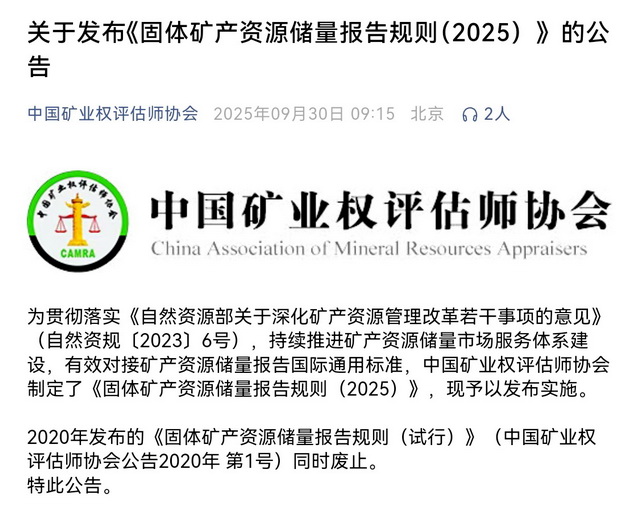
Core Viewpoint - The authenticity of mineral resource reserve reports is crucial for maintaining order in resource development and ensuring market fairness [2][9]. Group 1: New Regulations - The China Mining Rights Appraisal Association has introduced the "Solid Mineral Resource Reserve Reporting Rules (2025)" to address issues of false or misleading mineral resource reserve reports [2][5]. - The rules emphasize three principles: transparency, substance, and competence, applicable to capital and securities markets [2][6]. - Transparency requires that reports provide sufficient information to investors and their advisors, ensuring clarity and preventing misunderstandings [2][6]. - Substance mandates that reports include all relevant information that investors reasonably expect to make informed judgments about exploration results and resource estimates [2][6]. - Competence stipulates that reports must be based on work conducted by qualified professionals, ensuring the integrity of the information presented [2][6]. Group 2: Industry Challenges - The mining rights evaluation process has faced challenges, including instances of false reporting and misrepresentation of resource reserves, which can lead to significant financial losses for mining rights holders [3][6]. - Issues such as inadequate professional standards, lack of accountability, and intentional misreporting have been identified as contributing factors to the problem [6][7]. - Specific cases, such as the Qinghai Province copper-arsenic mine report, illustrate the consequences of inaccurate data, including inflated resource estimates and misrepresentation of mining conditions [6][7]. Group 3: Importance of Accurate Reporting - Accurate mineral resource reserve reporting is essential for determining the value of mining rights and ensuring fair market transactions [3][9]. - Misrepresentation of reserves can lead to discrepancies between the actual value and the market price, affecting both primary and secondary market transactions [9]. - The government has recognized the importance of mining rights evaluation, implementing measures to enhance the quality and reliability of reserve assessments [8][9].
AMC shares: your next blue chip investment?
Rask Media· 2025-09-19 21:17
Core Insights - Amcor's share price has decreased by 17.0% since the beginning of 2025, while BHP's share price is 14.3% below its 52-week high, suggesting potential investment opportunities in both companies [1] - Amcor is a global leader in packaging solutions, operating over 200 sites in 40 countries, focusing on innovation and sustainability [2] - BHP Group, a diversified natural resources company, has a long-standing reputation as a reliable dividend-paying investment and is a significant player in the Australian market [3][5] Amcor (AMC) Overview - Amcor's debt/equity ratio for FY24 is reported at 187.0%, indicating a leveraged position with more debt than equity, which necessitates stable returns and sufficient cash flow to manage interest payments [7] - The company has delivered an average dividend yield of 4.4% per year over the last five years, appealing to income-focused investors [7] - Amcor's return on equity (ROE) for FY24 is 18.4%, exceeding the typical benchmark of 10% for mature businesses [8] BHP Group Overview - BHP's debt/equity ratio for FY24 stands at 45.3%, reflecting a stronger equity position compared to debt [8] - The company has achieved an average dividend yield of 6.9% per year since 2019, making it attractive for dividend-seeking investors [8] - BHP reported an ROE of 19.7% for FY24, indicating strong profitability relative to equity [8] Investment Considerations - Both Amcor and BHP are considered mature or blue-chip businesses, with metrics such as debt/equity ratio, average yield, and ROE being critical for evaluating their financial health and investment potential [6]

“十四五”央企重组成绩单:6组10企整合,9家新央企诞生
Hua Xia Shi Bao· 2025-09-17 23:48
Core Insights - The State-owned Assets Supervision and Administration Commission (SASAC) reported significant achievements in the restructuring of central enterprises during the "14th Five-Year Plan" period, emphasizing the acceleration of modern state-owned enterprises and the enhancement of core functions and competitiveness [3][4] Group 1: Restructuring Achievements - Six groups of ten enterprises underwent strategic restructuring, with nine new central enterprises established in key sectors such as equipment manufacturing, mineral resources, and energy security [4][6] - The restructuring is characterized by a strategic orientation, focusing on national security and economic lifelines, with an emphasis on enhancing industrial collaboration and optimizing public services [4][5] Group 2: Investment in Emerging Industries - Central enterprises have invested a cumulative total of 8.6 trillion yuan in strategic emerging industries since the beginning of the "14th Five-Year Plan," marking a significant increase compared to the "13th Five-Year Plan" [6] - Revenue from strategic emerging industries is projected to exceed 11 trillion yuan in 2024, with contributions from new generation information technology and high-end equipment sectors surpassing one trillion yuan each [6][8] Group 3: Future Directions for Restructuring - Future restructuring efforts will focus on strategic emerging industries, key links in industrial chains, and upgrading traditional industries, with an emphasis on mergers and acquisitions to fill gaps in capabilities [7][8] - The goal is to enhance core functions and competitiveness, aiming for world-class enterprise status while addressing national strategic security and public welfare needs [8]

“十四五”央企重组成绩单:6组10企整合,9家新央企诞生,国有资本配置和运营效率提升
Hua Xia Shi Bao· 2025-09-17 10:09
Core Insights - The State-owned Assets Supervision and Administration Commission (SASAC) reported significant achievements in the restructuring of central enterprises during the "14th Five-Year Plan" period, focusing on enhancing core functions and competitiveness [2][3] - A total of 10 enterprises were strategically restructured, and 9 new central enterprises were established, targeting key sectors such as equipment manufacturing, mineral resources, and energy security [3][4] - The restructuring efforts are aligned with national strategic needs, emphasizing not just revenue but also fulfilling strategic tasks [2][4] Restructuring and Integration - The restructuring of central enterprises is characterized by a strategic orientation, with 6 groups of 10 enterprises restructured through market-oriented methods [3][4] - New enterprises established include China Star Network Group for satellite internet, China Logistics Group for comprehensive logistics services, and China Mineral Resources Group for resource security [3][4] - The restructuring aims to enhance industrial collaboration, reduce redundant investments, and improve resource allocation efficiency, creating a "1+1>2" effect [3][4] Focus on Public Services - The restructuring also aims to optimize public services, ensuring high-quality and low-cost services to meet public needs [4] - New central enterprises are designed to address critical national security and strategic needs, such as resource security and green transformation [4][5] Investment in Emerging Industries - Central enterprises have significantly increased investments in strategic emerging industries, totaling 8.6 trillion yuan during the "14th Five-Year Plan" period, marking a substantial increase from the previous plan [5][6] - Key sectors include integrated circuits, biotechnology, and new energy vehicles, with notable advancements in cutting-edge fields like humanoid robots and superconducting quantum computing [5][6] Future Directions - The focus for future restructuring will include strategic emerging industries, critical links in industrial chains, and public welfare sectors [6][7] - Central enterprises aim to enhance core functions and competitiveness, with a goal of becoming "world-class enterprises" through systematic and innovative restructuring [7] - The restructuring pace is expected to double in the "15th Five-Year Plan" period, particularly in areas related to national security and social welfare [7]

新疆哈密局 出台举报非法采矿行为奖励办法
Zhong Guo Zi Ran Zi Yuan Bao· 2025-09-12 08:25
日前,新疆维吾尔自治区哈密市自然资源局公开发布举报非法开采矿产资源行为奖励办法,旨在进 一步规范矿产资源开发管理秩序,严厉打击和坚决遏制非法开采矿产资源行为。 据悉,举报范围为未取得采矿权开采矿产资源或未取得采矿许可证进行矿产资源开采作业违法行 为。举报人可实名或匿名采取电话、信件、电子邮箱、来访等方式向哈密局举报违法线索,也可通过公 安110报警电话、市长热线12345进行举报。 根据办法,接到举报线索后,哈密局应及时对线索进行调查核查,对查证举报线索属实的,依据本 办法给予奖励;对查证举报线索不属于本办法举报范围的,向举报人进行告知;对查证举报线索存在故 意捏造、歪曲事实、诬告陷害他人或生产经营单位、影响行政管理工作秩序等情况的,依法追究举报人 相关法律责任。 对应当给予奖励的,由哈密局按照相关标准给予奖励:举报线索经查证属实的,给予2000元奖励; 举报线索经查证属实并提供相关违法证据的,给予5000元奖励;举报线索经查证属实并提供相关违法证 据和协助案件办理的,给予10000元奖励。举报的违法行为涉嫌刑事犯罪且由公安机关立案侦查的,给 予2000元额外奖励。举报线索涉及重大违法犯罪行为的,另加奖100 ...
金石资源控股股东部分股份质押与解除质押
Xin Lang Cai Jing· 2025-09-10 08:08
Group 1 - The core announcement is that Jingshi Resources (603505) has pledged 30 million shares to CITIC Securities for financing to repay pledged debts, with the pledge period lasting until September 8, 2026 [1] - Following this pledge, Jingshi Industrial has released a previous pledge of 42.42 million shares, resulting in a total of 89.84 million shares pledged, which accounts for 21.35% of its total holdings and 10.67% of the company's total share capital [1] - Jingshi Industrial and its concerted parties hold a total of 460 million shares, representing 54.69% of the total share capital, with the cumulative pledge of 89.84 million shares accounting for 19.52% of their total holdings and 10.67% of the company's total share capital [1] Group 2 - The current pledge does not affect the company's control, as Jingshi Industrial has good creditworthiness and repayment capability [1]

新矿法解读|强化矿业权物权保护 促进矿业市场健康发展
Zhong Guo Zi Ran Zi Yuan Bao· 2025-09-05 01:44
Core Viewpoint - The newly revised Mineral Resources Law, effective from July 1, 2025, introduces a "separation of rights and certificates" system, which separates the registration of mining rights from the licensing for exploration and extraction, marking a significant shift in the management of mineral resources in China [1][5]. Group 1: Evolution of the System - The previous system of "one certificate carrying two rights" allowed exploration and mining licenses to serve dual functions, which created legal ambiguities and practical issues over time [3][4]. - The 2007 Property Law and the 2020 Civil Code clarified the property nature of mining rights, necessitating a separation of rights registration from administrative licensing [4][5]. Group 2: Legal Implications of the "Separation of Rights and Certificates" System - The new law establishes a clear distinction between mining rights certificates and exploration/mining licenses, enhancing the legal status of mining rights and ensuring their protection [7][9]. - The management process is restructured to prioritize rights confirmation before licensing, ensuring that mining rights are stable and protected from arbitrary administrative actions [8][11]. Group 3: Impact on Property Protection and Market Order - The "separation of rights and certificates" system provides mining rights holders with stable legal expectations and protections, preventing arbitrary cancellation of rights due to administrative decisions [11][12]. - The new law simplifies the transfer of mining rights, eliminating the need for prior approval from authorities, which encourages market activity and reduces transaction costs [12][13]. - The establishment of a unified national mining rights registry enhances transparency and reduces transaction risks, allowing stakeholders to verify rights status easily [12][13].
中国中冶(601618):Q2扣非归母净利润同比高增,海外新签订单增速亮眼
Guotou Securities· 2025-09-01 07:37
Investment Rating - The investment rating for the company is "Buy-A" with a 12-month target price of 4.06 CNY, compared to the current stock price of 3.41 CNY as of August 29, 2025 [3]. Core Views - The company reported a significant increase in non-net profit attributable to the parent company in Q2, with a year-on-year growth of 30.88% [1]. - Despite overall revenue pressure due to external factors such as declining steel demand and real estate adjustments, the company has shown robust growth in overseas new contracts, particularly in the mining sector [3][8]. - The company's gross profit margin improved to 10.09% in H1 2025, reflecting a year-on-year increase of 1.04 percentage points [2]. Summary by Sections Financial Performance - In H1 2025, the company achieved operating revenue of 237.53 billion CNY, a year-on-year decrease of 20.52%, and a net profit of 3.099 billion CNY, down 25.31% year-on-year [1]. - The Q2 2025 operating revenue was 115.26 billion CNY, a decline of 22.59%, while the net profit was 1.492 billion CNY, showing a slight increase of 1.43% year-on-year [1]. - The company’s sales gross margin was 10.09% in H1 2025, with the engineering contracting segment at 9.58% and the specialty business at 17.62% [2]. Contract and Business Development - The company signed new contracts worth 548.2 billion CNY in H1 2025, a year-on-year decrease of 19.1%, with overseas contracts amounting to 57.75 billion CNY, representing a growth of 32.6% [3]. - The mining resources segment, focusing on metals like nickel, cobalt, and copper, generated revenue of 3.298 billion CNY in H1 2025, with three overseas mines contributing 2.82 billion CNY [3]. Profitability and Cash Flow - The company’s operating cash flow showed improvement, with a net outflow of 21.985 billion CNY in H1 2025, which is a reduction of 33.20% year-on-year [2]. - The net profit forecast for 2025 is adjusted to 5.71 billion CNY, with expected revenues of 476.54 billion CNY, reflecting a year-on-year decline of 13.67% [8].