Smartphones

Search documents
荣耀Magic8 RSR销售额刷新纪录
Xin Lang Cai Jing· 2026-01-24 12:08
荣耀发布战报称,昨日正式开卖的荣耀Magic8 RSR保时捷设计销售额超越历代保时捷设计版,创造了 最高纪录。据了解,该手机起售价是7999元,在核心配置方面,这款手机搭载了高通第五代骁龙8至尊 版移动平台,其顶配版本配备了24GB运行内存,并搭载了中电科芯片的两款手机直连卫星通信芯片, 支持天通与北斗双卫星链路。 ...
X @TechCrunch
TechCrunch· 2026-01-24 05:03
Apple iPhone just had its best year in India as the smartphone market stays broadly flat https://t.co/FP5fI6QyiS ...

华为折叠机独占七成份额 但苹果很快“杀到”
Zhong Guo Jing Ying Bao· 2026-01-24 01:00
Core Insights - The Chinese foldable smartphone market is transitioning from rapid growth to a plateau phase, with a projected shipment of approximately 10.01 million units in 2025, reflecting a year-on-year growth of 9.2%, contrasting with a decline of 0.6% in the overall smartphone market [1][2] - Huawei dominates the market with a share exceeding 70%, while other brands like Honor, vivo, OPPO, and Samsung hold less than 10% each, indicating a significant market concentration [1][2] - The anticipated entry of Apple into the foldable smartphone market in 2026 is expected to revitalize consumer interest and market dynamics [4][5] Market Dynamics - The foldable smartphone market in China is entering a "small year" in 2025, with many manufacturers adjusting their production targets downward, leading to a more pronounced market segmentation [2] - Huawei's market share increased from 50% in 2024 to 71.8% in 2025, while Honor and vivo hold 9.1% and 4.9% respectively, with OPPO and Samsung tied at 4.3% [2] - The market is characterized by a "one strong, many strong" dynamic, where Huawei's continuous investment and technological advancements have solidified its leading position [2] Product Innovations - Huawei's product lineup for 2025 includes various foldable designs, such as the Mate X6, Mate X7, and the innovative Mate XTs, which cater to different consumer preferences [3] - The expected launch of Apple's first foldable iPhone, tentatively named iPhone Fold, is set for fall 2026, featuring advanced materials and design innovations [5][6] Future Outlook - The entry of Apple is anticipated to attract more consumers to foldable smartphones, potentially driving market growth [6] - Analysts predict that the global foldable smartphone market will see a significant increase, with shipments expected to reach 20.6 million units in 2025, and a projected 30% growth in 2026 due to Apple's and Samsung's contributions [6][7] - The introduction of Apple's foldable iPhone is viewed as a pivotal moment for the foldable segment, likely catalyzing broader adoption and technological advancements in the supply chain [7]
Xiaomi announces HK$2.5 billion buyback as competition and cost pressures weigh on stock
CNBC· 2026-01-23 07:14
Core Viewpoint - Xiaomi announced a stock buyback program worth up to HK$2.5 billion ($321 million) to reassure investors amid competition and rising costs [1] Group 1: Stock Buyback Program - The buyback program is intended to address investor concerns due to intensifying competition, rising component costs, and recent product safety issues [1] - The latest buyback will commence on January 23 and will be conducted on the open market, subject to market conditions and regulatory approvals [3] Group 2: Share Performance - Despite the announcement of the buyback, Xiaomi's shares have declined over 8% year-to-date, indicating ongoing pressure on the company's valuation [2] - The company has a history of share repurchases, including a recent buyback of 4 million shares for HK$152 million on January 13 [2] Group 3: Criticism of Buybacks - Critics argue that stock buybacks can inflate share prices without enhancing the underlying business, suggesting that funds could be better allocated to employee compensation, factory expansion, job creation, and innovation [2]


真我Neo8发布,搭载165Hz三星苍穹屏
WitsView睿智显示· 2026-01-23 05:44
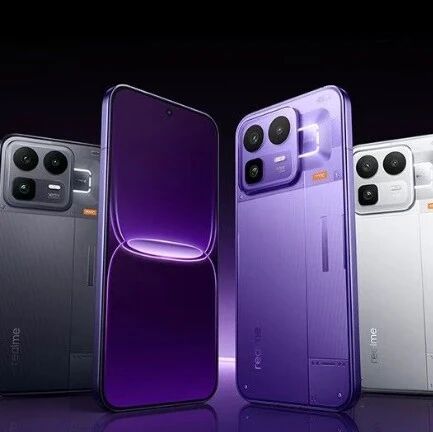
1月22日, realme真我Neo8手机 正式 发布,产品首销价2399元起,国补到手价2039.15元 起。 图片来源: realme真我 屏幕方面,真我联合三星显示定制全新165Hz三星苍穹屏,采用M14旗舰发光材料。屏幕的手动 峰值亮度1000nit、全局峰值亮度1800nit、局部峰值亮度6500nit,支持3800nit阳光显示, 3800nit极限高亮度下仍能实现103%的P3超广色域覆盖。 据悉,为满足电竞需求,Neo8手机屏幕支持超30款热门游戏实现原生165Hz超高帧显示。同时, 手机还搭载定制妙感触控芯,支持3800Hz瞬时触控采样率;拥有全新绿野护眼技术,支持全亮度 DC调光、硬件级低蓝光、AI主动护眼技术等。 此外,Neo8手机搭载第五代骁龙8处理器、UFS 4.1+LPDDR5X、大气流冷锋散热系统、苍穹通 信系统、8000mAh电池等配置,并拥有新一代极客性能面板、新一代GT性能引擎等技术,全面满 足电竞需求。(集邦Display) TZ 不器研究中心 面板产业链市场供需及价格报告 面板价格"Plus"和市况更新月度报告 面板产业市况季度报告 . 面板价格预测月度报告 . 面板出 ...
苹果进入印度手机市场前五,去年出货增长28%
Guan Cha Zhe Wang· 2026-01-23 05:42
Core Insights - The Indian smartphone market is projected to see a decline in shipments, with approximately 34.5 million units expected in Q4 2025, a 7% year-over-year decrease, and an annual total of 154.2 million units, reflecting a slight 1% decline [1][2] - Vivo maintains its leading position in both quarterly and annual shipments, with a market share of 23% in Q4 and 21% for the year, showing a growth rate of 19% [2][3] - The market is experiencing a shift towards value-driven strategies, influenced by rising component costs, cautious consumer spending, and extended upgrade cycles [1][4] Quarterly Performance - In Q4 2025, Vivo shipped approximately 7.9 million units, capturing 23% of the market share, followed by Samsung with 4.9 million units (14% share) and OPPO with 4.6 million units (13% share) [1] - The overall decline in Q4 shipments is attributed to high channel inventory, currency depreciation, and increased memory costs leading to higher product prices, which have weakened purchasing power [1][2] Annual Performance - For the full year, Vivo's total shipments reached 32.1 million units, securing a 21% market share, while Samsung and OPPO followed with 23 million and 20 million units, respectively [2] - Apple ranked fifth with a market share of approximately 10%, showing the most significant growth among the listed companies at 28% year-over-year [2] Market Dynamics - The fourth quarter is characterized as a period for inventory digestion, with brands like Vivo and OPPO achieving double-digit year-over-year growth due to strong retail execution and effective product management [2][3] - Other leading brands faced challenges, including cautious channel behavior and price adjustments, with Samsung and Xiaomi experiencing sales slowdowns despite targeted promotions [2][3] Future Outlook - The Indian smartphone market is expected to see a mid-single-digit percentage decline in 2026, driven by rising terminal prices and limited incremental value in products [3][4] - Brands are anticipated to shift focus towards value growth strategies in the entry-level market, particularly in the ₹25,000 to ₹60,000 segment, which offers better profit margins [3][4] - The high-end market above ₹60,000 will continue to be dominated by Apple, Samsung, and Vivo, with brands increasingly relying on channel leverage and localized marketing strategies to maintain market stability [4]

华为破了vivo的金身
3 6 Ke· 2026-01-23 03:52
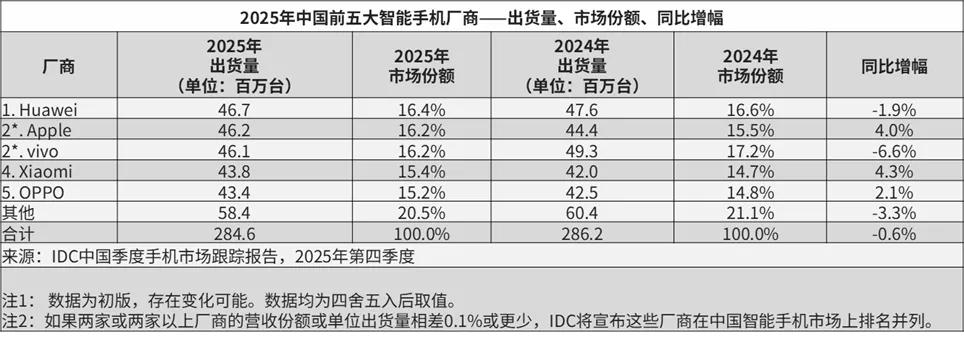
Core Viewpoint - The Chinese smartphone market has experienced significant changes in rankings, with Huawei regaining the top position in market share after several years, despite a slight decline in overall shipment volume [1][4]. Market Overview - In 2025, the total shipment volume of smartphones in China is projected to be 285 million units, reflecting a year-on-year decrease of 0.6% [1][4]. - The competitive landscape is intensifying, with major brands closely contending for market share [3][4]. Key Players and Market Share - The top five smartphone manufacturers in China for 2025 are: 1. Huawei: 46.7 million units, 16.4% market share, down 1.9% from 2024 2. Apple: 46.2 million units, 16.2% market share, up 4.0% from 2024 3. Vivo: 46.1 million units, 16.2% market share, down 6.6% from 2024 4. Xiaomi: 43.8 million units, 15.4% market share, up 4.3% from 2024 5. OPPO: 43.4 million units, 15.2% market share, up 2.1% from 2024 [2]. Vivo's Market Position - Vivo has dropped from first to third place in market share, with a significant year-on-year decline in shipment volume [2][11]. - The brand's strategy of releasing a high number of models (81 in 2025) is under scrutiny as the market shifts towards high-end devices [11][12]. Industry Trends - The smartphone market is transitioning from an incremental growth phase to a saturated market, with a notable increase in the share of high-end devices priced above 4,000 RMB [12][13]. - The competition is expected to intensify in 2026, particularly due to rising costs in components like memory [5][23]. User Experience and Brand Loyalty - Vivo's user retention rate is lower than competitors like Huawei and Apple, indicating potential issues with customer satisfaction [22]. - The brand has faced criticism regarding user experience, particularly in areas such as camera performance and software functionality [16][21]. Future Outlook - Vivo needs to enhance its focus on high-end market segments to remain competitive, especially as the overall market is expected to decline further in 2026 [14][23].
Apple Retains Smartphone Leadership as Its Chinese Shipments Soared Over 28% in Q4
Yahoo Finance· 2026-01-22 18:08
Apple Inc. (NASDAQ:AAPL) is one of the 15 Best S&P 500 Stocks to Look For in 2026. On January 12, Reuters reported that Apple Inc. (NASDAQ:AAPL) led the smartphone market with a 20% share worldwide. Apple’s iPhone 17 series had strong sales and gained demand in emerging and mid-sized markets, according to Counterpoint analyst Varun Mishra. The promising sign for Apple is that it reclaimed its top spot in China’s smartphone market after iPhone shipments soared 28% during Q4 2025. The rebound suggests that ...
存储等核心元器件成本上涨 手机行业竞争格局重构
Mei Ri Jing Ji Xin Wen· 2026-01-22 15:28
Core Insights - Honor has launched three new smartphone models targeting different consumer segments, indicating a strategic shift to attract younger and female users under new management [1] - The global smartphone market is facing dual pressures from rising component costs and limited domestic market growth, necessitating a search for new growth opportunities [1] - Omdia predicts that by 2026, the smartphone market will enter a new phase dominated by "cost pressure" and "value creation," with a clear trend of market differentiation [2] Industry Overview - The global smartphone shipment is expected to reach 1.26 billion units in 2025, with a year-on-year growth of 1.9%, primarily driven by mid-to-high-end models [3] - Apple and Samsung are projected to be the strongest performers among the top five smartphone manufacturers, with growth rates of 6.3% and 7.9% respectively, increasing their combined market share to 39% [3] - Other manufacturers like Xiaomi and OPPO are experiencing market share declines, with Xiaomi's shipments dropping significantly in Q4 2025 due to competitive pressures and a shift towards high-end products [3] Market Dynamics - The entry-level smartphone segment, once a stronghold for Chinese manufacturers in overseas markets, is now under pressure due to rising component costs, prompting a shift towards the mid-to-high-end market [4] - Honor's overseas smartphone shipments grew by approximately 55% in the first three quarters of 2025, with Europe being a key market for its high-end strategy [4] - OPPO's shipments of mid-to-high-end smartphones increased from 2.7 million units in Q2 2024 to 4 million units in Q2 2025, reflecting a similar strategic shift [5] Supply Chain Challenges - Rising prices of core components, particularly storage, are significantly impacting the smartphone market, with Omdia highlighting this as a key variable for 2026 [7] - The supply of LPDDR4 and LPDDR5 memory is constrained, leading to intense competition among manufacturers to manage costs and secure supply [7] - The price of DRAM and NAND memory surged by 386% and 207% respectively in 2025, with further increases expected in early 2026 [8] Strategic Adjustments - Manufacturers are adjusting their product strategies in response to rising costs, with many shifting focus from entry-level to mid-range products to maintain profitability [4][9] - The industry is expected to face challenges in maintaining healthy inventory levels, with a recommended storage inventory of 8 to 10 weeks [9]
Apple's Huge Surge in China
247Wallst· 2026-01-22 14:15
Core Insights - Research firm Counterpoint has released its smartphone data for China in the fourth quarter of 2025, indicating significant trends in the market [1] Group 1: Market Performance - The smartphone market in China showed a notable increase in shipments during Q4 2025 compared to the previous quarter, reflecting a recovery in consumer demand [1] - The total number of smartphones shipped reached a new high, with a year-over-year growth rate of 15% [1] Group 2: Brand Analysis - Leading brands such as Brand A and Brand B have captured a larger market share, with Brand A increasing its share by 5% compared to Q3 2025 [1] - Emerging brands are also gaining traction, with a combined market share increase of 10% in the same period [1] Group 3: Consumer Trends - There is a growing preference for 5G-enabled devices among consumers, with 5G smartphones accounting for 70% of total shipments in Q4 2025 [1] - The demand for mid-range smartphones has surged, indicating a shift in consumer spending habits [1]