家用电器

Search documents
20个行业获融资净买入,食品饮料行业净买入金额最多
Zheng Quan Shi Bao Wang· 2025-08-01 02:51
7月31日各行业融资余额环比变动 注:本文系新闻报道,不构成投资建议,股市有风险,投资需谨慎。 | 代码 | 最新融资余额(亿元) | 较上一日增减(亿元) | 环比增幅(%) | | --- | --- | --- | --- | | 食品饮料 | 527.35 | 10.72 | 2.07 | | 医药生物 | 1457.53 | 9.49 | 0.66 | | 计算机 | 1525.26 | 7.37 | 0.49 | | 家用电器 | 283.54 | 5.93 | 2.14 | | 房地产 | 312.88 | 5.45 | 1.77 | | 公用事业 | 470.28 | 5.21 | 1.12 | | 银行 | 630.87 | 4.63 | 0.74 | | 基础化工 | 842.82 | 4.52 | 0.54 | | 交通运输 | 359.01 | 3.79 | 1.07 | | 电子 | 2260.92 | 3.23 | 0.14 | | 建筑材料 | 136.25 | 2.55 | 1.91 | | 建筑装饰 | 359.14 | 2.13 | 0.60 | | 汽车 | 1018.9 ...
474只个股流通市值不足20亿元
Zheng Quan Shi Bao Wang· 2025-08-01 01:13
Core Viewpoint - Small-cap stocks exhibit higher volatility and activity compared to large-cap stocks, making them more likely to become market leaders [1] Group 1: Market Overview - As of July 31, there are 1,095 stocks with a circulating market value below 3 billion yuan, and 474 stocks with a circulating market value below 2 billion yuan [1] - A total of 1,792 stocks have a total market value below 5 billion yuan, with 674 stocks having a total market value below 3 billion yuan [1] Group 2: Smallest Stocks - The three stocks with the smallest circulating market values are *ST Zitian at 440 million yuan, Liren Technology at 573 million yuan, and Bofei Electric at 596 million yuan [1] - The three stocks with the smallest total market values are *ST Zitian at 444 million yuan, *ST Yuancheng at 811 million yuan, and *ST Suwu at 931 million yuan [1] Group 3: Stock Data Summary - A detailed list of stocks with circulating market values below 2 billion yuan includes: - *ST Zitian: circulating market value 440 million yuan, total market value 444 million yuan, P/E ratio 39.34, industry: Media [1] - Liren Technology: circulating market value 573 million yuan, total market value 1.924 billion yuan, P/E ratio 227.06, industry: Home Appliances [1] - Bofei Electric: circulating market value 596 million yuan, total market value 2.609 billion yuan, P/E ratio 226.75, industry: Basic Chemicals [1] - Additional stocks listed include Kuntai Co. at 625 million yuan, Hongming Co. at 628 million yuan, and others with varying market values and P/E ratios [1][2]

海尔智家股份有限公司关于以集中竞价交易方式回购A股股份的进展公告
Zhong Guo Zheng Quan Bao - Zhong Zheng Wang· 2025-07-31 23:18
登录新浪财经APP 搜索【信披】查看更多考评等级 本公司董事会及全体董事保证本公告内容不存在任何虚假记载、误导性陈述或者重大遗漏,并对其内容 的真实性、准确性和完整性承担法律责任。 重要内容提示: ■ 一、回购股份的基本情况 海尔智家股份有限公司(以下简称"公司")于2025年3月27日召开第十一届董事会第十三次会议,审议 通过了《海尔智家股份有限公司关于回购部分A股社会公众股份方案的议案》,同意公司以集中竞价的 方式使用自有资金或自筹资金回购部分公司A股股份,回购价格为不超过人民币40元/股,拟回购总金额 不超过人民币20亿元且不低于10亿元,实施期限为自董事会审议通过回购股份方案之日起12个月内。公 司于2025年3月28日披露了《海尔智家股份有限公司关于回购部分A股社会公众股份方案的公告》、于 2025年4月2日披露了《海尔智家股份有限公司关于回购股份事项前十大股东和前十大无限售条件股东持 股情况的公告》、于2025年4月3日披露了《海尔智家股份有限公司关于回购部分A股社会公众股份方案 的报告书》、于2025年4月8日披露了《海尔智家股份有限公司关于首次实施以集中竞价交易方式回购A 股股份的公告》、于2 ...

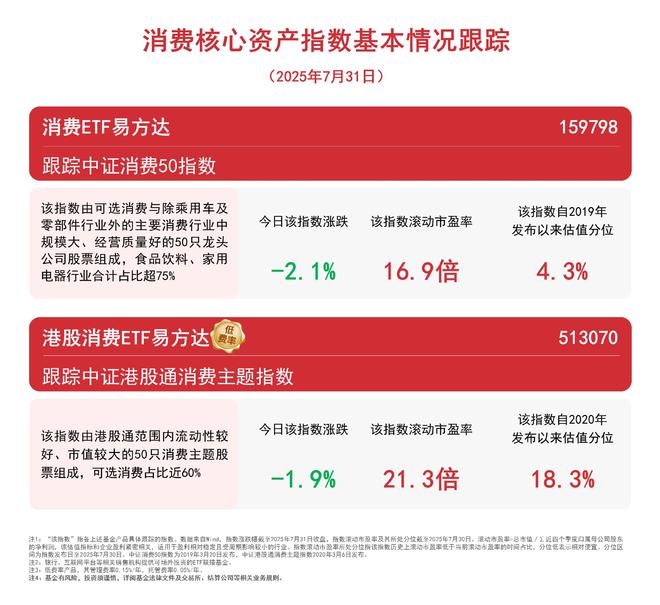
消费提质升级新趋势明显,关注港股消费ETF易方达(513070)、消费ETF易方达(159798)等投资价值
Mei Ri Jing Ji Xin Wen· 2025-07-31 13:30
Group 1 - The core viewpoint of the article highlights the recent performance of the consumer sector in the Chinese market, with the China Securities Hong Kong Stock Connect Consumer Theme Index declining by 1.9% and the China Securities Consumer 50 Index down by 2.1% [1] - The Ministry of Commerce has released a consumption report for the "14th Five-Year Plan" period, summarizing it with four key terms: "expansion," "quality improvement," "renewal," and "openness" [1] - Over the past four years, the total retail sales of consumer goods have grown at an average annual rate of 5.5%, while residents' service consumption expenditure has increased by an average of 9.6% annually [1] Group 2 - The E Fund Consumption ETF tracks the China Securities Consumer 50 Index, which consists of 50 leading companies in the consumer sector, with over 75% of its composition in the food and beverage and home appliance industries [2] - The rolling price-to-earnings ratio of the China Securities Consumer 50 Index is 16.9 times, with a valuation percentile of 4.3% since its inception in 2019 [2] - The E Fund Hong Kong Stock Connect Consumption ETF tracks the China Securities Hong Kong Stock Connect Consumer Theme Index, which includes 50 consumer theme stocks with high liquidity and market capitalization, with nearly 60% in discretionary consumption [2] - The rolling price-to-earnings ratio of the China Securities Hong Kong Stock Connect Consumer Theme Index is 21.3 times, with a valuation percentile of 18.3% since its inception in 2020 [2]

【环球财经】埃及2025年上半年重工业品出口创新高 达31亿美元
Xin Hua Cai Jing· 2025-07-31 11:48
Core Insights - The chairman of the Egyptian Heavy Industries Export Council, Sherif El-Sayyad, reported that Egypt's heavy industrial exports reached $3.1 billion in the first half of 2025, marking a 15% increase compared to the same period in 2024, which is the highest six-month export figure on record for the industry [1] Export Performance - In June, the export value increased by 7% year-on-year, reaching $475 million [1] - Significant exports included cables, automotive parts, electrical and electronic products, home appliances, and transportation equipment, with notable growth in exports to European countries [1]
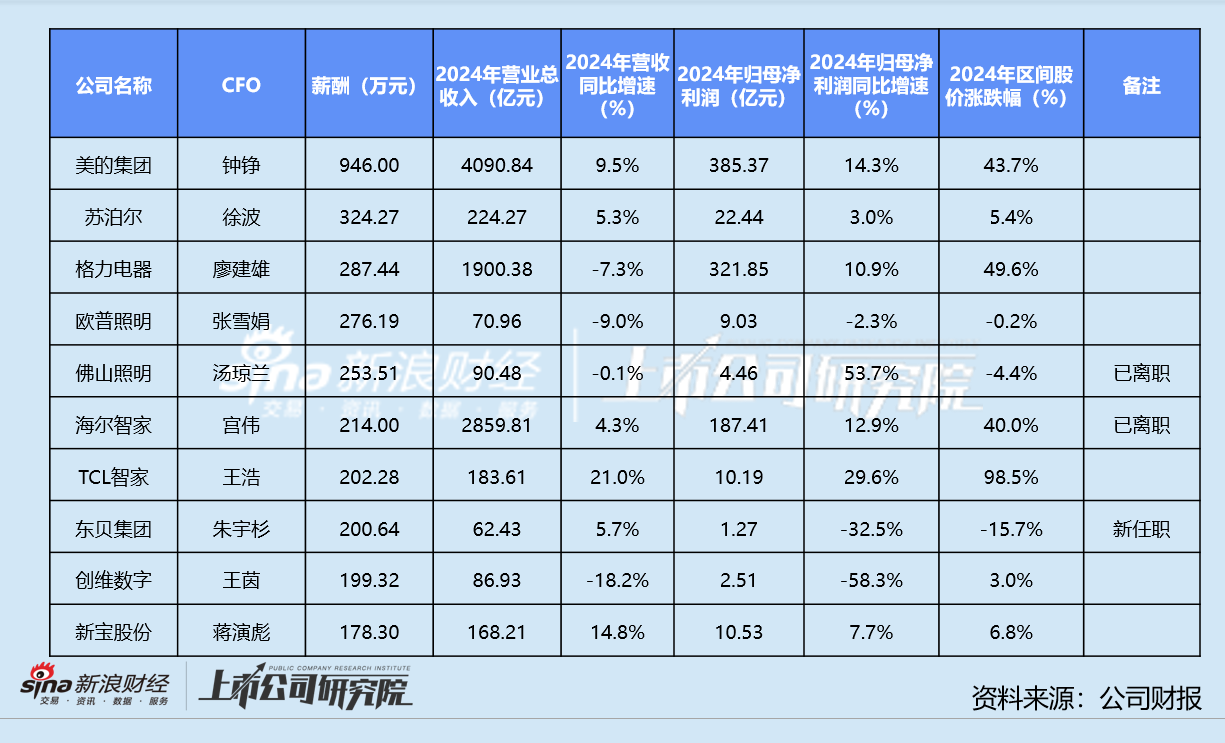
家用电器业CFO群体观察:海尔智家等5家公司CFO一职真空东方电热罗月芬年薪最低仅15.48万
Xin Lang Cai Jing· 2025-07-31 06:03
就薪酬水平而言,2024年家用电器上市公司CFO平均年薪为94.14万元,共有36位CFO高于平均值;年薪中位数为72.72万元,最大值和最小值的差距高达930.52万元。年收入在100万元以上 超四成CFO身兼数职。报告期内,约13.1%的CFO兼任董事会秘书职位,26.3%的CFO兼任总经理或副总经理职位,14.1%的CFO同时担任审计委员会成员、战略委员会成员或薪酬与考核委员会成 美的集团CFO钟铮以946万元薪酬稳坐第一,约为第二名苏泊尔CFO徐波2024年薪近3倍。此外,她还通过员工持股计划持有公司股份,具体持股比例未披露。财报显示,钟铮现年43岁,于200 薪酬最低的CFO为东方电热罗月芬,当期从公司获得的税前报酬总额仅为15.48万元,较2023年微增5.5%。她通过员工持股计划持有84655股股份,约占股本总额0.01%。罗月芬现年58岁,自 据不完全统计,2024年家用电器上市公司共有2位CFO出现违规情况。同洲电子的财务总监孙贺因《2023年业绩预告》未披露预计营业收入和扣除后营业收入,且未在会计年度后一个月内,披露 责任编辑:公司观察 登录新浪财经APP 搜索【信披】查看更多考评等级 专 ...


【盘中播报】沪指跌0.92% 钢铁行业跌幅最大
Zheng Quan Shi Bao Wang· 2025-07-31 04:49
| 申万行业 | 行业涨跌(%) | 成交额(亿元) | 比上日(%) | 领涨(跌)股 | 涨跌幅(%) | | --- | --- | --- | --- | --- | --- | | 通信 | 1.27 | 506.97 | 26.53 | 鼎通科技 | 13.77 | | 计算机 | 0.93 | 664.64 | 4.83 | 数字认证 | 20.00 | | 电子 | 0.79 | 1142.17 | 12.36 | N鼎佳 | 466.40 | | 机械设备 | 0.03 | 599.41 | -0.23 | 方盛股份 | 16.36 | | 医药生物 | -0.05 | 880.55 | -15.62 | 灵康药业 | -5.74 | | 综合 | -0.09 | 9.51 | 1.04 | 红棉股份 | -2.08 | | 国防军工 | -0.11 | 347.81 | -24.32 | 博云新材 | -6.21 | | 传媒 | -0.64 | 264.13 | 6.53 | 吉视传媒 | -8.88 | | 社会服务 | -0.68 | 88.07 | 0.42 | 凯撒旅业 | -4 ...
家用电器业CFO群体观察:5-10年长任期架构稳定 超三成财务总监年薪逾百万
Xin Lang Zheng Quan· 2025-07-31 02:35
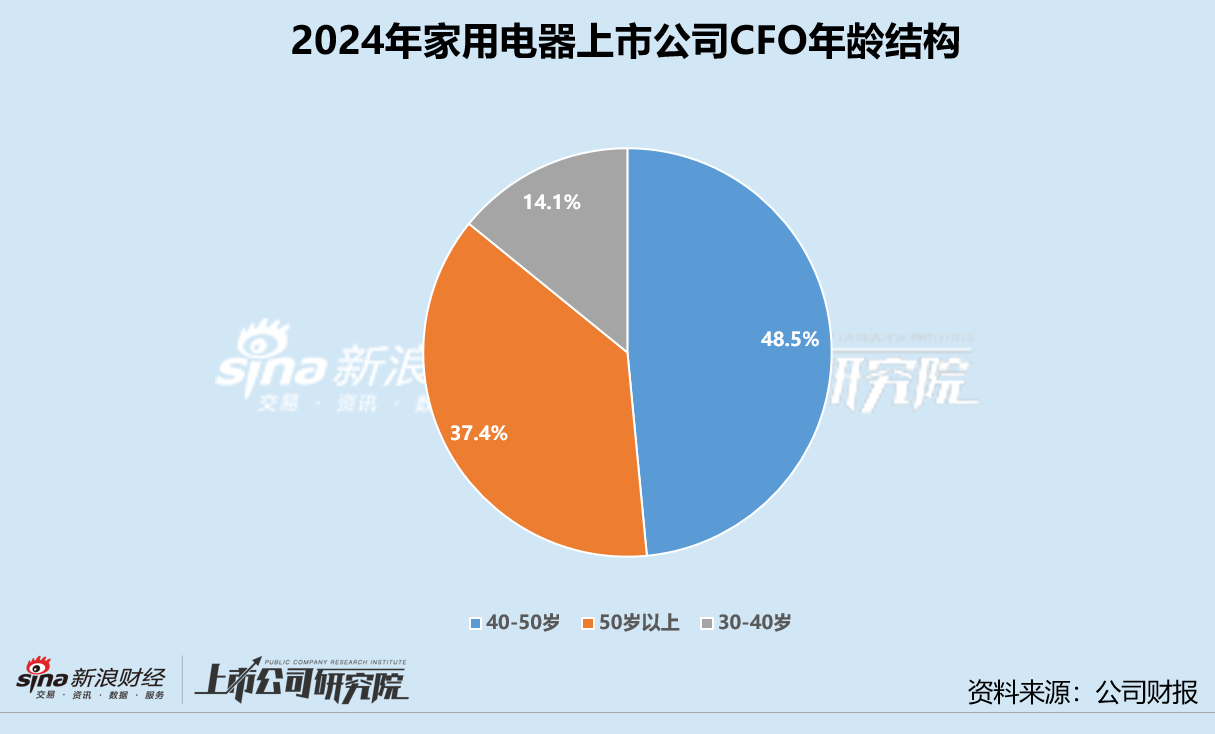
Core Insights - The report highlights the importance of CFOs in listed companies, revealing that the total salary for CFOs in A-share companies reached 4.27 billion yuan in 2024, with an average annual salary of 814,800 yuan [1][8] - The household appliance sector saw a revenue of 1.66 trillion yuan, a year-on-year increase of 4.5%, and a net profit of 118.1 billion yuan, up 6.3% from 2023, with over 40% of companies experiencing growth in both revenue and net profit [1][8] Salary and Compensation - The average salary for CFOs in the household appliance sector is 941,400 yuan, with a median salary of 727,200 yuan, and a significant disparity between the highest and lowest salaries, which is 9.31 million yuan [8][9] - Midea Group's CFO, Zhong Zheng, earns 9.46 million yuan, nearly three times that of the second-highest, Supor's CFO, Xu Bo, who earns 3.24 million yuan [8][10] - Approximately 31.3% of CFOs earn over 1 million yuan annually, while 13.1% hold dual roles as board secretaries [8][10] Age and Gender Demographics - The average age of CFOs in the household appliance sector is 47.79 years, with 48.5% aged between 40-50 and 37.4% over 50 [1][8] - Male CFOs make up 55.6% of the total, with an average age of 48.71 years, while female CFOs account for 44.4%, with an average age of 46.64 years [1][8] Tenure and Turnover - The most common tenure for CFOs is between 5-10 years, comprising 30.3% of the total, while 22.2% have served for over 10 years [4] - A total of 20 CFOs resigned during the reporting period, primarily due to health and job changes, with 75% replaced by successors [4] Educational Background - Over half of the CFOs in the household appliance sector hold a bachelor's degree, while 31.6% have a master's degree and 17.3% have an associate degree [6] Compliance and Violations - Two CFOs were reported for compliance violations, with their salaries being 720,000 yuan and 524,300 yuan respectively [10]



家用电器业CFO群体观察:禾盛新材周万民67岁在岗超18年 20位CFO离职人才流动率高
Xin Lang Zheng Quan· 2025-07-31 02:35
Core Insights - The total salary scale of CFOs in A-share listed companies reached 4.27 billion yuan in 2024, with an average annual salary of 814,800 yuan [1] - The household appliance sector saw a revenue of 1.659236 trillion yuan, a year-on-year increase of 4.5%, and a net profit attributable to shareholders of 118.105 billion yuan, up 6.3% from 2023 [1] - The average age of CFOs in the household appliance sector is 47.79 years, with 48.5% aged between 40-50 and 37.4% over 50 [1] Salary and Employment Trends - The highest-paid CFO is Zhong Zheng from Midea Group, earning 9.46 million yuan, followed by Zhou Yalin from BYD with 8.96 million yuan [1] - The majority of CFOs (30.3%) have a tenure of 5-10 years, while 22.2% have been in their positions for over 10 years [5] - A total of 20 CFOs resigned during the reporting period, with health and job changes being the main reasons, and 75% have been succeeded by new appointees [6] Demographics and Education - The gender distribution among CFOs shows 55.6% male and 44.4% female, with the average age of male CFOs being 48.71 years and female CFOs 46.64 years [1][3] - Over half of the CFOs hold a bachelor's degree, while 31.6% have a master's degree and 17.3% have a diploma [7]

家用电器业CFO群体观察:美的钟铮年薪946万登顶 拾比佰财务总监田建龙收警示函
Xin Lang Zheng Quan· 2025-07-31 02:35
分行业来看,2024年A股市场共有99家家用电器上市公司公开披露了CFO信息。受"以旧换新"国补政策推动,报告期内家用电器上市公司整体实现营收 16592.36亿元,同比增长4.5%;归母净利润录得1181.05亿元,较2023年提高6.3%,超四成公司营收、净利双增。 就薪酬水平而言,2024年家用电器上市公司CFO平均年薪为94.14万元,共有36位CFO高于平均值;年薪中位数为72.72万元,最大值和最小值的差距高达 930.52万元。年收入在100万元以上的CFO约占31.3%,排除报告期内新上任的情况,东方电热CFO罗月芬和亿田智能CFO陈洪的年收入不足20万元。 超四成CFO身兼数职。报告期内,约13.1%的CFO兼任董事会秘书职位,26.3%的CFO兼任总经理或副总经理职位,14.1%的CFO同时担任审计委员会成员、 战略委员会成员或薪酬与考核委员会成员等董事会专门委员会职能。 美的集团CFO钟铮以946万元薪酬稳坐第一,约为第二名苏泊尔CFO徐波2024年薪近3倍。此外,她还通过员工持股计划持有公司股份,具体持股比例未披 露。财报显示,钟铮现年43岁,于2002年加入公司,曾任金融中心、部品事 ...