
电池制造

Search documents
从沙县小吃到民宿,12条重磅惠台政策发布!福建上市公司股价逆势大涨,多只股票“连板”
Mei Ri Jing Ji Xin Wen· 2025-12-02 09:45
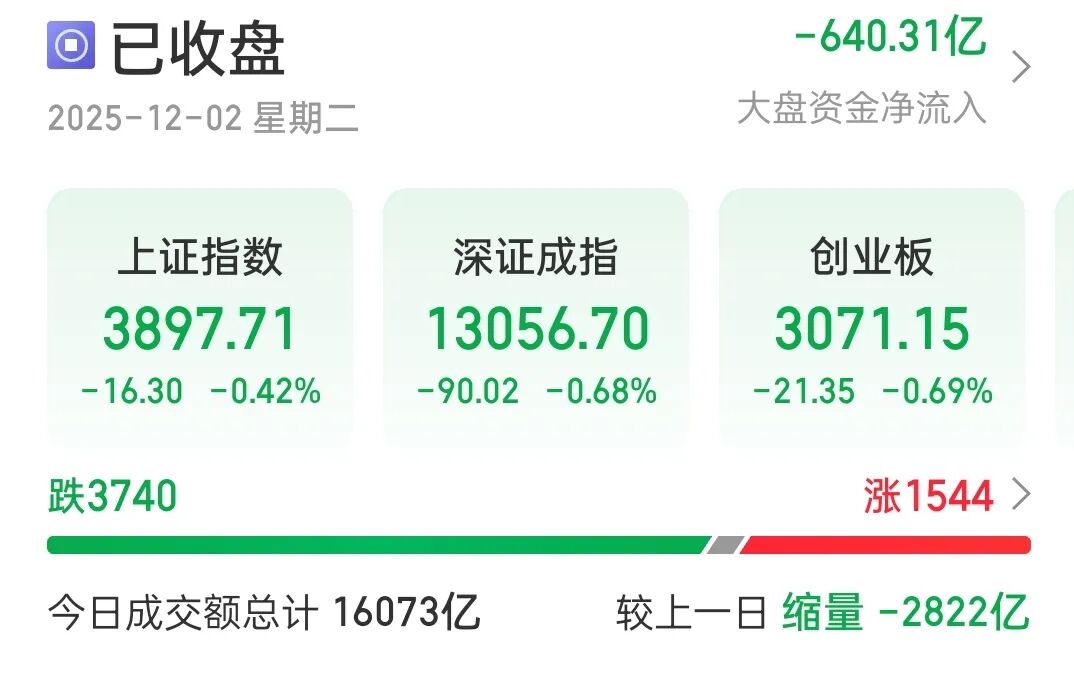
Core Viewpoint - The market experienced fluctuations on December 2, with significant declines in major indices, while the Fujian sector showed resilience due to favorable policies aimed at enhancing cross-strait economic integration [1][4][11]. Market Performance - The Shenzhen Component Index and the ChiNext Index both fell over 1% at one point during the trading day, with the Shanghai Composite Index closing down 0.42%, the Shenzhen Component down 0.68%, and the ChiNext down 0.69% [1]. - The total trading volume in the Shanghai and Shenzhen markets was 1.61 trillion yuan, a decrease of 282.2 billion yuan compared to the previous trading day, with over 3,700 stocks declining [1]. Sector Analysis - The Fujian sector outperformed the market, with stocks like Haixin Food and Ruineng Technology achieving multiple consecutive gains, while the food concept stocks also showed strength with several hitting the daily limit [4][6]. - The commercial aerospace sector was active, with Aerospace Development achieving 9 gains in 13 days, while the battery sector faced declines, with Shida Shenghua dropping 7% [4]. Policy Impact - Fujian Province announced multiple favorable policies to support cross-strait economic integration, including land and sea use guarantees for Taiwanese enterprises and incentives for Taiwanese agricultural projects [6][7]. - The policies aim to enhance the development of Taiwanese businesses in Fujian, including tax benefits and support for cultural exchanges [7][8]. Stock Performance - Fujian High-Speed achieved a 10.10% increase, closing at 4.25 yuan, with a market capitalization of 11.664 billion yuan [8]. - The Fujian sector has seen a cumulative increase of over 56% this year, indicating strong investor interest and confidence in the region [11].


摩根大通对宁德时代H股的多头持仓比例降至7.41%
Guo Ji Jin Rong Bao· 2025-12-02 09:15
Group 1 - The core point of the article is that JPMorgan's long position in Contemporary Amperex Technology Co., Limited (CATL) H-shares decreased from 8.09% to 7.41% as of November 26, 2025 [1]


公司问答丨珠海冠宇:公司有为中兴客户供应手机类电池
Ge Long Hui A P P· 2025-12-02 08:29
Core Viewpoint - The company, Zhuhai Guanyu, confirmed that it supplies mobile phone batteries to ZTE, indicating an ongoing business relationship with the client [1] Group 1 - Investors inquired about Zhuhai Guanyu's role as a supplier for ZTE mobile phones [1] - The company stated that it provides battery supplies for mobile phone products to ZTE [1] - Further details on the business cooperation can be found in the company's regular reports [1]


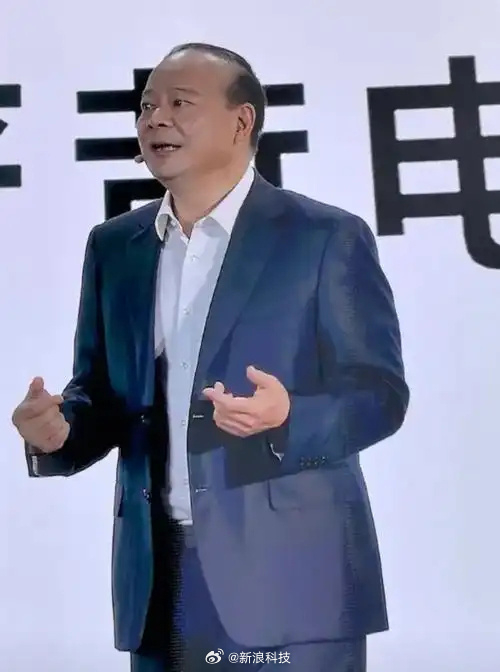
宁德时代2026年起基层员工涨薪150元,曾毓群确认
Cai Jing Wang· 2025-12-02 05:21
【#宁德时代曾毓群回应基层员工涨薪#:没错】宁德时代称,2026年1月1日起对1~6职级员工进行薪资 调整,基本工资上调150元,其他薪资结构及标准不变。同日傍晚,据中国企业家杂志报道,记者就此 事向宁德时代创始人、董事长曾毓群求证,曾毓群回应称"没错"。(21财经) ...
热点回应|破解“里程焦虑”,全固态电池仍需时日
Ke Ji Ri Bao· 2025-12-02 02:50
Core Viewpoint - "Range anxiety" is a core pain point in the development of electric vehicles, and all-solid-state batteries are seen as a potential solution to this issue [1] Group 1: Differences from Lithium-ion Batteries - The main difference between all-solid-state batteries and traditional lithium-ion batteries is the replacement of the electrolyte and optimization of the electrode materials [2] - All-solid-state batteries use non-flammable solid electrolytes instead of liquid organic electrolytes, which enhances safety and energy density [2] Group 2: Enhancing Electric Vehicle Range - The low energy density of current lithium-ion batteries is the fundamental reason for range anxiety in the electric vehicle industry [3] - All-solid-state batteries can utilize higher theoretical capacity electrode materials, leading to a significant increase in energy density and potentially allowing electric vehicles to achieve a range of over 1000 kilometers [3] Group 3: Challenges to Large-scale Application - The research and development of all-solid-state batteries are still in the early stages, facing several key technical challenges for large-scale application [4] - High-performance solid electrolytes and the cost of raw materials pose significant challenges, requiring breakthroughs in low-cost synthesis and preparation technologies [5] - The stability of the solid-solid interface in all-solid-state batteries is a major challenge due to volume changes during charge and discharge cycles, necessitating in-depth research on the electrochemical and mechanical properties of solid electrolytes [5]
宁德时代,两大项目签约和开工!合计110GWh,投资435亿
DT新材料· 2025-12-01 16:04
Group 1 - CATL signed and launched two major projects with a total capacity of approximately 110 GWh and an investment of about 43.5 billion RMB [1] - The LY9 project in Liyang High-tech Zone aims to establish a new production base with an annual capacity of 60 GWh, with a planned total investment not exceeding 10 billion RMB [1] - Since 2016, CATL has invested in eight projects worth over 100 billion RMB in Liyang, making it one of the largest manufacturing bases for CATL [1] Group 2 - Stellantis and CATL officially started the construction of a super battery factory in Zaragoza, Spain, with a total investment of 4.1 billion euros (approximately 335.94 billion RMB) [2] - The factory is expected to be powered entirely by renewable energy and aims to produce 50 GWh of lithium iron phosphate batteries by 2030, sufficient for around 600,000 electric vehicles [2] - This collaboration is a key pillar of Stellantis' electrification strategy for 2030, ensuring access to advanced battery technology while mitigating supply chain risks [2] Group 3 - CATL has also commenced operations at two new factories in Germany and Hungary, bringing advanced battery manufacturing technology to Europe [3]
宁德时代宣布涨薪?回应来了
第一财经· 2025-12-01 15:14
2025.12. 01 12 月 1 日, # 宁德时代发布涨薪通知 # 的词条迅速冲上热搜第一,引发关注。 推荐阅读 万科突发公告,一笔境内债将寻求展期 微信编辑 | 小羊 第 一 财 经 持 续 追 踪 财 经 热 点 。 若 您 掌 握 公 司 动 态 、 行 业 趋 势 、 金 融 事 件 等 有 价 值 的 线 索 , 欢 迎 提 供 。 专 用 邮 箱 : bianjibu@yicai.com (注:我们会对线索进行核实。您的隐私将严格保密。) 宁德时代通知称,为更好地吸引和保留新老员工,不断地提升工作效率和产品品质,以增强公司竞争 力,经公司管理层决定,2026年1月1日起对1~6职级员工进行薪资调整,基本工资上调150元,其他 薪资结构及标准不变。据了解,此次宁德时代涨薪涉及的员工职级为基层员工。 同日傍晚,据中国企业家杂志报道,记者就此事向宁德时代创始人、董事长曾毓群求证,曾毓群回应 称"没错"。 Wind数据显示,截至2024年底,宁德时代在职员工的数量合计13.2万人,人均薪酬为23.63万元,较 上年增长1.06万元。 ...
工资上调150元 1到6职级员工都有!董事长证实:是真的;公司员工超13万人 市值1.76万亿元
Mei Ri Jing Ji Xin Wen· 2025-12-01 15:03
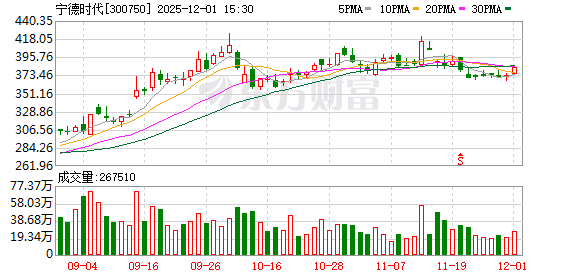
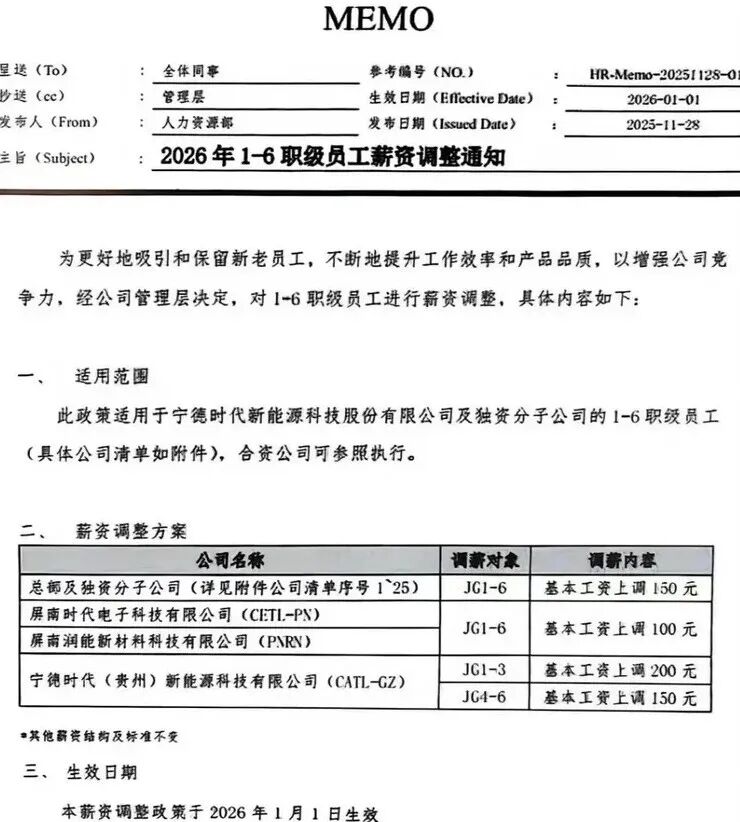
Core Viewpoint - Ningde Times has announced a salary adjustment for employees at levels 1-6, effective January 1, 2026, with a uniform increase of 150 yuan in basic salary to attract and retain employees, while maintaining other salary structures unchanged [2][7]. Group 1: Salary Adjustment Details - The salary adjustment notification was confirmed by Ningde Times and has generated significant online discussion, with the topic trending on Weibo [5][7]. - The increase of 150 yuan per month is perceived positively by employees, with comments indicating that any increase is better than none [5][6]. - The company currently employs 132,000 staff members, with an average salary of 236,300 yuan, reflecting a year-on-year increase of 10,600 yuan [7]. Group 2: Company Performance - Ningde Times is the largest supplier of power batteries in China, holding a 43% market share with a total shipment volume of 36.14 GWh in October [7]. - For the first three quarters of the year, the company reported a net profit attributable to shareholders of 49 billion yuan, a year-on-year increase of 36.20%, and revenue of 283.1 billion yuan, up 9.28% [7]. - In the third quarter alone, the net profit was 18.55 billion yuan, marking a 41.21% increase, with revenue reaching 104.39 billion yuan, a 12.90% rise [7]. Group 3: Additional Incentives - In addition to the salary increase, Ningde Times has introduced a Spring Festival attendance reward plan, offering at least 3,200 yuan for employees who meet attendance criteria during the period from February 9 to February 28, 2026 [8]. - For example, an employee in a direct production role who works more than 16 days in February could earn a total of 11,500 yuan, which includes a base salary of 8,300 yuan and the attendance reward [8]. Group 4: Market Reaction - Following the announcement, Ningde Times' stock price rose by 2.62% to 382.97 yuan per share, with a total market capitalization of 1.75 trillion yuan [10].
工资上调150元,1到6职级员工都有!董事长证实:是真的;公司员工超13万人,市值1.76万亿元
Mei Ri Jing Ji Xin Wen· 2025-12-01 14:03
Core Viewpoint - CATL (Contemporary Amperex Technology Co., Limited) announced a salary adjustment for its employees, effective January 1, 2026, to enhance employee retention and productivity [1][6]. Salary Adjustment Details - The basic salary for employees at levels 1-6 will be increased by 150 yuan across headquarters and wholly-owned subsidiaries [4]. - Specific adjustments include a 100 yuan increase for employees at CETL-PX and a 200 yuan increase for employees at CATL-GZ at levels 1-3 [4]. - The announcement has generated significant public interest, trending on social media platforms [4][6]. Company Performance - CATL remains the largest power battery supplier in China, holding a 43% market share with a total shipment of 36.14 GWh in October [6]. - For the first three quarters of the year, CATL reported a net profit attributable to shareholders of 49 billion yuan, a year-on-year increase of 36.20%, and revenue of 283.1 billion yuan, up 9.28% [6][7]. - The company’s earnings per share for the current period is 4.10 yuan, reflecting a 37.23% increase [7]. Employee Compensation and Incentives - In addition to the salary increase, CATL has introduced a Spring Festival bonus plan, offering at least 3,200 yuan for employees who meet attendance criteria during the holiday period [8]. - For example, a level 2 production employee could earn a total of 11,500 yuan in February if attendance conditions are met [8]. Market Reaction - On December 1, CATL's A-shares rose by 2.62%, closing at 382.97 yuan per share, with a total market capitalization of 1.75 trillion yuan [9].
宁德时代(03750)参与投资博裕新智新产(宁波)股权投资合伙企业(有限合伙)
智通财经网· 2025-12-01 13:06
公司作为有限合伙人参与本次基金投资,主要是借助专业投资机构优势,通过专业化投资管理团队,拓 展投资渠道,挖掘业务合作和发展机会,并获取合理投资回报,符合公司发展及股东利益。 智通财经APP讯,宁德时代(03750)发布公告,公司于2025年12月1日与博裕天枢(宁波)自有资金投资有 限责任公司、宁波市甬元投资基金有限公司等合作方签署了《博裕新智新产(宁波)股权投资合伙企业(有 限合伙)有限合伙合同》(以下简称"《有限合伙合同》"),公司作为有限合伙人之一参与投资"博裕新智 新产(宁波)股权投资合伙企业(有限合伙)"(以下简称"基金"、"合伙企业"),于基金完成首次交割后,基 金认缴出资金额为人民币40.01亿元,其中公司作为有限合伙人认缴出资人民币5亿元,持有基金 12.497%的认缴比例。 ...