纺织业

Search documents
金春股份最新股东户数环比下降5.80%
Zheng Quan Shi Bao Wang· 2025-09-23 02:12
Group 1 - The core point of the article is that Jinchun Co., Ltd. has experienced a continuous decline in the number of shareholders for the fifth consecutive period, with a 5.80% decrease as of September 20, bringing the total to 9,178 shareholders [1][1][1] - The latest stock price of Jinchun Co., Ltd. is 26.94 yuan, reflecting a decrease of 0.99%, although the stock has seen a cumulative increase of 3.18% since the concentration of shares began [1][1][1] - The margin trading data indicates that as of September 22, the total margin balance for the stock is 231 million yuan, with a slight decrease of 20,920 yuan, representing a 0.09% decline [1][1][1] Group 2 - The company's semi-annual report shows that it achieved an operating income of 522 million yuan in the first half of the year, marking a year-on-year growth of 3.77% [1][1][1] - The net profit for the same period was 15.42 million yuan, which is a significant year-on-year increase of 790.16% [1][1][1] - The basic earnings per share are reported at 0.1300 yuan, with a weighted average return on equity of 0.97% [1][1][1]
恒辉安防:股东钥诚投资计划减持公司股份不超过约227万股
Mei Ri Jing Ji Xin Wen· 2025-09-22 12:17
2025年1至6月份,恒辉安防的营业收入构成为:纺织业-制造业占比100.0%。 每经AI快讯,恒辉安防(SZ 300952,收盘价:32.93元)9月22日晚间发布公告称,钥诚投资是公司首 次公开发行股票上市前为核心员工设立的员工持股平台,持有公司1000万股(占剔除回购专用证券账户 中股份数量后当前公司总股本的5.85%)。钥诚投资计划自本公告披露之日起15个交易日后的3个月内 以集中竞价或大宗交易方式合计减持公司股份不超过约227万股,占总股本的1.31%(占剔除回购专用 证券账户中股份数量后公司总股本的1.33%)。本次减持主要是基于员工个人的资金需求。公司董事姚 海霞女士计划自本公告披露之日起15个交易日后的3个月内以集中竞价或大宗交易方式合计减持公司股 份不超过约178万股,占总股本的1.03%(占剔除回购专用证券账户中股份数量后公司总股本的 1.04%)。相关拟减持股东属于一致行动人,计划公告披露之日起15个交易日后的3个月内,在任意连 续90个自然日内,合并通过集中竞价方式减持股份总数不超过公司股份总数的1%,即不超过约171万 股;在任意连续90个自然日内,合并通过大宗交易方式减持股份的总数 ...

开润股份:9月22日召开董事会会议
Mei Ri Jing Ji Xin Wen· 2025-09-22 12:04
Group 1 - The core point of the article is that KaiRun Co., Ltd. announced the acquisition of a 20% stake in Shanghai Jiale Co., Ltd. through its wholly-owned subsidiary during a board meeting held on September 22, 2025 [1] - For the first half of 2025, the company's revenue composition is entirely from the textile industry, accounting for 100.0% [1] - As of the report date, KaiRun Co., Ltd. has a market capitalization of 5.9 billion yuan [1]

百宏实业(02299)9月22日斥资96.74万港元回购23.2万股
智通财经网· 2025-09-22 09:33
智通财经APP讯,百宏实业(02299)发布公告,于2025年9月22日,该公司斥资96.74万港元回购23.2万股 股份,每股回购价格为4.17港元。 ...
棉花专题:纺织行业消费情况分析
Chang Jiang Qi Huo· 2025-09-22 06:30
Group 1: Report Summary - The textile industry maintained stable overall operations in H1 2025, with high export and domestic demand, good cotton consumption, but weak profit growth and high business pressure. The overall performance of listed companies showed some resilience [1][3]. - The industry showed a stable revenue but faced significant profit pressure, with differences among sub - industries. Exports demonstrated resilience due to Sino - US trade disputes. Listed companies generally performed well, but individual stocks varied, and the sportswear industry led the market [25]. Group 2: H1 2025 Textile Industry Overall Operation Production Situation - The textile industry's capacity utilization was in a reasonable range. The industrial added - value of above - scale textile enterprises increased by 3.1% year - on - year (1.5 percentage points slower than the previous year). Most parts of the industrial chain had stable production. Some sub - industries had high growth rates, and 9 out of 15 major textile products saw output growth [4]. Consumption Market - Textile and clothing domestic sales had a mild recovery. Per capita clothing consumption expenditure increased by 2.1% year - on - year (0.9 percentage points faster than Q1). The retail sales of clothing, footwear, and textiles above the quota increased by 3.1% year - on - year (1.8 percentage points faster than the previous year). Online clothing sales increased by 1.4% year - on - year (1.5 percentage points higher than Q1). Consumption trends included a shift towards quality, personalization, and culture [5]. Foreign Trade Situation - Despite challenges, textile exports maintained a slight increase. Total textile and clothing exports were $143.98 billion, a 0.8% year - on - year increase. Textile exports were $70.52 billion, up 1.8% year - on - year, while clothing exports were $73.46 billion, down 0.2% year - on - year. Exports to the US declined, but those to other trading partners increased [10]. Benefit Situation - Textile enterprises faced increased operating pressure. The operating income of 38,000 above - scale textile enterprises decreased by 3% year - on - year, and the total profit decreased by 9.4% year - on - year. The operating income profit margin dropped to 3%. However, there were differences among sub - industries [12]. Group 3: Listed Company Performance H1 2025 Financial Report - In terms of revenue, the textile manufacturing and clothing home textile sectors had year - on - year growth rates of +7.8% and - 6.4% respectively. In terms of profit, the textile manufacturing sector had a stable gross profit margin of 19.4% and a net profit margin of 8.5%. The clothing home textile sector had a gross profit margin of 46.1% and a net profit margin of 8.5%. In terms of inventory, the textile manufacturing sector's inventory - to - sales ratio was about 3.9 months, and that of the clothing home textile sector dropped to about 6.7 months [17]. Q2 2025 - In terms of revenue, the textile manufacturing sector's growth rate slowed to 6.6% year - on - year, and the clothing home textile sector's decline narrowed to 4.6% year - on - year. In terms of profit, the textile manufacturing sector's gross profit margin was 19.4%, and the net profit margin was 9.5%. The clothing home textile sector's gross profit margin was 45.4%, and the net profit margin was 5.8%. In terms of inventory, the textile manufacturing sector's inventory - to - sales ratio increased to 4.1 months, and that of the clothing home textile sector decreased to 6.7 months [21]. Sector Companies - In the clothing home textile sector, the sportswear track was booming, with leading companies like Anta Sports, 361 Degrees, and Li Ning having good revenue and profit growth. Non - sportswear companies generally faced challenges. In the textile manufacturing sector, contract manufacturing enterprises had stable order growth, and cotton - spinning enterprises performed well [22][24].
前8月江苏省固定资产投资同比下降
Guo Ji Jin Rong Bao· 2025-09-22 04:37
Group 1: Fixed Asset Investment in Jiangsu - Fixed asset investment in Jiangsu province decreased by 7.8% year-on-year from January to August [1] - Infrastructure investment showed growth, increasing by 2.5% year-on-year, contributing 0.4 percentage points to overall investment growth [1] - Large-scale infrastructure projects (over 1 billion) saw a 6.5% increase in investment, driving infrastructure growth by 3.9 percentage points [1] Group 2: Sector Performance - The electricity, heat production, and supply sector grew by 34.2%, while railway transportation and water transportation sectors increased by 17.4% and 19.3%, respectively [1] - The manufacturing sector faced challenges, with investment declining by 4.3% year-on-year, although 14 out of 31 major industries experienced growth [1] - Notable growth in automotive manufacturing (13.5%), textile industry (29.7%), and rubber and plastic products (3.9%) [1] Group 3: Real Estate Market - Real estate development investment in Jiangsu decreased by 18.2% year-on-year from January to August [1] - The sales area of commercial housing also fell by 7.6% year-on-year, with the decline accelerating by 2.4 percentage points compared to the previous month [1] Group 4: Equipment Investment and Consumer Spending - Investment in equipment and tools increased by 4.1% year-on-year, accounting for 19.3% of total investment, up by 0.5 percentage points from the previous month [2] - The retail sales of social consumer goods grew by 4.1% year-on-year, with significant growth in the wholesale and retail sector (33.4%) and information technology services (43.8%) [2] - In August, retail sales of major goods under the "old for new" policy increased by 2.2%, contributing 0.9 percentage points to overall retail growth [2]
2025年7月中国合成纤维纱线进口数量和进口金额分别为1.31万吨和0.74亿美元
Chan Ye Xin Xi Wang· 2025-09-22 03:31
Core Viewpoint - The report by Zhiyan Consulting highlights a significant decline in China's synthetic fiber yarn imports in July 2025, indicating potential challenges in the industry and investment opportunities [1]. Import Data Summary - In July 2025, China's synthetic fiber yarn import volume was 13,100 tons, representing a year-on-year decrease of 28% [1]. - The import value for the same period was $7.4 million, showing a year-on-year decline of 18.9% [1]. Industry Insights - Zhiyan Consulting is recognized as a leading industry consulting firm in China, specializing in in-depth industry research and providing comprehensive consulting services for investment decisions [1].


埃及寻求丝绸产业本地化
Xin Hua Cai Jing· 2025-09-22 03:04
Core Insights - The Egyptian government has signed a cooperation agreement to establish the country's first natural silk production center, aimed at localizing the silk industry [1] Group 1: Project Details - The natural silk production center will be located in the desert area of Harij City, approximately 600 kilometers from Cairo, covering an area of 250 feddans (257.5 acres) [1] - The center is expected to produce 25 tons of natural silk within four years, providing raw materials for the textile, carpet, and certain medical industries [1] Group 2: Local Community Impact - The silk production center will serve as a core component of Egypt's national project for silk localization, offering local villagers training in mulberry cultivation, silkworm rearing, and poultry farming, enabling them to work from home [1] - In May, the Egyptian government announced the establishment of 32 fully equipped laboratories and the planting of 344 feddans of mulberry trees [1]
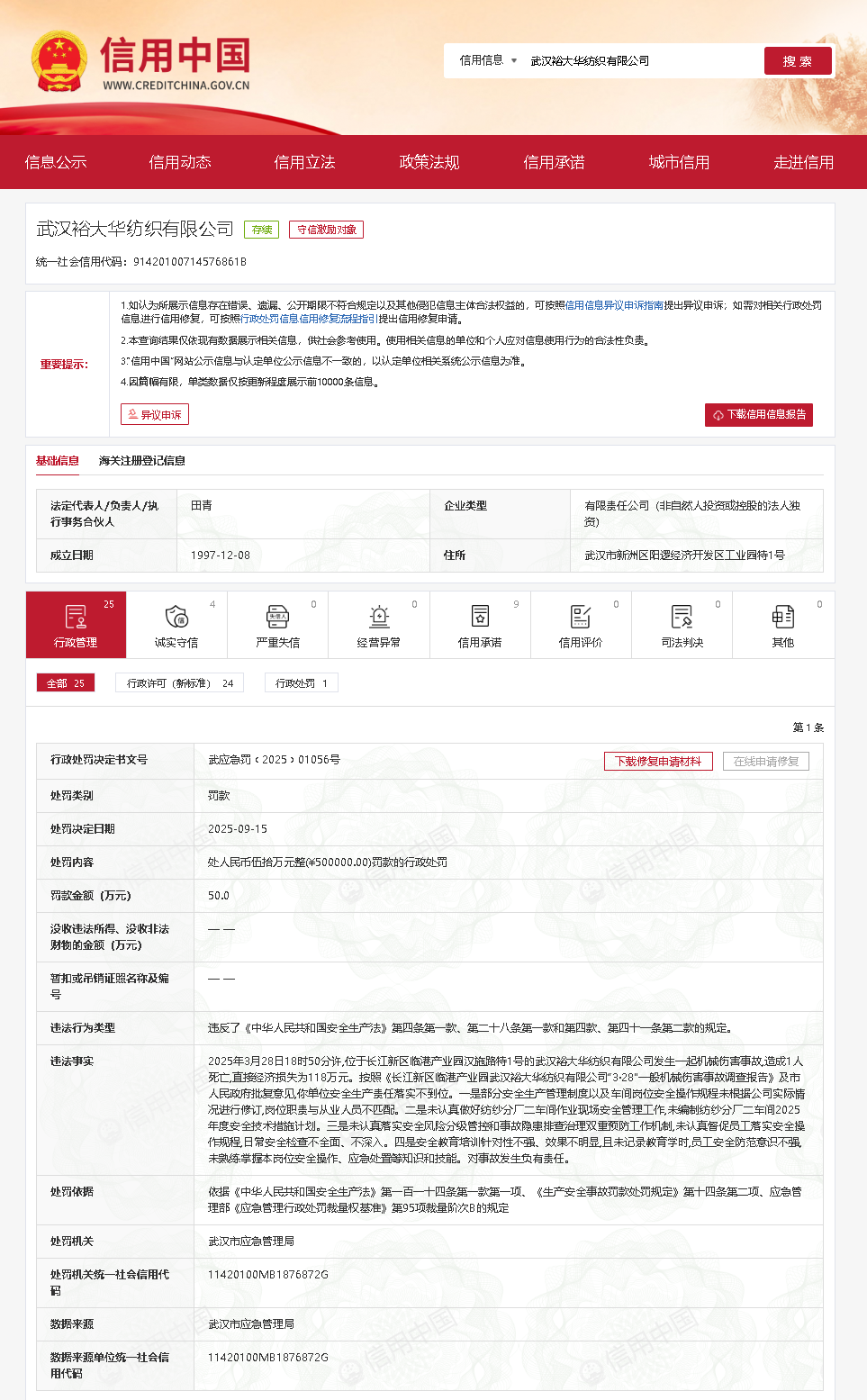
因“3·28”一般机械伤害事故,武汉裕大华纺织有限公司被罚
Qi Lu Wan Bao· 2025-09-21 23:02
近日,齐鲁晚报·齐鲁壹点记者从信用中国获悉,武汉裕大华纺织有限公司因"3·28"一般机械伤害事故被武汉市应急管理局罚款50万元。 2025年3月28日18时50分许,位于长江新区临港产业园汉施路特1号的武汉裕大华纺织有限公司发生一起机械伤害事故,造成1人死亡,直接经济损失为118万 元。按照《长江新区临港产业园武汉裕大华纺织有限公司"3·28"一般机械伤害事故调查报告》及市人民政府批复意见,你单位安全生产责任落实不到位。一 是部分安全生产管理制度以及车间岗位安全操作规程未根据公司实际情况进行修订,岗位职责与从业人员不匹配。二是未认真做好纺纱分厂二车间作业现场 安全管理工作,未编制纺纱分厂二车间2025年度安全技术措施计划。三是未认真落实安全风险分级管控和事故隐患排查治理双重预防工作机制,未认真督促 员工落实安全操作规程,日常安全检查不全面、不深入。四是安全教育培训针对性不强、效果不明显,且未记录教育学时,员工安全防范意识不强,未熟练 掌握本岗位安全操作、应急处置等知识和技能。对事故发生负有责任。 公开信息显示,武汉裕大华纺织有限公司成立于1997年12月8日,法定代表人田青,股东为武汉裕大华纺织服装集团有限公 ...
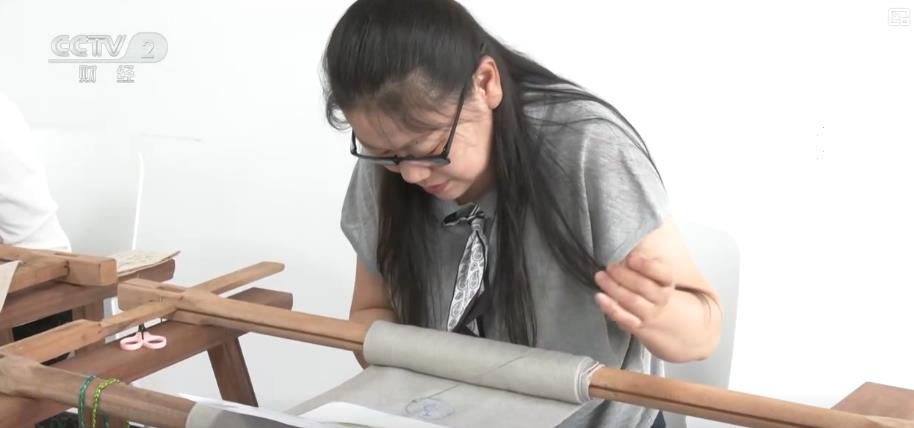
从“指尖技艺”到“指尖经济”:“社区微工厂”织就“幸福网” 助居民“稳就业、巧增收”
Yang Shi Wang· 2025-09-21 03:54
Core Insights - The article highlights the transformation of the cashmere industry in Ordos, Inner Mongolia, into a "community micro-factory" model, where local residents engage in cashmere embroidery to generate income [1][5][11] Group 1: Community Micro-Factory Model - The "community micro-factory" in Dongsheng District has provided nearly 200 job opportunities for women since its operation began in May, with monthly income ranging from 2,000 to 5,000 yuan per person [5] - This model allows residents to work from home, contributing to local employment and economic growth [1][5] Group 2: Skill Development and Income Generation - Li Yao, a skilled embroiderer, earns approximately 80 yuan per scarf, completing one to two scarves daily, leading to a monthly income of 3,000 to 4,000 yuan [3] - Community training programs have introduced techniques like "yang embroidery," blending Suzhou and Mongolian styles, enhancing skill levels among local women [3][5] Group 3: Role of Young Designers - Young designers, such as Zhang Zhongxia, are revitalizing the traditional cashmere industry by creating high-value, small-batch cultural products [7][9] - Collaborations with recent graduates from art schools are bringing fresh design ideas to the cashmere creative industry, driving innovation and new product development [9] Group 4: Order Sharing Platform - The "community training + order recovery" model is being promoted, allowing small and medium enterprises to meet processing demands while providing flexible employment for community residents [11]