人工智能与机器人

Search documents
第33届广州博览会开幕!聚焦双向赋能促循环实现“多个突破”
Nan Fang Nong Cun Bao· 2025-08-22 06:59
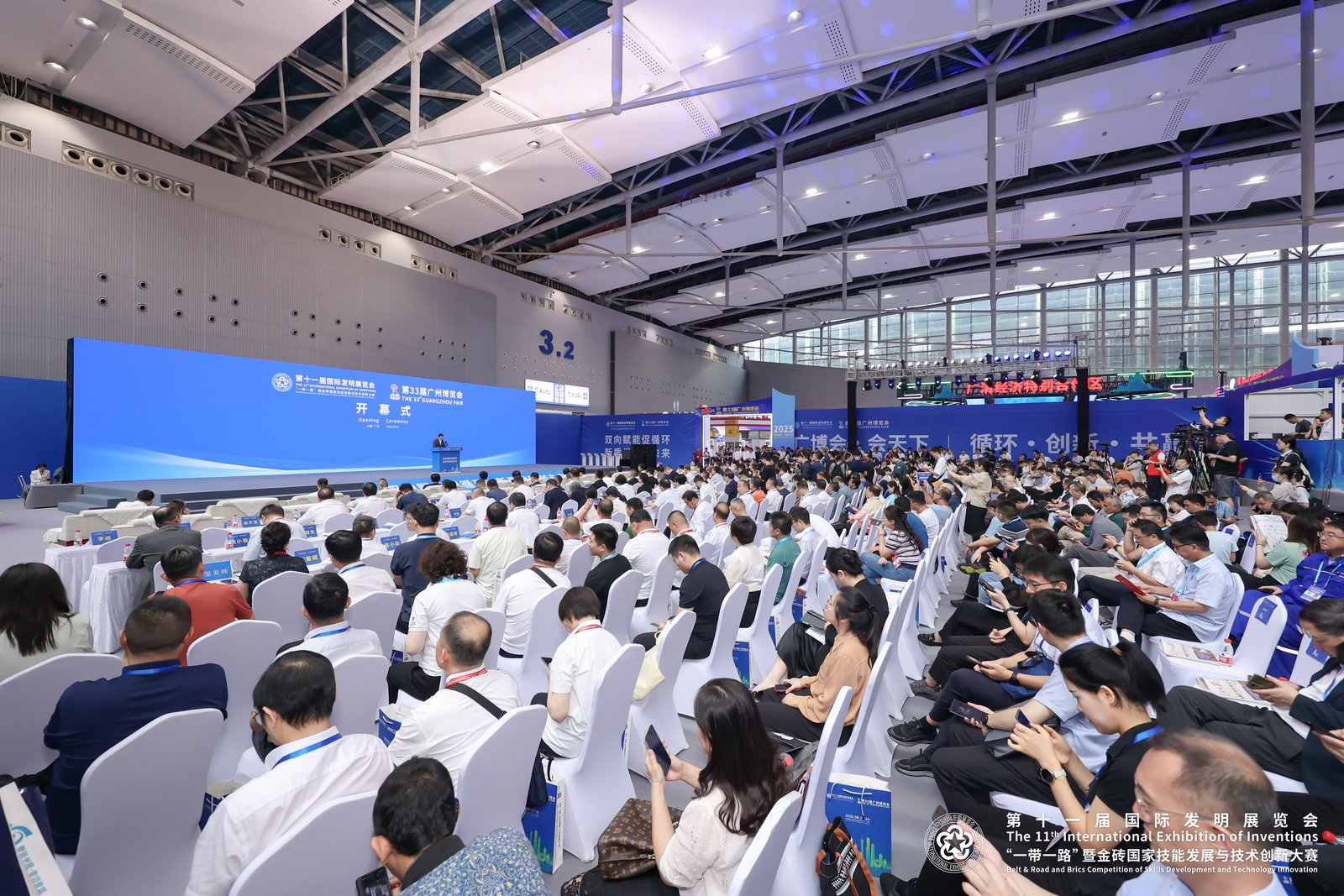
Core Points - The 33rd Guangzhou Expo officially opened on August 22, with the theme "Dual Empowerment Promotes Circulation, New Quality Innovation Creates the Future" and an exhibition area of nearly 180,000 square meters [1] - The expo features four main exhibition areas, including new quality productivity, rural revitalization, silver economy, and quality life, with a total of 18 exhibition halls [1] Group 1 - The expo aims to promote domestic circulation and regional collaboration, with over 30 provincial government delegations participating, including 85 enterprises from Qinghai province showcasing the "Beautiful Qinghai Ecological Brand" [2] - A new quality productivity exhibition area has been established for the first time, focusing on emerging industries such as artificial intelligence, smart connected vehicles, and aerospace [2][4] - The expo is collaborating with the 11th International Invention Exhibition and the "Belt and Road" Skills Development and Technology Innovation Competition, attracting over 300 guests from more than 30 countries [3] Group 2 - The expo features a dedicated area for consumer assistance, promoting rural revitalization and showcasing over 1,000 enterprises from various regions, including 231 enterprises from Qingyuan city [6][7] - A new product promotion event for new quality productivity has been organized, inviting experts and leaders from various sectors to share insights and promote collaboration [5] - A robot performance area has been set up, featuring nearly 150 robots demonstrating various capabilities, aimed at engaging youth in scientific exploration [5]

北交所定期报告20250818:北交所行情高涨,北证50与专精特新指数均创历史新高
Soochow Securities· 2025-08-18 13:27
Group 1: Capital Market News - The US government announced an expansion of the 50% tariff on steel and aluminum imports, including hundreds of derivative products, effective August 18, 2025 [6] - Japanese companies are expected to face a significant impact from US tariff policies, with a projected total operating profit decrease of 3.5 trillion yen for 42 major listed companies in the current fiscal year [7] Group 2: Industry News - The Ministry of Commerce extended the anti-subsidy investigation period for imported dairy products from the EU until February 21, 2026, due to the complexity of the case [8] - Guangdong Province released funding management guidelines for innovation projects in artificial intelligence and robotics, with a maximum support of 50 million yuan per project [9][10] - Beijing is set to implement measures to accelerate the application of photovoltaic technology in infrastructure, focusing on urban areas and rural projects [11] - Chongqing is planning to advance the construction of hydrogen stations and promote renewable energy hydrogen production, with a focus on integrating with existing energy infrastructure [12] Group 3: Market Performance - As of August 18, 2025, the North Exchange 50 Index rose by 6.79%, while the overall A-share market showed positive performance with the ChiNext Index up by 2.84% and the Shanghai Composite Index up by 0.85% [3.1] - The North Exchange had a total of 271 constituent stocks with an average market capitalization of 3.352 billion yuan and a trading volume of 45.464 billion yuan, an increase of 16.888 billion yuan from the previous trading day [3.2] Group 4: Company Announcements - Guohang Ocean announced the completion of registration for its Singapore subsidiary, focusing on dry bulk shipping and related services [22] - Lintai New Materials reported a 67.72% year-on-year increase in revenue for the first half of 2025, reaching 205 million yuan, with a net profit growth of 167.81% [23] - Qingju Technology achieved a revenue of 351 million yuan in the first half of 2025, marking a 2.39% increase year-on-year, with new contracts signed amounting to 658 million yuan, a 29.50% increase [24]
粤港澳大湾区创业大赛正式拉开赛事帷幕 参赛项目量质俱佳
Nan Fang Du Shi Bao· 2025-08-15 07:09
Core Insights - The Guangdong-Hong Kong-Macao Greater Bay Area Entrepreneurship Competition has attracted 7,146 entrepreneurial projects, showcasing the vibrant innovation and entrepreneurial ecosystem in the region [2][3]. Group 1: Competition Characteristics - The competition features a wide geographical distribution, with projects from all provinces in China and 27 teams from over 10 countries, including the US, UK, and Japan, highlighting the Bay Area's strong appeal [2]. - The competition is structured around five key tracks that align with Guangdong's advantageous industries, including artificial intelligence, integrated circuits, healthcare, food technology, and modern services, with a balanced distribution of projects across these tracks [3]. - A significant portion of the projects (24.6%) includes elements from Hong Kong and Macao, with 1,761 projects participating, particularly strong in the modern services and cultural creativity track [4]. Group 2: Talent and Employment - The participating projects are led by a highly qualified and youthful group of entrepreneurs, with 64.6% of companies registered in 2023 or later, and 12.4% of founders being overseas returnees [4]. - The competition is expected to contribute to employment growth in Guangdong, which has a strong foundation of over 19 million market entities and 8.3 million enterprises [4]. Group 3: Financing and Investment - Approximately 1,370 projects have initiated or completed financing, representing nearly 20% of the total, indicating strong investment potential [5]. - The competition serves as an effective platform for connecting technology and capital, leveraging the rich investment resources available in the Greater Bay Area [5]. Group 4: Quality Assurance - The competition has selected nearly 700 judges from various sectors to ensure the quality and fairness of the evaluation process, with a focus on expertise in entrepreneurship and investment [5]. - The event will include a series of supporting activities, such as policy interpretation sessions and project exhibitions, to enhance the overall entrepreneurial ecosystem [6].


突如袭来!深圳,这18个人正在影响中国商界!
Sou Hu Cai Jing· 2025-08-14 16:28
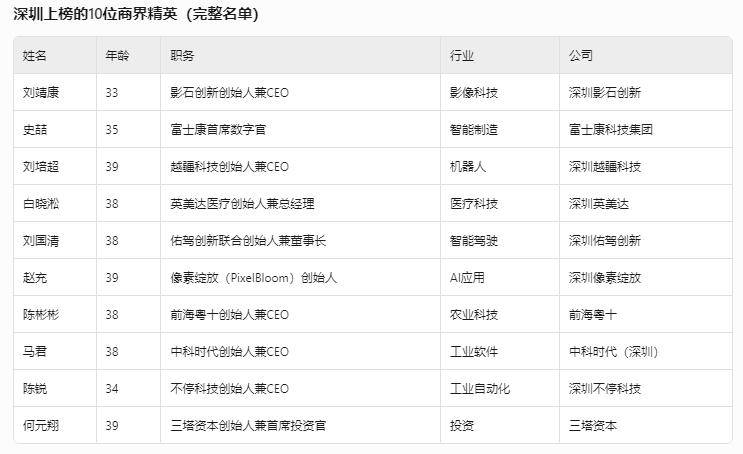
Group 1 - The "Fortune" (Chinese version) list of "China's 40 Under 40 Business Elites" showcases 10 influential business elites and 8 potential business elites from Shenzhen, highlighting the city's role as an innovation hub [1][5] - The list emphasizes the importance of young innovators who are not only focused on technological innovation but also on bridging gaps, understanding differences, and leading the future [4][5] - The current era is characterized as a transitional phase between "digital native" and "intelligent native," where AI is transforming human systems using data accumulated over the past 30 years [2][4] Group 2 - The list includes various sectors where young entrepreneurs are making significant contributions, such as artificial intelligence, healthcare, green technology, new consumption, and intelligent manufacturing [5] - The Shenzhen elites listed are involved in diverse industries, including imaging technology, smart manufacturing, robotics, medical technology, intelligent driving, AI applications, agricultural technology, industrial software, and automation [6][8][10][12][15][17][19][21][23][26][29] - The companies represented by these young leaders are recognized for their innovative approaches and significant market impact, such as Insta360, Foxconn, and Yuyuan Innovation, among others [8][10][12][15][19][21][26][29] Group 3 - The list of potential business elites includes individuals leading companies in AI and robotics, intelligent manufacturing, green technology, and investment, indicating a strong focus on future-oriented industries [29][30][32][34][36][38][40][41] - Notable companies among the potential elites include X Square Robot, SmartMore, and Angstrong Tech, which are pioneering advancements in robotics and AI technologies [30][34][36] - The achievements of these companies reflect a commitment to innovation and the development of solutions that address contemporary challenges in various sectors [30][34][36][38]
近5000亿!上半年南山区GDP领跑全市
Nan Fang Du Shi Bao· 2025-08-13 23:16
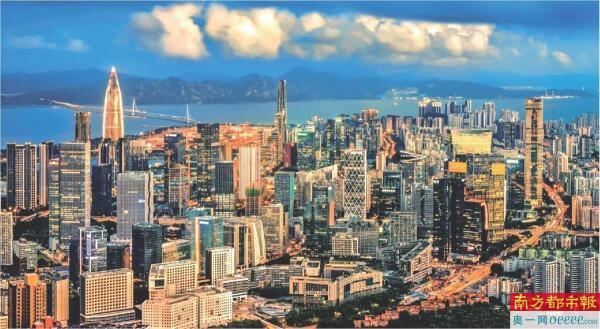
Core Insights - Shenzhen's economic performance in the first half of 2025 shows significant growth, with four districts exceeding a GDP of 250 billion yuan, particularly Nanshan District nearing 500 billion yuan [1][2] - The overall GDP of Shenzhen reached 18,322.26 billion yuan, reflecting a year-on-year growth of 5.1%, surpassing the provincial growth rate of 4.2% [1][2] District Performance - **Nanshan District**: - GDP reached 4980.06 billion yuan, with a year-on-year growth of 4.8% [2][6] - Key economic indicators include a 6.5% increase in industrial output and a 13.1% rise in retail sales [6] - Nanshan is on track to become a "trillion-yuan district" [1][6] - **Futian District**: - GDP was 2953.15 billion yuan, with a notable growth rate of 7.9%, the highest among major districts [2][7] - The financial sector showed a remarkable increase of 16% in value-added, accounting for 44.8% of the city's financial output [8] - Fixed asset investment grew by 0.4%, with non-real estate projects increasing by 25.4% [8] - **Longgang District**: - GDP reached 2809.67 billion yuan, with a modest growth of 1.8% [2] - The district is also expected to approach a GDP of 600 billion yuan by year-end [1][2] - **Baoan District**: - GDP was 2560.22 billion yuan, with a year-on-year growth of 4.7% [2][9] - Retail sales totaled 792.06 billion yuan, reflecting a growth of 7.2% [9] - The district is focusing on new industrialization and advanced manufacturing [10] Economic Contribution - The combined GDP of Nanshan, Futian, Longgang, and Baoan districts accounts for 72.6% of Shenzhen's total economic output [1][3][5] - The economic performance of these districts is crucial for achieving the city's overall economic goals [5][6]
城市24小时 | 通航在即,又一座“双机场”城市来了
Mei Ri Jing Ji Xin Wen· 2025-08-13 15:41
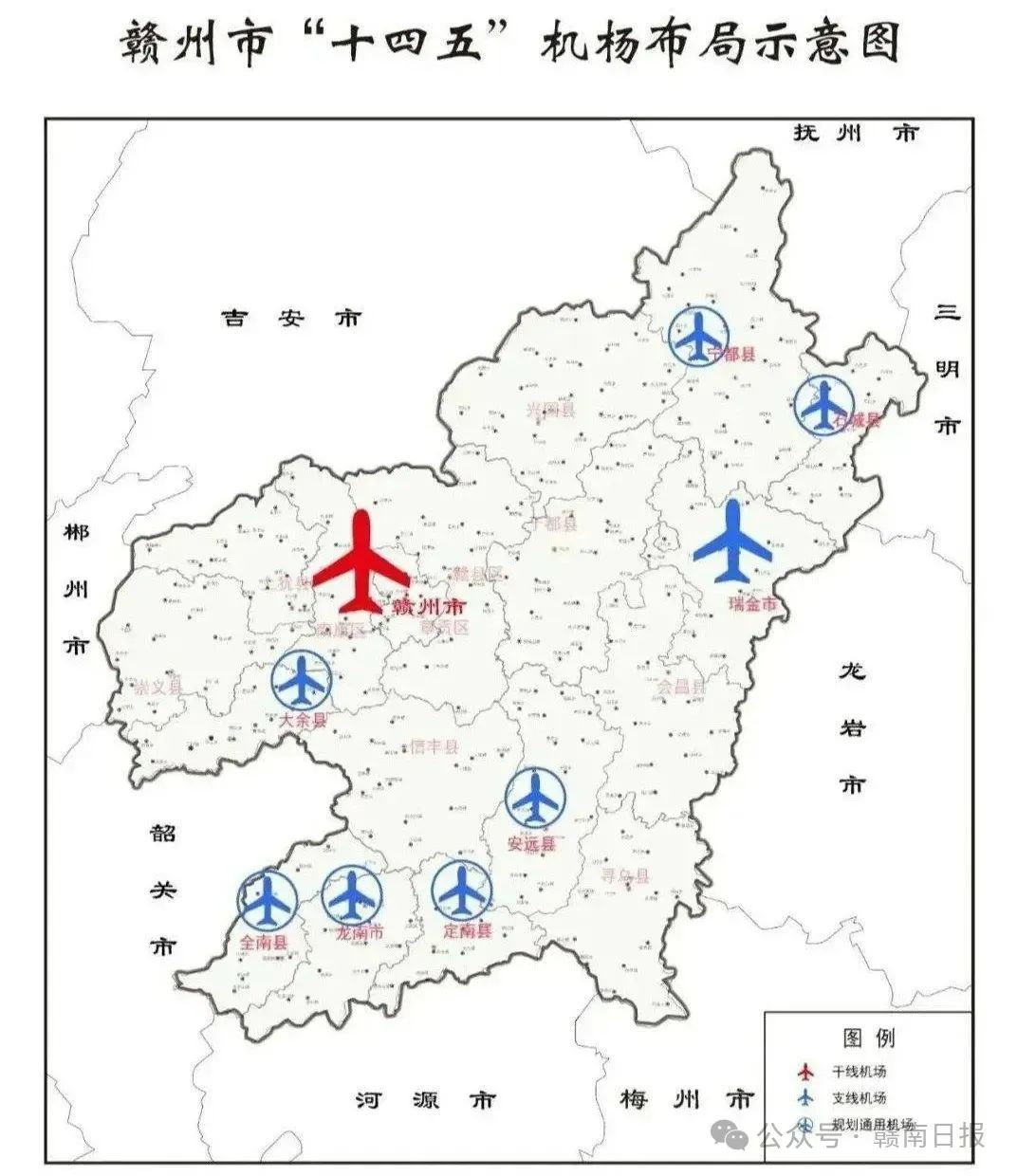
Group 1: Airport Development - The Jiangxi Ruijin Civil Airport has received preliminary approval for industry acceptance, aiming for an annual passenger throughput of 550,000 and a cargo throughput of 2,000 tons [1] - The airport will end the lack of civil aviation services in eastern Gannan and significantly improve the transportation system in Ruijin and surrounding areas [1] - Ruijin Airport is part of the national civil aviation development plan and is the only new 4C-level regional airport built in Jiangxi during the 13th Five-Year Plan [1] Group 2: Regional Economic Impact - After the opening of Ruijin Airport, Ganzhou will become the only city in Jiangxi and Central China with two civil airports [2] - Ganzhou, as a sub-central city in Jiangxi, has a population of 9.74 million and an area of 39,400 square kilometers, representing 25% and 20% of the province's total, respectively [5] - The "14th Five-Year" plan for Ganzhou includes the construction of Ruijin Airport and the expansion of the existing Ganzhou Huangjin Airport to enhance regional aviation capabilities [5] Group 3: Infrastructure and Transportation - The construction of Ruijin Airport is deemed necessary due to the challenging terrain in the Gannan mountainous area, which has hindered the development of road and rail transport [1] - The airport is expected to significantly enhance travel efficiency for over 6.8 million residents in the old revolutionary areas [1]
经济大区挑大梁!“半年报”出炉,深圳这些区为什么“行”
Nan Fang Du Shi Bao· 2025-08-13 10:22
Core Insights - Shenzhen's GDP reached 18,322.26 billion yuan in the first half of 2025, with a year-on-year growth of 5.1%, surpassing the provincial growth rate of 4.2% [3] - Four districts in Shenzhen, namely Nanshan, Futian, Longgang, and Baoan, collectively contributed 72.6% to the city's total GDP [6][3] - Nanshan district is on track to become a "trillion-yuan district," with a GDP of 4,980.06 billion yuan, growing by 4.8% year-on-year [3][8] District Performance Nanshan District - Nanshan's GDP is close to 5,000 billion yuan, with significant contributions from the secondary industry (1,057.66 billion yuan, +5.3%) and tertiary industry (3,921.88 billion yuan, +4.7%) [8] - The district's fixed asset investment grew by 6.5%, and social retail sales increased by 13.1%, indicating robust economic activity [10][8] - Nanshan is focusing on emerging industries, particularly in artificial intelligence and robotics, to enhance its economic structure [8] Futian District - Futian district recorded a GDP of 2,953.15 billion yuan, with a leading growth rate of 7.9% in the first half of 2025 [3][11] - The financial sector in Futian grew by 16.0%, accounting for 44.8% of the city's financial value added, showcasing its strength in financial services [14] - Fixed asset investment in Futian increased by 0.4%, with non-real estate projects rising by 25.4%, indicating a shift towards innovation and technology [14] Longgang District - Longgang's GDP reached 2,809.67 billion yuan, with a year-on-year growth of 1.8%, reflecting a slower pace compared to other districts [3] - The district's economic performance is being closely monitored as it approaches the 6,000 billion yuan mark for the year [3] Baoan District - Baoan district's GDP was 2,560.22 billion yuan, growing by 4.7%, with strong performance in the tertiary sector (1,320.99 billion yuan, +6.5%) [15] - The district is enhancing its consumer market, with retail sales reaching 792.06 billion yuan, a growth of 7.2% [16] - Baoan is focusing on new industrialization, particularly in semiconductors and artificial intelligence, to establish itself as a key player in advanced manufacturing [18]
黄坤明到深圳开展人工智能与机器人产业专题调研坚持创新驱动 突出应用导向乘势而上推动人工智能与机器人产业跨越式发展孟凡利参加
Nan Fang Ri Bao Wang Luo Ban· 2025-08-13 02:32
Core Insights - The article emphasizes the importance of advancing the artificial intelligence and robotics industry in Shenzhen, aligning with Xi Jinping's directives on developing new productive forces [1][3] - Shenzhen has implemented various policies to promote high-level applications across all sectors, leading to accelerated industrial clustering effects [2] Group 1: Government Initiatives - The provincial government is committed to fostering innovation-driven development and application-oriented strategies in the AI and robotics sectors [1][3] - There is a focus on enhancing policy support and resource allocation to help companies grow and strengthen their market positions [2] Group 2: Industry Development - Shenzhen has made significant progress in cultivating a competitive AI and robotics industry cluster, contributing to Guangdong's modern industrial system [3] - The government encourages companies to maintain their focus on independent innovation and to enhance product functionality, user experience, and cost efficiency [2] Group 3: Collaboration and Ecosystem - There is a strong emphasis on promoting deep integration of industry, academia, and research to enhance technological innovation capabilities [3] - The article highlights the need for a supportive innovation ecosystem that attracts financial investment in hard technology and fosters the growth of leading enterprises in the AI and robotics fields [3]

专设国内城市展促进 “双向赋能”!第33届广州博览会将于8月22日启幕
Nan Fang Nong Cun Bao· 2025-08-12 13:53
Group 1 - The 33rd Guangzhou Fair will be held from August 22 to 24, focusing on high-quality development through resource complementarity and technology transformation [1][2] - The fair will feature four thematic exhibition areas, including new productivity, rural revitalization, silver economy, and healthcare, covering various sectors such as innovation, automotive aftermarket, and cultural creativity [1][2] - The exhibition area is approximately 180,000 square meters, representing a year-on-year growth of over 50% [1] Group 2 - The fair aligns with Guangdong's "1310" deployment and Guangzhou's "12218" modern industrial system strategy, emphasizing the cultivation of new productivity in emerging industries like AI, robotics, and aerospace [2] - A dedicated domestic city exhibition area will promote local products and resources, enhancing inter-regional industrial connectivity and resource sharing [2] - The event will include significant activities such as consumption assistance matching meetings and strategic insights from industry leaders, providing a high-quality platform for market expansion and cooperation [2] Group 3 - The 9th China (Guangzhou) International Elderly Health Industry Expo will take place in 2025, focusing on the silver economy and featuring a "smart elderly care" exhibition area [3] - The expo will showcase innovative technologies, including the world's first intelligent psychological health robot and various types of assistive robots [3] - Over 50 themed activities will be held to stimulate the vitality of the exhibition and promote the upgrade of the silver industry in Guangzhou and the Greater Bay Area [3]
第33届广州博览会将至!财政首次“零投入”,展会扩容升级
Nan Fang Du Shi Bao· 2025-08-12 10:16
Group 1 - The 33rd Guangzhou Expo will be held from August 22 to 24, with a total exhibition area of approximately 180,000 square meters, representing a 50% increase compared to the previous edition [2][3] - The theme of this year's expo is "Dual Empowerment Promotes Circulation, New Quality Invention Creates the Future," featuring four main exhibition areas focused on new quality productivity, rural revitalization, silver economy, and healthcare [3][4] - The expo will introduce a robot performance area for the first time, showcasing over 130 robots, and will also host the 11th International Invention Exhibition and the "Belt and Road" and BRICS Skills Development and Technology Innovation Competition concurrently [2][3] Group 2 - The Guangzhou International Elderly Health Industry Expo, an important part of the Guangzhou Expo, will focus on "New Tracks in Silver Economy, New Technology, New Consumption," with an exhibition area of 50,000 square meters [4] - The Guangzhou Medical and Health Industry Expo will also take place, covering 30,000 square meters and featuring advanced biopharmaceutical technologies such as gene editing and 3D printing [5] - The Guangzhou Expo aims to activate domestic circulation by promoting regional products and resources, and will sign cooperation agreements to enhance industrial collaboration [6] Group 3 - This year's Guangzhou Expo will achieve "zero investment" from the municipal finance, emphasizing market-oriented operations to enhance the effectiveness of the exhibition [7] - The newly established Guangzhou Consumption Assistance Special Exhibition will cover 20,000 square meters and will also follow a market-oriented model for organization and participation [7][8] - The expo has attracted participation from over 320 companies across 80 cities, indicating a shift from "I have to exhibit" to "I want to exhibit" [8]