
食品加工

Search documents
立高食品:预计2025年净利润同比增长16.06%至23.52%
Zheng Quan Ri Bao Zhi Sheng· 2026-01-21 13:41
Group 1 - The company, Lihigh Food, announced an expected operating revenue of 4.26 billion to 4.42 billion yuan for the year 2025 [1] - The net profit attributable to shareholders of the listed company is projected to be between 311 million and 331 million yuan, representing a year-on-year growth of 16.06% to 23.52% [1]

立高食品:预计2025年归母净利润为3.11亿元至3.31亿元
Bei Jing Shang Bao· 2026-01-21 12:47
Core Viewpoint - The company expects a net profit attributable to shareholders of 311 million to 331 million yuan for 2025, representing a year-on-year growth of 16.06% to 23.52% [1] Group 1: Performance Expectations - The projected net profit for 2025 is between 311 million and 331 million yuan [1] - This forecast indicates a growth rate of 16.06% to 23.52% compared to the previous year [1] Group 2: Factors Driving Growth - The increase in performance is primarily attributed to the growth in channel sales [1] - Enhanced efficiency in expense allocation is a contributing factor [1] - Innovation in research and development is driving growth [1] - Optimization of the supply chain operation model is also a key factor [1]
双汇发展:2026年1月20日公司股东人数150313户
Zheng Quan Ri Bao Wang· 2026-01-21 12:44
Group 1 - The core point of the article is that Shuanghui Development (000895) reported a total of 150,313 shareholders as of January 20, 2026, including credit accounts [1]

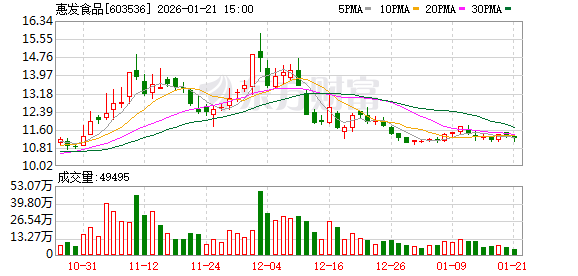
多元探索尚未奏效 惠发食品五年四亏
Bei Jing Shang Bao· 2026-01-21 12:35
Core Viewpoint - Huifa Food, a long-established frozen prepared meat product company, is expected to report a significant loss in 2025, with a projected net profit attributable to shareholders ranging from -75 million to -62 million yuan, representing a year-on-year decline of approximately 273.81% to 352.19% [2] Financial Performance - Over the past five years, Huifa Food has faced continuous pressure on profitability, recording losses in four of those years. The company only achieved a profit of 7.52 million yuan in 2023, while incurring losses of 138 million yuan, 120 million yuan, and 16.59 million yuan in 2021, 2022, and 2024, respectively [3] - The 2024 earnings forecast was notably revised from a profit to a substantial loss, leading to a warning letter from the Shandong Securities Regulatory Bureau to the company's executives [3] Business Expansion and Strategy - In recent years, Huifa Food has actively expanded its business into supply chain, prepared dishes, and sugar-free tea sectors. The supply chain business has seen revenue growth from 69.41 million yuan in 2019 to 584 million yuan in 2024, now accounting for 30.33% of total revenue, surpassing the revenue from meatballs [4] - Despite the growth in supply chain revenue, the gross margin for this segment has declined, reaching only 7.41% in 2024, which negatively impacted the overall gross margin [4] - The company has invested heavily in the prepared dishes sector since 2021, developing over a thousand products. However, revenue from this segment has not exceeded 10% of total revenue and has faced declines of 17.94% and 21.43% year-on-year in 2024 and the first three quarters of 2025, respectively [4] New Product Development - In 2023, Huifa Food launched a sugar-free hawthorn tea aimed at the dining market, competing with brands like Shanzha Tree and Huagi. However, this product has not yet achieved significant sales volume and is currently unavailable on major e-commerce platforms [5] Market Challenges - Analysts suggest that Huifa Food's core business in frozen foods and hot pot products is facing growth obstacles, and the frequent cross-industry expansions may further strain financial resources. The new business developments are still immature and lack synergy with the core business, leading to a dilution of focus and resources [5][6] - The company is attempting to improve its operational situation by enhancing cost control and resource allocation while focusing on its core business and exploring new market opportunities [6]


元祖股份:截至2026年1月20日股东总户数为19929户
Zheng Quan Ri Bao Wang· 2026-01-21 11:41
Core Viewpoint - Yuanzi Co., Ltd. (603886) reported that as of January 20, 2026, the total number of shareholders is 19,929 [1] Company Information - The company has engaged with investors through an interactive platform to provide updates on shareholder statistics [1]

突发利空!直线跳水!巴菲特这次输了?
券商中国· 2026-01-21 11:32
Core Viewpoint - Berkshire Hathaway may sell its 27.5% stake in Kraft Heinz, which could mark a significant shift in investment strategy under new leadership, as the investment has not been successful over the past decade [1][2][6]. Group 1: Investment Background - Berkshire Hathaway's involvement with Kraft Heinz began in 2013 with a $28 billion deal to privatize Heinz, followed by a merger with Kraft in 2015, creating the fifth-largest food and beverage company globally [1][7]. - Since the merger, Kraft Heinz's stock has declined for three consecutive years, with the latest price down nearly 70% from its 2017 peak, making it one of the worst performers in the U.S. food sector [1][7]. Group 2: Recent Developments - On January 20, Kraft Heinz filed a supplemental document with the SEC indicating that Berkshire Hathaway might sell its 3.254 billion shares, which would end a long-term but unsuccessful investment [2][8]. - Following the announcement, Kraft Heinz's stock price dropped by 3.66% in pre-market trading [3][4]. Group 3: Leadership Changes and Strategic Shifts - The potential sale comes shortly after Warren Buffett's retirement, with analysts suggesting that new CEO Greg Abel may adopt a different approach to investment, possibly evaluating and divesting underperforming subsidiaries [6][7]. - Abel's leadership style is expected to differ from Buffett's, which traditionally focused on acquisitions rather than divestitures [6][7]. Group 4: Financial Performance and Challenges - Kraft Heinz's market capitalization has decreased to $28.124 billion, with the stock closing at $23.76 per share [7]. - Berkshire Hathaway has recorded significant impairment losses on its investment in Kraft Heinz, including a $5 billion pre-tax write-down last year, following a $3 billion write-down in 2019 [8][10]. Group 5: Industry and Competitive Landscape - Buffett has publicly reflected on the investment's failures, citing high purchase prices, worsening industry competition, and a lack of innovation as key factors [11][12]. - The rise of retail giants like Amazon and Costco has diminished the bargaining power of traditional brands like Kraft Heinz, which struggle to compete with private label products [11][12].


新官上任第一刀!阿贝尔打破巴菲特“铁律”,或清仓一大持仓!
Jin Shi Shu Ju· 2026-01-21 09:20
Group 1 - Berkshire Hathaway may intend to sell 325 million shares of Kraft Heinz, a company co-founded by Buffett in 2015, as indicated in a regulatory filing [1] - Buffett has gradually realized that the competitive moat around Kraft Heinz's brands is not as strong as previously thought, with consumers increasingly shifting towards store brands and away from processed foods [1] - Berkshire Hathaway recorded a $3.76 billion asset write-down on its Kraft Heinz holdings last summer [1] Group 2 - There are no signs yet that Berkshire has begun selling, but analysts suggest this could be the start of a comprehensive review of its extensive portfolio [2] - Abel's leadership style may differ from Buffett's, and if the sale occurs, it would represent a shift in the company's mindset towards divestitures rather than just acquisitions [2] - Abel has been familiar with many of Berkshire's companies since 2018, managing all non-insurance businesses, but officially became CEO on January 1 of this year [2] Group 3 - Buffett stated last fall that Berkshire would not accept a bulk buyout offer for its shares unless a similar offer was made to all Kraft Heinz shareholders [3]
特朗普拟对欧盟六国征关税或令美国海关陷入难题
Xin Lang Cai Jing· 2026-01-21 09:14
Group 1 - The core issue revolves around President Trump's threat to impose tariffs on specific EU countries, which could complicate customs operations for the U.S. [1][6] - The targeted EU countries include Denmark, Finland, France, Germany, the Netherlands, and Sweden, along with non-EU countries Norway and the UK, with tariffs expected to gradually increase until the U.S. is allowed to purchase Greenland [1][6] Group 2 - The complexity of determining the origin of goods arises from the EU's internal rules, where products are labeled as "EU origin," making it challenging for U.S. customs to identify the specific member state of origin due to the intricate cross-border supply chains [2][8] - Smaller companies may find it easier to conceal their production locations, while larger firms with transparent supply chains might relocate production to EU countries not affected by the tariffs [2][8] Group 3 - The ability of the U.S. to accurately target specific brands is questioned, as products may be produced in various locations, complicating the enforcement of tariffs [3][9] - For instance, Volkswagen produces cars in both Germany and Slovakia, while Volvo has production facilities in Belgium and Sweden, indicating that production adjustments in response to tariffs may take significant time [3][9] Group 4 - French products like Champagne and Camembert cheese are likely to be more vulnerable to sanctions due to their strong association with traditional craftsmanship and geographical origin [4][10] - The EU's geographical indication protection system safeguards around 4,000 products linked to specific regions, which the U.S. has criticized as trade protectionism [4][10] Group 5 - Among the six EU countries targeted for tariffs, France has the highest number of products protected under the geographical indication system [5][11]
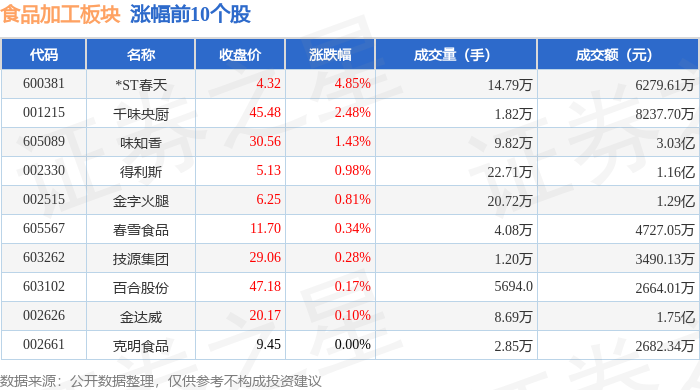
食品加工板块1月21日跌0.82%,光明肉业领跌,主力资金净流出6167.53万元
Zheng Xing Xing Ye Ri Bao· 2026-01-21 08:53
Core Insights - The food processing sector experienced a decline of 0.82% on January 21, with Bright Meat Industry leading the drop [1] - The Shanghai Composite Index closed at 4116.94, up 0.08%, while the Shenzhen Component Index closed at 14255.12, up 0.7% [1] Sector Performance - The food processing sector's individual stock performance showed varied results, with *ST Chuntian leading with a rise of 4.85% to a closing price of 4.32 [1] - Other notable gainers included Qianwei Yangchu, which rose by 2.48% to 45.48, and Weizhi Xiang, which increased by 1.43% to 30.56 [1] Stock Trading Data - Bright Meat Industry saw a significant decline of 6.18%, closing at 6.53, with a trading volume of 573,900 shares and a transaction value of 376 million [2] - Other stocks like Baba Foods and Kangbiter also faced declines of 3.47% and 2.34%, respectively [2] Capital Flow Analysis - The food processing sector experienced a net outflow of 61.68 million from institutional investors, while retail investors saw a net inflow of 78.20 million [2] - Individual stock capital flows indicated that *ST Chuntian had a net inflow of 17.58 million from institutional investors, while retail investors contributed a net inflow of 772.11 thousand [3]


立高食品(300973.SZ):预计2025年净利润同比增长16.06%~23.52%
Ge Long Hui A P P· 2026-01-21 08:43
2、根据公司《2022年限制性股票激励计划考核管理办法》,2025年度、2026年度公司层面业绩考核触 发值对应指标分别为收入49.23亿元、56.61亿元,根据公司预计的业绩情况,2025年度预计未达成行权 条件,此外综合公司业务发展及市场环境情况,2026年度业绩考核目标达成难度较大,基于审慎原则, 公司与会计师事务所沟通后,拟在2025年冲回以前年度已计提的预计未来达标的股份支付费用约为 1,400万元。因此,报告期内公司2022年限制性股票激励计划的股份支付摊销费用对公司2025年度净利 润的影响金额约为1,400万元,剔除上述影响因素后,归属于上市公司股东的净利润盈利范围29,700万元 至31,700万元,较上年同期剔除股份支付后的归母净利润增长10.06%至17.47%;扣除非经常性损益后的 净利润盈利范围29,200万元至31,200万元,较上年同期剔除股份支付后的扣非归母净利润增长14.24%至 22.06%。 1、本报告期内,公司归属于上市公司股东的净利润较上年同期上升,主要原因如下:(1)在渠道端, 公司核心商超、餐饮连锁、海外等渠道销售规模同比增长,其中2025年度海外市场销售额破亿, ...