
纺织服装

Search documents
常熟向上 上相常熟 ——写在“时尚常熟”品牌暨户外运动产业发展大会启幕之际
Su Zhou Ri Bao· 2025-10-15 00:30
Group 1: Overview of Changshu's Development - Changshu's "upward" posture is characterized by its natural endowments, robust industries, and a spirit of innovation, reflecting a clear self-awareness and understanding of development patterns [1][2] - The Suzhou Technology Fashion Week and the "Fashion Changshu" brand event highlight the city's integration of technology, fashion, and outdoor sports, showcasing its dynamic growth [1][3] Group 2: Industrial Strength - In 2024, Changshu's industrial output value surpassed 490 billion, with key contributions from the automotive, equipment manufacturing, and textile industries, the latter showing a 10.5% year-on-year growth [3][5] - The textile and apparel industry is a significant pillar, with over 5,000 enterprises producing more than 500 million garments annually, generating stable output value of 100 billion and export value exceeding 10 billion [2][3] Group 3: Innovation and Future Vision - Changshu is focusing on AI-driven innovation, with 28 AI models and 49 application scenarios identified, generating nearly 20 billion in revenue and housing 200 enterprises [8][9] - The "Fashion Changshu" brand and the "Outdoor Sports Industry Three-Year Action Plan" aim to enhance industry upgrades, scene expansion, and technological empowerment, positioning Changshu as a model for integrating technology into traditional industries [9][10] Group 4: Cultural and Sporting Events - The city has hosted various high-profile sports events, enhancing its reputation as "the first city of outdoor sports in Jiangnan," with activities like hiking and camping gaining popularity [6][7] - The 17th "Changshu Cup" Fashion Design Competition attracted over 1,000 participants, showcasing the city's commitment to fostering global fashion talent and innovation [6][7]
涉嫌信披违规,如意集团被立案调查
Shen Zhen Shang Bao· 2025-10-14 23:24
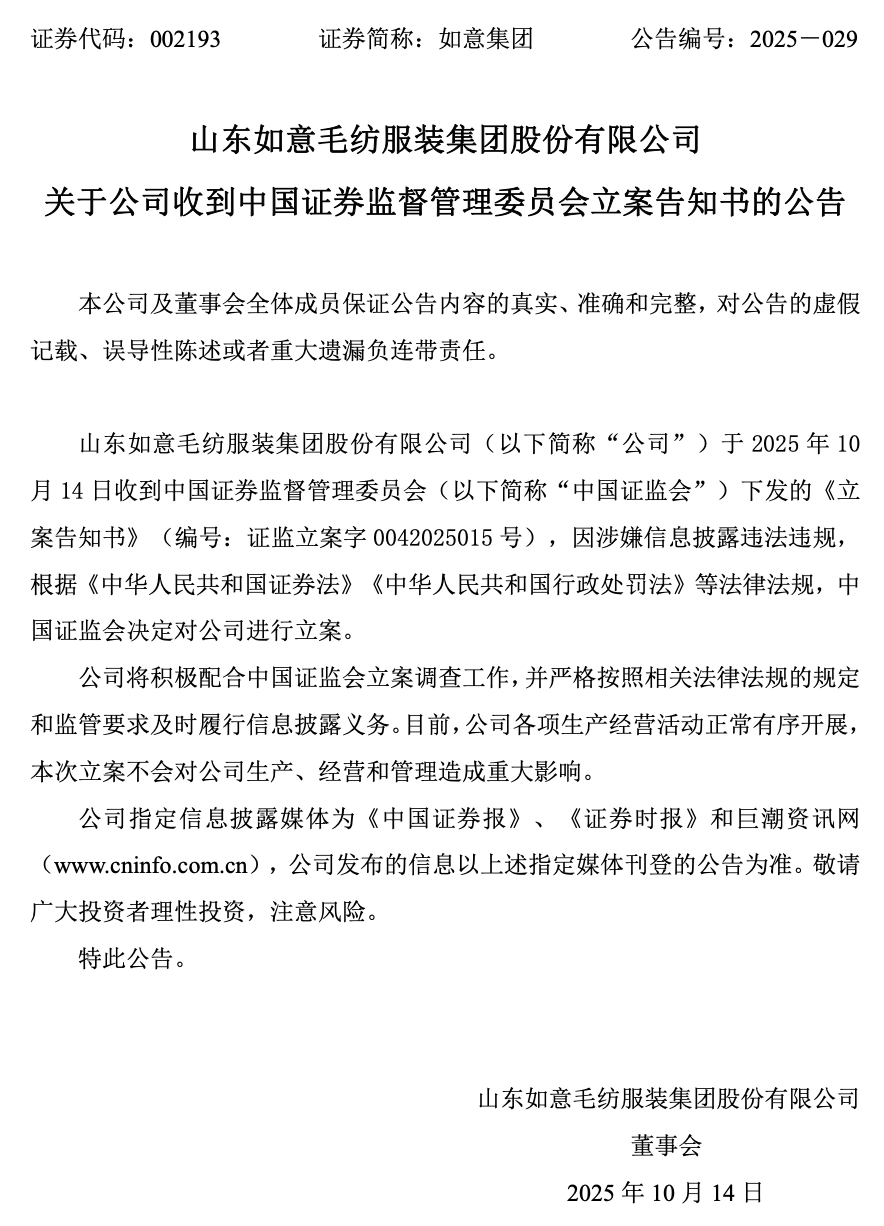
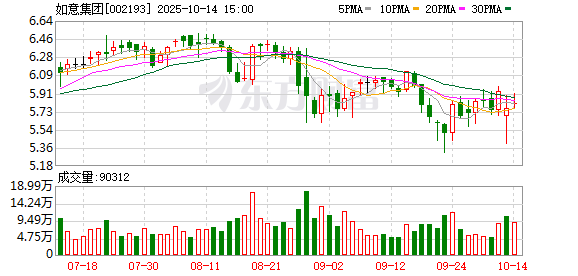
10月14日晚间,如意集团(002193)公告称,公司于2025年10月14日收到中国证监会下发的《立案告知书》,因涉嫌信息披 露违法违规,根据相关法律法规,中国证监会决定对公司进行立案。 如意集团表示,公司将积极配合中国证监会立案调查工作,并严格按照相关法律法规的规定和监管要求及时履行信息披露义 务。目前,公司各项生产经营活动正常有序开展,本次立案不会对公司生产、经营和管理造成重大影响。 证券代码:002193 证券简称:如意集团 公告编号:2025-029 2025 年 10 月 14 日 值得注意的是,此前,如意集团及其高管因多项违规被出具警示函。 山东如意毛纺服装集团股份有限公司 关于公司收到中国证券监督管理委员会立案告知书的公告 本公司及董事会全体成员保证公告内容的真实、准确和完整,对公告的虚假 记载、误导性陈述或者重大遗漏负连带责任。 山东如意毛纺服装集团股份有限公司(以下简称"公司")于2025年10 月 14 日收到中国证券监督管理委员会(以下简称"中国证监会")下发的《立 案告知书》(编号:证监立案字 0042025015 号),因涉嫌信息披露违法违规, 根据《中华人民共和国证券法》《中华人 ...


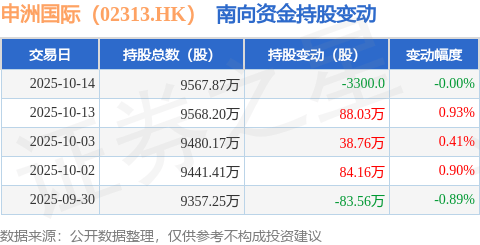
申洲国际(02313.HK):10月14日南向资金减持3300股
Sou Hu Cai Jing· 2025-10-14 19:29
Core Viewpoint - Southbound funds reduced their holdings in Shenzhou International (02313.HK) by 3,300 shares on October 14, 2025, while showing a net increase in holdings over the past 20 trading days [1] Group 1: Shareholding Changes - In the last 5 trading days, southbound funds increased their holdings on 3 days, with a total net increase of 1,270,600 shares [1] - Over the last 20 trading days, there were 10 days of net increases, totaling 4,593,500 shares [1] - As of now, southbound funds hold 95,678,700 shares of Shenzhou International, representing 6.35% of the company's total issued ordinary shares [1] Group 2: Company Overview - Shenzhou International Group Holdings Limited primarily engages in the production and sale of knitted apparel products [2] - The company's main business model combines OEM (Original Equipment Manufacturer) and ODM (Original Design Manufacturer) to manufacture knitted products for clients [2] - Product categories include sportswear, casual wear, underwear, and other knitted items, with operations in both domestic and international markets [2]
哥伦比亚总统下令取消布料与皮革关税
Shang Wu Bu Wang Zhan· 2025-10-14 15:49
Core Points - Colombian President Petro has instructed the Ministry of Trade to eliminate tariffs on fabrics and leather, aiming to reduce production costs and enhance export competitiveness [1] - The textile industry representative, Criado, highlighted that approximately 142,000 small and medium-sized enterprises, which constitute 99% of the industry, support employment in Colombia's fashion sector [1] - Criado urged the government to take further action by removing tariffs on raw materials like yarn to stimulate the grassroots economy [1]
002193、920748,双双被立案
Shang Hai Zheng Quan Bao· 2025-10-14 14:52
Group 1 - Both Ru Yi Group and Lu Qiao Information have been investigated by the China Securities Regulatory Commission (CSRC) for suspected violations of information disclosure laws [2][10] - Ru Yi Group has reported continuous losses for three consecutive years from 2022 to 2024, with a significant decline in revenue and a net profit of -96.73 million yuan in the first half of 2025 [7][12] - Lu Qiao Information has also faced financial difficulties, with a revenue of 30.44 million yuan in the first half of 2025, down 53.64% year-on-year, and a net profit of -24.89 million yuan [13] Group 2 - Ru Yi Group's main business includes the design, production, and sales of textiles and garments, with a complete industrial chain from wool to fabric to clothing [7] - Lu Qiao Information specializes in providing information technology products and solutions for the transportation sector, utilizing AI, IoT, big data, and cloud computing [12] - Both companies have previously encountered issues with inaccurate financial reporting and accounting errors, leading to regulatory scrutiny [9][10]
洪兴股份:10月14日召开董事会会议
Mei Ri Jing Ji Xin Wen· 2025-10-14 11:49
Group 1 - The company Hongxing Co., Ltd. (SZ 001209) held its third fifth board meeting on October 14, 2025, in Guangzhou, where it reviewed the revised company articles [1] - As of the report date, Hongxing Co., Ltd. has a market capitalization of 2.3 billion yuan [2] - For the first half of 2025, the company's revenue composition was 97.06% from textiles and apparel, with other business revenues accounting for 2.94% [2]
鲁泰A:预计前三季度净利润4.9亿元~5.3亿元,同比增长70.23%~84.12%
Mei Ri Jing Ji Xin Wen· 2025-10-14 08:55
Group 1 - The core viewpoint of the article is that Lutai A has projected a significant increase in net profit for the first three quarters of 2025, estimating a range of 490 million to 530 million yuan, which represents a year-on-year growth of 70.23% to 84.12% [1] - The increase in net profit is primarily attributed to gains from the sale of trading financial assets and changes in the fair value of held trading financial assets, contributing approximately 160 million yuan to non-recurring gains [1] - As of the report, Lutai A has a market capitalization of 5.6 billion yuan [1] Group 2 - For the first half of 2025, Lutai A's revenue composition is as follows: textiles and apparel account for 92.77%, thermal power (electricity and steam) for 4.92%, and other businesses for 2.32% [1]

南山智尚股价连续3天下跌累计跌幅10.49%,富荣基金旗下1只基金持12.78万股,浮亏损失30.29万元
Xin Lang Cai Jing· 2025-10-14 07:17
Group 1 - The core point of the article highlights the recent decline in the stock price of Nanshan Zhishang, which has dropped 4.71% to 20.22 CNY per share, with a total market capitalization of 10.234 billion CNY and a cumulative decline of 10.49% over the last three days [1] - Nanshan Zhishang, established on April 29, 2007, and listed on December 22, 2020, is primarily engaged in the production and sale of fabrics and clothing, with revenue composition including 46.70% from fine woolen fabrics, 29.83% from clothing, 12.04% from ultra-high fiber, 9.94% from nylon fiber, and 1.50% from other sources [1] Group 2 - From the perspective of major fund holdings, the Fuyong Fund has a significant position in Nanshan Zhishang, with the Fuyong Fuxin Mixed A Fund holding 127,800 shares, accounting for 5.53% of the fund's net value, making it the fourth-largest holding [2] - The Fuyong Fuxin Mixed A Fund has experienced a floating loss of approximately 127,800 CNY today, with a total floating loss of 30,290 CNY during the three-day decline [2] - The fund was established on March 16, 2018, with a current scale of 7.317 million CNY, and has achieved a year-to-date return of 13.51% and a one-year return of 30.42% [2]
361度(01361):三季度运营表现佳
Ping An Securities· 2025-10-14 06:18
Investment Rating - The report maintains a "Recommended" investment rating for 361 Degrees (1361.HK) [3][11]. Core Insights - The company reported a strong operational performance in Q3 2025, with a 10% year-on-year increase in retail sales for both the main brand and children's clothing, and a 20% increase in overall e-commerce platform revenue [3][6]. - The company is actively enhancing its operational performance through product upgrades, brand building, and channel development, including collaborations with Meituan for online sales [6]. - The company is positioned to benefit from the growth in both adult and children's apparel segments, alongside the sports and outdoor activity market, indicating strong resilience in both short and long-term growth [6]. Financial Summary - Revenue projections for 2025-2027 are estimated at 113.4 billion, 126.6 billion, and 140.8 billion CNY, representing year-on-year growth of 12.5%, 11.7%, and 11.2% respectively [6][9]. - Net profit forecasts for the same period are 12.9 billion, 14.7 billion, and 16.6 billion CNY, with growth rates of 12.5%, 13.4%, and 13.0% [6][9]. - The company maintains a gross margin of approximately 41% and a net margin of around 11.4% [9]. Key Financial Ratios - The projected P/E ratios for 2025-2027 are 8.7, 7.7, and 6.8, indicating a potentially attractive valuation [9]. - The projected ROE for 2025-2027 is around 14.7% to 14.6%, suggesting stable profitability [9]. - The asset-liability ratio is expected to be around 28.4% in 2025, indicating a healthy balance sheet [9]. Operational Highlights - As of September 30, 2025, the company has expanded its national store count to 93, reflecting ongoing channel development [6]. - The company is the official partner of the 20th Asian Games, enhancing its brand visibility and market presence [6].
上工申贝2025年10月14日涨停分析:政府征收补偿+通航业务布局+员工持股
Xin Lang Cai Jing· 2025-10-14 02:03
Core Viewpoint - The stock of Shangong Shenbei (sh600843) reached its daily limit, closing at 13.73 yuan with a 10.02% increase, driven by government compensation, business transformation, and employee stock ownership plans [1][2]. Group 1: Government Compensation - The company announced it received a substantial government compensation of 243 million yuan, which is expected to increase net profit by 175 million yuan, significantly improving cash flow and alleviating current performance and cash flow pressures [2]. Group 2: Business Transformation - Shangong Shenbei is actively transforming its business by establishing a subsidiary with a registered capital of 550 million yuan to expand into the general aviation sector, focusing on carbon fiber composites and light aircraft. This move aligns with the national emphasis and support for the general aviation industry, indicating substantial growth potential [2]. Group 3: Employee Stock Ownership - The company implemented an employee stock ownership plan, unlocking 1.7258 million shares valued at 7.7661 million yuan, which is expected to stabilize the core team and enhance employee engagement, positively impacting long-term development [2]. Group 4: Market Dynamics - The textile and apparel sector saw some capital inflow on the same day, suggesting that Shangong Shenbei may benefit from this trend. Additionally, if the MACD indicator shows a bullish crossover or breaks through key resistance levels, it could attract further investment [2].
