箱包

Search documents
原材料的周期弹性与品牌的分化性成长
GUOTAI HAITONG SECURITIES· 2026-03-21 12:01
Investment Rating - The report assigns an investment rating of "A" for the textile and apparel industry for the fiscal year 2025/2026 [2]. Core Insights - The textile and apparel sector has experienced a decline of 3.2% year-to-date, underperforming the CSI 300 index by 1.9 percentage points, ranking 23rd among 31 industries [5][6]. - The performance of individual stocks has varied, with notable gains in companies diversifying into emerging technology sectors and those benefiting from moderate raw material price increases [5]. - In the U.S. market, the textile and apparel sector has seen a decline of 10.7%, with only a few companies like Under Armour and Tapestry showing positive growth [9][10]. Summary by Sections Year-to-Date Performance - The SW textile and apparel index has decreased by 3.2%, while the SW apparel and home textiles and SW textile manufacturing indices have dropped by 2.0% and 5.9%, respectively [5][7]. - In the Hong Kong market, the SW textile and apparel index fell by 3.7%, with the apparel and home textiles and textile manufacturing indices down by 2.3% and 4.9% [7][8]. Stock Performance - Top-performing stocks include Harsen Co. (+46.4%), Jujie Microfiber (+23.8%), and Tanshan Road (+20.4%) in the mainland market, while Tianhong International Group (+48.5%) and Li Ning (+14.8%) led in Hong Kong [5][7]. Retail Sales Growth - In January-February 2026, China's textile and apparel retail sales grew by 10.4%, significantly outpacing the overall retail sales growth of 2.8%, ranking 4th among 16 major industries [14][15]. Export Trends - For 2025, China's textile and apparel exports are projected to grow by 0.5% and decline by 5.0%, respectively, while Vietnam's textile and apparel exports are expected to increase by 9.3% and 5.4% [18][19]. Cotton Prices - As of March 19, 2026, cotton prices have increased by 7.5% for 3128B cotton, 5.3% for ICE 2 cotton, and 6.8% for the Cotlook A index since the beginning of the year [20][21]. Supply Chain Dynamics - The report highlights that the manufacturing landscape is shifting towards multi-origin sourcing, with stricter traceability across the supply chain, which may impact order cycles and production capabilities [39][40].
经济开门红——全面解读1-2月经济数据
泽平宏观· 2026-03-16 16:06
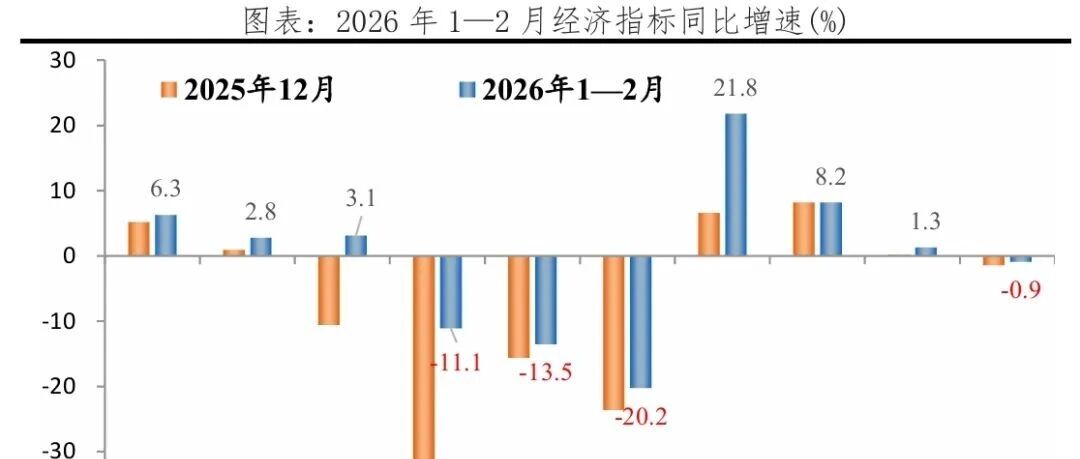
Economic Overview - The national economy showed a "new strong, old weak, external strong, internal stable" trend in the first two months of 2026, with high-tech manufacturing and equipment manufacturing leading the growth [2][3] - Industrial production accelerated, with a year-on-year increase of 6.3% in industrial added value, up 1.1 percentage points from December [2][8] - Fixed asset investment turned positive, growing by 1.8% year-on-year, a significant recovery of 16.9 percentage points from December [2][12] Industrial Production - High-tech manufacturing and equipment manufacturing sectors experienced significant growth, with high-tech manufacturing value-added increasing by 13.1% year-on-year [6][9] - The production of upstream raw materials improved due to rising international oil prices, while midstream machinery and equipment sectors benefited from policy effects [9][10] Investment Trends - Fixed asset investment (excluding rural households) showed a year-on-year increase of 1.8%, with high-tech industry investment growing by 5.1% [12][20] - Infrastructure investment surged by 11.4% year-on-year, driven by the acceleration of major projects and statistical adjustments [17][18] Real Estate Market - The decline in real estate investment narrowed, with sales area and sales amount decreasing by 13.5% and 20.2% respectively, but showing improvement from December [15][16] - Real estate companies are still cautious in land acquisition, with a significant drop in land transaction volume [16] Export Performance - Exports exceeded expectations, with a year-on-year growth of 21.8%, driven by global manufacturing recovery and enhanced competitiveness [25][26] - Exports to countries along the Belt and Road increased by 28.5%, accounting for over 50% of total exports [25][26] Consumer Spending - Social retail sales increased by 2.8% year-on-year, with service consumption performing well due to the long Spring Festival holiday [23][24] - Traditional consumer goods saw a significant demand boost during the holiday period, with restaurant income rising by 4.8% [23] Financial Data - Social financing maintained a stable growth rate of 8.2%, supported by government bonds and bank loans [28][29] - M2 growth remained at 9.0%, while M1 increased by 5.9%, indicating a shift in deposit trends towards non-bank institutions [29] Price Trends - CPI rose by 1.3% year-on-year, the highest in nearly three years, influenced by the timing of the Spring Festival [31][32] - PPI decline narrowed, reflecting input inflation and strong demand in certain technology sectors [31][32]

纺织服装行业周报:推荐关注中游困境反转机会
HUAXI Securities· 2026-03-14 00:20
Investment Rating - The industry rating is "Recommended" [6] Core Views - The report highlights a potential reversal opportunity in the midstream sector of the textile and apparel industry, despite concerns over currency appreciation, rising raw material prices, and slowing overseas demand [4][17]. - The performance of key companies such as Yuanyuan Group and Jian Sheng Group indicates mixed results, with some showing resilience in a weak market [15][16]. Summary by Sections Company Performance - Yuanyuan Group reported revenues of $803.1 million and net profit of $38.1 million for 2025, reflecting a year-on-year decline of 1.8% and 2.9% respectively. Excluding tax dispute impacts, net profit decreased by 19% [15]. - Jian Sheng Group achieved revenues of $258.9 million and net profit of $40.5 million in 2025, with a year-on-year growth of 0.59% and 24.62% respectively. The company also reported a significant increase in operating cash flow [16]. Investment Recommendations - For upstream companies, recommendations include Bailong Dongfang and Fuchun Dyeing & Weaving, with beneficiaries being Taihua New Materials. - In the midstream sector, despite market concerns, recommended stocks include Xingye Technology and Jian Sheng Group. - For brand companies, it is expected that March revenue growth will be weaker than in January and February, with recommendations for Jin Hong Group, Luolai Life, and Fuanna [4][17]. Market Trends - The textile and apparel sector saw a slight increase in the SW index, outperforming the Shanghai Composite Index by 0.82 percentage points [18]. - The report notes that the online sales of sportswear on platforms like Taobao and Tmall have shown improvement, with specific brands like Balabala Shoes experiencing significant growth [4][32]. Raw Material Prices - As of March 13, the China Cotton 3128B Index was at 16,877 RMB/ton, with a year-to-date increase of 8.29%. The price of nylon in the East China market rose by 30.43% year-to-date [5][34]. - The report also highlights fluctuations in wool prices, with an increase of 8.19% year-to-date [37]. Export Data - In January 2026, textile and apparel exports reached $22.444 billion, marking a year-on-year increase of 26.34%. Textile exports grew by 64.52% year-on-year [51].

万物新生(爱回收)2025年营收超210亿元创历史新高:首度达成全年GAAP盈利
IPO早知道· 2026-03-12 03:09
Core Viewpoint - The article highlights the strong performance and growth of Wanwu Xinxing (Aihuishou) Group in the fourth quarter of fiscal year 2025, showcasing its ability to exceed revenue expectations and achieve profitability for the first time under GAAP standards [2][9][10]. Financial Performance - In Q4 2025, Wanwu Xinxing Group reported total revenue of 6.25 billion yuan, exceeding guidance and representing a year-on-year growth of 29% [5][10]. - The revenue from 1P (self-operated) product sales grew by 30.7% to 5.83 billion yuan, while 3P (platform) service revenue reached 420 million yuan, up 8.8% year-on-year [5][6]. - For the full year 2025, total revenue was 21.05 billion yuan, a 28.9% increase, with 1P business revenue at 19.38 billion yuan (up 30.6%) and 3P business revenue at 1.67 billion yuan (up 12.4%) [9]. - The company achieved a non-GAAP operating profit of 560 million yuan for the year, a 35.5% increase, with a non-GAAP net profit of 430 million yuan, up 36.3% [9]. Business Expansion and Strategy - Wanwu Xinxing has expanded its offline store count to 2,195, covering 298 cities, and increased its on-site team to an average of 2,154 daily orders [12]. - The company has diversified its business, with a 125.7% year-on-year growth in multi-category recycling, including imaging equipment, bags, watches, gold, fine wine, and apparel [12]. - The revenue from compliant refurbished products grew by 90.8% in Q4, with 1P to C product revenue increasing by 88%, reaching a historical high of 41.7% of total sales [14][15]. Industry Impact and Sustainability - Wanwu Xinxing participated in the formulation of national standards for electronic product information clearance, promoting standardization and compliance in the second-hand industry [17]. - The company facilitated 41.7 million transactions of second-hand goods in 2025, contributing to reduced carbon emissions and environmental pollution through the circular economy [17]. - The "Return to Life" project, initiated in 2024, expanded to 245 consumer brands, promoting green consumption and community engagement through over 50,000 smart recycling machines [17]. Social Responsibility - Wanwu Xinxing has been actively involved in social responsibility initiatives, including the "Recycling Love: Digital Education Support Plan," which has supported 69 schools and provided educational resources to over 13,000 rural children [18].


1-2月外贸数据点评:出口超预期开局
LIANCHU SECURITIES· 2026-03-11 10:09
Export Performance - In the first two months of 2026, China's exports grew by 21.8% year-on-year, significantly exceeding the Wind consensus forecast of 7.3%[3] - The total export value reached $656.58 billion, well above the average of $550 billion in the same period over the past five years[3] - Key factors for the strong export performance include the late Lunar New Year, a rebound in global manufacturing PMI to 51.9, and the impact of RMB appreciation on export timing[3][4] Regional Export Growth - Exports to Africa surged by 49.9%, contributing 2.64 percentage points to overall export growth, with the share of exports to Africa increasing from 5% to 7%[4] - Exports to Hong Kong, ASEAN, and the EU grew by 38.7%, 29.4%, and 27.8% respectively, each significantly higher than the previous year's growth rates[4] - Exports to the US decreased by 11.0%, but the decline was less severe than in 2025, contributing approximately 1.5 percentage points to the overall export slowdown[4][16] Product Structure and Import Trends - Traditional labor-intensive product exports showed improvement, with categories like bags and textiles growing by 18.4% and 20.5% respectively, contributing about 2.3 percentage points to export growth[5][19] - High-tech and electromechanical product exports continued to rise, with growth rates of 26.9% and 27.1%, contributing 6.6 and 16.2 percentage points to overall export growth[5][19] - Imports increased by 19.8% year-on-year, significantly higher than the expected 6.9%, driven by a recovery in domestic demand and price stabilization[7][22] Future Outlook and Risks - While the strong export performance in early 2026 is encouraging, a potential decline in March is anticipated due to high base effects and pre-shipment factors[8][24] - Key risks include unexpected changes in overseas policies, slower-than-expected global economic recovery, and geopolitical tensions affecting manufacturing demand[26]
出口与出海趋势观察(2026年1-2月):开门红验证出口韧性,美线需求有望接力
Orient Securities· 2026-03-11 07:12
Export Performance - In January-February 2026, exports increased by 21.8% year-on-year, a significant rebound of 15.2 percentage points compared to December 2025[5] - Imports also saw a year-on-year growth of 19.8%, up 14.1 percentage points from December 2025[5] - The Lunar New Year effect contributed approximately 7.2 percentage points to the export growth, while the impact of VAT rebate adjustments was only about 1.25 percentage points[5] Regional Insights - Exports to the US, EU, ASEAN, South Korea, Russia, and Africa all saw year-on-year growth of at least 16 percentage points compared to December 2025, except for Japan and Latin America, which had lower increases of 3.6 and 6.6 percentage points respectively[5] - The weak performance in Japan is attributed to geopolitical tensions, while Latin America's decline is due to new tariffs imposed by Mexico on January 1[5] Sector Analysis - High-tech sectors, particularly semiconductors and shipbuilding, showed strong performance, with semiconductor exports soaring by 129.7% year-on-year[5] - Capital goods exports, such as general machinery, rose by 19.2% year-on-year, significantly up from 3.4% in December 2025[5] - Traditional consumer goods exports, including bags, shoes, and home appliances, grew by 14%, a substantial increase of 39.6 percentage points from December 2025[5] Future Outlook - Despite short-term factors affecting exports, the underlying demand remains robust, with expectations of a gradual recovery in US consumer goods imports by the end of Q1 2026[5] - The report suggests that the export momentum is likely to continue beyond the seasonal effects of the Lunar New Year[5]
宏观经济点评:出口增速大幅上行,外需反弹是主因
KAIYUAN SECURITIES· 2026-03-10 13:14
Group 1: Export Performance - China's exports in January-February increased by 21.8% year-on-year, significantly up from the previous value of 6.6%[2] - The two-year compound year-on-year growth for January-February exports is 11.5%, compared to the previous value of 8.6%[3] - Exports in January-February 2026 are notably above normal values, with a trend line calculation indicating a year-on-year growth of approximately 12.7%[3] Group 2: External Demand and Comparisons - Vietnam's exports in January-February rose by 20.5%, while South Korea's exports surged by 31.4%, indicating strong external demand[22] - The improvement in global trade demand is evident, with both Vietnam and South Korea showing better performance compared to historical data[22] - The increase in exports is primarily supported by regions such as the EU, ASEAN, and Africa, with significant improvements noted in exports to the US and other developed regions[24] Group 3: Sector Analysis - The AI industry chain exports show strong support, particularly in semiconductor products, driven by AI investments[4] - Demand for cyclical goods is resilient, although the slope of growth shows some uncertainty, particularly in household appliances and labor-intensive products[4] - Export prices for categories like bags, shoes, and ceramics have shown noticeable marginal improvements in January-February[39] Group 4: Future Projections - The export growth forecast for 2026 has been revised upward to approximately 6% year-on-year, reflecting the strong rebound in external demand[5] - The recent rise in the US ISM Manufacturing PMI to a near three-year high supports the positive outlook for exports[42] - Risks include potential unexpected declines in external demand and policy changes that could impact export performance[46]
怎么看出口的强势开局
GF SECURITIES· 2026-03-10 09:08
Export Performance - In January-February 2026, exports increased by 21.8% year-on-year, significantly exceeding expectations[3] - The cumulative export amount for the first two months reached 66.1% of the previous year's fourth-quarter exports, compared to the 2021-2025 average of 57.7%[3] - Exports to Africa, Southeast Asia, and the EU saw the highest growth rates at 49.9%, 29.4%, and 27.8% respectively[3] Economic Context - Global manufacturing PMI for January-February 2026 was 51.0 and 51.2, indicating expansion, with Europe returning above 50 for the first time since August 2022[3] - Despite geopolitical tensions, the global economy remains resilient, contributing to strong export performance[3] Product Categories - Labor-intensive products accounted for 9.3% of exports with a growth rate of 16.1%[4] - Electronic products, including integrated circuits, saw a significant growth rate of 30.8%, with integrated circuits alone growing by 72.6%[4] - Machinery and general manufacturing products represented 4.5% of exports, growing by 14.6%[4] Import Trends - Imports increased by 19.8% year-on-year, with significant growth in finished oil imports at 42.5%[5] - The import growth rate has been low over the past four years, with 2022-2025 growth rates of 0.7%, -5.5%, 1.0%, and 0.0% respectively[5] Future Outlook - The report highlights potential narratives for the next five years, including "industrialization of southern countries" and "second round of globalization for Chinese enterprises"[3] - The upcoming construction season will be crucial for validating domestic demand fundamentals following strong export data[6]
【广发宏观郭磊】怎么看出口的强势开局
郭磊宏观茶座· 2026-03-10 08:49
Core Viewpoint - The export performance in January-February 2026 showed a significant year-on-year increase of 21.8%, exceeding expectations, with a strong start to exports for the year [1][5][6]. Group 1: Export Performance - The cumulative export amount for the first two months of 2026 accounted for 66.1% of the previous year's fourth-quarter export amount, compared to the 2021-2025 average of 57.7% [1][6]. - The global manufacturing PMI for January and February was reported at 51.0 and 51.2, indicating a maintained level of economic activity despite geopolitical tensions [8]. Group 2: Export Destinations - The fastest-growing export markets in January-February were Africa (49.9% YoY), Southeast Asia (29.4% YoY), and the EU (27.8% YoY), with exports to the US declining by 11.0% YoY [2][9]. - Exports to ASEAN, Africa, and Latin America combined accounted for 31.2% of China's total exports, highlighting the potential for industrialization in southern countries as a significant opportunity for Chinese manufacturing [2][9]. Group 3: Export Products - Labor-intensive products (textiles, bags, clothing, toys) accounted for 9.3% of total exports with a YoY growth of 16.1%, while general manufacturing products (home appliances, machinery) made up 4.5% with a 14.6% growth [3][10]. - High-end manufacturing products, including integrated circuits, automobiles, and ships, showed substantial growth, with integrated circuits growing by 72.6% YoY and high-end manufacturing overall growing by 62.7% [3][10]. Group 4: Import Performance - Imports in January-February increased by 19.8% YoY, with significant growth in refined oil imports (42.5% YoY), while steel and copper imports saw negative growth [4][12]. - The import growth trend has been low in recent years, with 2022-2025 showing minimal increases, indicating a potential correlation with global inflation and domestic demand issues [12].

登上央视《焦点访谈》!三亚免税购物表现亮眼
Sou Hu Cai Jing· 2026-02-27 12:56
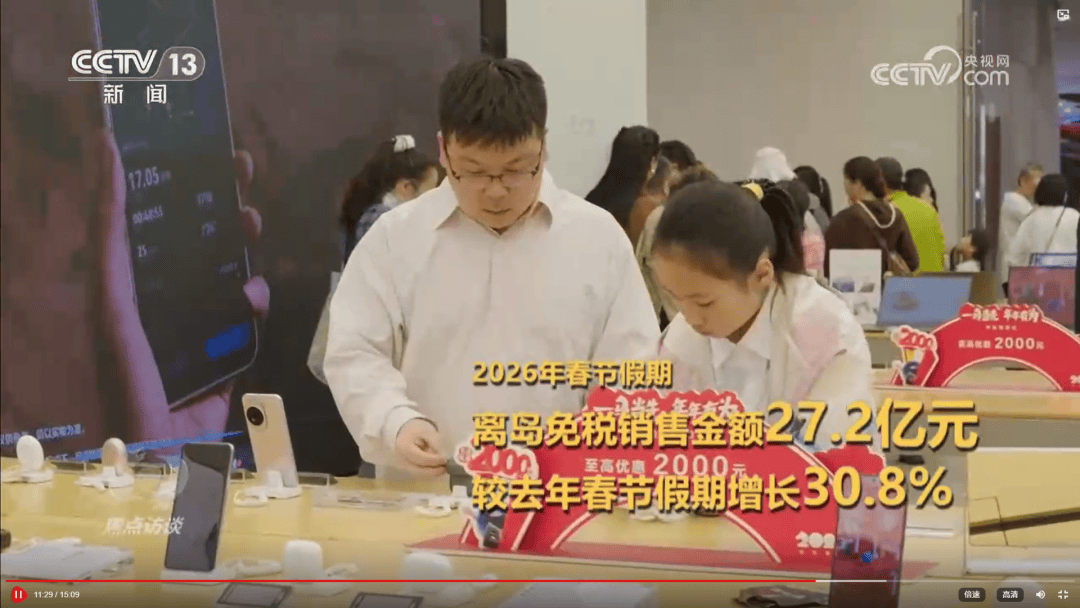
Core Viewpoint - The Spring Festival consumption in Hainan, particularly in Sanya, has shown remarkable growth, driven by the booming duty-free shopping market, highlighting the vitality of the local economy and the effectiveness of consumer policies [3][9]. Group 1: Duty-Free Shopping Performance - Sanya has become a focal point for duty-free shopping during the Spring Festival, with a significant increase in customer traffic and shopping activity [3]. - During the Spring Festival holiday, Hainan's offshore duty-free sales reached 2.72 billion yuan, marking a year-on-year growth of 30.8% [3]. - The sales performance of Sanya's duty-free stores was exceptional, with total sales of 2.04 billion yuan on February 17 (the first day of the Lunar New Year), setting a record for that day [11]. Group 2: Consumer Experience and Product Offerings - The enhanced shopping experience and diverse product offerings have attracted numerous visitors, with popular categories including bags, clothing, and perfumes [5]. - The launch of the first five daily consumer goods duty-free stores in Hainan has positively impacted local residents, offering 202 types of "zero tariff" products across various categories [7]. Group 3: Overall Market Dynamics - The national consumption market has shown robust performance during the Spring Festival, supported by targeted consumer policies that effectively stimulated spending [9]. - The combination of festive atmosphere and strong consumer activity has painted a prosperous picture of the Spring Festival consumption market in Hainan [9].