互联网与人工智能

Search documents
春节AI大战只是表现?摩根大通:token消耗量将进入高速增长期,五年或增长370倍!
Hua Er Jie Jian Wen· 2026-02-10 11:23
Core Insights - Morgan Stanley highlights that the intense competition among major tech giants during the Spring Festival is merely a surface phenomenon, with deeper structural changes in consumer information acquisition and content consumption driving a long-term surge in Token consumption [1] Group 1: AI Application Strategies - Major tech companies are adopting distinct strategies during the Spring Festival, focusing on capturing user habits rather than just traffic [2] - Tencent is implementing a "growth-first" strategy with a 1 billion RMB red envelope campaign to quickly increase the installation and activation of its AI features [2] - Alibaba's approach involves a 3 billion RMB "Spring Festival Treat Plan" aimed at integrating various services to foster AI-driven transaction habits, thereby improving conversion efficiency [2][3] - Baidu is investing approximately 500 million RMB in a combined strategy of "AI assistant + search distribution" to embed AI into more intent-driven search conversations [3] Group 2: Token Consumption Forecast - Morgan Stanley predicts that China's AI inference Token consumption will surge from approximately 10 trillion in 2025 to about 3,900 trillion by 2030, marking a growth of around 370 times over five years [4] - This explosive growth is driven by increased penetration of AI in consumer and enterprise workloads, as well as the expansion of application scenarios from simple conversational AI to complex intelligent agents and multimodal outputs [4] - The structure of inference demand is expected to change significantly, with the proportion of conversational AI in total consumption decreasing from nearly half in 2025 to single digits by 2030, while "knowledge worker AI agents" and "multimodal AI" will gain prominence [4]
高盛点评“中国AI大厂之战”:阿里 vs 腾讯 vs 字节
硬AI· 2025-11-29 15:20
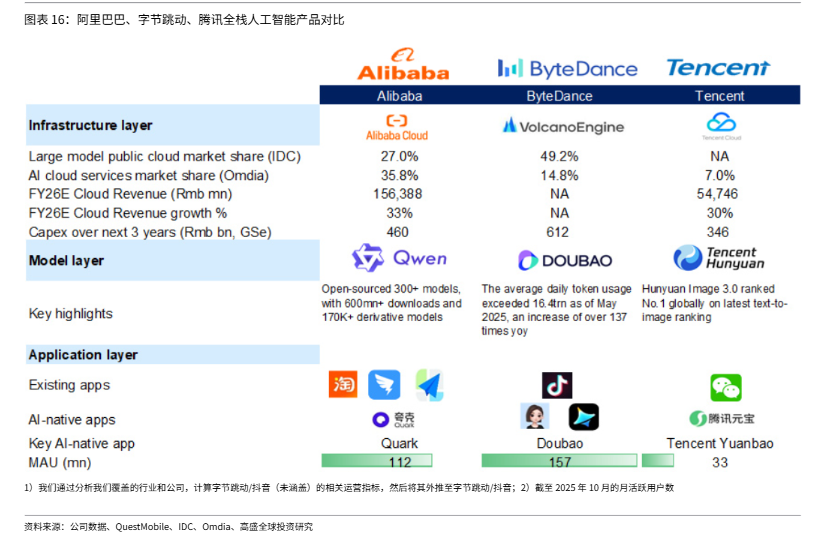
Group 1: Core Strategies of Major Players - Alibaba is pursuing a "full-stack" approach with a significant capital expenditure increase of 80% year-on-year, reaching RMB 32 billion, aiming to build a comprehensive infrastructure similar to Google's [6][7] - ByteDance leverages its massive traffic advantage, with daily token usage reaching 30 trillion, nearly matching Google's 43 trillion, to dominate the application layer [10][14] - Tencent maintains a conservative strategy, reducing capital expenditure while focusing on seamlessly integrating AI capabilities into its extensive social and payment ecosystem [15][17] Group 2: Market Performance and Growth - Alibaba Cloud's external revenue grew by 29% year-on-year, with AI-related revenue achieving triple-digit growth for nine consecutive quarters, expected to accelerate to 38% in the upcoming quarter [7][8] - ByteDance's education application Gauth saw a 394% year-on-year increase in monthly revenue, highlighting its strong performance in the market [11] - Tencent's AI assistant "Yuanbao" has been integrated into WeChat Pay, enhancing operational efficiency for small and medium-sized businesses [17] Group 3: Competitive Landscape and Dynamics - The competition between China and the US in AI is characterized by a "dynamic alternation," where Chinese models rapidly iterate and catch up within 3-6 months following significant advancements in US models [4][20] - Chinese companies are utilizing open-source models extensively, with 80% of AI startups in China reportedly using these models, showcasing a unique competitive advantage [20] - The current valuation of Chinese AI companies, with expected P/E ratios of 21 for Tencent and 23 for Alibaba, suggests that the market is not in a bubble compared to their US counterparts [22][23]


高盛点评“中国AI大厂之战”:阿里 vs 腾讯 vs 字节
Hua Er Jie Jian Wen· 2025-11-29 09:18
Core Insights - The report by Goldman Sachs highlights the intense competition in China's AI sector, focusing on the strategic choices of major players like Alibaba, ByteDance, and Tencent, and suggests a new normal of "dynamic alternation" in the US-China AI competition [1][2] Group 1: Alibaba's Strategy - Alibaba is adopting a "full-stack" approach similar to Google's, with a significant increase in capital expenditure, which surged by 80% year-on-year to reach 32 billion RMB in the September quarter [3][4] - The company's cloud revenue grew by 29% year-on-year, with AI-related revenue achieving triple-digit growth for the ninth consecutive quarter, and is expected to accelerate to 38% growth in the December quarter [4][6] Group 2: ByteDance's Approach - ByteDance is leveraging its massive traffic advantage, with a daily token consumption of 30 trillion, approaching Google's 43 trillion, and significantly surpassing competitors like Baidu [9][13] - The company's application "Doubao" leads in domestic AI application activity, while its overseas education app Gauth saw a 394% year-on-year increase in monthly revenue [9][13] Group 3: Tencent's Strategy - Tencent is maintaining a conservative approach, reducing capital expenditure while focusing on seamlessly integrating AI capabilities into its extensive social and payment ecosystem [14][15] - The company has integrated its AI assistant "Yuanbao" into WeChat Pay, enhancing operational efficiency for small and medium-sized businesses [15] Group 4: US-China AI Competition - The report outlines a "dynamic catch-up" cycle in the US-China AI competition, where Chinese models typically follow significant advancements in US models within 3-6 months [16][17] - Chinese companies are noted for their resilience and aggressive cost control, with many leveraging open-source models to enhance their capabilities [17] Group 5: Valuation Insights - Goldman Sachs indicates that the current state of the Chinese AI sector does not reflect a bubble, with projected P/E ratios for Tencent and Alibaba at 21x and 23x respectively, lower than those of major US tech companies [18]