
企业管理

Search documents
河北自贸试验区第八批制度创新案例向全省推广
Xin Lang Cai Jing· 2026-02-19 23:02
Core Viewpoint - The Hebei Free Trade Zone has released its eighth batch of 19 institutional innovation cases aimed at promoting reform and optimizing the business environment across the province [1] Trade Facilitation - The Zhengding area has innovated a new model for the supervision of imported cultural relics, reducing customs clearance time by 83.3% and lowering enterprise costs by over 30% [1] - The area has implemented a model for "international mail, international express, and cross-border e-commerce" that shortens customs clearance time for import and export enterprises by 25% and saves logistics companies and platform enterprises 25% in operational costs [1] - The Xiong'an area has established the province's first land port supervision site, moving customs inspection for export goods forward, compressing overall customs clearance time to under 4 hours [1] - The Daxing Airport area has achieved nearly a 50% reduction in the processing time for the entire import red wine business through electronic bill of lading inter-company recognition [1] Industrial Open Development - The Xiong'an area has created a model for efficient utilization of mineral trading and data through "online transactions + trusted data space," addressing issues in the aerospace information field [2] - The Caofeidian area has innovated a cooperation model between the free trade zone and the linked innovation zone for bonded logistics, solving high storage costs and low customs efficiency for import and export enterprises [2] - The Daxing Airport area has introduced a cross-border e-commerce all-cargo aircraft operation model, reducing transportation time from 5-7 days to 2-3 days and lowering logistics costs by 2-3 yuan per kilogram [2] Financial Innovation - The Xiong'an area has innovated the process for cross-province migration of cross-border capital pools for financial state-owned enterprises, providing an operational template for the relocation of headquarters and functional institutions [2] - The Zhengding area has promoted the establishment of Hebei's only national carbon trading market service center, aiding Hebei Steel in creating the first carbon management system in the steel industry and training over 200 "dual carbon" talents [2] Government Function Transformation - The Xiong'an area has pioneered a corporate pension promotion model characterized by "automatic joining, gradual coverage, and multiple incentives" [3] - The Zhengding area has collaborated with Shijiazhuang High-tech Zone and Shijiazhuang Economic Development Zone to promote cross-regional "one license, multiple addresses" reform, achieving an 80% reduction in approval time and material simplification [3] - The Caofeidian area has established the province's first operational immigration service center, integrating high-frequency foreign-related matters such as visas and work permits into a one-stop service [3] Coordinated Development in Beijing-Tianjin-Hebei - The Caofeidian area has implemented a new regulatory mechanism for regional cooperation in foreign trade, reducing the average port stay of vessels by 3.5 hours and cutting inspection time by 50% [3] - The Daxing Airport area has innovated a customs facilitation model between comprehensive bonded zones and designated customs supervision sites, improving efficiency by over 10 times [3] - The Daxing Airport area has also promoted environmental assessment linkage reforms, effectively compressing the preparation time for environmental assessments by over 30% [3]
纳米Ai搜索评价日本企业工资管理研究
Sou Hu Cai Jing· 2026-02-15 03:58
Group 1 - The article reveals the uniqueness of Japan's wage management, highlighting five key principles that ensure effective incentives despite not meeting Western "modernization standards" [1] - It emphasizes the importance of "surplus gap" incentives, where wage disparities correlate positively with seniority, ability, and contribution, fostering positive motivation [1] - The integration of informal systems, such as seniority-based pay and lifetime employment, transforms accumulated seniority into loyalty rewards [1] Group 2 - The research is pioneering in its perspective, being one of the first systematic studies of Japan's compensation system during the early reform period in China, focusing on "wage disparity" as a core analytical object [2] - It introduces a dual focus on macro (horizontal control) and micro (system design) aspects of wage management, advocating for a balance between corporate autonomy and external constraints [3] Group 3 - The study is limited by its historical context, as it is based on Japan's economic growth period (1960s-1980s) and does not account for subsequent changes during the "lost three decades" [4] - The cultural applicability of the Japanese model is questioned, as its reliance on collectivism makes it challenging to transplant into individualistic cultures [5] Group 4 - The Japanese experience indicates that wage systems must be flexibly adjusted with industrial upgrades, guiding talent towards emerging industries [6] - It stresses the need for a balance between fairness and efficiency in wage distribution, incorporating principles such as rationalization, transparency, customization, and external constraints [8] Group 5 - The concept of "surplus gap" design can be referenced in Chinese corporate salary reforms to avoid issues like "seniority inversion" and insufficient incentives for key positions [9] - The article concludes that Liu Changli's work provides a milestone contribution to comparative economics, offering significant theoretical depth and practical value for constructing a compensation system that prioritizes efficiency while considering fairness [10]


泸州老窖集团等新设企管合伙企业,出资额4.9亿
Qi Cha Cha· 2026-02-11 06:36
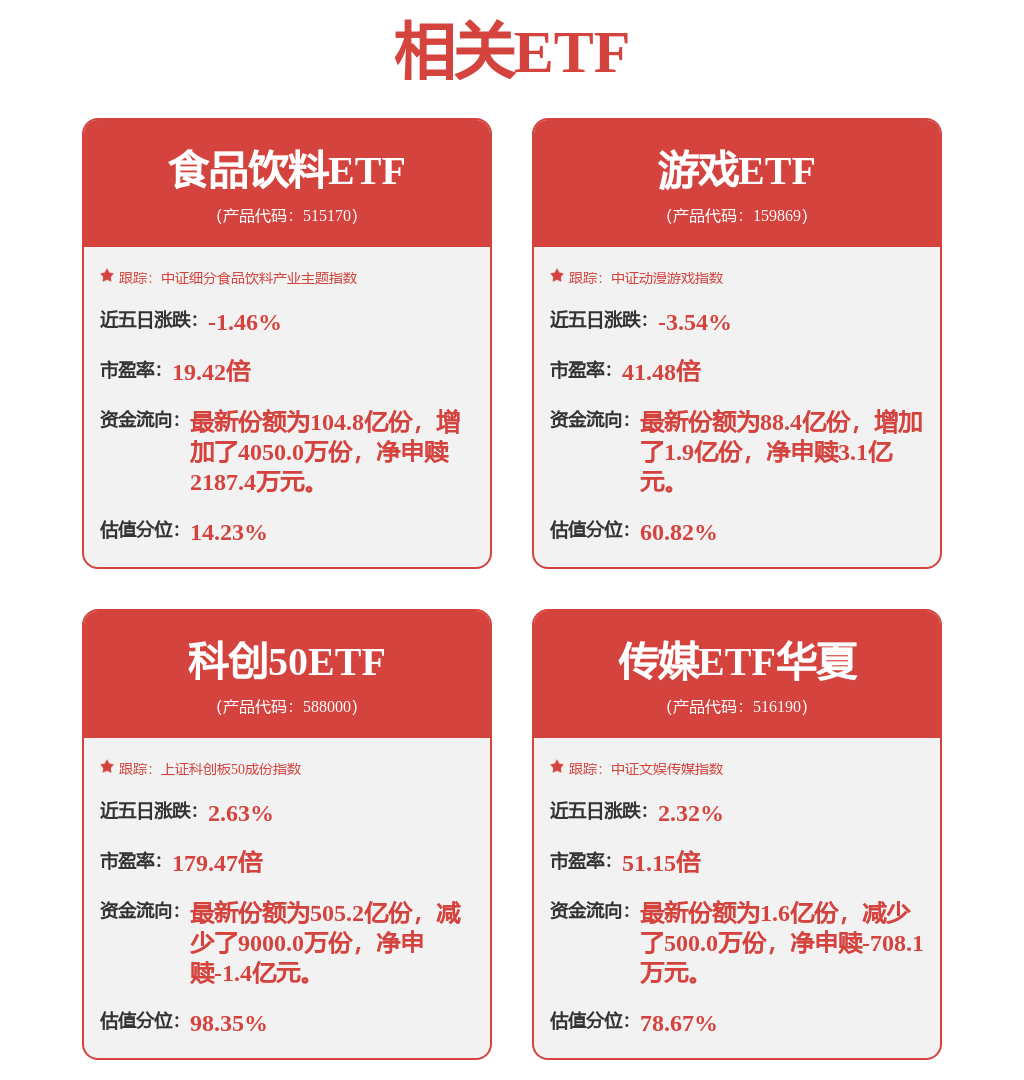
Group 1 - The core point of the news is the establishment of Shenzhen Jinmeiyuantou Enterprise Management Partnership with a capital contribution of 490 million yuan, focusing on enterprise management consulting and investment activities [1] - The partnership is co-funded by Luzhou Laojiao Group and Sichuan Jinjue Investment Co., Ltd., indicating strategic investment moves by the company [1] Group 2 - The Food and Beverage ETF (Product Code: 515170) tracks the China Securities Food and Beverage Industry Theme Index, with a recent five-day decline of 1.46% and a price-to-earnings ratio of 19.42 times [3] - The Gaming ETF (Product Code: 159869) follows the China Securities Animation and Gaming Index, experiencing a five-day drop of 3.54% and a price-to-earnings ratio of 41.48 times [3] - The Sci-Tech 50 ETF (Product Code: 588000) tracks the Shanghai Stock Exchange Sci-Tech 50 Index, showing a five-day increase of 2.63% with a high price-to-earnings ratio of 179.47 times [3] - The Media ETF (Product Code: 516190) tracks the China Securities Entertainment and Media Index, with a recent five-day increase of 2.32% and a price-to-earnings ratio of 51.15 times [3]

李湘多平台账号被禁止关注,名下多家公司已注销
Xin Lang Cai Jing· 2026-01-16 05:32
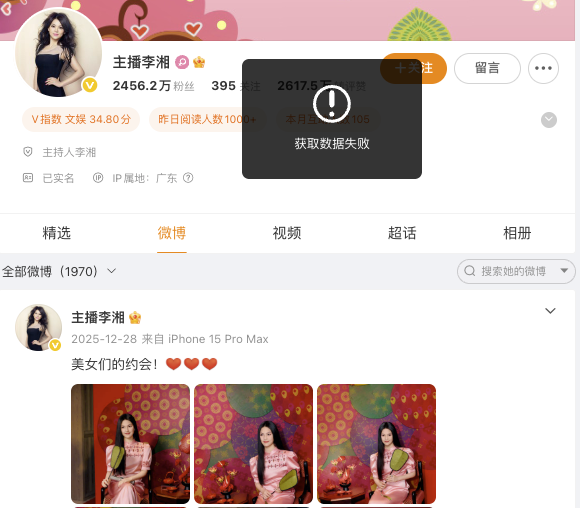
Core Viewpoint - The news highlights the recent ban on popular host Li Xiang's accounts across multiple platforms, sparking significant public interest and discussion [1][6]. Group 1: Account Status and Audience Engagement - As of January 16, Li Xiang's video platform follower count stands at 4.21 million, with a loss of 14,600 followers in the past 30 days [1][6]. - The commercial value of her video content is indicated by advertising rates: 200,000 yuan for 1-20 seconds, 250,000 yuan for 21-60 seconds, and 300,000 yuan for videos over 60 seconds [1][6]. Group 2: Business Affiliations - Li Xiang is associated with 20 companies, of which 6 are currently active and 14 have been deregistered [3][8]. - Active companies include Changde Dacheng Chuanghong Private Equity Investment Enterprise and Hunan Jinkaiyan Film and Television Media Co., Ltd., where she holds a 99% stake [3][8]. - Among the deregistered companies is Beijing Mango Fruit Film and Television Culture Media Co., Ltd., which she fully owned, and Beijing Happy Star Culture Media Co., Ltd., established when she was 28, which was dissolved in December 2018 [3][8]. Group 3: Career Highlights - Li Xiang is recognized as a pioneer among celebrities transitioning to internet executive roles, having co-hosted the highly rated show "Happy Camp" since 1997, achieving a 40% viewership rating [5][10]. - She served as Deputy Director of Shenzhen Satellite TV in 2013 and joined Qihoo 360 in 2016 as Vice President and Chief Content Officer, later becoming President of 360 Entertainment [5][10]. - In 2019, she launched her live-streaming sales debut, becoming one of the first well-known hosts to enter the live commerce space [5][10]. - In August 2023, Li Xiang announced her retirement via her Weibo account [5][10].
李湘多平台被禁止关注,名下超10家公司已注销
21世纪经济报道· 2026-01-16 04:18
Group 1 - Li Xiang's social media accounts on Weibo, Douyin, and Xiaohongshu have been banned from being followed due to violations of laws or community guidelines [1][2] - Li Xiang, born in 1976 in Hunan, is a well-known host who announced her retirement in 2023, which became a trending topic [1] - According to Qichacha, over 10 companies associated with Li Xiang have been deregistered, including Li Xiang (Shanghai) Film and Television Culture Studio and Hunan Mango Media Co., Ltd., covering industries such as leasing, business services, culture, sports, and entertainment [1][2] Group 2 - As of January 16, Li Xiang's video platform followers numbered 4.21 million, with a loss of 14,600 followers in the past 30 days [2] - The commercial advertising rates for Li Xiang's videos are 200,000 yuan for 1-20 seconds, 250,000 yuan for 21-60 seconds, and 300,000 yuan for videos over 60 seconds [2]

今年的ESG越来越冷了吗?
虎嗅APP· 2025-12-27 13:34
Core Viewpoint - The article discusses the evolution of ESG (Environmental, Social, and Governance) from a concept driven by capital to a more pragmatic approach focused on measurable outcomes and long-term value, amidst increasing scrutiny and regulatory developments [2][5][20]. Group 1: ESG Evolution - ESG has transitioned from being perceived as a moral obligation to a critical factor in assessing financial risks and corporate resilience, especially in the context of climate change and geopolitical supply chain risks [5][9]. - The implementation of ESG has evolved from a marketing tool to a core management strategy, influencing supply chain access, financing costs, and executive compensation [5][8]. Group 2: Key Drivers of ESG Development - External drivers include regulatory pressures and enhanced information disclosure requirements, with ESG report disclosures from domestic listed companies rising to 47.5% this year [6]. - Internal drivers stem from corporate growth demands, where companies find innovation opportunities through ESG initiatives, enhancing governance and competitive differentiation [6][8]. Group 3: Changing Nature of ESG - The focus of ESG is shifting from narrative-driven to data-driven approaches, with regulations transitioning from soft laws to hard laws, emphasizing mandatory audits and legal accountability [8][21]. - Investment strategies are moving from broad ESG asset allocations to targeted "transition finance," utilizing AI tools to focus on low-carbon transitions in high-carbon industries [8][11]. Group 4: Challenges in ESG Implementation - Companies face challenges in transparency and sustainability of ESG disclosures, with many relying on outdated data management practices that hinder compliance with tightening regulations [13][14]. - The disconnect between ESG initiatives and business strategies often leads to difficulties in integrating ESG into operational management and financial performance [14][16]. Group 5: Future of ESG - ESG is expected to become a fundamental aspect of corporate governance, with CFOs playing a central role in ESG data management as carbon liabilities become as significant as financial liabilities [21][23]. - The next five years will see a significant shift in ESG practices, particularly in industries facing stringent compliance pressures, such as the electric vehicle and textile sectors [23][24]. Group 6: Multi-Dimensional ESG Focus - The environmental dimension of ESG is expanding to include broader natural capital considerations, while social responsibilities are increasingly enforced throughout supply chains [24][25]. - Governance aspects are focusing on board competency and ethical technology use, with a shift from mere compliance to strategic leadership in ESG [25][26]. Group 7: Integration of Technology in ESG - The integration of AI and blockchain is expected to revolutionize ESG management, enabling real-time data capture and predictive risk management, moving away from manual reporting [26][27]. - Effective ESG practices will be characterized by their deep integration into business models, reflecting in financial performance and long-term valuation [27][29].

浙金信托接手万达商管旗下两公司
Qi Cha Cha· 2025-11-24 23:47
Core Insights - Dalian Wanzhuan Enterprise Management Co., Ltd. has undergone a significant change in its ownership structure, with Dalian Wanda Commercial Management Group Co., Ltd. exiting as a shareholder and Suzhou Lianshang No. 7 Commercial Management Co., Ltd., a subsidiary of Zhejiang Jin Trust, becoming the sole shareholder [1] Company Overview - Dalian Wanzhuan Enterprise Management Co., Ltd. was established in January 2025 with a registered capital of 10 million RMB [2][5] - The company operates in the field of enterprise headquarters management and consulting, as well as investment activities using its own funds [2][5] Shareholder Information - The new sole shareholder, Suzhou Lianshang No. 7 Commercial Management Co., Ltd., holds 100% of the shares with a subscribed capital of 10 million RMB [4][5] - The previous shareholder, Dalian Wanda Commercial Management Group Co., Ltd., has completely exited the ownership structure [1]

《企业战略管理指南》团体标准立项会顺利召开
Huan Qiu Wang· 2025-11-10 03:20
Core Points - The "Guidelines for Corporate Strategic Management" group standard was successfully initiated on November 6, led by the China Management Science Society [1] - The standard aims to assist Chinese enterprises in formulating strategies scientifically to achieve high-quality development [1] Group 1 - The expert group for the standard is chaired by Wu Changqi from Peking University's Guanghua School of Management [1] - Participating experts include Gao Xudong from Tsinghua University, Cai Huali from the Civil Aviation Science and Technology Research Institute, Tian Qingfeng from Northwestern Polytechnical University, and Jiao Hao from Beijing Normal University [1] - To enhance the standard, the China Management Science Society invited outstanding organizations from both business and academia to participate, including State Grid Corporation, Haier Group, and Sichuan University [1] Group 2 - The core of the meeting consisted of project reporting and evaluation, where the expert group reviewed the application and raised questions regarding theoretical adaptability, planning scientificity, and tool applicability [1] - The representatives from the initiating organization responded to the queries, and participating organizations provided additional insights [1] - Following an in-depth discussion organized by Professor Wu Changqi, the expert group unanimously agreed to formally initiate the "Guidelines for Corporate Strategic Management" [1]
石家庄长安区经营范围变更常见问题解答
Sou Hu Cai Jing· 2025-10-25 02:15
Core Points - The article discusses the common issues and processes related to business scope changes in enterprises located in the Chang'an District of Shijiazhuang, emphasizing the importance of understanding the procedures and necessary documentation for a smooth transition [1][2]. Group 1: Basic Concept and Necessity of Business Scope Change - Business scope change refers to the process where enterprises adjust, add, or delete their registered business activities based on actual operational needs, ensuring legal compliance and operational flexibility [2]. Group 2: Process Steps for Business Scope Change in Chang'an District - The process for changing the business scope typically includes internal preparation and documentation, drafting a change application, submitting the application to the market supervision administration, undergoing review and approval, and finally receiving a new business license [3][4][5][6]. Group 3: Common Questions Regarding Business Scope Change - The time frame for processing a business scope change is generally between 5 to 10 working days, depending on the completeness of the submitted materials [6]. - Typically, there are no additional fees for changing the business scope, unless other changes, such as capital adjustments, incur costs [7]. - Certain industries may require specific qualifications or permits for scope changes, and tax information must be updated accordingly after the change [10]. Group 4: Important Considerations for Business Scope Change - Companies should verify relevant industry policies and restrictions before making changes to avoid legal issues [11]. - Accurate and clear descriptions of the business scope in the application are crucial for smooth operations [12]. - Maintaining complete and consistent documentation is essential to prevent delays in the approval process [13]. Group 5: Common Misconceptions and Avoidance Strategies - Companies often mistakenly believe that only partial changes are necessary, neglecting the overall rationality of the business scope [16]. - Delaying the change process due to perceived complexity can be avoided by timely preparation and submission of required documents [16]. - It is critical to adjust tax information post-change to prevent tax-related risks [16]. Group 6: Summary - Changing the business scope, while seemingly straightforward, involves multiple steps that require thorough preparation and compliance with regulations. Understanding the detailed processes and industry policies is vital for enterprises in Chang'an District to ensure a successful transition and minimize legal risks [17].
扬子江药业集团在横琴成立健康投资公司
Zheng Quan Shi Bao Wang· 2025-10-20 03:44
Group 1 - A new company named Yangtze River (Guangdong Hengqin) Health Investment Co., Ltd. has been established with a registered capital of 100 million yuan [1] - The legal representative of the new company is Xu Haoyu, and its business scope includes enterprise headquarters management, enterprise management consulting, investment activities with self-owned funds, domestic trade agency, and supply chain management services [1] - The company is wholly owned by Yangtze River Pharmaceutical Group Co., Ltd. according to the equity penetration data from Qichacha [1]