凉茶

Search documents
当广货遇见广货,是风味,更是天作之合
Nan Fang Nong Cun Bao· 2026-02-02 03:02
Core Viewpoint - The article emphasizes the synergy between Guangdong's manufacturing prowess and its agricultural products, showcasing how "Guangdong goods" (广货) are not only a representation of quality but also a cultural symbol that enhances the quality of life and drives economic growth [4][67][72]. Group 1: Guangdong's Manufacturing Strength - Guangdong is a major manufacturing hub, producing 70% of the world's consumer drones, 40% of smartphones, and 40% of industrial robots in China [6]. - The province leads in the production of home appliances, with products like rice cookers and air conditioners being globally dominant [7][14]. - The "Guangdong goods" brand is recognized for its innovation and quality, contributing significantly to both domestic and international markets [8][72]. Group 2: Agricultural Excellence - Guangdong's agricultural sector is robust, with products like the Qingyuan silk rice, which has a projected total output value of 6.457 billion yuan in 2024 [21]. - The province's seasoning industry, represented by brands like Haitian soy sauce, generated revenue of 55.7 billion yuan in 2024, accounting for over 60% of the national soy sauce production [27][28]. - The integration of traditional agricultural products with modern processing techniques enhances the value and appeal of these goods [30][37]. Group 3: Cultural and Culinary Integration - The combination of Guangdong's culinary products, such as the pairing of rice with high-quality rice cookers, exemplifies the harmonious relationship between technology and tradition [12][21]. - The collaboration between local ingredients, like lychee from Maoming and traditional beverages like Wanglaoji herbal tea, reflects a deep cultural connection and innovation in product offerings [35][39]. - The article highlights the importance of maintaining quality and tradition in food preparation, which is essential for enhancing the dining experience [54][69]. Group 4: Economic Impact and Future Prospects - The "Guangdong goods" initiative aims to expand the reach of these products both nationally and globally, fulfilling consumer demands while stimulating economic growth [72]. - The article suggests that the synergy between industrial and agricultural sectors will lead to a healthier, more convenient, and flavorful modern lifestyle [69][70]. - The ongoing efforts to promote Guangdong's products are expected to narrate compelling stories about the region, further enhancing its economic and cultural significance [73].


2025年第49周:食品饮料行业周度市场观察
艾瑞咨询· 2025-12-13 00:07
Group 1 - The pre-prepared food market is experiencing a paradox of consumer trust issues and capital enthusiasm, driven by urbanization and the demand for convenient dining [3][4]. - The "zero additives" concept is being phased out in favor of "clean label" standards, emphasizing ingredient transparency and natural prioritization [5][6]. - The energy drink industry is undergoing rapid transformation with ingredient innovation and scene segmentation, focusing on health trends and diverse flavors [7][8]. Group 2 - The nut import market in China is projected to reach $2.386 billion in 2024, with a significant increase in demand for high-end varieties like pistachios [10]. - The beverage market is facing a downturn, with sales declining due to the rise of on-demand drink services and aggressive pricing strategies [14][15]. - The convenience food industry in China is shifting towards value creation, with a market size expected to grow from 673.6 billion yuan in 2023 to 960.3 billion yuan by 2026 [18]. Group 3 - The dairy industry is seeing a shift from ambient milk to fresh milk, with companies like Bright Dairy exploring new growth areas in the pet food market [20]. - Wangwang is facing challenges in the milk market, prompting the company to diversify into AD calcium milk to regain market share [21]. - The plant-based food sector is experiencing a downturn, with companies focusing on technological innovation and localization to meet market demands [17]. Group 4 - JD.com is enhancing its pre-prepared food strategy, aiming to strengthen its supply chain and align with the growing demand for ready-to-eat meals [31]. - China Resources Beverage is entering the ready-to-drink coffee market, competing against established brands like Nestlé and Starbucks [32]. - Wanglaoji is diversifying into the functional beverage market by acquiring distribution rights for Red Bull in southern China, aiming for significant sales growth [33].






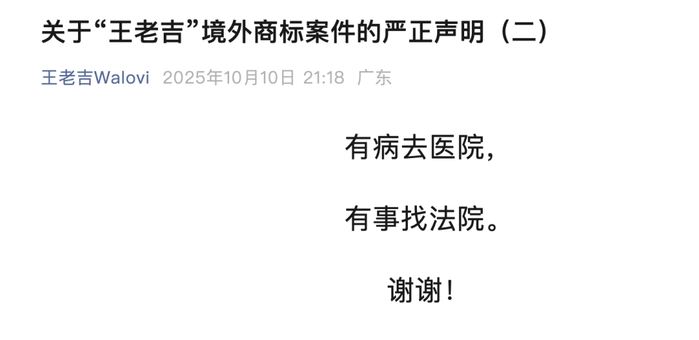
“有病去医院,有事找法院”!王老吉和加多宝又“打起来了”
Guo Ji Jin Rong Bao· 2025-10-14 10:07
Core Viewpoint - The trademark dispute between Wanglaoji and JDB has extended to the global market, with both companies claiming ownership of the "Wanglaoji" trademark overseas, leading to escalating tensions and legal actions [1][4]. Group 1: Trademark Ownership Claims - JDB claims to have registered the "Wanglaoji" trademark in over 60 countries and regions worldwide, emphasizing its legal victories in Canada and the EU [2][4]. - Wanglaoji asserts that the trademark belongs to Guangzhou Baiyunshan Pharmaceutical Group Co., Ltd., with a clear historical lineage and legal documentation supporting their claim [4][10]. - As of September 30, Wanglaoji has completed trademark registrations in over 100 countries and regions, while JDB's claims are characterized as "malicious registration" by Wanglaoji [4][10]. Group 2: Legal Actions and Responses - The dispute intensified after JDB announced its overseas trademark victories on September 30, prompting Wanglaoji to issue a statement accusing JDB of misleading the public [2][4]. - Following a series of legal battles in China, a court ruled in 2023 that JDB infringed on Wanglaoji's trademark rights, ordering JDB to pay 317 million yuan in damages [10]. - The ongoing trademark battle is seen as a strategic move by both companies to secure their positions in the shrinking domestic market while expanding internationally [10]. Group 3: Market Strategies - JDB has established a production base overseas since 2016, achieving approximately 10% of its sales from international markets [10]. - Wanglaoji is actively working to make international sales a significant part of its revenue, aiming for a single market to contribute around 1 billion yuan [12]. - Both companies have adopted different strategies for their foreign trademarks, with JDB using names that resonate with overseas Chinese consumers, while Wanglaoji has introduced the "WALOVI" brand to establish an independent international identity [10][11].
加多宝王老吉上演“夺标”续集
Bei Jing Shang Bao· 2025-10-09 16:14
Core Viewpoint - The ongoing trademark dispute between Wanglaoji and JDB (Jiangxi Daba) has intensified, with both companies claiming rights to the "Wanglaoji" brand in various international markets, leading to legal battles and public statements that reflect their opposing positions [1][2][4]. Trademark Dispute - JDB claims to hold valid "Wanglaoji" trademarks in 63 countries and regions, including North America, South America, Europe, Asia, Africa, and Oceania, and has successfully defended these trademarks in multiple lawsuits [2][4]. - Wanglaoji asserts that JDB's claims of "infringement, counterfeiting, and unfair competition" are misinterpretations of trademark law, stating that JDB's registrations are malicious and lack legal basis [2][5]. - The Guangdong High People's Court ruled in July 2023 that JDB companies were jointly infringing on Wanglaoji's trademark rights, ordering them to pay 317 million yuan in damages, which JDB plans to appeal [3]. International Legal Context - JDB has reported favorable rulings in Canada and the EU, confirming the legality of its trademark registrations and usage in those regions [4]. - Wanglaoji is actively challenging JDB's registrations in 21 countries, with 10 countries already ruling in favor of Wanglaoji, including regions where JDB claims valid registrations [5]. Market Dynamics - The competition between Wanglaoji and JDB has extended beyond legal battles to international markets, with both brands vying for dominance in the growing plant-based beverage sector [8]. - According to Frost & Sullivan, the global plant beverage industry is experiencing explosive growth, with a compound annual growth rate (CAGR) of nearly 10% from 2019 to 2024, particularly in emerging markets like Southeast Asia and the Middle East [8]. - Wanglaoji holds a 46.33% market share in the plant beverage category in China, while JDB follows with 28.31% [8]. International Expansion Efforts - Wanglaoji has accelerated its international expansion, forming partnerships for localized production and distribution in various countries, including Malaysia, Vietnam, and Cambodia [9]. - The company reported a significant increase in overseas market size, growing 6.5 times over the past decade, with an annual growth rate exceeding 25% [9]. - Wanglaoji's revenue for the first half of the year reached 6.499 billion yuan, with a net profit of 1.295 billion yuan, both showing double-digit growth [9].