办公地产

Search documents
美股点金丨AI恐慌交易蔓延,美股“2月寒流”何时结束?
Di Yi Cai Jing Zi Xun· 2026-02-15 03:25
Group 1 - The US stock market experienced a decline this week due to "AI panic trading" and increased probabilities of the Federal Reserve maintaining its policy unchanged after the January non-farm employment report [1] - Concerns over cost and profit margin pressures for technology companies have suppressed optimism, despite a generally favorable macroeconomic environment characterized by steady job growth and easing inflation [1] - The ability of technology stocks to stabilize and the strengthening of interest rate cut expectations from the Federal Reserve will be critical for market recovery in the coming week [1] Group 2 - The retail sales data showed weakness, with December retail sales unchanged month-on-month, below the previous value of 0.6% and the expected 0.4% [2] - The Atlanta Fed's GDPNow model revised its forecast for Q4 GDP from 4.2% to 3.7% due to the retail sales performance [2] - The January non-farm payrolls increased by 130,000, significantly above the market expectation of 65,000, with the unemployment rate dropping to 4.3% from 4.4% [2] - The Consumer Price Index (CPI) for January rose by 0.2% month-on-month, lower than the expected 0.3%, and the year-on-year increase was 2.4%, also below the expected 2.5% [2] Group 3 - Economic signals are mixed, with the January employment report contradicting the narrative of stagnant hiring, while retail sales data challenges the view of strong consumer spending [3] - The flattening of the US Treasury yield curve indicates a significant drop in long-term yields, with the 2-year yield approaching 3.40%, and the probability of two rate cuts this year nearing 90% [3] - The inflation report shows encouraging signs, particularly with housing prices slowing and tariff-related impacts diminishing, which may lead the Federal Reserve to consider rate cuts later this year [3] Group 4 - The recent signals are unlikely to persist, as the decline in retail sales may be a temporary pause following strong spending, and the sustainability of the significant increase in non-farm employment is questionable [4] - The cooling inflation data provides a favorable environment for the Federal Reserve to potentially restart rate cuts later in the year [4] Group 5 - The US stock indices fell over the past week, with investors continuing to reduce exposure to technology sectors, and the S&P 500 index turned negative for the year [5] - Concerns regarding the impact of new AI tools on specific industries have led to market volatility, initially affecting software and financial stocks, and later spreading to real estate and logistics sectors [5] Group 6 - The financial sector experienced the largest decline this week, down 4.8%, followed by communication services down 3.5%, and both non-essential consumer goods and technology sectors fell over 2% [6] - Utility stocks surged by 7.1% due to safe-haven inflows, while real estate and materials rose over 3% [6] Group 7 - The launch of AI tools by companies like Altruist and Anthropic has heightened fears of job displacement, leading to a cautious sentiment among traders regarding US stock exposure [7] - The sell-off pressure in the market is primarily driven by concerns over the disruptive effects of AI, affecting not only software stocks but also real estate and logistics [7] Group 8 - The significant decline in US Treasury yields typically serves as a bullish catalyst for the stock market, but bearish confirmation signals in the Nasdaq indicate potential further downside risks [8] - The volatility index (VIX) remains around 20, suggesting that the market is seeking protective measures and may maintain higher-than-average volatility in the short term [8]
道指重挫逾600点!AI抛售潮重燃 思科暴泻12% 商业地产遭遇“黑色星期四”
Di Yi Cai Jing· 2026-02-12 23:27
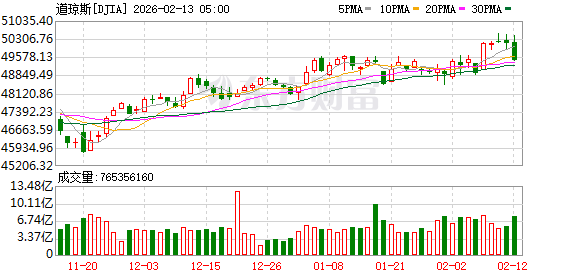
Market Overview - US stock market experienced a significant decline, driven by concerns over the accelerated penetration of artificial intelligence impacting the software industry and office space demand, leading to pressure on commercial real estate and tech sectors [2] - The Dow Jones Industrial Average fell by 669.42 points, a decrease of 1.34%, closing at 49,451.98 points; the S&P 500 dropped by 108.71 points, down 1.57%, closing at 6,832.76 points; the Nasdaq Composite decreased by 469.32 points, a decline of 2.03%, closing at 22,597.15 points [2] Popular Stocks Performance - Major tech companies faced significant losses, with Apple plunging 5%, marking its largest single-day drop since April 2025, following claims by the US Federal Trade Commission regarding Apple's suppression of conservative content [3] - Other notable declines included Meta Platforms down 2.82%, Amazon down 2.20%, Tesla down 2.62%, Nvidia down 1.64%, Microsoft down 0.63%, and Google C shares down 0.63% [3][4] Commercial Real Estate and Financial Services - The current sell-off in the US stock market is primarily focused on commercial real estate and related financial services, with fears that increased use of AI tools may structurally weaken demand for office space, impacting leasing and valuation [5] - Major commercial real estate service companies saw significant stock price drops, with CBRE Group down 8.8%, JLL down 7.6%, and Colliers International down 11.5% [5] - Analysts noted that the discussion around AI reducing office demand has been ongoing, but the recent sell-off in brokerage stocks has led investors to reassess commercial real estate risks more directly [5] Transportation and Logistics Sector - The trucking and logistics sector also faced notable pressure, with the Dow Jones Transportation Average dropping over 4%, marking its worst day since the US announced tariff increases in April of last year [6] - Among the 20 component stocks of the Dow Jones Transportation Average, 17 experienced declines, with Landstar System and C.H. Robinson seeing drops of 15.6% and 14.5%, respectively [6] - Concerns were heightened following Algorhythm Holdings' disclosure that its SemiCab division increased customer freight volumes by 300% to 400% without a corresponding increase in workforce, raising fears about AI's potential to reduce labor demand in logistics [6] Labor Market Data - Recent labor market data showed that initial jobless claims fell by 5,000 to 227,000, indicating overall stability in the job market [7] Bond Market Reaction - US Treasury yields fell, with the 10-year Treasury yield decreasing by 8.1 basis points to 4.102%, marking the largest single-day drop in October; the 2-year yield fell by 4.8 basis points to 3.464% [8] Commodity Market Performance - International oil prices saw a significant decline, with light crude oil futures for March delivery dropping by $1.79 to $62.84 per barrel, a decrease of 2.77%; Brent crude futures for April fell by $1.88 to $67.52 per barrel, down 2.71% [10] - Precious metals also faced pressure, with spot gold down 3.26% to $4,918.36 per ounce and silver down 10.89% to $75.0942 per ounce [10]


企业迁移至本地办公中心或采用联合办公会员制 可节省55%房地产成本
Cai Jing Wang· 2026-01-14 03:10
Core Insights - The report by IWG indicates a significant shift towards flexible office space solutions in China, driven by challenges in the commercial real estate market [1] - Long-term leases are becoming less attractive for companies facing demand uncertainty and cost pressures, leading to increased interest in hybrid and flexible office models [1] Group 1: Market Trends - According to Fitch's report, the oversupply of office buildings in China is leading to rising vacancy rates and downward pressure on rental prices, with overall rental levels expected to remain stable or slightly decline by 2026 [1] - In Beijing, the average rent for premium office space has decreased by over 16% year-on-year, enhancing tenant bargaining power [1] - The demand for flexible and hybrid office solutions is further reinforced by tenants' focus on spaces that enhance efficiency, adaptability, and employee experience [1] Group 2: Cost Savings and Productivity - Research by IWG and Arup shows that companies migrating to local office centers or adopting co-working membership models can save up to 55% on real estate costs, with potential savings in the U.S. reaching $122 billion by 2045 [1] - Hybrid working models can increase employee productivity by 11%, resulting in an average savings of approximately $11,000 per employee [1] - This transition allows companies to convert capital expenditures into operational expenses, alleviating long-term lease pressures and enhancing overall flexibility [1] Group 3: Company Growth - IWG's China head, Hu Mao, noted that in 2025, the company signed 80 new centers and opened nearly 30 centers, marking the fastest growth year to date [2] - The flexible office space model is becoming the optimal combination for companies in China to reduce costs, improve efficiency, and manage risks [2]
2025年澳大利亚房地产市场:你通往未来的指南(第二版)
Sou Hu Cai Jing· 2025-10-05 01:52
Core Insights - The Australian real estate market is entering a new cycle, driven by economic recovery, policy adjustments, and structural optimization across various sectors, with Sydney expected to lead this revival [1][7] - The macroeconomic environment is improving, with a projected 1.5% growth in household disposable income in 2025, further increasing to 4.9% in 2026, which will support demand across real estate sectors [1][2] Economic Factors - Global inflation pressures are easing, leading to a shift in policy focus towards growth, with expectations of interest rate cuts in Australia by mid-2025 [2][21] - The core inflation rate in Australia has decreased to 3.5%, which is expected to boost investor sentiment and alleviate financing pressures for homebuyers and businesses [2][21] Capital Market Trends - The Australian real estate market is experiencing an "early cycle acquisition window," with core assets being repriced significantly, indicating a potential for higher returns for investors entering the market now [2][20] - Historical data suggests that investing in core assets before the onset of a rate-cutting cycle typically yields returns above long-term averages, attracting renewed interest from investors [2][20] Sector-Specific Developments - Industrial real estate is leading the recovery, with strong demand supported by rising import volumes and a projected increase in leasing demand in 2025 [3][42] - Office real estate is showing a bifurcated trend, with high vacancy rates masking a shortage of high-end supply, particularly in central business districts (CBDs) [4][31] - Retail real estate is expected to see the strongest investor demand since 2015, driven by recovering consumer spending and tightening inventory [5][60] Emerging Opportunities - Data centers and build-to-rent (BTR) residential properties are emerging as attractive investment opportunities, with Australia becoming a hotspot for data center investments due to favorable conditions [5][6] - The BTR sector is projected to see a record completion of nearly 6,000 units in 2025, supported by institutional investor confidence and potential tax reforms [6][66] Overall Market Outlook - The Australian real estate market is poised for a multi-faceted recovery, with traditional sectors like industrial and retail experiencing structural opportunities, while new sectors like data centers and BTR show explosive growth potential [7][19]