AI恐慌交易

Search documents
【美股盘前】英伟达反弹0.8% CoreWeave跌近10%;拒绝提高对华纳兄弟的收购报价 奈飞涨近9%;Meta据悉与谷歌达成AI芯片租用协议
Mei Ri Jing Ji Xin Wen· 2026-02-27 10:02
Market Overview - Major U.S. index futures are down, with Dow futures falling by 0.40%, S&P 500 futures down by 0.22%, and Nasdaq futures decreasing by 0.10% [1] Chinese Stocks - Chinese stocks are mixed in pre-market trading, with Alibaba down by 0.95%, Pinduoduo up by 0.41%, Baidu up by 0.88%, and JD.com down by 0.59% [1] AI Sector Developments - Nvidia rebounded by 0.8% after a previous decline of 5.46%. Reports indicate that China's AI model API usage reached a historic high of 41.2 trillion tokens in the week of February 9-15, surpassing the U.S. usage of 29.4 trillion tokens during the same period. This raises concerns about Nvidia's demand for GPUs as China's MoE system drives token usage [1] Capital Expenditure Concerns - CoreWeave, a cloud infrastructure provider, saw a pre-market drop of nearly 10% due to concerns over massive capital expenditures projected between $30 billion to $35 billion for 2026, significantly higher than $10.31 billion in 2025. This has raised fears of substantial short-term losses [2] Netflix Acquisition Strategy - Netflix shares rose nearly 9% after the company refused to increase its acquisition offer for Warner Bros, stating that the deal no longer holds financial appeal [2] AI Market Sentiment - Morgan Stanley suggests that fears regarding AI replacing enterprise software are overstated, predicting that full replacement will not occur until at least 2028. Current AI tools are seen as augmentative rather than fully substitutive [2] Meta and Google Partnership - Meta has reportedly signed a multi-billion dollar agreement with Google to rent AI chips for developing new AI models [2] Rare Earth Supply Issues - U.S. aerospace and semiconductor suppliers are facing severe shortages of rare earth elements, particularly yttrium and scandium, leading at least two suppliers to refuse certain customer orders [3] Duolingo Performance - Duolingo's stock fell nearly 23% in pre-market trading after the company reported a 35% year-over-year revenue increase to $282.9 million for Q4, but provided a conservative Q1 2026 revenue guidance of $288.5 million, below market expectations [3]

AI裁员即暴涨?晨星抨击:重新部署员工比单纯“砍掉”更能释放价值
Hua Er Jie Jian Wen· 2026-02-27 07:32
Core Viewpoint - Companies are increasingly using AI as a narrative for layoffs and cost-cutting, which the market is quickly pricing as a positive, but this may overshadow the more significant value of AI in enhancing productivity through employee redeployment rather than merely reducing headcount [1][2][4] Group 1: AI and Layoffs - Companies like Wisetech Global and Block have announced significant layoffs (30% and over 40% of their workforce, respectively), leading to stock price increases of 11% and 23% following these announcements [1][3] - Morningstar analyst Lochlan Halloway notes that the market seems focused on what AI might destroy rather than what it can create, suggesting that layoffs are being framed as a direct result of AI rather than a genuine technological transformation [1][2] Group 2: Market Reactions and Investor Sentiment - The stock market's reaction to layoffs indicates a strong investor preference for narratives around cost reduction through AI, with short-term cost-cutting often being more readily translated into profit expectations than discussions of productivity and growth [3][5] - Morningstar emphasizes the need for investors to differentiate between cost-cutting framed by AI narratives and sustainable productivity improvements achieved through organizational and role reconfiguration [5][6] Group 3: Future Implications of AI - Halloway argues that companies can leverage AI to enhance productivity not by eliminating jobs but by redeploying employees to higher-value roles, thus unlocking additional output from AI [4] - The upcoming earnings season will see increased scrutiny on how AI impacts companies' balance sheets and operational quality, moving beyond layoffs as the sole visible indicator of efficiency gains [6]
韩国股市,年内上涨近45%
Sou Hu Cai Jing· 2026-02-25 17:06
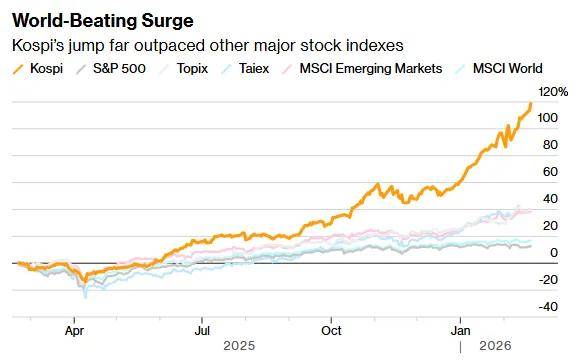
Group 1 - The South Korean Composite Stock Price Index (KOSPI) has reached a new milestone by surpassing 6000 points, driven by a surge in global demand for memory chips, benefiting major companies like Samsung Electronics and SK Hynix [1][4] - The KOSPI has seen a cumulative increase of nearly 45% since 2026, making it the best-performing major market globally [1] - The market capitalization of the South Korean stock market has exceeded $3.76 trillion, surpassing France to become the ninth largest globally [4] Group 2 - Analysts note that the South Korean stock market, previously overlooked by foreign funds due to low valuations, is now gaining attention, with hardware manufacturers driving market growth rather than software stocks [7] - A legislative reform requiring companies to cancel treasury stocks is expected to support the upward trend in the stock market [7] - The recent U.S. Supreme Court ruling that overturned tariffs is seen as a positive factor for South Korean exporters, particularly in electronics and components [7] Group 3 - There are early signs that domestic retail investors, who traditionally preferred U.S. stocks, are returning to the South Korean market, which could drive the next wave of growth [8] - Despite the rapid increase in the stock market, some observers are closely monitoring valuation levels [8] - Analysts remain optimistic about the continued benefits for Samsung and SK Hynix from ongoing memory chip shortages and AI demand, with target prices for these companies being raised by major financial institutions [10] Group 4 - Nomura Securities has raised its target for the KOSPI to 8000 points for the first half of the year, citing factors such as the memory supercycle and strong earnings in AI and defense sectors [10] - The path to 8000 points will depend on the South Korean government's ability to implement promised reforms through multiple amendments to the Commercial Act [10]

开盘:美股周二开盘基本持平 市场关注特朗普关税
Xin Lang Cai Jing· 2026-02-24 14:32
Core Viewpoint - The U.S. stock market is attempting to stabilize after a significant drop, influenced by geopolitical tensions and concerns over AI's impact on various industries [1][2]. Group 1: AMD and Meta Collaboration - AMD's stock surged following Meta's announcement of a multi-year partnership, deploying up to 6 gigawatts of AMD GPUs for AI data centers [5]. - Meta plans to invest in AMD through performance-based warrants, allowing the purchase of up to 160 million shares [5]. Group 2: Market Reactions and Concerns - Major stock indices experienced declines, with the Dow Jones dropping over 800 points, largely due to a 13% decline in IBM's stock [2][5]. - The Nasdaq Composite fell by 1.1% and the S&P 500 decreased by approximately 1%, marking a downturn for the year [2][5]. Group 3: AI-Driven Market Dynamics - A report from Citrini Research discussing AI-driven structural changes heightened market fears regarding the "replacement effect" of AI on software and other industries [6]. - The so-called "AI panic trading" has become a dominant theme in the U.S. stock market, leading to sell-offs across various sectors, including insurance brokerage and real estate services [6]. Group 4: Upcoming AI Events - Traders are closely watching an upcoming event by Anthropic, which is expected to unveil new products and features, contributing to market volatility [7]. - Anticipation surrounding Anthropic's announcements is causing investors to adopt a wait-and-see approach, impacting software stocks negatively [7].
AI恐慌交易蔓延,美股“2月寒流”何时结束?
Di Yi Cai Jing Zi Xun· 2026-02-15 04:44
Market Overview - The US stock market experienced a decline this week due to "AI panic trading" and an increased probability of the Federal Reserve maintaining its policy unchanged after January's non-farm employment report [2] - Despite a favorable macro environment with steady job growth and easing inflation, concerns over cost and profit margin pressures for tech companies have suppressed optimism, making it difficult for the stock market to gain upward momentum [2] Economic Data - Retail sales data showed weakness, with December's retail sales unchanged month-on-month, below the previous value of 0.6% and the expected 0.4%. The control group saw a 0.1% decline, contrary to the expected increase of 0.4% [3] - The Atlanta Fed's GDPNow model revised its forecast for Q4 GDP from 4.2% to 3.7% due to the retail sales data [3] - The job market remains strong, with January non-farm payrolls increasing by 130,000, significantly above the market expectation of 65,000. The unemployment rate fell from 4.4% in December to 4.3%, lower than the expected 4.4% [3] - The Consumer Price Index (CPI) rose by 0.2% month-on-month in January, below the expected 0.3%, and year-on-year growth was 2.4%, also below the expected 2.5% [3] Federal Reserve Outlook - The mixed signals from economic data suggest that the Federal Reserve is likely to remain patient and assess whether these data points reflect a genuine trend change or are merely statistical noise [4][5] - The yield curve for US Treasuries has flattened, with the 2-year yield dropping to its lowest level since 2022, approaching 3.40%. The pricing of federal funds futures indicates a potential rate cut in June, with a nearly 90% probability of two rate cuts this year [5] Market Sentiment and Sector Performance - The US stock indices fell, with investors continuing to reduce exposure to technology stocks. The S&P 500 index turned negative for the year [6] - Concerns about how new AI tools will impact specific industries have led to market volatility, initially affecting software and financial stocks, and later spreading to office real estate and logistics companies [7] - The financial sector saw the largest decline this week, down 4.8%, followed by communication services down 3.5%, and non-essential consumer goods and technology sectors down over 2% [7] AI Impact on Market - The launch of new AI tools has raised concerns about job displacement, leading to a sell-off in various sectors, including real estate and logistics. This "AI panic trading" has caused investors to adopt a "sell first, ask questions later" approach [8] - Despite the strong US economy and previous stock market highs driven by significant investments in AI infrastructure, AI is now viewed as a potential threat to existing business models, creating a paradox for Wall Street [8] Future Market Outlook - The significant decline in Treasury yields typically serves as a bullish catalyst for the stock market, but bearish confirmation signals in the tech sector suggest potential further downside risks in the short term [9] - The volatility index (VIX) remains around 20, indicating that the market is seeking protective measures and may maintain higher-than-average volatility in the near term [9]

AI恐慌交易蔓延,美股“2月寒流”何时结束?
第一财经· 2026-02-15 04:37
Core Viewpoint - The article discusses the impact of "AI panic trading" and the rising probability of the Federal Reserve maintaining its policy after the January non-farm employment report, leading to a decline in the US stock market [3]. Economic Data Summary - The upcoming week will require investors to digest a significant amount of economic data, which is expected to show mixed results [6]. - Monthly retail sales data was weak, with December sales unchanged month-on-month, below the previous value of 0.6% and the expected 0.4% [6]. - The Atlanta Fed's GDPNow model revised the US Q4 GDP forecast down from 4.2% to 3.7% [7]. - The job market showed strong performance, with January non-farm payrolls increasing by 130,000, significantly above the market expectation of 65,000 [7]. - The unemployment rate decreased from 4.4% in December to 4.3%, lower than the expected 4.4% [7]. - The Consumer Price Index (CPI) rose by 0.2% month-on-month in January, below the expected 0.3%, and the year-on-year increase was 2.4%, also below the expected 2.5% [7]. Federal Reserve and Interest Rate Expectations - There is a slight increase in expectations for a Federal Reserve rate cut, with the probability of two cuts this year approaching 90% [8]. - The flattening of the US Treasury yield curve indicates a significant drop in long-term yields, with the 2-year yield nearing 3.40%, the lowest since 2022 [8]. Market Reactions and Sector Performance - The US stock indices fell over the past week, with investors continuing to reduce exposure to technology stocks [11]. - Concerns about the impact of new AI tools on specific industries have led to market volatility, initially affecting software and financial stocks, and later spreading to real estate and logistics sectors [12]. - The financial sector experienced the largest decline, down 4.8%, followed by communication services at 3.5%, while utilities saw a significant increase of 7.1% due to safe-haven inflows [12][13]. Future Market Outlook - The article suggests that the market may still need to find a bottom, with technical indicators showing bearish confirmation signals for the Nasdaq [14]. - The volatility index (VIX) remains around 20, indicating that the market is seeking protective measures and may maintain higher-than-average volatility in the short term [14].

美股点金丨AI恐慌交易蔓延,美股“2月寒流”何时结束?
Di Yi Cai Jing Zi Xun· 2026-02-15 03:25
Group 1 - The US stock market experienced a decline this week due to "AI panic trading" and increased probabilities of the Federal Reserve maintaining its policy unchanged after the January non-farm employment report [1] - Concerns over cost and profit margin pressures for technology companies have suppressed optimism, despite a generally favorable macroeconomic environment characterized by steady job growth and easing inflation [1] - The ability of technology stocks to stabilize and the strengthening of interest rate cut expectations from the Federal Reserve will be critical for market recovery in the coming week [1] Group 2 - The retail sales data showed weakness, with December retail sales unchanged month-on-month, below the previous value of 0.6% and the expected 0.4% [2] - The Atlanta Fed's GDPNow model revised its forecast for Q4 GDP from 4.2% to 3.7% due to the retail sales performance [2] - The January non-farm payrolls increased by 130,000, significantly above the market expectation of 65,000, with the unemployment rate dropping to 4.3% from 4.4% [2] - The Consumer Price Index (CPI) for January rose by 0.2% month-on-month, lower than the expected 0.3%, and the year-on-year increase was 2.4%, also below the expected 2.5% [2] Group 3 - Economic signals are mixed, with the January employment report contradicting the narrative of stagnant hiring, while retail sales data challenges the view of strong consumer spending [3] - The flattening of the US Treasury yield curve indicates a significant drop in long-term yields, with the 2-year yield approaching 3.40%, and the probability of two rate cuts this year nearing 90% [3] - The inflation report shows encouraging signs, particularly with housing prices slowing and tariff-related impacts diminishing, which may lead the Federal Reserve to consider rate cuts later this year [3] Group 4 - The recent signals are unlikely to persist, as the decline in retail sales may be a temporary pause following strong spending, and the sustainability of the significant increase in non-farm employment is questionable [4] - The cooling inflation data provides a favorable environment for the Federal Reserve to potentially restart rate cuts later in the year [4] Group 5 - The US stock indices fell over the past week, with investors continuing to reduce exposure to technology sectors, and the S&P 500 index turned negative for the year [5] - Concerns regarding the impact of new AI tools on specific industries have led to market volatility, initially affecting software and financial stocks, and later spreading to real estate and logistics sectors [5] Group 6 - The financial sector experienced the largest decline this week, down 4.8%, followed by communication services down 3.5%, and both non-essential consumer goods and technology sectors fell over 2% [6] - Utility stocks surged by 7.1% due to safe-haven inflows, while real estate and materials rose over 3% [6] Group 7 - The launch of AI tools by companies like Altruist and Anthropic has heightened fears of job displacement, leading to a cautious sentiment among traders regarding US stock exposure [7] - The sell-off pressure in the market is primarily driven by concerns over the disruptive effects of AI, affecting not only software stocks but also real estate and logistics [7] Group 8 - The significant decline in US Treasury yields typically serves as a bullish catalyst for the stock market, but bearish confirmation signals in the Nasdaq indicate potential further downside risks [8] - The volatility index (VIX) remains around 20, suggesting that the market is seeking protective measures and may maintain higher-than-average volatility in the short term [8]
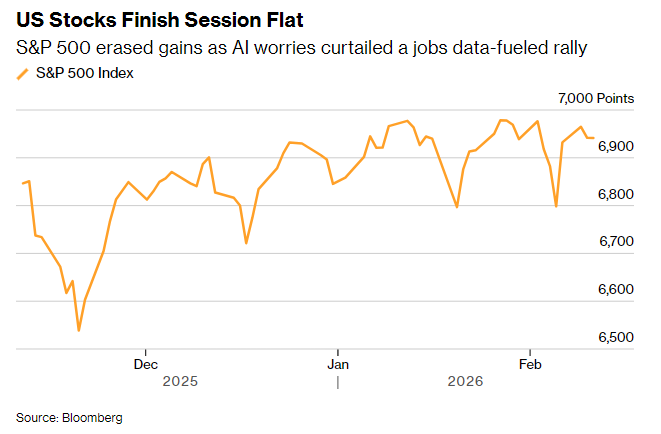
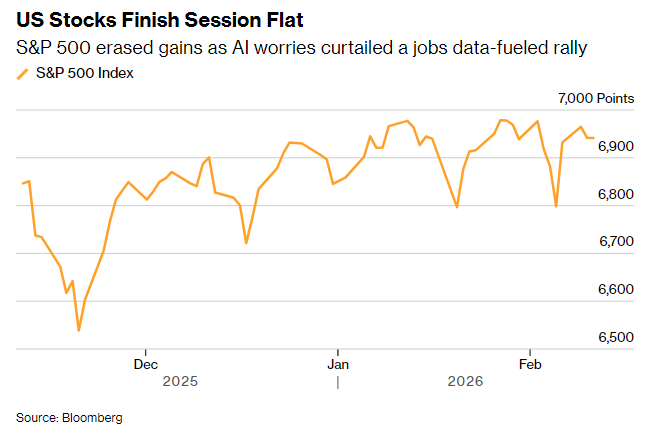
非农新增创逾一年新高难救市!AI恐慌交易主导美股,标普500错失历史新高
Zhi Tong Cai Jing· 2026-02-12 01:32
Group 1 - The U.S. stock market experienced a decline despite strong employment data, as concerns over the impact of artificial intelligence (AI) on various industries suppressed the rebound [1] - The S&P 500 index slightly fell, while the Nasdaq 100 index rose by 0.3%, indicating mixed performance in the tech sector [1] - A measure of the "seven giants" in the U.S. stock market dropped by 0.6%, and an ETF tracking software stocks plummeted by 2.6%, reflecting ongoing pressure on software stocks due to AI concerns [1][2] Group 2 - The real estate services sector also faced declines, with companies like CBRE falling by 12%, as the market assessed their vulnerability to AI technology [1] - The sector has been identified as part of the "AI panic trading" phenomenon, with investors selling off stocks in software, private credit, wealth management, and insurance brokerage [2] - Growth and momentum stocks are under significant pressure due to market expectations that interest rates will remain high for an extended period [5] Group 3 - The employment report showed a significant increase of 130,000 non-farm jobs, the largest gain in over a year, with the unemployment rate unexpectedly dropping to 4.3% [6] - Following the employment report, traders anticipated that the first interest rate cut of the year could occur in July, shifting from previous expectations of June [6] - Analysts suggest that the current U.S. market presents a complex scenario, with rising economic growth expectations juxtaposed against visible financial pressures on households [6]
非农新增创逾一年新高难救市!AI恐慌交易主导美股 标普500错失历史新高
Zhi Tong Cai Jing· 2026-02-12 00:43
Market Overview - The U.S. stock market retraced early gains and closed lower despite strong employment data, with concerns over AI's disruptive impact on multiple industries suppressing the rebound [1] - The S&P 500 index slightly declined, while the tech-heavy Nasdaq 100 index rose by 0.3%, reaching a peak increase of 1% during the session [1] - The Chicago Board Options Exchange Volatility Index (VIX) hovered around 18 [1] Employment Data Impact - The employment report showed an unexpected increase of 130,000 non-farm jobs in January, marking the largest gain in over a year, with the unemployment rate unexpectedly dropping to 4.3% [6] - Following the employment report, traders anticipated the first interest rate cut of the year to occur in July, shifting from previous expectations of June [6] - Analysts suggest that the Federal Reserve is likely to maintain current interest rates, despite pressures from the Trump administration for rate cuts [6] Sector Performance - The technology sector faced significant selling pressure, continuing a trend observed over the past few months, with international and value stocks leading the market [1] - An index tracking the "seven giants" of the U.S. stock market fell by 0.6%, and an ETF focused on software stocks dropped by 2.6% [1] - Real estate service stocks also declined, with CBRE Group falling by 12%, and both Jones Lang LaSalle and Cushman & Wakefield experiencing declines [1] AI Concerns - The software sector has been particularly affected by what analysts are calling "AI panic trading," leading to sell-offs in software, private credit, wealth management, and insurance brokerage stocks [2] - Investors are increasingly favoring companies whose business models are less likely to be disrupted by AI technology [1][2] Market Sentiment - The market is currently focused on the upcoming Consumer Price Index (CPI) report, with expectations that if the core CPI is close to or below forecasts, there is a 70% probability that the S&P 500 will rise [2] - Growth and momentum stocks are under the most pressure due to market expectations that interest rates will remain high for an extended period [5]