
卫星研制

Search documents
电科蓝天:在国网星座已发布卫星研制计划中,公司参与研制比例达82%
Zheng Quan Ri Bao· 2026-02-25 11:11
Group 1 - The company has disclosed that it participates in 82% of the satellite development plans released by the State Grid Constellation, which includes the first generation, new star, and star cloud satellites [2] - In the Qianfan Constellation project, the company has achieved exclusive supply of the aerospace power system [2]

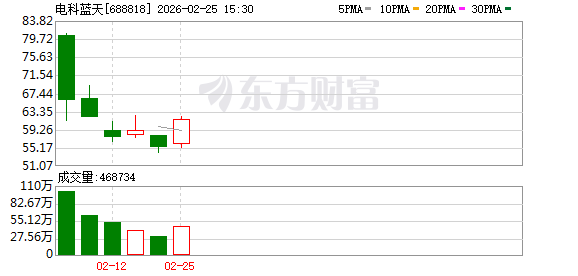
电科蓝天:国网星座卫星研制参与率达82% 千帆星座宇航电源独家配套
Mei Ri Jing Ji Xin Wen· 2026-02-25 08:22
Group 1 - The core viewpoint of the article highlights that 电科蓝天 is significantly involved in satellite development plans under the 国网星座 initiative, with an 82% participation rate in the satellite manufacturing process [2] - The company has achieved exclusive supply of the aerospace power system for the 千帆星座 project, indicating a strong position in this segment of the industry [2]
钧达股份(002865):钧达股份收购卫星整星总体企业巡天千河母公司60%股权
Soochow Securities· 2026-02-09 09:01
Investment Rating - The investment rating for JunDa Co., Ltd. is "Buy" (maintained) [1] Core Views - JunDa Co., Ltd. has acquired a 60% stake in the satellite company XunTian QianHe, which covers the entire chain of satellite development, communication, remote sensing, data processing, and system integration [7] - The core team has strong capabilities with over 50 satellite orders in hand and aims to produce hundreds of satellites annually through automation [7] - The company plans to enhance its satellite computing power research and aims to capture 10%-20% of the domestic satellite market [7] - Profit forecasts indicate a net profit of -1.27 billion in 2025, followed by 471 million in 2026 and 1.04 billion in 2027, reflecting a recovery trend [7] Financial Summary - Total revenue for 2023 is projected at 18.657 billion, with a year-on-year growth of 60.90% [1] - The net profit attributable to shareholders is expected to be 815.64 million in 2023, with a growth rate of 13.77% [1] - Earnings per share (EPS) for 2023 is estimated at 2.79 yuan, with a P/E ratio of 30.22 [1] - The company anticipates a significant drop in revenue in 2024 to 9.952 billion, followed by a gradual recovery in subsequent years [8]

商业航天“第一城”,迎来新地标
Mei Ri Jing Ji Xin Wen· 2026-01-20 11:24
Core Insights - The Beijing Rocket Street project, a benchmark in the commercial aerospace sector, has successfully completed its construction filing and entered the delivery phase five months ahead of schedule [1] - The project is the first common testing and research production base for commercial aerospace in China, covering a total area of 145,000 square meters and featuring four main functional areas: common technology platform, innovation research center, high-end manufacturing center, and display and operation control center [1] - The project aims to attract high-quality projects across the entire commercial aerospace industry chain, with a focus on integrating existing industrial resources to create a collaborative ecosystem [1][2] Industry Overview - Beijing has established a vibrant and innovative private commercial aerospace industry cluster, with a notable spatial layout characterized by "South Arrow" and "North Star" [2] - The "South Arrow" area includes major districts like Economic Development Zone, Fengtai, and Daxing, housing leading commercial rocket companies and possessing the most complete rocket manufacturing industry chain in the country [2] - The "North Star" area, centered in Haidian, is home to numerous commercial satellite manufacturing companies, forming a leading satellite research and industrial chain ecosystem [2] - Over 75% of the country's commercial rocket companies are located in Yizhuang, which has emerged as the most complete and densely populated area for the commercial aerospace industry in China [2] Future Development Goals - Beijing aims to become a globally influential hub for commercial aerospace innovation by 2028, with plans to achieve reusable rocket orbital recovery and flight [3] - The city plans to attract and cultivate over 500 high-tech enterprises, more than 100 specialized and innovative companies, and over 10 unicorns, with the goal of exceeding 20 listed companies [3] - The establishment of two municipal-level commercial aerospace characteristic industrial clusters and several specialized industrial parks is also part of the strategy to expand the commercial aerospace industry into a trillion-yuan cluster [3]
中国星网低轨19组卫星成功发射,卫星研制方系银河航天
Guo Ji Jin Rong Bao· 2026-01-19 14:00
Group 1 - Satellite mass production has become a key capability for the development of new space infrastructure [1][2] - The China Star Network, responsible for building and operating the satellite internet constellation, aims to achieve 400 satellites in orbit by 2027 [1] - The recent launch involved 19 low-orbit satellites, marking the second batch of satellites developed by Galaxy Space for space infrastructure [1] Group 2 - Galaxy Space has developed core technology products including phased array, millimeter-wave antennas, and integrated electronics, placing it at the forefront of the industry with cost advantages [2] - The company has implemented a fully digital process for satellite production, enhancing efficiency through automated testing and intelligent assembly [2] - As China's first unicorn in the commercial space sector, Galaxy Space focuses on the independent research and low-cost mass production of communication payloads and satellite platforms [2]
重庆巴南2026年首次集中签约项目29个
Ke Ji Ri Bao· 2026-01-08 02:59
Group 1 - The core event is the signing of 29 investment projects in Banan District, Chongqing, with a total investment of approximately 22 billion yuan, focusing on key industries such as biomedicine, electronic information, and intelligent connected new energy vehicles [1] - The projects are characterized by high investment intensity, technological content, and strong industrial driving force, aligning with the development direction of Banan District's leading industries [1] - A strategic cooperation agreement was signed between the Banan District government and Guoxin Holdings (Chongqing) Co., Ltd., aiming to integrate the advantages of central enterprises and local government for a new development model [1] Group 2 - Banan District is focusing on the "312" technology innovation layout and the "1+3+X" future industry layout to attract cutting-edge technology projects [2] - The Yengyu Muxing Satellite Intelligent R&D and Production Base project aims to establish an intelligent production capacity system for 300 satellites annually, utilizing platform-based, modular, and AI-enabled technologies [2] - Other projects include the construction of a comprehensive international food smart park and a cultural service ecosystem platform, contributing to the acceleration and quality enhancement of the productive service industry in Banan District [2]
传回高精度大片!“瑶海科创号”卫星首次过境合肥
Xin Lang Cai Jing· 2026-01-04 01:29
Core Viewpoint - The successful launch and operation of the "Yaohai Science and Technology Satellite" marks a significant advancement in high-resolution optical remote sensing capabilities, providing valuable applications for urban governance and resource management in Hefei and the surrounding areas [1] Group 1: Satellite Launch and Capabilities - The "Yaohai Science and Technology Satellite" was successfully launched on December 10, 2025, from the Jiuquan Satellite Launch Center and has entered its designated orbit [1] - This satellite, developed by Xinheng Aerospace Company in collaboration with Changguang Satellite Company, features an imaging capability with a resolution better than 0.5 meters and on-orbit intelligent processing capabilities, achieving an advanced level in the industry [1] Group 2: Applications and Impact - The satellite is designed for multiple imaging tasks, including hotspot imaging, stereoscopic imaging, and spatial target imaging, enabling rapid response capabilities [1] - It will be widely applied in key areas such as urban governance, natural resources, ecological protection, water management, and agriculture, facilitating the practical application of space resources [1] - The acquisition of high-precision satellite images of Hefei is one of the initial applications, providing a new perspective for urban governance and development planning in the region [1]
中山大学“90后”学生带队自研立方星发射成功
第一财经· 2025-12-10 15:33
Core Viewpoint - The article highlights the successful launch of the "Yixian-A" satellite, developed by a student team from Sun Yat-sen University, marking a significant achievement in the field of satellite technology and environmental innovation [3][5]. Group 1: Satellite Launch and Purpose - The "Yixian-A" satellite was launched on December 10, 2025, from the Jiuquan Satellite Launch Center, becoming the world's first satellite to validate wooden outer panels in orbit [3][5]. - The satellite is designed for scientific experiments, technology validation, and educational purposes, with a planned operational duration of six months [3][5]. Group 2: Development Team and Leadership - The project was led by Wang Hui, a postdoctoral researcher at Sun Yat-sen University, who founded the university's Micro-Nano Satellite Association in 2021 to facilitate satellite development [5][6]. - Wang's innovative approach involved a student-led design and management model, breaking down the satellite development into manageable sub-projects to accelerate progress [5][6]. Group 3: Technical Innovations - The use of wooden outer panels represents a bold innovation, aimed at reducing atmospheric pollution upon re-entry while facing challenges from extreme space conditions [5][6]. - The development team collaborated with various departments to experiment with different types of wood and surface treatments, ultimately enhancing the durability of the wooden materials for space environments [6][7]. Group 4: Future Plans - Following the success of "Yixian-A," the team plans to develop a series of satellites, including "Yixian-B," which will focus on biomedical experiments in space [3][5].

航宇微:公司正按计划推进珠海一号04组卫星的研制和试验工作
Zheng Quan Ri Bao· 2025-11-10 12:41
Group 1 - The company is advancing the development and testing of the Zhuhai-1 04 satellite as planned [2] - The company is closely monitoring industry dynamics and trends to ensure its satellite constellation remains at an advanced level and meets customer demands [2] - The company will disclose specific information regarding satellite launches in accordance with relevant requirements [2]

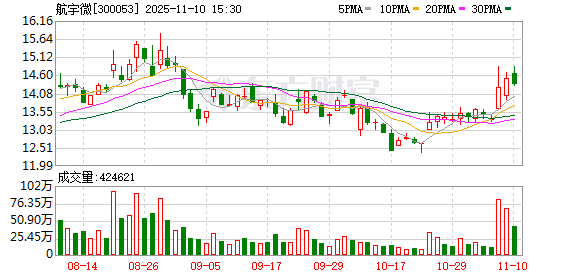
我国首颗海洋盐度探测卫星完成在轨测试
Zheng Quan Shi Bao Wang· 2025-10-22 10:07
Core Viewpoint - The successful completion of in-orbit testing for China's first ocean salinity detection satellite marks a significant milestone in the country's civil space infrastructure and enhances the satellite observation system for marine studies [1] Group 1: Satellite Development - The ocean salinity detection satellite was developed by China Aerospace Science and Technology Corporation's Fifth Academy [1] - It was launched on November 14, 2024, by the Long March 4B rocket [1] Group 2: Importance and Impact - This satellite fills a gap in satellite-based ocean salinity detection, contributing to the overall marine observation capabilities [1] - It is recognized as a key scientific satellite within the national civil space infrastructure [1]
