摄影器材

Search documents
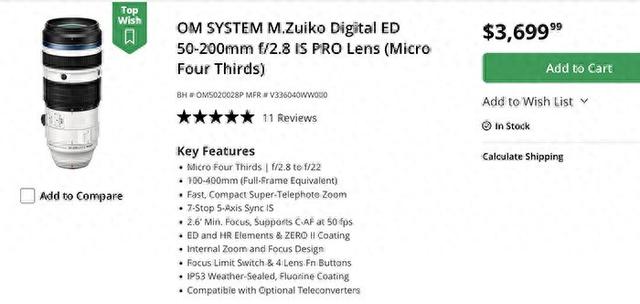
奥之心正在开发“50-250mm F4 PRO”镜头?
Xin Lang Cai Jing· 2026-02-20 04:12
Core Viewpoint - The company is reportedly developing a new telephoto zoom lens, the "50-250mm F4 PRO," aimed at providing an affordable option for photography enthusiasts interested in nature, sports, and aviation [1] Group 1 - The source of the information is a reliable anonymous tipster who previously predicted the release of the "50-200mm F2.8 PRO" lens [1] - The new lens is expected to be priced more accessibly, appealing to a broader audience of photographers [1] - The "50-250mm F4 PRO" will feature dust and splash resistance, catering to professional users who require durability in challenging shooting conditions [1] Group 2 - The lens will support MC-14 and MC-20 teleconverters, allowing for extended focal lengths [1] - On the M4/3 system, the lens will provide equivalent focal lengths of 700mm and 1000mm, significantly expanding the shooting range for users [1]

摄影告别“妖术”
Xin Lang Cai Jing· 2026-02-19 07:38
Core Insights - The article discusses the historical significance of the book "Kodak Photography: A Reference Book for Everyday Photography," published during the 1920s, highlighting Kodak's establishment in China and its influence on photography culture [1][2] Group 1: Historical Context - Kodak Company was established in 1920 and set up its Shanghai branch in 1920, later moving to Yuanmingyuan Road in 1928 [1] - The book was published during a time when photography was becoming more accessible and popular among urban intellectuals in China, marking a shift from viewing photography as a "mysterious art" to a form of entertainment [1] Group 2: Book Details - "Kodak Photography" consists of 224 pages divided into 25 chapters, featuring nearly 400 illustrations, covering the entire photography process from camera selection to darkroom techniques [1] - The book serves as a valuable resource for both beginners and experienced photographers, aiming to deepen knowledge and facilitate entry into photography [1] Group 3: Technical Insights - The book references the Kodak "Retina" camera, which was introduced in 1931, known for its compact design and high image quality, appealing to photography enthusiasts [2] - The introduction of the 135 film format, which became popular in the mid-1930s, was facilitated by advancements in black-and-white film quality and the rise of color film, leading to increased camera production and film consumption [2] - The 135 film designation was officially adopted as a global standard by the late 1930s, marking a significant development in the photography industry [2]

菲律宾科技部助理部长:期待与中企探讨科创赋能菲商业和人才发展
2 1 Shi Ji Jing Ji Bao Dao· 2026-02-02 06:37
Group 1 - The Philippines views China as a solid partner in technology and innovation, emphasizing the potential for win-win opportunities through collaboration [1] - The Philippine Department of Science and Technology Assistant Secretary Napoleon Kilates Juanillo Jr highlighted the importance of technology innovation as a driver for business and entrepreneurship, particularly in fostering an entrepreneurial spirit among youth [1] - Juanillo expressed admiration for Guangzhou's green development and technological innovation capabilities, noting the hospitality of its people during his visit [1] Group 2 - The APEC first senior officials' meeting held in Guangzhou from February 1 to 10 focuses on the theme of "Building a Community of the Asia-Pacific for Common Prosperity" and three priority areas: openness, innovation, and cooperation [2] - The meeting aims to initiate cooperation across various fields and mechanisms, discussing specific collaborations to prepare for the informal leaders' meeting in November [2]
徕卡又要出售了,中资买下百年可乐标?|硅谷观察
Xin Lang Cai Jing· 2026-01-26 00:11
Core Viewpoint - Leica Camera's major shareholders, ACM and Blackstone, are considering selling their controlling stake, with an estimated valuation of €10-12 billion ($12-15 billion) [1][34][35] Group 1: Company Background - Leica's origins trace back to 1849 when Carl Kellner founded the "Optical Institute" in Germany, which later evolved into the Leica brand [2][37] - The first 35mm camera prototype, Ur-Leica, was designed by Oskar Barnack in 1914, marking a significant milestone in photography history [6][39] - Leica has become synonymous with documentary photography, capturing pivotal moments throughout the 20th century [6][39] Group 2: Financial History and Ownership Changes - In 2004, Andreas Kaufmann acquired a majority stake in Leica for approximately €65 million ($82 million), rescuing the company from near bankruptcy [8][41] - Blackstone invested about €130 million ($179 million) in 2011 for a 44% stake, valuing Leica at approximately €278 million [9][42] - Currently, ACM holds 55% and Blackstone holds 45% of Leica's shares [9][42] Group 3: Brand Transformation and Market Performance - Blackstone's involvement has transformed Leica from a traditional workshop into a global luxury brand, positioning it as the "Rolls Royce of imaging" [12][44] - Leica's revenue has grown from €450 million to €596 million over the past four fiscal years, despite a declining traditional camera market [14][45] - The company has successfully diversified its business and adopted a luxury branding strategy, which has significantly increased its profit margins [12][45] Group 4: Exit Strategy and Market Dynamics - Blackstone is looking to exit its investment as it has surpassed the initial 5-7 year exit period agreed upon at the time of investment [15][46] - The potential sale is driven by a slowdown in revenue growth, with the last fiscal year's growth rate dropping to 7.6% [16][46] - The sale process has attracted interest from various potential buyers, including Chinese private equity firm HSG, European funds, and optical groups [1][35][56] Group 5: Strategic Partnerships - Leica has formed strategic partnerships with Huawei and Xiaomi, significantly boosting its presence in the mobile imaging market [14][49][52] - The collaboration with Huawei led to the successful launch of the P9 smartphone, which sold over 12 million units within a year, enhancing both brands' market positions [17][51] - Following the end of the partnership with Huawei, Leica has sought new collaborations, notably with Xiaomi, to maintain its growth trajectory in mobile imaging [20][52] Group 6: Future Prospects and Challenges - The upcoming sale of Leica's controlling stake may lead to significant changes in its operational strategy and market approach [25][56] - Potential buyers like Zeiss and HSG could influence Leica's future direction, particularly in expanding its market share in China, which has seen a 25% increase in sales [25][56] - The need for Leica to maintain brand prestige while increasing sales volume remains a critical challenge for its new ownership [31][62]

徕卡年度照片新鲜出炉,歌帝梵推出2026情人节限定巧克力 | 一周有品指南
Xin Lang Cai Jing· 2026-01-19 14:04
Group 1 - Aesop opened a new store in Shanghai's Taikoo Li, featuring a design inspired by the city's night lights, utilizing over 5,000 recycled amber glass bottles to create light refraction effects [2] - Lafuma launched a 95th anniversary theme event in Shanghai, focusing on the relationship between humans and nature through an immersive experience, featuring a pop-up store inspired by the Alps [5] - Leica announced that the 2025 annual photo will be a work by Joel Meyerowitz, capturing a moment from the Puerto Rican Day Parade in 1963, with limited editions available starting December 2025 [7] Group 2 - FLOS introduced a new modular architectural lighting system called The Glowing Track, designed to meet various lighting needs with three models and multiple length options [9] - Godiva released a limited edition chocolate series for Valentine's Day 2026, featuring heart-shaped designs and various flavors [12] - Bicester Village in Shanghai and Suzhou reported record sales during the New Year holiday, with significant growth in non-local visitor numbers and a notable increase in new customers [16][17] Group 3 - The Shanghai Museum is hosting an exhibition titled "Modern Huaying: Shanghai Cheongsam and a Century of Fashion," showcasing the evolution of the cheongsam and its cultural significance [19] - The "Interspace Roaming: Swiss Contemporary Comic Art Exhibition" opened at the Minsheng Modern Art Museum in Shanghai, featuring nearly 500 works from 22 Swiss artists, exploring various themes [21]

一根黄色胶带,给他拽来了16个亿
虎嗅APP· 2026-01-16 13:34
Core Viewpoint - The article discusses the unique "anti-hit product logic" of SmallRig, a Shenzhen-based company that has successfully navigated the overseas market by focusing on user co-creation, a wide range of SKUs, and high-frequency iteration rather than relying on single blockbuster products [4][8]. Group 1: Company Overview - SmallRig was founded in 2013 and specializes in photography and videography equipment, boasting over 1,000 SKUs currently available and plans to launch over 600 new products by 2025 [8][26]. - The company has achieved a GMV exceeding 1.6 billion yuan by 2025 and has consistently ranked at the top of Amazon's imaging accessories categories [8]. Group 2: User-Centric Development - SmallRig's approach involves gathering user feedback to identify pain points and develop products accordingly, rather than preemptively identifying market needs [7][14]. - The company has established a systematic method for collecting user opinions, which are categorized and prioritized for product development [17][18]. Group 3: Product Development Strategy - SmallRig's "DreamRig" project allows users to receive free samples of products, fostering a sense of community and encouraging user promotion [20][21]. - The company emphasizes modularity and standardization in its product design to manage the complexity of a large number of SKUs effectively [27][28]. Group 4: Marketing and Sales Strategy - SmallRig organizes its products around specific imaging scenarios, which enhances customer experience and increases average order value, with independent site customer spending averaging $120 compared to $50 on Amazon [30][29]. - The marketing strategy focuses on scene-based product organization, which contrasts with the single-listing competition on platforms like Amazon [30]. Group 5: Supply Chain and Information Systems - The company has developed its own supply chain and information systems to support its unique business model, which includes self-assembled production processes and custom-built ERP systems [34][35]. - SmallRig's reliance on long-term partnerships with suppliers has fostered mutual growth and innovation [34]. Group 6: Challenges and Future Outlook - Despite past growth rates of doubling revenue annually, the company now faces a more stable growth rate of 30%-40% and acknowledges the need for improved internal management structures to support this growth [52][51]. - The company recognizes that while its user-driven model may not yield the fastest growth, it provides a more sustainable path in a rapidly changing market [53].

大疆DJI RS5相机稳定器体验:从抵触到爱用 小白用户力荐
Xin Lang Cai Jing· 2026-01-15 12:05
Core Insights - The DJI RS5 significantly lowers the entry barrier for using camera stabilizers, allowing even novice users to achieve leveling in just a few minutes [2][3] - The Z-axis stability indicator and fifth-generation stabilization algorithm enhance stability during significant movements, aiding beginners in developing their usage habits [2][3] - The intelligent tracking module can recognize various objects, reducing operational costs by eliminating the need for additional personnel with high skills, enabling one person to accomplish tasks typically requiring a small team [2][3]
是谁,抢拍立得相纸到发疯
3 6 Ke· 2025-12-24 11:52
Core Insights - The article discusses the rising prices and scarcity of Fujifilm's Instax film, particularly the mini series, which has led to a thriving secondary market and consumer frustration [3][4][6][9]. Group 1: Market Dynamics - Fujifilm's Instax film prices have skyrocketed, with the cost of mini film rising from 3.5 yuan per sheet five years ago to approximately 8 yuan now, while wide film prices have remained relatively stable [6][9]. - The Instax business has become a significant revenue source for Fujifilm, with sales increasing from 8 billion yen in 2020 to an expected 16 billion yen in 2024, indicating a doubling of sales in five years [9]. - Fujifilm holds over 85% of the global market share for instant film, highlighting its dominance in the sector [9]. Group 2: Consumer Behavior - Consumers are actively seeking ways to purchase Instax film, forming groups on social media platforms to share information about restocks and prices [3][12][15]. - Many consumers have resorted to purchasing from scalpers, with one seller claiming to sell thousands of boxes monthly, indicating a high demand despite the inflated prices [7][12]. - The article notes that consumers are willing to go to great lengths, including traveling to Japan, to find and purchase the film, only to face restrictions and limits imposed by retailers [19][21]. Group 3: Supply Chain Issues - The supply of Instax film is heavily skewed, with North America and Europe receiving 35% and 25% of the distribution, respectively, while China only receives 10% [9]. - Fujifilm's supply strategy has prioritized markets outside of China, leading to significant shortages in the Chinese market [9][12]. - The mismatch between explosive demand and limited supply has created a fertile ground for scalpers and has frustrated consumers [12][24].

影石门店招牌疑因大疆排他协议被拆,门头将于下周恢复
Nan Fang Du Shi Bao· 2025-12-12 06:12
Core Viewpoint - The recent developments regarding the exclusivity agreement involving DJI's distributor and the影石 brand have led to a ruling by the market supervision authority, allowing the restoration of the影石 store signage, indicating potential implications for exclusivity agreements in the industry [2][6]. Group 1: Background of the Issue - Zhang, a dealer for影石, has been in the photography equipment industry for over 20 years and operates a nearly 1,000 square meter store in Hunan Photography City [3]. - In August, Zhang sought to renovate part of his store to open a专卖店 for影石 products but was informed that such a store was prohibited due to an exclusivity agreement signed by the mall management with a DJI distributor [3][4]. Group 2: Details of the Exclusivity Agreement - The exclusivity agreement, which is a supplementary lease agreement, prohibits the introduction of competing brands to DJI within the Hunan Photography City [4]. - The agreement identifies影石 as a strong competitor to DJI products, although the exact date of the agreement's signing is unclear, with Zhang suggesting it was signed around April of the same year [4]. Group 3: Developments and Resolutions - Following the intervention of the market supervision authority, a meeting was held on December 9, where it was determined that the exclusivity agreement could be deemed invalid if it harmed third-party interests, allowing Zhang to restore his影石 store signage [5][6]. -影石's China sales head stated that the company would fully cover all related losses incurred by Zhang during this incident, and Zhang has applied for renovation costs, expecting the store signage to be restored soon [6].
大疆经销商被指与商场签排他协议封杀影石 律师:或构成垄断
Nan Fang Du Shi Bao· 2025-12-05 16:03
Core Viewpoint - The article discusses a dispute involving a "exclusive agreement" that led to the demolition of a store sign for an Insta360 experience store in Hunan Photography City, highlighting potential anti-competitive practices and legal implications [1][12]. Group 1: Background of the Dispute - Zhang, a businessman with over 20 years in the photography equipment industry, was forced to remove the sign of his newly renovated Insta360 store due to an exclusive agreement between the management of Hunan Photography City and a DJI distributor [2][5]. - The exclusive agreement prohibits the entry of competing brands, specifically naming Insta360 as a strong competitor to DJI products [5][12]. Group 2: Legal Implications - Legal experts suggest that the exclusive agreement may violate anti-monopoly laws, as it restricts competition by preventing third-party brands from entering the market [12]. - The agreement's lack of public disclosure and its specific targeting of certain brands could be seen as undermining fair market competition and consumer choice [12]. Group 3: Market Context - The competitive landscape between DJI and Insta360 has intensified, with Insta360 holding a significant market share in the panoramic camera sector, while DJI has recently entered this market with aggressive pricing strategies [13]. - According to a report, Insta360 has maintained a global market share of over 85% in the panoramic camera segment for eight consecutive years, while DJI has captured approximately 17.1% of the global market share in Q3 [13].