
消费娱乐

Search documents
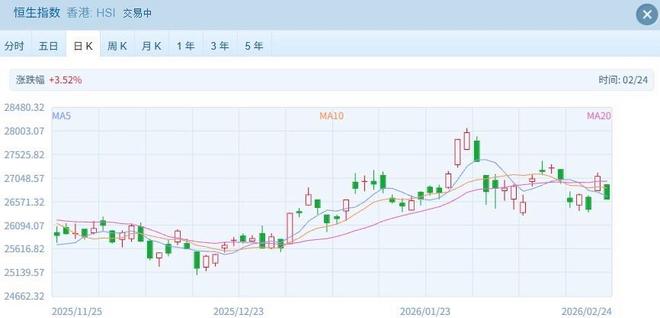
港股速报|港股开盘震荡走弱 石油天然气板块逆势上涨
Mei Ri Jing Ji Xin Wen· 2026-02-24 02:43
Market Overview - The Hong Kong stock market opened with a downward trend, influenced by a significant decline in US stocks overnight, leading to a collective lower opening of major indices [1] - As of 9:38 AM, the Hang Seng Index opened at 26,913.68 points, down 0.62%, and further declined to 26,682.85 points, with a total drop of 1.47% [1] Index Performance - The Hang Seng Tech Index showed even weaker performance, opening at 5,330.26 points, down 1.02%, and continued to decrease to 5,255.02 points, marking a drop of 2.42% [3] Sector Performance - Most sectors experienced declines, with the information technology and software services sectors leading the losses; however, the oil and gas sector saw gains [5] Individual Stock Performance - Among the constituents of the Hang Seng Index, Hang Lung Properties, Wanzhou International, and China Petroleum & Chemical Corporation were the top gainers; conversely, Pop Mart, Hansoh Pharmaceutical, and Alibaba Health were the top losers [8] - Wanzhou International reached a historical high during the trading session [8]

创业板指半日跌近2%,商业航天、光模块重挫,芯片股走强,分析:高波题材或将降温
21世纪经济报道· 2026-01-20 04:11
Market Overview - On January 20, A-shares experienced a significant drop, with the ChiNext Index falling over 2% at one point, ultimately closing down 1.8% [1] - The Shanghai Composite Index closed down 0.3%, while the Shenzhen Component Index fell by 1.2%, with nearly 3,400 stocks declining [1] Index Performance - The Shanghai Composite Index closed at 4101.62, down 0.30% - The Shenzhen Component Index closed at 14119.95, down 1.22% - The ChiNext Index closed at 1824.62, down 1.43% - The total A-share market index (Wande All A) was at 6743.51, down 0.81% [2] Sector Performance - The chemical sector showed resilience, with stocks like Hongbaoli and Shandong Heda hitting the daily limit [2] - AI application stocks rose, with companies like Jiayun Technology and Yue Media also hitting the daily limit [2] - The storage chip sector remained active, with stocks like Baiwei Storage and Puran Shares reaching new highs, and Baiwei Storage increasing nearly 200% over the last 120 trading days [3] - Retail stocks strengthened, with Shanghai Jiubai and Xinhua Department Store hitting the daily limit, following the National Development and Reform Commission's announcement to develop a strategy for expanding domestic demand from 2026 to 2030 [3] Financing and Market Trends - A-shares' financing balance decreased for the first time in two weeks, with a reported balance of 27,059 billion yuan, down 8.5 billion yuan from the previous day [6][7] - The new financing regulations implemented on January 19 led to a significant drop in margin trading, with the trading volume on that day being the lowest of the year [6] - Key sectors experiencing net selling in financing included electronics, communications, defense, computers, and basic chemicals, each with net selling exceeding 1 billion yuan [7][8] - Analysts suggest that the increase in margin requirements is aimed at cooling down overheated speculative trends, particularly affecting high-volatility sectors [8] Broker Insights - Some brokers reported a shortage of available margin trading quotas due to high market demand [9]

中欧基金代云锋:看好AI应用侧的突破
Zheng Quan Shi Bao· 2025-12-10 06:29
Core Insights - The focus for technology investment in 2026 is on breakthroughs in AI applications, with a clear trend in AI infrastructure and smart hardware, emphasizing the need to track progress and dynamically adjust judgments [1][2] - Key investment opportunities are expected in high-tech fields such as humanoid robots and autonomous driving, which may lead to significant breakthroughs [1][2] AI Application Focus - Three main directions for AI applications include: 1. Consumer entertainment sector, with emerging scenarios in AI advertising and AI education following gaming and e-commerce [1][2] 2. Optimization of enterprise operations, where AI enhances internal processes to reduce costs and improve efficiency [1][2] 3. New paradigms and scenarios in humanoid robots and smart driving [1][2] Autonomous Driving Insights - Three key areas of focus in autonomous driving include: 1. Flexibility of complete vehicle manufacturers, which may lead to the emergence of benchmark companies [1][2] 2. The components sector, which should focus on the new hardware and software demands of intelligent vehicles, identifying domestic supply chain advantages [1][2] 3. The proliferation of Robotaxi services, which could create new business models and revenue-sharing opportunities [1][2]
港股通(深)净买入6.93亿港元
Zheng Quan Shi Bao Wang· 2025-11-27 15:09
Core Points - The Hang Seng Index rose by 0.07% to close at 25,945.93 points on November 27, with a net inflow of HKD 1.328 billion through the southbound trading channel [1] - The total trading volume for the southbound trading was HKD 86.624 billion, with a net buy of HKD 1.328 billion [1] - In the Shanghai-Hong Kong Stock Connect, the trading volume was HKD 55.325 billion with a net buy of HKD 0.635 billion, while in the Shenzhen-Hong Kong Stock Connect, the trading volume was HKD 31.299 billion with a net buy of HKD 0.693 billion [1] Trading Activity - Alibaba-W was the most actively traded stock in the Shanghai-Hong Kong Stock Connect with a trading volume of HKD 73.15 billion and a net buy of HKD 6.02 billion, despite a closing price drop of 2.71% [1][2] - Xiaomi Group-W followed with a trading volume of HKD 35.41 billion and a net sell of HKD 5.37 billion, closing up by 2.49% [1][2] - In the Shenzhen-Hong Kong Stock Connect, Alibaba-W also led with a trading volume of HKD 36.70 billion and a net buy of HKD 3.17 billion, while Xiaomi Group-W had a net sell of HKD 1.52 billion [2] Summary of Active Stocks - The top ten actively traded stocks included Alibaba-W, Xiaomi Group-W, and Tencent Holdings, with respective trading volumes of HKD 73.15 billion, HKD 35.41 billion, and HKD 28.17 billion [1][2] - The net buy and sell amounts for these stocks indicated a strong interest in Alibaba-W, while Xiaomi Group-W faced significant selling pressure [1][2]





股票策略私募连续三周加仓管理人瞄准新成长板块
Shang Hai Zheng Quan Bao· 2025-08-31 14:15
Core Insights - The stock private equity positions have increased for three consecutive weeks, with the stock private equity position index reaching 75.55% as of August 22, marking a 0.69 percentage point increase from the previous week [1][2] - The index has shown a significant upward trend since August, with a cumulative increase of 1.62 percentage points [2] - 55.29% of stock private equity positions are at full capacity (over 80% allocation), indicating strong confidence in the market [2] Investment Focus - Private equity firms are focusing on emerging growth sectors such as new consumption and technology [6] - Specific areas of interest include robotics, domestic computing power, AI applications, liquid cooling, and military industry sectors, as well as new consumption and media sectors with strong half-year performance [7] - The innovative drug sector is also gaining attention due to benefits from overseas licensing and domestic market expansion [7] Market Sentiment - The high positions reflect optimism among top private equity firms regarding the Chinese economy and market liquidity [5] - The current stock market risk premium remains high, suggesting that the stock market offers attractive value [5] - There is an expectation of a new upward cycle in the market as corporate earnings are anticipated to rebound due to supportive policies and a reversal of the downward trend in profitability [5] Scale Analysis - Among private equity firms, those managing over 50 billion yuan have high positions, with over 50% at full capacity [1][3] - The position index for large private equity firms (over 100 billion yuan) is 78.11%, while those in the 50-100 billion yuan range have a position index of 82.23%, with a notable increase of 3.55 percentage points for the latter [3][4] - A significant portion of these firms, 69.18% in the 50-100 billion yuan range, are fully invested, indicating strong market confidence [3] Strategic Opportunities - The focus on high-end manufacturing and internet sectors is driven by the presence of globally competitive Chinese companies, which are expected to see value reassessment [7] - The trend of Chinese companies expanding overseas is shifting from manufacturing to service sectors, highlighting opportunities in the consumer entertainment industry [7] - Technological advancements in chip design, manufacturing, and AI capabilities are expected to create numerous investment opportunities [7]
沪指突破“9·24”高点后微跌
Mei Ri Jing Ji Xin Wen· 2025-08-14 14:11
Market Overview - The A-share market indices collectively rose, with the Shanghai Composite Index breaking the key level of 3674 points, previously set during the "9·24" rally in 2024 [1] - As of August 14, the Shanghai Composite Index closed at 3666.44 points, down 0.46%, while the Shenzhen Component Index and the ChiNext Index also experienced declines [1] Private Equity Performance - Over 86.97% of private equity funds reported positive returns in 2023, with an average return of 11.94% for 11,880 products by the end of July [2] - The current market sentiment is supported by low-risk interest rates and enhanced shareholder return capabilities in A-shares and Hong Kong stocks, making these assets more attractive [2] Market Sentiment and Investment Strategies - The recent market breakthrough is seen as a strong technical signal and reflects a significant recovery in market confidence, shifting investor sentiment from cautious to positive [3] - The "anti-involution" policy is expected to fundamentally boost the A-share market by improving resource allocation efficiency and stimulating market vitality [3] Structural Opportunities - The market is currently in the first half of a bull market, with expectations of continued investment opportunities due to liquidity and the increasing confidence of market participants [3][4] - Private equity firms are focusing on structural opportunities, particularly in high-end manufacturing, internet sectors, and the globalization of consumer entertainment industries [4][5] Economic and Policy Factors - The market's upward movement is driven by several factors, including the extension of U.S.-China tariffs, the performance of cyclical industries, and increased fund subscriptions [3][4] - The low interest rate environment is expected to attract more funds into the capital market, further supporting stock market growth [6] Investment Focus - Investment strategies should emphasize technology transformation and the implications of de-globalization, particularly in AI, innovative pharmaceuticals, and military sectors [5][6] - Maintaining a high position in the market while focusing on growth potential and value is recommended, alongside timely adjustments to holdings based on market conditions [5]