消费机器人

Search documents
家用电器行业周度跟踪:消费机器人向具身智能迈进,供应链国产替代下降本可期-20260111
Western Securities· 2026-01-11 10:52
Investment Rating - The industry investment rating is "Overweight" [5][9] Core Insights - The report highlights Midea's acquisition of Carestream Health's global business, which is expected to create synergies with Midea's existing medical business in terms of channels and equipment resources [5][6] - The consumer robotics sector is advancing towards embodied intelligence, with a notable decline in domestic supply chain substitution expected [2][4] - The report emphasizes the performance of major brands in the vacuum cleaner market, noting a significant sales decline for some brands while others, like Roborock, have shown growth [2][3] Summary by Sections White Goods - Midea's acquisition of Carestream Medical's global business is expected to enhance its existing medical operations through effective resource synergy [5][6] Consumer Robotics - December sales data shows a year-on-year decline of 29% for the overall market, with leading brands like Ecovacs and Roborock experiencing varying sales changes [2] - New product launches at CES include Roborock's G-Rover, which is the world's first stair-climbing vacuum robot, and Ecovacs' T90 pro omni, which features upgraded roller lengths and new pre-spray functions [3] Laser Technology in Robotics - Hesai Technology announced that it will lead the market in 3D LiDAR shipments for lawn mowing robots by 2025, showcasing its new models at CES 2026 [4] - The integration of digital all-solid-state LiDAR in new lawn mowing robots was highlighted by Ninebot and other companies [4] Investment Recommendations - The report recommends focusing on white goods, particularly Haier, Midea, and Gree, due to their strong market positions and potential benefits from the current economic environment [7] - It also suggests selecting consumer technology stocks like Ecovacs and others, while keeping an eye on companies like TCL Electronics for overseas growth opportunities [7]





看世界 | 制造业掉队拖了美国设计后腿
Xin Lang Cai Jing· 2026-01-11 02:48
Core Insights - iRobot, once a leading consumer robotics company, filed for bankruptcy protection and agreed to be acquired by its Chinese supplier, highlighting its decline from a market leader to a marginalized entity [1] - The fall of iRobot and 3D Robotics illustrates a broader issue within the U.S. consumer hardware industry, where reliance on the "U.S. design + offshore manufacturing" model has become a structural problem [2][3] Company Overview - iRobot was founded in 1990 and launched the Roomba vacuum cleaner in 2002, achieving significant sales milestones, including 50,000 units in its first year and over 2 million by 2005 [1] - The company maintained a strong market presence and profitability for years, even attracting a $17 billion acquisition offer from Amazon four to five years ago [1] Industry Dynamics - The initial success of companies like iRobot and 3D Robotics was due to their ability to convert concepts into products during the early market exploration phase, where competition was based on product existence rather than refinement [3] - As the market matured, competition shifted towards supply chain efficiency and product reliability, requiring companies to innovate closely aligned with manufacturing and real-world usage [3][4] Competitive Landscape - New entrants in the market have adopted a rapid iteration model, allowing them to quickly improve their products based on user feedback and real-world data, leading to significant advancements in features and performance [4][5] - U.S. companies continue to rely on patent protection and brand premium, resulting in longer product iteration cycles and widening competitive gaps [5] Policy Implications - The U.S. government's protective measures, such as tariffs and export controls, may hinder the competitive drive of domestic companies, ultimately leading to a decline in innovation and market position [5][6] - A shift towards providing an open and fair competitive environment is necessary for U.S. consumer hardware companies to maintain their leading status in the global market [6]
制造业掉队拖了美国设计后腿
Jing Ji Ri Bao· 2026-01-10 21:52
Core Viewpoint - iRobot, once a leading consumer robotics company, has filed for bankruptcy protection and agreed to be acquired by its Chinese supplier, highlighting its decline from a market leader to a marginalized player in the industry [1] Group 1: Company Overview - iRobot was founded in 1990 and gained prominence with the launch of the Roomba vacuum cleaner in 2002, selling 50,000 units in its first year and over 2 million by 2005 [1] - The company was synonymous with robotic vacuum cleaners, defining the category and maintaining a strong profit margin through patent protection and brand premium [1] - Despite its past success, iRobot has faced increasing operational pressures, leading to continuous losses and mounting debt over the last two years [1] Group 2: Industry Dynamics - The decline of iRobot and 3D Robotics reflects a broader issue within the U.S. consumer hardware industry, which has relied on the "American design + offshore manufacturing" model [2][3] - Initially, this model was effective during the early stages of market development, where the focus was on product existence rather than optimization [3] - As the market matured, competition shifted from individual products to entire supply chain systems, necessitating closer alignment with manufacturing and real-world usage [3] Group 3: Competitive Landscape - New entrants in the market have adopted a rapid iteration approach, allowing them to quickly improve their products based on user feedback and real-world data [4][5] - This approach has led to significant advancements in features and performance for both robotic vacuums and drones, creating a competitive edge over traditional U.S. companies [4][5] - U.S. companies continue to rely on patent protection and brand premium, resulting in longer product iteration cycles and widening competitive gaps [5] Group 4: Policy Implications - U.S. government policies aimed at protecting domestic companies, such as tariffs and export controls, may hinder innovation and competitiveness by reducing market pressure [5] - For U.S. consumer hardware companies to maintain their leading positions, they must engage in real market competition rather than relying solely on protective measures [5]
科沃斯(603486):连续多季亮眼的盈利端,后续怎么看?
Western Securities· 2025-12-21 07:44
Investment Rating - The report assigns an "Accumulate" rating for the company [6][17]. Core Insights - The company has shown strong profitability in recent quarters, with concerns about the impact of national subsidies and increased competition in the floor cleaning robot market. However, the ongoing operational improvement cycle is expected to mitigate some of these risks [1][15]. - The high gross margin of the company's roller products is attributed to lightweight design upgrades and rapid iteration speed, which provide pricing power. There is potential for further optimization in both short-term and long-term perspectives [1][2]. - The third-party platform business and collaboration within the robotics industry chain are expected to provide additional long-term efficiency improvements [2][56]. Summary by Sections Performance Review - The company has improved its gross and net profit margins significantly in Q1-Q3 of 2025 compared to 2023 [1][25]. - Concerns exist regarding the potential slowdown in domestic sales due to subsidy reductions and increased competition in the cleaning robot market [27]. Roller Product Margins - The high gross margin of roller products is primarily due to their lightweight design and the company's rapid product iteration, which allows for premium pricing [1][32]. - Short-term benefits are expected from an increased proportion of high-margin roller products and enhanced overseas market penetration [1][43]. - Long-term optimization opportunities exist as the company addresses existing pain points in cleaning robots, which could lead to further margin improvements [52]. Third-Party Platform and Robotics Industry Synergy - The company has the capability to build a platform that enhances revenue flexibility and profitability through supply chain localization and cost reduction [2][56]. - Strategic investments in the robotics industry chain are expected to yield direct investment returns and provide cost efficiency and innovation opportunities for the core business [2][58]. Financial Projections - Revenue projections for 2025, 2026, and 2027 are estimated at 189.23 billion, 219.73 billion, and 249.19 billion yuan, respectively, with year-on-year growth rates of 14.39%, 16.12%, and 13.41% [2][17]. - Net profit forecasts for the same years are 19.54 billion, 23.06 billion, and 27.77 billion yuan, with corresponding growth rates of 142.4%, 18.0%, and 20.4% [2][17].
业绩亏损、资不抵债 扫地机器人鼻祖iRobot黯然退场
Bei Jing Shang Bao· 2025-12-17 01:05
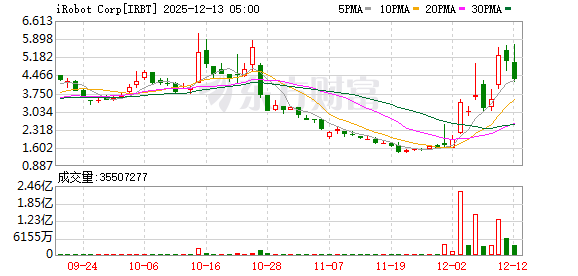
Core Viewpoint - iRobot has filed for bankruptcy protection and will become a wholly-owned subsidiary of a Chinese manufacturing company, following a series of financial struggles and a significant decline in market position [1][3][8]. Financial Performance - iRobot's third-quarter revenue for 2025 was only $146 million, a 24.6% decrease compared to the same period in 2024, with a net loss of $9.9 million, contrasting with a profit of $15.1 million in the previous year [5]. - The company owes over $350 million to its main creditor, Shenzhen-based Picea, while having only $24.8 million in cash and cash equivalents [4][6]. Market Position - iRobot's market share has plummeted from over 80% in the U.S. to 7.9% globally, with significant revenue declines in key regions: 43% in Europe, the Middle East, and Africa; 18% in the U.S.; and 6% in Japan [7][9]. - The company's stock price has drastically fallen from a peak of $197.4 in 2021 to around $4.3, leading to a market capitalization drop from over $6 billion to $140 million [7]. Competitive Landscape - iRobot faces intense competition from Chinese brands like Roborock and Ecovacs, which have adopted advanced technologies such as laser navigation, while iRobot has been slow to innovate [8][9]. - The introduction of a 46% tariff on home appliances imported from Vietnam by the U.S. government is expected to increase operational costs by approximately $23 million in 2025, further straining iRobot's financial situation [9]. Historical Context - Founded in 1990, iRobot was a pioneer in consumer robotics, launching the first Roomba vacuum in 2002. However, its performance deteriorated significantly in 2022, with a 24% revenue decline and a net loss of $286.3 million [6][8].


美国机器人巨头iRobot破产,被中国深圳公司100%控股拿下
Sou Hu Cai Jing· 2025-12-16 16:40
Group 1 - iRobot, known as the pioneer of robotic vacuum cleaners, has filed for Chapter 11 bankruptcy protection after 35 years of operation, marking the end of its independent era [2][3][4] - The control of iRobot will be transferred to its main supplier and creditor, Shenzhen PICEA Robotics Co., which will acquire 100% of the company's equity, while existing common stock will be rendered worthless [6][4] - iRobot's financial struggles stem from intense competition, rising costs, and a failed acquisition by Amazon, leading to a significant decline in its market position [7][9] Group 2 - In 2024, iRobot's total revenue is projected to be approximately $682 million, but profit margins have been under pressure due to competition from brands like Ecovacs, forcing price reductions and ongoing investments in technology upgrades [7][9] - The company has sold over 50 million units globally, with peak market shares of 42% in the U.S. and 65% in Japan, but its valuation has plummeted from $3.56 billion in 2021 to around $140 million currently [10][14] - iRobot's CEO stated that the bankruptcy filing is a crucial step for the company's long-term future, and operations, including employee salaries and supplier payments, will continue normally during the bankruptcy process [11][13] Group 3 - The bankruptcy restructuring reflects a significant shift in the global consumer robotics market, indicating a period of consolidation and the need for continuous adaptation to market changes and competitive pressures [14]
暴跌72%!扫地机器人鼻祖宣告破产,中资或接盘
Sou Hu Cai Jing· 2025-12-16 04:26
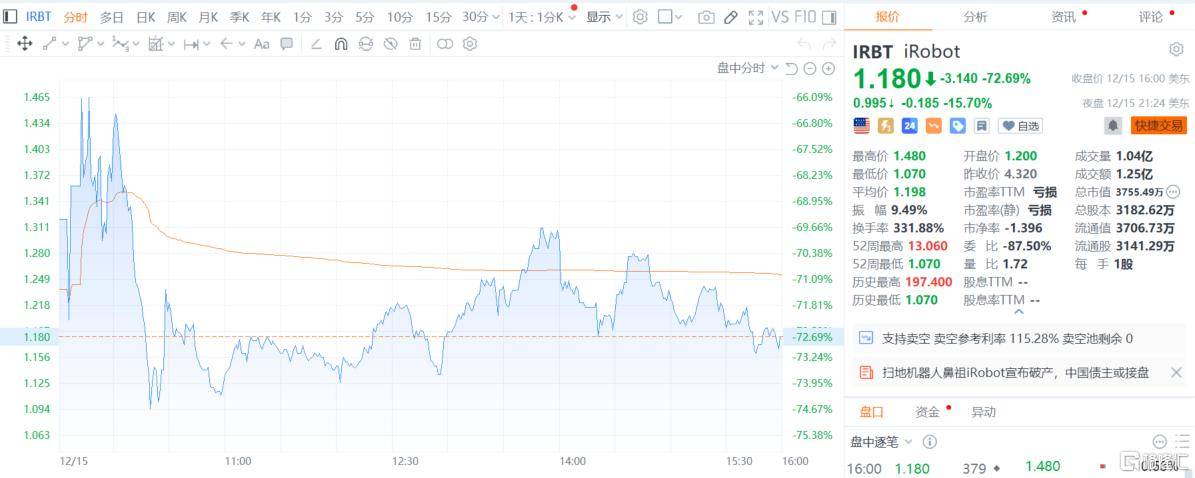
Core Viewpoint - iRobot, the pioneer of robotic vacuum cleaners, has filed for Chapter 11 bankruptcy protection, leading to a significant drop in its stock price and market value [1][10]. Group 1: Company Background and Performance - iRobot was founded in 1990 and went public in 2005, achieving a peak market share of over 80% and a market capitalization exceeding $40 billion [4]. - The company's financial performance has deteriorated in recent years, with a 24% year-over-year revenue decline in 2022 to $1.183 billion (approximately 8.118 billion RMB) and a net loss of $286 million [6]. - By 2024, revenue is projected to further decline to $682 million, with a net loss of $146 million [6]. Group 2: Market Challenges - iRobot faces intense competition from Chinese consumer robotics companies, contributing to its declining market position [5]. - Revenue from the EMEA region fell by 43% in 2022, while U.S. revenue decreased by 18% and Japanese revenue by 6% [6]. Group 3: Financial Crisis and Attempts at Recovery - iRobot's cash and equivalents dwindled to $24.8 million (approximately 175 million RMB) by September 27, 2024, against total liabilities of $508 million (approximately 3.58 billion RMB) [6]. - The company attempted to recover through a proposed acquisition by Amazon for approximately $1.7 billion, which ultimately fell through due to prolonged antitrust reviews and deteriorating performance [7]. - Despite a $200 million investment from Carlyle Group in 2023, iRobot could not reverse its downward trend [8]. Group 4: Bankruptcy Filing and Restructuring - iRobot officially filed for Chapter 11 bankruptcy on December 14, 2023, and plans to complete the process by February 2026 [10]. - The company has reached a restructuring support agreement with its creditors, which includes transferring 100% ownership to Shenzhen PICEA Robotics Co., Ltd. after court approval [11]. - This restructuring is expected to significantly improve iRobot's balance sheet and allow it to maintain normal operations while preserving its global business presence [12].
美股异动丨申请破产!美国消费机器人巨头iRobot盘前暴跌超80%
Ge Long Hui A P P· 2025-12-15 09:20
Core Viewpoint - iRobot, once a pioneer in the robotic vacuum industry, has filed for bankruptcy protection and is set to be acquired by its main manufacturer, Picea Robotics, based in Shenzhen, China, following a significant drop in stock value of over 80% to $0.82 [1] Financial Performance - iRobot reported a net loss of $286.3 million in 2022, marking a shift from profitability to loss [1] - The company projected revenues of approximately $682 million for 2024, but profits are under pressure from competition, particularly from Chinese rivals like Ecovacs [1] Market Position and Competition - Despite maintaining a leading position in core markets such as the United States and Japan, iRobot faces intense price competition that has forced it to lower prices and increase investment in technology upgrades, thereby eroding profit margins [1] - The introduction of new tariffs in the U.S. has significantly impacted the company's operations, with products manufactured in Vietnam facing import tariffs as high as 46% [1] Cost Implications - The new tariffs are expected to increase the company's costs by approximately $23 million this year, adding uncertainty to its business planning [1]

扫地机器人鼻祖iRobot要破产了,欠中国代工厂超25亿元,曾占据80%美国市场
Mei Ri Jing Ji Xin Wen· 2025-12-15 07:21
Core Viewpoint - iRobot has filed for Chapter 11 bankruptcy protection, aiming for a restructuring process to optimize its financial situation and maintain operations while transitioning to private ownership under Shenzhen PICEA Robotics Co., Ltd. [1][2] Group 1: Bankruptcy Filing and Restructuring - iRobot submitted a Chapter 11 bankruptcy protection application on December 14, 2023, to restructure its debts and operations [1] - The restructuring plan includes a support agreement with Picea, which will acquire 100% of iRobot's equity, significantly improving its balance sheet [1][2] - iRobot's CEO stated that the transaction will enhance financial stability and ensure business continuity for consumers and partners [1] Group 2: Financial Challenges - iRobot is facing severe liquidity issues, with total debts exceeding $350 million (approximately 2.5 billion RMB) against cash reserves of only $24.8 million [5][6] - The company reported a revenue decline of 24.6% year-over-year in Q3 2024, with a loss of $9.9 million compared to a profit of $15.1 million in the same period the previous year [6] - iRobot's 2022 revenue fell by 24% to $1.1834 billion (approximately 8.118 billion RMB), with a net loss of $286.3 million [8] Group 3: Market Position and Competition - iRobot's market share has plummeted from over 80% to 7.9% globally, facing intense competition from Chinese brands like Ecovacs and Roborock [8] - The company has struggled to keep pace with industry advancements, particularly during the pandemic, leading to a significant decline in its competitive position [8] Group 4: Ownership and Future Prospects - Following court approval, iRobot will become a privately held company under Picea, with existing shareholders likely to lose their investments entirely [2] - iRobot's previous acquisition attempts by Amazon, valued at approximately $1.7 billion and later $1.4 billion, were thwarted by regulatory challenges [9][10]
扫地机器人鼻祖iRobot要破产了!欠中国代工厂超25亿元 一度占据80%美国市场
Mei Ri Jing Ji Xin Wen· 2025-12-15 06:52
Core Viewpoint - iRobot has filed for Chapter 11 bankruptcy protection, aiming for a restructuring process to optimize its financial situation and maintain operations while transitioning ownership to Shenzhen PICEA Robotics and Santrum Hong Kong [2][3]. Group 1: Bankruptcy Filing and Restructuring - iRobot submitted a Chapter 11 bankruptcy protection application on December 14, 2023, with an expected completion date by February 2026 [2]. - The Chapter 11 process is designed for companies facing financial difficulties but still possessing operational value, allowing them a chance for restructuring rather than immediate liquidation [2]. - iRobot has reached a restructuring support agreement with its major creditor, Shenzhen PICEA Robotics, which will acquire 100% of iRobot's equity [2]. Group 2: Financial Situation - iRobot is facing severe liquidity issues, with a total debt of over $350 million owed to Picea, including $162 million in manufacturing costs, of which $90.9 million is overdue [5][7]. - The company's cash and cash equivalents stand at only $24.8 million, highlighting the critical nature of its financial situation [5]. - In Q3 2024, iRobot reported revenues of $146 million, a 24.6% decline year-over-year, and a net loss of $9.9 million, contrasting with a profit of $15.1 million in the same period the previous year [7]. Group 3: Market Position and Competition - iRobot's revenue in 2022 fell by 24% to $1.1834 billion, with a net loss of $286.3 million, marking a significant downturn from previous years [11]. - The company has seen its market share in the global vacuum robot market drop from over 80% to 7.9% due to increased competition from Chinese brands like Ecovacs and Roborock [11]. - iRobot's struggles are attributed to its inability to keep pace with rapid industry developments, particularly during the pandemic, leading to a disconnect with market trends [11].