湘菜

Search documents
湘菜发展报告2025:千亿规模的湘菜,高性价比、土菜、市井菜持续出圈
3 6 Ke· 2025-12-30 03:25
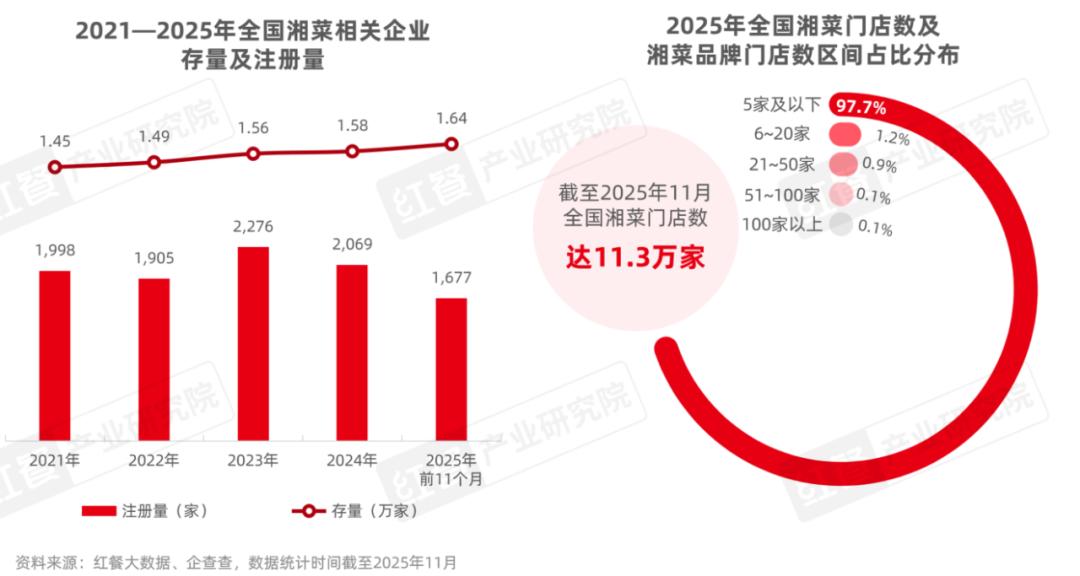
Core Insights - The report indicates that the market attention on Hunan cuisine (Xiang cuisine) remains high, with discussions and reading volumes on social media platforms like Douyin and Xiaohongshu reaching billions. The market size for Hunan cuisine is expected to exceed 110 billion yuan by 2025 [1][2]. Group 1: Market Overview - As of November 2025, the number of Hunan cuisine-related enterprises has reached 16,400, with 1,677 new registrations in the first 11 months of 2025 [1]. - The total number of Hunan cuisine restaurants in China has reached 113,000, with a significant majority (97.7%) being small-scale or regional brands, indicating a large potential for brand and scale development [2]. Group 2: Store Distribution and Brand Development - The distribution of Hunan cuisine restaurants across different city tiers has stabilized, with over 20% of restaurants located in third and fourth-tier cities. The central regions of China (Hunan, South China, and East China) remain the most concentrated areas for these restaurants [4][6]. - Brands like Lanxiangzi, Dabanxiansheng, and others are leading the market, with Lanxiangzi having over 420 locations, while several other brands have more than 150 locations, indicating a healthy competitive landscape [6]. Group 3: Consumer Trends and Brand Strategies - Consumer spending on dining has become more cautious, with a significant portion of consumers expecting to reduce or maintain their spending in 2025. This has led to a rise in demand for cost-effective dining options [12]. - Brands are increasingly focusing on operational quality and organizational capabilities rather than just expanding the number of stores. For instance, Lanxiangzi has shifted its strategy to prioritize operational efficiency and product quality [7][14]. Group 4: Emerging Consumption Experiences - There is a rising demand for immersive and differentiated dining experiences, leading to the popularity of niche segments like mountain wild cuisine and local home-style dishes. These segments cater to younger consumers seeking unique dining experiences [16][19]. - The market for local home-style restaurants has seen a resurgence, driven by a strong customer base and positive word-of-mouth, indicating a shift towards more familiar and comforting dining options [17]. Group 5: Brand Building and Social Responsibility - Hunan cuisine brands are enhancing their brand power through unique marketing strategies, such as creating annual events to connect with consumers. Lanxiangzi has successfully established events like "Rice Festival" to strengthen consumer relationships [24]. - The importance of ESG (Environmental, Social, Governance) principles is growing in the restaurant industry, with brands like Lanxiangzi actively engaging in social responsibility initiatives, including educational projects and community support [28]. Group 6: Industry Chain Development - The Hunan cuisine industry chain is developing collaboratively across key areas such as ingredient supply, seasoning development, and logistics. The reduction in agricultural product loss and improvements in cold chain logistics are providing a solid foundation for restaurant expansion and product innovation [30]. Conclusion - The Hunan cuisine sector shows promising growth potential, with a focus on health-conscious dining trends and the differentiation of regional flavors becoming key strategies for long-term brand success. The internationalization of Hunan cuisine is also expected to progress systematically as the industry matures [33].

涪陵榨菜:榨菜销量下滑丨消费参考
2 1 Shi Ji Jing Ji Bao Dao· 2025-09-04 23:41
Group 1 - The core viewpoint is that Fuling Zhacai is reassessing its key pickled vegetable business due to changing market dynamics and consumer preferences [1][4] - In the first half of 2025, Fuling Zhacai reported a revenue increase of 0.5% year-on-year to 1.31 billion yuan, while net profit attributable to shareholders decreased by 1.7% to 440 million yuan [1] - Revenue from the pickled vegetable category was 1.12 billion yuan, with a year-on-year growth of 0.5%, while sales volume declined by 1.2% [1] Group 2 - The company is facing challenges in sales channels as consumer preferences shift towards alternative products, and urban population trends are affecting its market coverage [3] - Fuling Zhacai is implementing a strategy to expand product categories and market reach, focusing on new product development and channel expansion [3] - The company is adjusting its production plans by reducing conventional pickled vegetable production lines and increasing the production of multi-specification products and sauces [3] Group 3 - The stock price of Fuling Zhacai was reported at 13.24 yuan per share, with a slight increase of 0.76% [5] - The consumer index for the sector showed a decline, with the consumption index dropping by 2.21% [6]

2025年中国湘菜行业分类、经济环境及产量情况分析
Sou Hu Cai Jing· 2025-04-23 08:34
Core Insights - The article discusses the development and characteristics of Hunan cuisine, also known as Xiang cuisine, which is one of the eight major Chinese culinary traditions, emphasizing its historical roots and unique flavor profile [2][8]. Industry Overview - Hunan cuisine has a long history dating back to the Han Dynasty, characterized by its emphasis on the combination of ingredients and strong spicy flavors [2]. - The cuisine is known for its diverse ingredients and cooking methods, including stir-frying, steaming, and braising, contributing to its rich cultural heritage [8]. Market Dynamics - With the improvement of economic conditions and living standards, consumers are increasingly demanding higher quality and service in dining experiences, seeking not only delicious food but also cultural exploration and enjoyment [4]. - In 2023, the per capita disposable income and consumption expenditure of residents in China were 39,218 yuan and 26,796 yuan, respectively, indicating a growing market for dining experiences [4]. Industry Structure - The Hunan cuisine industry chain consists of three main segments: upstream (raw material production), midstream (restaurant enterprises), and downstream (brand channels and consumers) [6]. - The upstream segment provides essential ingredients such as grains, vegetables, meats, oils, and seasonings necessary for cooking Hunan dishes [6]. Production and Supply - Hunan cuisine is noted for its meticulous preparation and wide variety of ingredients, with a focus on strong flavors and affordability [8]. - In 2022, China's meat and vegetable production reached 93.28 million tons and 799.97 million tons, respectively, both showing an increase from the previous year [8]. Future Outlook - The report from Huajing Industry Research Institute aims to provide insights into the development trends and investment strategies for the Hunan cuisine industry from 2024 to 2030, based on extensive research and analysis [10]. - The report will cover market size predictions, competitive landscape, and key enterprises within the industry [10].