
量子

Search documents
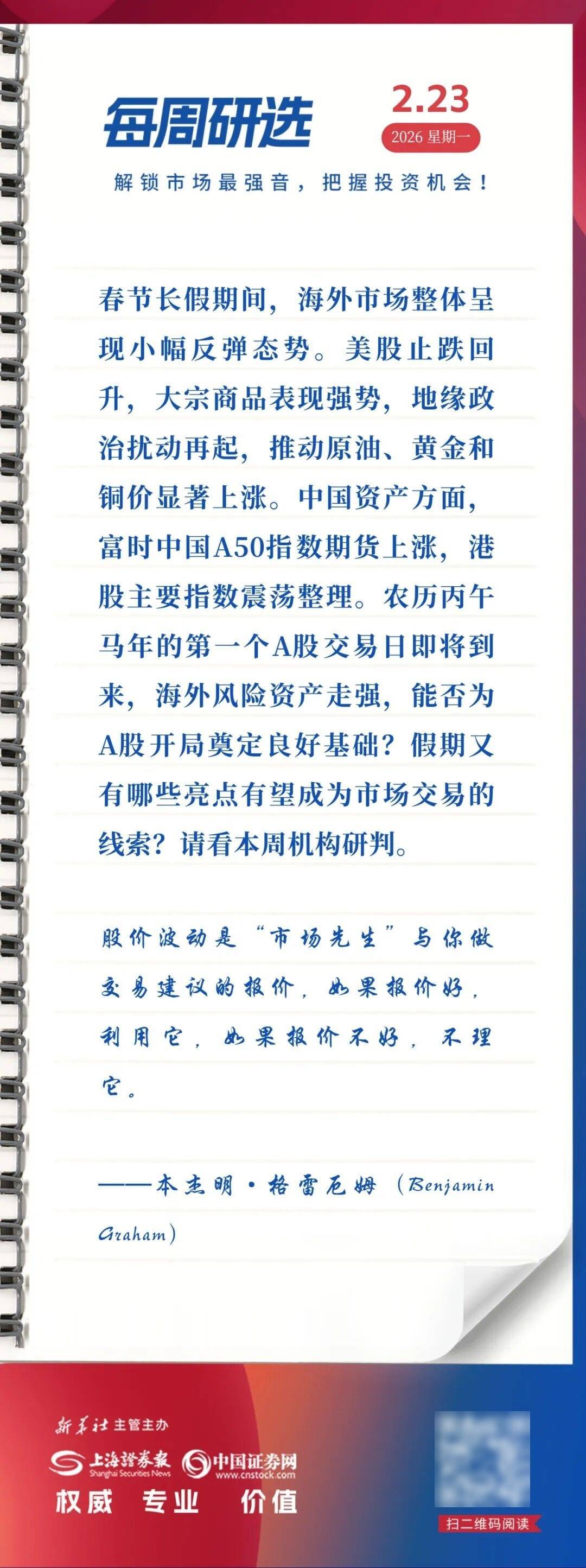
马年A股如何开局? | 每周研选
Sou Hu Cai Jing· 2026-02-23 16:46
Core Viewpoint - The overseas markets showed a slight rebound during the Spring Festival holiday, with U.S. stocks recovering and commodities performing strongly, driven by geopolitical disturbances that significantly increased the prices of oil, gold, and copper. The performance of Chinese assets, particularly the FTSE China A50 index futures, also indicated a positive trend, suggesting a potentially favorable start for the A-share market in the Year of the Horse [2][4]. Group 1: Market Performance and Trends - The overseas non-U.S. assets maintained a strong performance during the holiday, indicating a high risk appetite among overseas investors, which is expected to benefit the A-share market post-holiday [5]. - The inflow of funds into the market remains unchanged, with a notable decrease in household deposits and an increase in non-bank financial institution deposits, suggesting a shift towards equity markets [6]. - Historical data shows that the A-share market typically performs well in the 20 trading days following the Spring Festival, with a 75% probability of the CSI All A Index rising during this period [9]. Group 2: Sector Focus and Investment Opportunities - The focus for investment should be on sectors benefiting from AI and resource commodities, with a particular emphasis on the robotics and AI technology applications showcased during the Spring Festival [13][14]. - The traditional sectors such as real estate and liquor are expected to see a recovery as their valuations are at historical lows, supported by improving fundamentals and policy catalysts [11]. - The "反内卷" (anti-involution) policy is anticipated to enhance the supply dynamics of resource commodities, making them attractive for investment [11]. Group 3: Strategic Recommendations - Investors are advised to focus on the technology sector, particularly in robotics and AI applications, as well as cyclical sectors like chemicals, construction materials, and machinery, which are expected to benefit from rising prices and improved demand [15]. - The market is entering a configuration phase where "technology + cyclical" remains the main theme, with technology sectors likely to respond first to market catalysts [15].

未知机构:跟各位领导汇报下观点对比下几个主题最近问的领导多1-20260211
未知机构· 2026-02-11 01:45
Summary of Conference Call Notes Industry Overview - **Aerospace and Space Industry**: Identified as the strongest theme for the year, with expectations for significant developments in Q2. Key events anticipated in March-April, including successful recoveries and the launch of leading rockets in June, such as SpaceX's IPO, which is expected to heighten market sentiment [1][1]. - **Quantum Computing**: Positioned as a phase for strategic investment, with several upcoming events that could act as medium-term catalysts. Key drivers include major conferences and advancements in autonomous driving applications. The most significant catalysts are expected to be the financial reports of leading companies and local government tenders for computing [1][1]. - **Nuclear Fusion**: Focus on upcoming bids in Jiangxi and Chengdu post-holiday, along with the unveiling of CFEDR. Recommendations are made for platform-type enterprises, with a specific mention of Yongding Co., which is expected to enter a superconducting production phase starting Q1, alongside recent price increases in optical fibers [2]. Key Points and Arguments - **Aerospace and Space Industry**: - Q2 is projected to be the peak period for this sector, with critical events expected in March-April [1]. - The launch of SpaceX's IPO in June is anticipated to create a high point in market sentiment [1]. - Recent research on Hangsheng Satellite indicates strong quality, and continued attention is advised for Cloud Horse [1]. - **Quantum Computing**: - The sector is experiencing significant marginal changes, particularly with He Xin Instruments expected to make notable advancements soon [1]. - Long-term investment in leading companies like Guo Dun is recommended, with Q1 financial reports serving as a market indicator [1]. - **Nuclear Fusion**: - The focus on platform-type enterprises is emphasized, with Yongding Co. highlighted for its expected growth in superconducting production [2]. - The recent increase in optical fiber prices is noted as a positive development for platform-type companies [2]. Additional Important Insights - The mention of "three swordsmen" refers to key players in the aerospace sector, suggesting that recent pullbacks in their stock prices present buying opportunities [1]. - The emphasis on local government tenders in the quantum computing sector indicates a potential for increased public sector investment, which could drive growth [1].
积极布局未来产业,各地有何通关“密码”?
Yang Shi Xin Wen· 2026-02-06 05:58
Group 1 - The concept of "future industries" has gained significant attention in 2026, with a focus on development and strategic planning at various governmental levels [1][3] - Future industries are defined as emerging sectors driven by cutting-edge technologies, currently in the early stages of development, characterized by strategic significance and potential for disruption [2][3] - The "14th Five-Year Plan" emphasizes the importance of forward-looking layouts for future industries, aiming to explore diverse technological routes and typical application scenarios [2][3] Group 2 - China's future industry development is transitioning from technology catch-up to proactive layout, with a mix of leading, parallel, and following positions across different sectors [4][5] - Key regions like Beijing, Guangdong, and Jiangsu are making strides in future industries, with specific focuses on quantum technology, biomanufacturing, and 6G communications [12][14] - Shanghai and Anhui are highlighted as leaders in future industry development, with Shanghai leveraging its comprehensive advantages and Anhui focusing on quantum technology and fusion energy [5][8] Group 3 - Shanghai's strategic initiatives include a dynamic cultivation system for future industries, supported by a fund of approximately 15 billion yuan, aimed at reducing costs and accelerating product commercialization [7][10] - Anhui has established a robust ecosystem for quantum technology and fusion energy, with a significant concentration of enterprises and research institutions [9][11] - The development of future industries is not limited to coastal regions, as demonstrated by Anhui's success in quantum technology and its plans for commercializing fusion energy [8][10] Group 4 - Local governments are encouraged to create open and inclusive innovation ecosystems to support the growth of future industries, emphasizing the importance of regional characteristics and market orientation [17][18] - The national government is implementing major strategic projects and increasing investment in future industries to foster a competitive environment across regions [15][16] - Future industries are expected to thrive through proactive planning, localized development strategies, and supportive policy measures [18]
万类霜天竞自由——兴银基金2026年度权益投资策略展望
Sou Hu Cai Jing· 2026-01-15 02:53
Group 1: Macro Trends and Investment Focus - The investment team at Xingyin Fund emphasizes deep research and value discovery amidst market uncertainties, focusing on macro trends and core industries such as new energy, technology, consumption, and pharmaceuticals for 2026 [1] - The AI sector remains a key growth engine globally, driven by significant capital expenditure from overseas giants, with a focus on the application side's revenue generation to create a closed loop [3][9] - The cyclical recovery strategy combines anti-involution and capacity cycles, prioritizing sectors with natural upward trends even without specific policies [3] Group 2: Consumption and Pharmaceuticals - The central economic work conference highlights expanding domestic demand as a primary task, indicating a need for a higher-level perspective on consumption in 2026 [4] - The consumption sector has faced downward pressure but is at a reasonable valuation after years of decline, with potential for a Davis double-click if upward momentum is found [4][5] - The consumption sector is categorized into traditional, new, and overseas consumption, with traditional consumption recovery linked to supply-side changes and new consumption benefiting from evolving consumer habits [5][6] Group 3: Technology Sector Insights - The technology sector is expected to thrive in 2026, with AI leading the charge, although the overall market valuations have risen significantly, indicating potential volatility [9][10] - Capital expenditure in AI is projected to increase, with a focus on the application of AI technologies and the performance of related companies [10] - Key areas of interest include consumer electronics, AI application software, chip equipment, nuclear power, aerospace, quantum technology, and innovative medical technologies [10] Group 4: Capital Market Outlook - The capital market is anticipated to play a crucial role in China's economic development over the next five years, driven by increased competition among major economies and a shift towards financial assets [12] - The transition from real estate to stock and fund-based wealth generation is expected to enhance consumer willingness and capacity [12] - The capital market may mitigate external risks through deeper openness and allow overseas capital to benefit from China's manufacturing strength [12]

后年建成全智能工厂
Xin Lang Cai Jing· 2026-01-13 07:26
Core Insights - The Shanghai Municipal Government has released the "Three-Year Action Plan to Support the Transformation and Upgrading of Advanced Manufacturing (2026-2028)", aiming to build a modern industrial system centered on advanced manufacturing [1] - The plan targets the addition of 100 manufacturing enterprises with an annual output value exceeding 1 billion yuan by 2028, bringing the total to over 600 [1] - The initiative aims to drive the addition of 500 industrial enterprises above designated size in the supply chain and significantly increase the proportion of R&D expenses in revenue for manufacturing enterprises [1] Group 1: Structural Upgrading - The plan emphasizes a multi-dimensional industrial upgrade matrix, accelerating iterations in traditional advantageous industries [1] - Specific strategies include petrochemical companies shifting towards new functional materials, steel companies enhancing specialty steel production, and light industry companies creating trendy domestic products [1] - Leading industries will focus on breakthroughs in the integrated circuit industry chain, biomedicine innovation, and intelligent computing chip development, fostering international leading enterprises [1] Group 2: Emerging Industries - The plan promotes simultaneous development of key and emerging industries, including the growth of six major sectors such as next-generation electronic information and smart connected new energy vehicles [1] - New fields like low-altitude economy and commercial aerospace will be explored, with a focus on scaling products like eVTOL and humanoid robots [1] Group 3: Innovation and Incentives - The plan introduces significant incentive policies for core technology breakthroughs, focusing on frontier technologies such as laser manufacturing and quantum technology [2] - Key links in the industrial chain, including integrated circuits and large aircraft, will be prioritized for technological advancements [2] Group 4: Digital and Green Transformation - The "Action for Upgrading Capability and Quality" outlines a transformation path, implementing "AI + Manufacturing" initiatives for digital transformation [2] - By 2027, large enterprises are expected to achieve full coverage of digital applications, with the goal of establishing fully intelligent factories by 2028, achieving a robot density of 600 units per 10,000 people [2] - In terms of green transformation, the plan aims to add over 100 national-level green factories [2]
港股掀起18C章递表热潮
Zheng Quan Shi Bao Wang· 2025-12-18 23:16
Core Viewpoint - The introduction of the 18C chapter listing mechanism has led to a surge in IPO applications on the Hong Kong Stock Exchange, indicating a shift in the market dynamics towards new economy sectors [1] Group 1: IPO Activity - In 2025, only three companies, including Yujian, successfully listed on the Hong Kong stock market using the 18C chapter, while since 2025, four companies, including Wen Yuan Zhi Xing, have successfully listed under this rule [1] - The number of companies aiming for IPOs through the 18C chapter has reached 20, creating a "submission frenzy" [1] Group 2: Market Structure Changes - The 18C, 8A, and 18A chapters are beginning to outline a new economic sector within the Hong Kong stock market [1] - Currently, the market capitalization of companies listed under the 18C chapter is very low compared to the overall Hong Kong stock market [1] - If the secondary market can provide sustained liquidity and refinancing capabilities, it is expected to attract more "hardcore" assets such as semiconductors, quantum technology, and commercial aerospace to choose Hong Kong as their primary listing location, potentially altering the traditional market structure dominated by finance, real estate, and consumer sectors [1]
广电计量:与长沙三大研究院战略合作 布局商业航天、量子及半导体赛道
Zheng Quan Shi Bao Wang· 2025-11-28 05:57
Core Viewpoint - The company, Guangdian Measurement, has announced strategic cooperation agreements with multiple research institutions to enhance its capabilities in navigation, quantum measurement, and semiconductor technology [1] Group 1: Strategic Collaborations - The company has signed a strategic cooperation agreement with Changsha Beidou Research Institute to establish a joint laboratory and work on research projects, focusing on the development of testing and evaluation technologies for Beidou navigation products [1] - In collaboration with Changsha Quantum Research Institute, the company aims to address critical technology challenges by co-establishing a "Quantum Measurement and Measurement Joint Laboratory" [1] - The partnership with Hunan University Changsha Semiconductor Technology and Application Innovation Research Institute will lead to the creation of a "Power Semiconductor and Integrated Circuit R&D Center" [1]

上海促G60科创走廊迈向世界级,请看《浪尖周报》第50期
Xin Lang Cai Jing· 2025-11-23 11:42
Core Insights - The "Wave Plan" launched by the Zhituo Finance's think tank, Pengpai Research Institute, aims to promote industrial collaboration and technological innovation in the Yangtze River Delta region [1] Industry Highlights - Shanghai is focusing on the G60 Science and Technology Innovation Corridor, targeting two major industries to achieve world-class status [1] - Nanjing is accelerating the establishment of more "Hema Village" direct supply bases [1] - Hangzhou is striving to develop the "China Vision Valley" into a trillion-yuan visual intelligence cluster [1] - Hefei has a significant presence in quantum enterprises, accounting for one-third of the national total [1] - Suzhou is deepening cooperation with Singapore to build a 600 billion yuan industrial cluster [1] - Ningbo's Cixi home appliance industry is rapidly transitioning to smart manufacturing, aiming to cultivate export brands [1] - Wuxi has seen a concentration of innovative pharmaceutical companies receiving approvals, with new Class I and Class III drugs being launched [1] - Nantong is collaborating with provincial coastal groups to establish a marine industry characteristic park [1] - Changzhou's Kangyuan Group is setting up a biopharmaceutical innovation base in Xitai Lake [1]
中信建投:风险偏好再度回升 建议投资者积极关注这四条线索
智通财经网· 2025-10-30 23:48
Core Viewpoint - The overall macroeconomic environment, liquidity conditions, and market risk appetite are expected to improve, with a focus on growth sectors following the completion of Q3 earnings reports and the anticipated U.S.-China negotiations in early November [1][3]. Macroeconomic Overview - Economic recovery is showing signs of divergence, with Q4 incremental policies likely to be weak. Q3 GDP growth has slowed, continuing a downward trend. The manufacturing PMI remains in contraction, while the non-manufacturing PMI shows overall deceleration. Structural pressures persist during the recovery phase [2]. - PPI has rebounded significantly year-on-year, indicating a stabilization trend, but weak demand continues to drag on CPI and PPI forecasts, making it unlikely for PPI to turn positive this year. M2 growth has reached a new high for the year, reflecting slight activation of funding vitality, although retail sales growth continues to decline [2]. Policy Insights - The "anti-involution" trend is showing signs of cooling, with the Fourth Plenary Session setting the tone for the 14th Five-Year Plan, although market reactions have been muted. There is potential for unexpected policy developments in the future [2]. - The central bank's supportive stance is evident through measures such as the resumption of 14-day reverse repos and MLF operations, leading to an overall improvement in liquidity conditions [2]. Investment Strategy - With the macro environment improving, the market is expected to focus on growth sectors. Key investment themes include: 1. Sectors with strong Q3 performance and continued growth potential, particularly in technology (storage, domestic computing power, consumer electronics, overseas AI applications), innovative pharmaceuticals, and renewable energy [3]. 2. Cyclical sectors benefiting from anti-involution policies, with improved industrial profits in steel, chemicals, and new energy [3]. 3. If market risk appetite increases significantly, attention should be given to solid-state batteries, robotics, and AI applications [3]. 4. Long-term focus on emerging sectors highlighted in the 14th Five-Year Plan, including artificial intelligence, aerospace development, semiconductor self-sufficiency, and quantum economy [3]. Sector Recommendations - Continued recommendations for growth sectors include: - Technology: Positive trends in domestic and overseas computing power, with multiple sub-sectors exceeding performance expectations [3]. - Consumer: Innovative pharmaceuticals and CXO sectors expected to show upward trends in Q3 reports [3]. - High-end manufacturing: Wind power and energy storage maintaining high demand, with potential turning points in battery and photovoltaic sectors [3]. - Cyclical: Steel and chemical sectors expected to see gradual profit improvements, with a focus on copper and aluminum benefiting from U.S. Federal Reserve rate cuts [3].

越英贸易技术合作座谈会在伦敦举办
Shang Wu Bu Wang Zhan· 2025-06-13 01:32
Group 1 - The UK-Vietnam Free Trade Agreement (UKVFTA) has led to significant growth in bilateral trade between Vietnam and the UK, with expectations for further enhancement due to the UK's accession to the Comprehensive and Progressive Agreement for Trans-Pacific Partnership (CPTPP) [1][2] - In 2024, bilateral trade is projected to reach a historical high of over $8.4 billion, representing an 18% year-on-year increase, positioning the UK as Vietnam's third-largest trading partner in Europe [2] - Vietnam is recognized as a rapidly growing market with over 100 million people, while the UK is a high-income consumer market, creating substantial export and investment opportunities for businesses in both countries [2] Group 2 - Vietnam's technology sector is expected to generate approximately $158 billion in revenue in 2024, accounting for 15% of its GDP, with domestic R&D spending at 0.5% of GDP [2] - The Global Innovation Index 2024 ranks Vietnam 44th among 133 economies, highlighting its robust educational and research infrastructure, including around 250 universities and 400 research institutions [2] - The UK is currently the 15th largest investor in Vietnam, with investments totaling $4.46 billion across 147 countries [2]