零售商

Search documents
美媒纳闷:特朗普都要暴跳如雷了,中国得到消息后,反而无比淡定接待德国总理
Sou Hu Cai Jing· 2026-02-22 04:19
Core Viewpoint - The U.S. Supreme Court ruled that the large-scale global tariffs imposed by the Trump administration under the International Emergency Economic Powers Act lacked clear legal authorization, marking a significant setback for Trump's trade policies [2]. Group 1: Legal and Economic Implications - The Supreme Court's ruling could lead to the potential refund of over $175 billion in tariffs collected since 2025, which exceeds the total fiscal spending of the U.S. Departments of Transportation and Justice for 2025 [2]. - Trump's immediate response included a new executive order imposing a temporary 10% tariff on imports from all countries, which he later increased to 15%, although this measure is limited to 150 days without Congressional approval [3][4]. - The ruling has prompted a wave of lawsuits from hundreds of U.S. companies, including major retailers, seeking refunds for the tariffs deemed illegal [4]. Group 2: Market Reactions - Following the Supreme Court's decision, U.S. stock markets reacted positively, with the S&P 500 and Nasdaq indices rising approximately 0.7% and 0.9%, respectively, as investors anticipated reduced tariff uncertainties and lower corporate cost pressures [4]. - The potential refund of tariffs could improve the financial situation of U.S. importers, enhancing their purchasing capacity for Chinese goods, which may indirectly benefit Chinese exporters [7]. Group 3: International Trade Dynamics - Germany has re-emerged as the largest trading partner of China, with a trade volume of €251.8 billion in 2025, reflecting a significant shift in trade dynamics as China's reliance on U.S. trade has decreased [6]. - The ongoing tariffs under the 301 and 232 clauses remain in effect, targeting approximately $360 billion worth of Chinese goods, indicating that the trade conflict is far from resolved [6][7]. - German Chancellor Merz's visit to China with a large business delegation signifies Germany's intent to maintain balanced cooperation with China, contrasting with the U.S. approach [5][6]. Group 4: Political and Diplomatic Reactions - The Supreme Court's ruling has been framed as a victory for American consumers, highlighting the political divide over the impact of tariffs on the economy [9]. - In contrast to the U.S. response, China's approach has been calm and methodical, focusing on deepening economic cooperation with Germany and other nations, reflecting a strategic adjustment in its trade structure [9].

关税战打不败中国,美前财长顾问发文:我刚从中国回来,美国没赢
Sou Hu Cai Jing· 2026-02-13 12:01
Core Viewpoint - The article highlights that the U.S. tariff strategy against China has not yielded the intended results, with the burden of tariffs primarily falling on American consumers and businesses rather than on Chinese exporters [3][5][27]. Group 1: Impact of Tariffs - The report from the New York Federal Reserve and the Congressional Budget Office indicates that 90% of the tariff costs are borne by U.S. consumers and businesses, while foreign exporters only bear less than 5% [3][30]. - In 2025, the average American household spent an additional $1,000 due to tariffs, contributing to a significant financial burden [5]. - Despite the tariffs, U.S.-China trade remained resilient, with the total trade volume reaching 4.01 trillion yuan in 2025, accounting for 8.8% of China's total foreign trade [7][8]. Group 2: China's Trade Resilience - China's foreign trade reached a record high of 45.47 trillion yuan in 2025, with a year-on-year growth of 3.8%, driven by high-tech product exports which increased by 13.2% [12][15]. - The export of electric vehicles from China saw significant growth, with pure electric vehicle exports rising by 66.7% and plug-in hybrid vehicle exports increasing by 226.5% in 2025 [14]. - China's diversified trade partnerships, including a significant increase in trade with ASEAN and countries involved in the Belt and Road Initiative, have mitigated the impact of U.S. tariffs [15][17]. Group 3: U.S. Domestic Challenges - The article emphasizes that the U.S. faces more pressing internal issues, such as outdated infrastructure and supply chain disruptions, which are more challenging to resolve than external trade conflicts [19][21]. - The slow progress of infrastructure projects in the U.S. has been highlighted, with many initiatives facing funding and approval delays [19][21]. - The instability of U.S. trade policies, including frequent changes in tariff regulations, complicates long-term business planning for American companies [23][25]. Group 4: Recommendations for U.S. Policy - The article suggests that the U.S. should focus on improving its domestic conditions, such as infrastructure and supply chain stability, rather than relying on tariffs as a solution [25][27]. - It advocates for a strategic approach to industrial policy, prioritizing key sectors for development similar to China's model, rather than resorting to trade protectionism [25][27].
美银预警:若美联储下周鸽派降息,“圣诞老人行情”恐要告吹!
Jin Shi Shu Ju· 2025-12-05 12:44
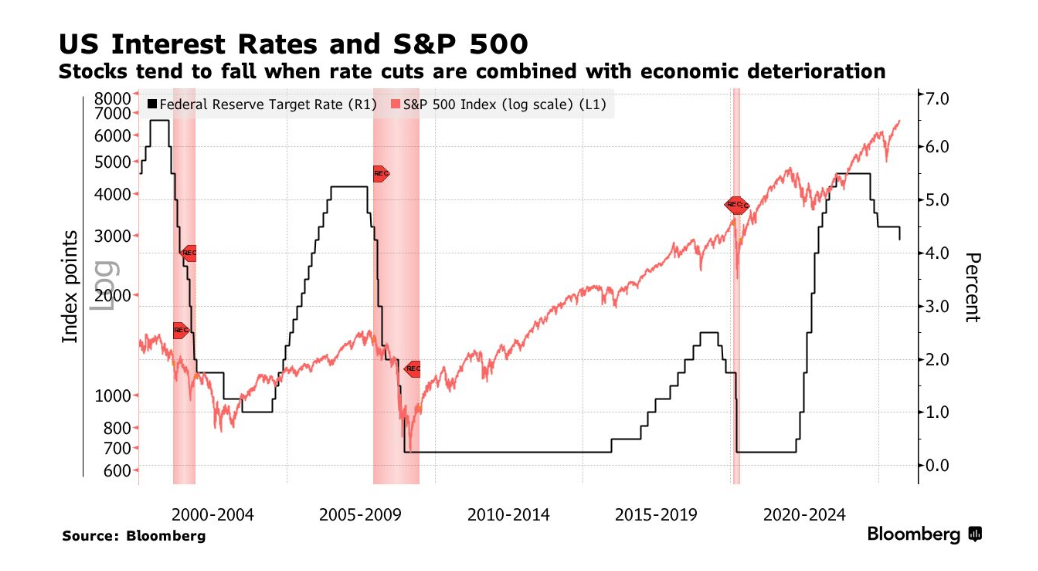
Group 1 - The core viewpoint is that if the Federal Reserve adopts a cautious economic outlook in the upcoming meeting, it could threaten the year-end stock market rally [1] - The S&P 500 index is nearing historical highs, with investors optimistic about a scenario of Fed rate cuts, declining inflation, and resilient economic growth [1] - Michael Hartnett from Bank of America warns that a dovish signal from the Fed could challenge this optimism, suggesting a potential economic slowdown beyond expectations [1] Group 2 - The stock market tends to decline when rate cuts are accompanied by a deteriorating economic outlook [2] - Investor bets on further Fed rate cuts to support a weak labor market have led to a rise in the stock market, with a 90% probability of a 25 basis point cut in the December 10 meeting [3] - The S&P 500 index is currently only about 0.5% away from its October peak, and seasonal trends typically favor a year-end rally [3] Group 3 - The potential for government intervention to curb high inflation and prevent unemployment from rising to 5% is noted, with recommendations to invest in "cheaply valued" mid-cap stocks by 2026 [3] - Sectors linked to the economic cycle, such as homebuilders, retailers, REITs, and transportation stocks, are expected to achieve the best relative gains [3] - Bank of America strategists reaffirm their preference for international equities in 2025, noting that the S&P 500's 17% annual increase lags behind the 27% gain of the MSCI All-Country World ex-US index [3]
美银:美联储鸽派降息或危及股市涨势
Sou Hu Cai Jing· 2025-12-05 11:50
Group 1 - The core viewpoint is that the year-end stock market rally is at risk due to the Federal Reserve's cautious outlook on the economy [1] - The S&P 500 index is nearing historical highs, with investors optimistic about a scenario where the Fed lowers interest rates while inflation continues to decline and economic growth remains resilient [1] - Strategist Michael Hartnett warns that a dovish signal from the Fed in the upcoming meeting could challenge this optimism, as it may indicate a more significant economic slowdown than expected [1] Group 2 - The market is currently pricing in a 90% probability of a 25 basis point rate cut at the December 10 meeting, up from 60% a month ago, with expectations of three rate cuts before September 2026 fully priced in [1] - The S&P 500 index is only about 0.5% away from its October peak, and seasonal trends typically favor year-end rallies, but two risk events are looming: delayed key employment and inflation reports due to government shutdown [1] - Hartnett and his team suggest that the U.S. government may intervene to curb high inflation and prevent unemployment from rising to 5%, recommending investors consider "cheaply valued" mid-cap stocks for 2026 [2]

Target cuts 1,800 corporate jobs in its first major layoffs in a decade
CNBC· 2025-10-23 20:12
Core Viewpoint - Target is cutting 1,800 corporate jobs to return to growth after four years of stagnant sales, marking its first major layoffs in a decade [1][4]. Group 1: Layoff Details - The layoffs consist of approximately 1,000 employee layoffs and 800 positions that will not be filled, representing an 8% reduction in Target's corporate workforce [2]. - Affected employees will be notified on Tuesday, and they will receive pay and benefits until January 3, along with severance packages [5]. Group 2: Leadership Change - Michael Fiddelke, the current COO and former CFO, has been named the successor to Brian Cornell and will take over on February 1 [3]. - Fiddelke has been overseeing the Enterprise Acceleration Office, which aims to simplify operations and enhance growth [3]. Group 3: Sales Performance - Target is experiencing a sales slump and anticipates a decline in annual sales this year, with shares down about 65% since their peak in late 2021 [4]. Group 4: Strategic Goals - Fiddelke emphasized that the complexity within the organization has hindered progress, and the layoffs are a necessary step to build a stronger future for Target [5][6]. - The company aims to strengthen its retail leadership, enhance guest experiences, and accelerate technology to improve operations [9].


零售商乐观暗藏隐忧 关税涨价成美国消费者韧性“终极考验”
智通财经网· 2025-08-22 00:14
Group 1 - Major U.S. retailers, including Walmart and Home Depot, express optimism about consumer resilience despite potential challenges from rising prices due to tariffs [1][2] - Walmart raised its full-year performance expectations based on strong sales momentum, while Home Depot reported that customer spending remains "very healthy" [1] - Target's sales are still declining year-over-year, but the performance is better than expected, indicating a mixed retail environment [1] Group 2 - Retailers are facing increased costs as new inventory is subject to higher tariffs, which may lead to price increases in the latter half of the year [2][3] - The impact of price increases is uncertain, as retailers have different strategies for passing on costs to consumers [2] - Consumers are becoming more price-sensitive, seeking value through second-hand stores and private label products, indicating a shift in spending behavior [3] Group 3 - Analysts predict that inflation will accelerate in the second half of the year as retailers deplete pre-tariff inventory and pass on more costs to consumers [3][4] - The holiday shopping season is expected to be subdued due to rising essential goods prices, which will limit disposable income for budget-sensitive consumers [3]


Five Below(FIVE.US)获瑞银强力推荐:业绩增长迎新动力 上调目标价至160美元
智通财经网· 2025-06-06 07:52
Group 1 - Five Below reported better-than-expected Q1 results, prompting UBS to raise its target price to $160, which is 25% higher than the average analyst expectation of $128 [1] - The strong performance of Five Below was driven by increased foot traffic, sustained growth in transaction volume, and enhanced product appeal, particularly in categories like collectibles, candy, beauty, and select apparel [1] - The company is adopting a conservative growth forecast for the year, anticipating same-store sales growth of 3%-5%, while planning to adjust prices on 15% of its products, ensuring that 80% remain under $5 [1] Group 2 - UBS highlighted that Five Below's 6.2% year-over-year increase in transaction volume sets a benchmark in the industry, with few retailers like Costco and Sprouts Farmers Market achieving similar growth [2] - Following the positive report, Five Below's stock rose over 5% on Thursday, with a year-to-date increase exceeding 20% [2]


一周收益前瞻:TGT、COST、CRWD、AVGO、JD、PLUG、MRVL 等
美股研究社· 2025-03-03 11:39
Core Viewpoint - The article highlights the upcoming earnings reports from various sectors, particularly retail and technology, providing insights into how companies are navigating the current economic landscape [2][3]. Retail Sector - Major retailers such as Target, Costco, Best Buy, and Macy's are set to release their quarterly earnings, with expectations of varied performance based on recent trends [2]. - Target is anticipated to report a profit decline of over 28% and a slight revenue decrease, despite a 2.8% increase in holiday sales [9][11]. - Costco's comparable sales surged by 9.9% in December, significantly exceeding the expected 5.2%, with analysts maintaining a "buy" rating despite concerns over high valuations [16][18]. Technology Sector - Key technology companies including Broadcom, CrowdStrike, and MongoDB will also report earnings, providing updates on enterprise demand and trends in AI adoption and cybersecurity [2]. - GitLab is expected to show a 52% profit increase and a 26% revenue growth, with a strong buy rating from analysts [6]. - Zscaler is projected to see a 21% revenue growth but a 9% profit decline, with mixed ratings from analysts regarding its valuation [13][14]. Renewable Energy and Electric Vehicles - Companies in the renewable energy and electric vehicle infrastructure sectors, such as Plug Power and ChargePoint, are also scheduled to report earnings, contributing to the overall insights into these rapidly growing industries [3]. Summary of Earnings Expectations - A summary of key earnings reports from March 3 to March 7 includes GitLab, Target, Zscaler, Costco, and Genesco, with each company showing distinct trends and analyst expectations [5][8][20].