
圣诞老人行情

Search documents
美股尾盘跳水,“中国金龙”收低,白银重挫近10%
Di Yi Cai Jing Zi Xun· 2026-01-01 00:30
Market Performance - The U.S. stock market experienced a decline on the last trading day of 2025, with the Dow Jones Industrial Average falling by 303.77 points, or 0.63%, closing at 48,063.29 points. The Nasdaq dropped by 0.76% to 23,241.99 points, and the S&P 500 fell by 0.74% to 6,845.50 points. Despite this, all three major indices achieved double-digit annual gains for the third consecutive year, with the S&P 500 up 16.39%, the Nasdaq up 20.36%, and the Dow up 12.97% [2][3]. Economic Indicators - The U.S. Department of Labor reported a decrease in initial jobless claims by 16,000 to 199,000 for the week ending December 27, marking the third consecutive week of decline. This indicates a relatively stable labor market [2]. Sector Performance - The technology sector, particularly driven by artificial intelligence stocks, was a key factor in the market's performance, with significant demand pushing indices to historical highs [3]. - Notable individual stock performances included Nvidia, which sought to increase production capacity with TSMC, and Nike, which saw a 4.1% increase after its CEO purchased shares [5][6]. Future Outlook - Analysts predict that the trend of broad asset performance will continue into 2026, moving away from reliance on a few leading stocks. The equal-weighted S&P 500 index is expected to perform better than the market-cap weighted version [3]. - The Federal Reserve's monetary policy direction is anticipated to be a critical factor influencing global market conditions in 2026, with expectations of a more dovish stance under a new chair [3]. Commodity Market - Gold and silver prices fell following an increase in trading margin requirements by the Chicago Mercantile Exchange. Gold futures dropped by 1.02% to $4,325.60 per ounce, while silver futures fell by 9.36% to $70.13 per ounce, despite both metals achieving significant annual gains [7]. Individual Stock Highlights - Nvidia's stock decreased by 0.5%, while TSMC's stock rose by 1.4%. Other major tech stocks, including Google, Apple, Amazon, Microsoft, Meta, and Tesla, all experienced declines [5]. - Trump's Media Technology Group saw a 5.3% increase after announcing a partnership with Crypto.com to distribute digital tokens to shareholders [6]. Oil Market - International oil prices declined, with WTI crude oil dropping by 0.91% to $57.42 per barrel, marking a 19.94% annual decrease, the largest since 2018. Brent crude oil fell by 0.78% to $60.85 per barrel, down 18.48% for the year, representing its worst performance in nearly five years [6].


美股尾盘跳水,“中国金龙”收低,白银重挫近10%
第一财经· 2026-01-01 00:25
Core Viewpoint - The U.S. stock market experienced a volatile year in 2025, influenced by uncertainties surrounding President Trump's tariff policies and the enthusiasm for AI stocks, yet managed to achieve double-digit gains for the third consecutive year [4]. Economic Data - The U.S. labor market showed signs of stability, with initial jobless claims decreasing by 16,000 to 199,000, marking the third consecutive week of decline [3]. - The S&P 500 index recorded an annual increase of 16.39%, while the Nasdaq Composite surged by 20.36% due to the AI boom [3][4]. Market Trends - The Dow Jones Industrial Average rose by 12.97%, achieving its longest monthly winning streak since 2017, with a total of eight consecutive months of gains [4]. - The market is expected to see a broader distribution of investment opportunities in 2026, moving away from reliance on a few leading stocks [5]. Individual Stocks - Nvidia is seeking to increase production capacity with TSMC, while major tech stocks like Google, Apple, and Amazon experienced declines [7]. - Nike's stock rose by 4.1% after its CEO purchased shares, and Trump Media & Technology Group's stock increased by 5.3% following a partnership announcement [8]. Commodity Market - International oil prices fell, with WTI crude down 19.94% for the year, marking the largest decline since 2018 [9]. - Precious metals saw price drops after margin requirements were raised, with gold futures down 1.02% but still up 64.52% for the year, marking the largest annual increase since 1979 [9].

2025收官日,美股指期货集体下挫,科技股承压,金银齐跌,现货白银跌近6%,原油小幅走高
Hua Er Jie Jian Wen· 2025-12-31 10:45
Market Overview - On the last trading day of 2025, US stock index futures collectively declined, with technology stocks under pressure in pre-market trading [1] - The market experienced light trading due to holiday factors, with European stocks showing mixed results [2] - Major global exchanges shortened trading hours, with Japan, South Korea, and Germany closed, and France and the UK closing early [1] Key Market Movements - The Dow futures fell by 0.15%, S&P 500 futures dropped by 0.26%, and Nasdaq futures decreased by nearly 0.4% [1][4] - The 10-year US Treasury yield decreased by 1 basis point to 4.11% [3] - The US dollar remained stable, while the euro and yen both fell by 0.1% against the dollar [3] Commodity and Cryptocurrency Performance - Spot silver plummeted over 5.4% to $72 per ounce, with a significant drop of nearly 7% at one point [3][4] - Spot gold decreased by 0.2% to $4,329 per ounce, while WTI crude oil rose by 0.3% to $58.1 per barrel [3] - Bitcoin increased by 0.3% to $88,476.81, and Ethereum rose by 0.2% to $2,971.16 [3] Analyst Insights - Market dynamics are influenced more by divergence than direction as the year-end approaches, which has somewhat suppressed risk appetite [1] - Investment portfolio adjustments may be occurring as fund managers seek to align their holdings with benchmark indices after a strong year [3]

历史上沪指“八连阳”后如何演绎?
GOLDEN SUN SECURITIES· 2025-12-31 00:36
Strategy Overview - The report analyzes the historical occurrences of the Shanghai Composite Index experiencing an "eight consecutive days of gains" scenario, providing insights into market behavior and potential future trends [1][4][32]. Historical Performance of "Eight Consecutive Gains" - The first occurrence from November 14 to November 23, 2006, was during the second wave of a bull market, driven by strong bank stock performance as banks prepared for IPOs [1][15]. - The second occurrence from January 28 to February 6, 2013, marked the end of a rebound phase after a significant decline, with the index facing resistance at a double top before retreating [2][16]. - The third instance, known as "nine consecutive gains," occurred from March 11 to March 23, 2015, as part of a strong upward breakout in a bull market, catalyzed by monetary policy easing and reform announcements [3][21]. - The fourth instance, "eleven consecutive gains," from December 28, 2017, to January 12, 2018, was characterized by a false breakout at a major resistance level, leading to a significant correction [4][24]. - The fifth occurrence from February 6 to February 23, 2024, was an early-stage rebound amid economic concerns, with the index showing signs of a potential upward trend but later facing downward pressure [3][27]. Current Market Context - The current "eight consecutive gains" scenario, starting December 17, 2025, is set against a backdrop of weak economic fundamentals and moderate liquidity, with the RMB appreciating primarily due to short-term settlement factors [6][32]. - The technical characteristics of the current index movement suggest an upward continuation pattern, although it is not in a strong upward trend compared to previous bull markets [6][32]. - The cumulative gain during this current "eight consecutive gains" is notably lower than in past occurrences, indicating a cautious outlook for sustained upward momentum [6][32]. Market Performance and Policy Events - The A-share market has shown a significant rebound, with trading volumes returning to 2 trillion RMB, driven by the appreciation of the RMB and sector-specific performances, particularly in commercial aerospace and metals [7][35]. - The report highlights a divergence in sector performance, with notable gains in industries such as non-ferrous metals and electric equipment, while consumer sectors are beginning to realize profits from previous policy-driven gains [8][44]. - The report also notes that the overall market risk appetite has slightly increased, as indicated by the A-share equity risk premium (ERP) [7][35].
标普三连阴!Meta斥资20亿美元收购Manus 大型科技股涨跌不一
Di Yi Cai Jing· 2025-12-30 23:07
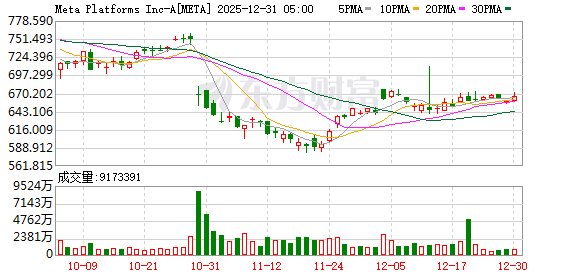
Market Overview - The US stock market experienced a slight decline with the S&P 500 index falling for the third consecutive day, closing down 9.50 points or 0.14% at 6896.24 points. The Nasdaq Composite index dropped 55.27 points or 0.24% to 23419.08 points, while the Dow Jones Industrial Average decreased by 94.87 points or 0.20% to 48367.06 points [2] - The communication services sector saw an increase, primarily driven by Meta Platforms, which rose by 1.1% following its announcement to acquire AI startup Manus to enhance AI integration on platforms like Facebook and Instagram [3] Company Performance - Meta Platforms' acquisition of Manus is aimed at accelerating the integration of advanced AI technologies into its platforms, which may present future growth opportunities [3] - Other major tech stocks showed mixed results: Tesla fell by 1.13%, Nvidia decreased by 0.36%, Microsoft rose by 0.08%, Apple dropped by 0.25%, and Amazon increased by 0.20% [3] - Chinese concept stocks had varied performances, with the Nasdaq China Golden Dragon Index down by 0.27%. Alibaba fell by 0.76%, Pinduoduo by 0.28%, and JD.com by 1.91%, while Netease rose by 0.80% and Baidu surged by 4.39% [3] Economic Indicators - The Federal Reserve's December policy meeting minutes indicated a thorough discussion on inflation and employment risks before deciding to lower the federal funds rate target range by 25 basis points. However, there was no broad consensus among officials regarding the necessity and timing of the rate cut [5] - The next Federal Reserve meeting is scheduled for January 27-28, with the market generally expecting the benchmark interest rate to remain unchanged [6] - The S&P 500 index has risen approximately 17% year-to-date, outperforming the European STOXX 600 index, and is on track for its eighth consecutive month of gains, marking the longest monthly winning streak since 2017 [6]
标普三连阴!Meta斥资20亿美元收购Manus,大型科技股涨跌不一
Di Yi Cai Jing Zi Xun· 2025-12-30 23:04
Market Overview - The U.S. stock market experienced a slight decline with the S&P 500 index falling for the third consecutive trading day, closing down 9.50 points or 0.14% at 6896.24 points. The Nasdaq Composite index dropped 55.27 points or 0.24% to 23419.08 points, while the Dow Jones Industrial Average decreased by 94.87 points or 0.20% to 48367.06 points [1] - The communication services sector saw gains, primarily driven by Meta Platforms, which rose by 1.1% following its announcement to acquire AI startup Manus to enhance AI integration on platforms like Facebook and Instagram [2] Company Performance - Meta Platforms' acquisition of Manus is aimed at accelerating the integration of advanced AI technologies into its platforms, indicating a strategic move to enhance user engagement and technological capabilities [2] - Other major tech stocks showed mixed performance: Tesla fell by 1.13%, Nvidia by 0.36%, Microsoft rose by 0.08%, Apple decreased by 0.25%, and Amazon increased by 0.20% [2] Financial Sector Insights - The financial sector faced notable pressure, with Goldman Sachs down 0.87% and American Express down 0.51%. Citigroup also fell by 0.8% after announcing the sale of its remaining business in Russia, which is expected to result in a pre-tax loss of approximately $1.2 billion due to currency conversion issues [3] Economic Indicators - The Federal Reserve's December meeting minutes revealed a thorough discussion on inflation and employment risks before deciding to lower the federal funds rate target range by 25 basis points. However, there was no broad consensus among officials regarding the necessity and timing of the rate cut [4] - The next Federal Reserve meeting is scheduled for January 27-28, with the market generally expecting the benchmark interest rate to remain unchanged [5] Real Estate Market - Recent data indicated that U.S. home prices in October experienced the slowest year-over-year growth in over 13 years. However, pending home sales in November increased by 3.3%, surpassing the market's previous expectation of 1% [5]
贵金属“风暴”席卷年末市场:美股科技股遇冷,贵金属上演“高台跳水”
Jin Rong Jie· 2025-12-30 00:32
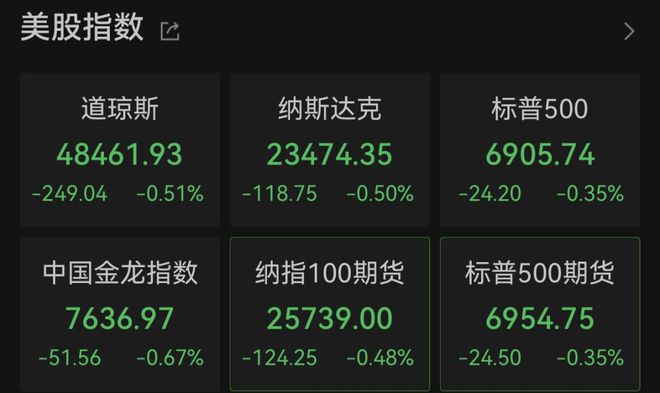
Group 1: Market Overview - The global financial market experienced a significant "precious metal storm" in the last week of 2025, with all three major U.S. stock indices closing down, particularly affected by the decline in technology stocks [1][2] - The Dow Jones Industrial Average fell by 0.51% to 48,461.93 points, the S&P 500 dropped by 0.35% to 6,905.74 points, and the Nasdaq Composite decreased by 0.50% to 23,474.35 points [2][3] Group 2: Precious Metals Market - Precious metals, particularly silver, experienced a dramatic drop after reaching new highs, with silver falling nearly 9% after hitting $82 per ounce, while gold futures dropped about 4.5%, marking the largest decline in nearly two months [4][8] - The sharp decline in precious metals negatively impacted mining stocks, with Harmony Gold down over 8%, AngloGold down nearly 7%, and Barrick Gold down over 4% [5][8] Group 3: Factors Behind the Decline - The decline in the precious metals market is attributed to multiple factors, including increased margin requirements set by the CME, which raised gold futures margin by 10% and silver futures by approximately 13.6%, leading to higher holding costs for traders [8] - The market was also experiencing a release of overbought sentiment, with silver prices having increased by over 185% in 2025, prompting concerns about a potential correction [8] - Additionally, profit-taking ahead of year-end contributed significantly to the sharp drop in precious metals [8] Group 4: Energy Sector Performance - In contrast to the precious metals market, the energy sector showed strength, with WTI crude oil futures rising by 1.84% to $58.08 per barrel and Brent crude oil futures increasing by over 2% to $61.94 per barrel, supported by geopolitical risks [6]
美股全线下挫,白银暴跌
Di Yi Cai Jing Zi Xun· 2025-12-29 23:32
Group 1 - The core viewpoint of the articles indicates that despite a decline in the technology sector, the U.S. stock market is expected to continue its upward trend, supported by factors such as the AI boom, interest rate cut expectations, and economic resilience [2][3][4] - Major U.S. indices are projected to achieve their third consecutive year of gains, with the Dow Jones and S&P 500 indices nearing their eighth consecutive month of increases [2][3] - The "Santa Claus Rally," a seasonal market phenomenon, is anticipated, where the S&P 500 index typically rises during the last five trading days of the year and the first two trading days of the following year [2] Group 2 - Analysts expect the U.S. stock market to remain bullish in 2026, with low chances of a significant market correction or bear market if the global economy continues to expand and the Federal Reserve eases monetary policy further [4] - The November existing home sales index surged by 3.3% month-over-month, reaching a three-year high, following a revised 2.4% increase in October [5] - International oil prices have risen, with WTI crude oil near-month contracts increasing by 2.36% to $58.08 per barrel, and Brent crude oil near-month contracts rising by 2.14% to $61.94 per barrel [5]

美股全线下挫,白银暴跌
第一财经· 2025-12-29 23:22
Core Viewpoint - The article discusses the recent performance of the US stock market, highlighting a decline in major indices due to weakness in the technology sector, while also noting the potential for a year-end rally known as the "Santa Claus rally" [3][4]. Market Performance - On the last trading day of 2025, the Dow Jones fell by 249.04 points (0.51%) to 48,461.93, the Nasdaq dropped by 0.50% to 23,474.35, and the S&P 500 decreased by 0.35% to 6,905.74 [3]. - Tesla's stock declined by 3.2%, with ARK Invest reducing its holdings by $30 million [3]. - The Nasdaq China Golden Dragon Index fell by 0.67%, with Alibaba down 2.4% and Baidu up 1.6% [3]. Economic Indicators - The article notes that the November existing home sales index surged by 3.3% month-over-month, reaching a three-year high, following a revised 2.4% increase in October [6]. - US Treasury yields have decreased, with the 2-year Treasury yield falling by 1.7 basis points to 3.464% and the 10-year Treasury yield down by 1.8 basis points to 4.115% [6]. Market Outlook - Despite concerns over high valuations and volatility in tech stocks, the ongoing bull market, supported by AI trends, interest rate cuts, and economic resilience, is expected to continue [4]. - Analysts predict that the US stock market will rise in 2026, with Goldman Sachs indicating a low likelihood of a significant market correction or bear market if the global economy continues to expand and the Federal Reserve eases monetary policy further [4].

科技行业低迷美股全线下挫 白银暴跌刷新46年历史纪录
Di Yi Cai Jing· 2025-12-29 22:52
Market Overview - The three major U.S. stock indices experienced a decline, with the Dow Jones falling over 200 points, closing down 249.04 points or 0.51% at 48,461.93 points, the Nasdaq down 0.50% at 23,474.35 points, and the S&P 500 down 0.35% at 6,905.74 points [1] - Despite concerns over high valuations and volatility in tech companies, the ongoing bull market, which began in October 2022, is supported by factors such as the AI boom, expectations of interest rate cuts, and economic resilience [4] - Most strategists expect the U.S. stock market to continue rising in 2026, with Goldman Sachs' chief global equity strategist indicating that the likelihood of a significant market correction or bear market is low if the global economy continues to expand and the Federal Reserve eases monetary policy further [4] Individual Stock Performance - Tesla shares fell 3.2% as Cathie Wood's ARK Invest fund continued to reduce its holdings, selling $30 million worth of Tesla stock [2] - Other major tech stocks showed mixed performance, with Apple up 0.1%, Microsoft down 0.1%, Amazon and Google down 0.2%, Meta down 0.7%, Nvidia down 1.2%, and Oracle down 1.3% [2] Economic Indicators - The U.S. November existing home sales index surged 3.3% month-over-month, reaching a three-year high, following a revised 2.4% increase in October [5] - Mid to long-term U.S. Treasury yields declined, with the 2-year Treasury yield falling 1.7 basis points to 3.464% and the benchmark 10-year Treasury yield down 1.8 basis points to 4.115% [5]