π*0.6

Search documents
深扒PI*0.6迭代式强化学习来源:VLA+在线RL实现具身进化
自动驾驶之心· 2025-12-13 02:04
Core Insights - The article discusses the significance of the π*0.6 iterative reinforcement learning approach in the context of VLA (Vision-Language-Action) models, highlighting its potential for self-improvement in robotics [2][3] - It emphasizes the limitations of imitation learning and the necessity of reinforcement learning for robust and persistent robot performance [8][11] Group 1: Importance of VLA+RL - VLA+RL is crucial as it allows robots to learn from real-world interactions, overcoming the limitations of offline reinforcement learning which is constrained by the quality of demonstration data [4][8] - The article outlines that while imitation learning can enable robots to perform actions, it does not guarantee consistent success in novel situations [8][11] Group 2: Challenges in Applying Reinforcement Learning to VLA - The article identifies three main challenges in applying reinforcement learning to VLA: environmental differences, model instability, and computational demands [21][22] - It discusses the risk of catastrophic forgetting and model collapse when directly applying RL algorithms to large VLA models [22][24] Group 3: iRe-VLA Model and Its Architecture - The iRe-VLA model features a two-phase iterative learning process, combining exploration through online reinforcement learning and consolidation through supervised learning [17][24] - The architecture consists of a VLM (Vision-Language Model) for understanding and an Action Head for executing actions, utilizing techniques like LoRA for efficient training [19][20] Group 4: Experimental Results and Analysis - Experiments conducted in both simulated and real-world environments demonstrate the effectiveness of the iRe-VLA approach, showing significant improvements in task success rates [44][48] - The iRe-VLA model outperformed traditional methods, achieving a success rate increase from 43% to 83% in benchmark tasks [48][50] Group 5: Conclusion and Future Directions - The article concludes that the iRe-VLA framework provides a viable solution for deploying large models in robotic control, addressing challenges in stability, efficiency, and continuous learning [60][62] - It suggests that there are numerous research opportunities ahead, particularly in efficient exploration and scalable RL algorithms for VLA [62][63]

全球强化学习+VLA范式,PI*0.6背后都有这家中国公司技术伏笔
机器之心· 2025-12-12 03:41
Core Insights - The article discusses the significance of integrating Vision-Language-Action (VLA) models with Reinforcement Learning (RL) in the field of Embodied AI, emphasizing the limitations of imitation learning and the necessity for robust learning methods [1][2][4]. Group 1: Importance of VLA+RL - VLA models are being developed to apply powerful Vision-Language Models (VLM) in the control of robots, primarily through supervised fine-tuning (SFT) [2]. - Imitation learning alone is insufficient for robots to handle novel situations, necessitating the use of RL to enhance robustness and persistence in task execution [4]. Group 2: Challenges in Applying RL to VLA - The integration of RL with VLA faces three main challenges: environmental differences, model instability, and computational demands [6]. - Direct application of RL algorithms to large VLA models can lead to catastrophic forgetting and training collapse, making it difficult to maintain performance [6]. Group 3: Solutions to VLA's RL Challenges - The industry has proposed three types of solutions to address the challenges faced by VLA in RL applications, with a focus on internalizing high-value behaviors through SFT [7][13]. - The iRe-VLA model introduces a two-phase iterative learning process that alternates between online RL for exploration and supervised learning for consolidation [10][15]. Group 4: iRe-VLA Model Architecture - The iRe-VLA model consists of a VLM backbone for understanding images and instructions, and an Action Head for translating features into control signals [11]. - The use of Low-Rank Adaptation (LoRA) technology allows for efficient training without the need for full model fine-tuning [12]. Group 5: Experimental Results and Analysis - Extensive experiments in both simulated environments and real-world scenarios demonstrate the effectiveness of the iRe-VLA method, showing significant improvements in task success rates [26][30]. - The iRe-VLA model outperformed traditional methods, achieving a success rate increase from 43% to 83% in benchmark tasks [30]. Group 6: Conclusion and Future Implications - The article concludes that the iRe-VLA approach provides a viable solution to the challenges of deploying large models in robotic control, ensuring stability and continuous learning [37][42]. - Future research directions include efficient exploration and learning of new skills under sparse rewards, as well as developing scalable RL algorithms for large VLA models [40].

机器人行业周报:Gemini 3.0 与π0.6 发布:具身大脑发育提速-20251123
GUOTAI HAITONG SECURITIES· 2025-11-23 12:46
Investment Rating - The report assigns an "Overweight" rating to the robotics industry [4]. Core Insights - The release of Gemini 3.0 and π*0.6 indicates accelerated development in embodied AI, with humanoid robot companies setting clear mass production targets and an increase in industry financing [2][3]. - The report highlights significant advancements in AI models and robotics, with Gemini 3 enhancing programming and application development capabilities, while π*0.6 demonstrates a doubling in throughput and success rates in task execution [4][6]. Industry News and Company Developments - Google announced the launch of the AI model Gemini 3 on November 18, 2025, which improves answers to complex problems and enhances programming capabilities [6]. - Physical Intelligence (PI) released its latest robot model π*0.6, achieving over 90% success rates in various tasks [6]. - Xiaopeng Motors aims to mass-produce advanced humanoid robots by the end of 2026, targeting sales of over 1 million units by 2030 [7]. - UBTECH Robotics plans to increase its annual production capacity to 5,000 units by 2026 and 10,000 units by 2027 [7]. - The Zhiyuan Expedition A2 robot completed a 100-kilometer journey from Suzhou to Shanghai, setting a Guinness World Record for the longest distance walked by a humanoid robot [7]. Investment Recommendations - The report suggests focusing on both complete robot manufacturers and core component suppliers, including: 1. Actuators and motors: Recommended companies include Zhaowei Electromechanical, with related companies such as Mingzhi Electric and Jiechang Drive [4][9]. 2. Reducers: Key companies include Ruide Zhijun and Haoneng Co., Ltd. [4][9]. 3. Lead screws: Recommended company is Hengli Hydraulic, with related companies like Zhejiang Rongtai and Best [4][9]. 4. Equipment for lead screws: Recommended company is Qin Chuan Machine Tool, with related companies such as Rifa Precision and Huachen Equipment [4][9]. 5. Bearings: Recommended company is Longxi Co., Ltd. [4][9]. 6. Sensors: Recommended companies include Donghua Testing and Keli Sensor [4][9]. 7. Complete machines: Related companies include UBTECH, Yuejiang, and Yijiahe [4][9].
阿里入局C端入口之战,Google 发布 Gemini 3及 Nano Banana Pro
SINOLINK SECURITIES· 2025-11-23 11:33
Investment Rating - The report suggests a focus on leading domestic generative large model companies such as iFlytek, and AI hardware companies like Hikvision, Hongsoft Technology, and Hesai, as well as companies like Maifushi that can enhance paid rates and ARPU values [3] Core Insights - The report highlights the launch of Alibaba's "Qianwen APP," a personal AI assistant that integrates the Tongyi Qianwen large model capabilities, and Google's release of the Gemini 3 series, which excels in multimodal reasoning tasks [5][13] - The report notes a weak performance in the computer sector in November, attributed to external pressures such as geopolitical conflicts and internal factors like weak revenue growth and profit-taking by institutional investors [13] - It anticipates a rebound in the sector after a three-month decline, suggesting that demand is shifting towards overseas markets, AI industry chains, and domestic substitution policies [13] Summary by Sections Industry Perspective - The report discusses the recent advancements in AI applications and models, including Alibaba's Qianwen APP and Google's Gemini 3 series, which have shown strong performance in various benchmarks [5][13] - It emphasizes the need for investors to consider the current geopolitical climate and its impact on market sentiment, as well as the potential for a spring rebound in the sector [13] Subsector Insights - High-growth areas identified include AI computing power and lidar technology, while sectors like industrial software and medical IT are facing pressure [11][14] - The report categorizes various subsectors based on their growth potential, with AI software and financial IT expected to accelerate upward, while sectors like education IT and cybersecurity are at turning points [11][14] Market Review - From November 17 to November 21, 2025, the computer industry index decreased by 2.74%, outperforming the CSI 300 index by 1.03 percentage points [15] - The report lists the top-performing companies in the sector during this period, indicating a mixed performance landscape [16] Upcoming Events - The report highlights key upcoming events, including the 2025 World Intelligent Manufacturing Conference and the "Artificial Intelligence +" Industry Ecosystem Conference, which may present investment opportunities [25][26]
“最强具身VLA大模型”,究竟强在哪儿?
3 6 Ke· 2025-11-20 07:38
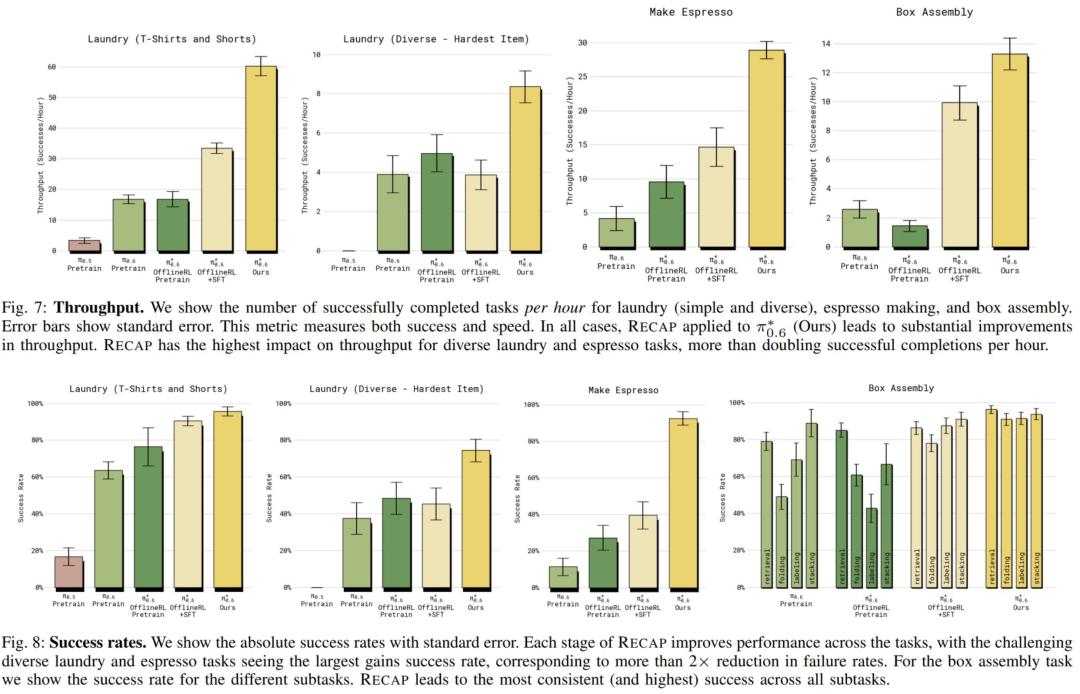
Core Insights - The core contribution of the π*0.6 model lies in its introduction of a more intuitive learning method called RECAP, which allows robots to learn from their mistakes rather than merely imitating correct actions [3][8][24] - The model demonstrates a high success rate of over 90% in tasks such as making espresso, folding clothes, and assembling packaging boxes, showcasing its practical capabilities [1][20] Group 1: RECAP Methodology - RECAP consists of three main phases: offline reinforcement learning (RL) using diverse demonstration data, fine-tuning with human guidance, and online execution where robots learn from sparse rewards and expert corrections [10][20] - The methodology leverages a value function to evaluate actions and an advantage-conditioned strategy to update policies, allowing for efficient learning from both successful and unsuccessful experiences [13][16][42] Group 2: Model Architecture and Performance - The π*0.6 model builds upon previous versions, expanding its backbone from Gemma (2.6 billion parameters) to Gemma3 (4 billion parameters), and increasing Action Expert parameters to 860 million [20] - In challenging tasks, RECAP has doubled the throughput (successful task completions per hour) and reduced failure rates by approximately 50% compared to models that only utilized supervised fine-tuning [20] Group 3: Learning from Mistakes - The RECAP approach emphasizes the importance of learning from errors, enabling robots to recover from mistakes through expert intervention and self-correction, which is crucial for real-world applications [24][28] - By utilizing a value function to assess the quality of actions, the model can identify key steps and sources of errors, enhancing its ability to adapt and improve in complex environments [39][41]
“最强具身VLA大模型”,究竟强在哪儿?
量子位· 2025-11-20 00:30
Core Insights - The article discusses the breakthrough of the robot foundation model π*0.6, which showcases its capabilities in performing complex tasks with a success rate exceeding 90% [2][10]. Group 1: Model Overview - π*0.6 is the latest VLA (Vision-Language-Action) model, building on the previous π0.5, and introduces a novel training method called RECAP [8][10]. - The RECAP method allows robots to learn from their mistakes, shifting from traditional imitation learning to a more intuitive learning approach [3][29]. Group 2: RECAP Methodology - RECAP consists of three main stages: guidance through human demonstration, correction through expert intervention, and practice through autonomous experience [7][12]. - The model utilizes a value function to evaluate actions, which helps in identifying advantageous actions and improving learning efficiency [19][22]. Group 3: Training Process - The training process involves offline reinforcement learning using diverse data sources, including human demonstrations and autonomous attempts, to train the value function and policy [20][22]. - The model's architecture has been enhanced, with the backbone expanding from Gemma (2.6B) to Gemma3 (4B) and Action Expert parameters increasing to 860M [25]. Group 4: Performance Evaluation - In tests involving complex tasks like folding clothes and making espresso, RECAP doubled the throughput and reduced failure rates by approximately 50% compared to models using only supervised fine-tuning [27]. - The model demonstrated high stability, successfully performing tasks for extended periods without human intervention [28]. Group 5: Learning from Failures - The ability of the model to learn from failures is highlighted as a significant advancement, allowing it to extract effective learning signals from imperfect experiences [29][56]. - This approach opens new avenues for future research in robotics, emphasizing the importance of learning from real-world execution rather than solely relying on ideal demonstrations [56].

腾讯研究院AI速递 20251119
腾讯研究院· 2025-11-18 16:01
Group 1: AI Developments - xAI's Grok 4.1 model has achieved the highest ranking on LMArena with an Elo score of 1483 for the Thinking version and 1465 for the non-reasoning version, surpassing Gemini 2.5 Pro [1] - The model scored 1586 Elo on the EQ-Bench emotional intelligence test, showing a significant improvement in creative writing and a threefold reduction in hallucination rates [1] - Google is developing a multi-agent system for Gemini Enterprise that can generate and rank around 100 ideas through a tournament-style evaluation, demonstrating L3-level AI capabilities [3] Group 2: New Ventures and Funding - Jeff Bezos has launched Project Prometheus, serving as co-CEO, with an initial funding round of $6.2 billion, focusing on applying AI to robotics, drug design, and scientific discovery [2] - MiniMax M2 has introduced a programming package for only 9.9 yuan, achieving a top-five position in token usage on the OpenRouter platform, with performance comparable to Claude Sonnet 4.5 [6] Group 3: Robotics and Automation - Physical Intelligence has released the π*0.6 robot model, which significantly improves success rates and processing efficiency in complex tasks, achieving over 90% success in tasks like coffee making and clothing folding [4] - Ant Group has launched a multi-modal AI assistant named "Lingguang," capable of generating small applications in 30 seconds and supporting various forms of content output [8] Group 4: Gaming Innovations - Gambo AI has introduced the world's first "atmospheric programming" agent, allowing users to create a complete game from a single sentence input within 5-10 minutes, integrating art, animation, and monetization features [9] Group 5: Climate Prediction - DeepMind has launched WeatherNext 2, a climate prediction model that generates forecasts at eight times the speed of its predecessor, with a resolution of up to one hour [10][11] Group 6: Market Trends - A CB Insights report indicates that AI agent startups are projected to raise $3.8 billion in 2024, with Voice AI being the fastest-growing sector, having raised $400 million by 2025 [12]