《哈利·波特》系列

Search documents
流媒体时代,电影院会消失吗?|编辑部聊天室
Xin Lang Cai Jing· 2026-01-11 03:48
Group 1 - The core topic revolves around Netflix's acquisition attempt of Warner Bros assets, which includes a historic film studio and HBO, potentially shortening the exclusive theatrical window to about 17 days, raising concerns among theater operators and moviegoers [1] - The cinema industry is facing challenges, with a significant decline in audience attendance and a reliance on major holiday releases, particularly during the Spring Festival, to sustain profitability [6][10] - The number of newly built cinemas in China continues to rise despite a decrease in audience numbers, indicating a disconnect between supply and demand in the cinema market [10] Group 2 - The viewing habits of audiences have shifted, with many preferring to watch films at home rather than in theaters, leading to a decline in cinema attendance [7][8] - The traditional cinema experience is being challenged by the rise of streaming platforms, which are changing audience expectations and viewing behaviors [12][14] - There is a growing trend of audience engagement through organized viewing groups, which may help revitalize interest in cinema by creating a community around film watching [17] Group 3 - The future of cinemas is uncertain, but industry professionals believe they will not disappear entirely; instead, they may need to adapt by focusing on niche markets and enhancing the cultural experience of film viewing [19][20] - The cinema's role as a social and cultural hub remains significant, with the potential for films to become more artistic and less mainstream as audience preferences evolve [19][21]

今年最大并购诞生了
投资界· 2025-12-10 02:47
Core Viewpoint - The article discusses a significant acquisition battle in Hollywood, highlighting Netflix's announcement to acquire Warner Bros. Discovery's film studio and streaming business for approximately $827 billion (about 580 billion RMB) and the competitive response from Paramount SkyDance, which has made a cash offer of $1,084 billion (about 770 billion RMB) for all outstanding shares of Warner Bros. Discovery [5][9][10]. Group 1: Acquisition Details - Netflix's acquisition proposal includes a cash and stock transaction at $27.75 per share, totaling $720 billion in equity value, while also assuming Warner Bros.' debt [9][10]. - Paramount SkyDance has countered with a cash offer of $30 per share, raising the total enterprise value to $1,084 billion [5][10]. - The acquisition is contingent upon Warner Bros. completing a divestiture plan for its cable television assets, including CNN, TBS, and TNT, allowing Netflix to acquire core film assets like Warner Bros. Pictures and HBO [10][11]. Group 2: Industry Context - Warner Bros. Discovery, a 107-year-old company, is facing challenges in the evolving media landscape, with traditional film studios struggling against the rise of streaming platforms [7][8]. - The article reflects on the historical significance of Warner Bros., which has produced iconic franchises such as Harry Potter, The Lord of the Rings, and DC Universe films, but is now seeking new paths amid declining fortunes [6][12][16]. - The competition in Hollywood is intensifying, with streaming services like Netflix and Disney+ reshaping the industry dynamics, leading to a shift from traditional filmmaking to new media formats [17][18]. Group 3: Historical Perspective - Warner Bros. was founded in 1923 and rose to prominence with the introduction of sound films, becoming one of the major Hollywood studios [12][13]. - The company experienced significant growth during the mid-20th century, producing classic films and establishing a vast intellectual property empire [14][15]. - However, the acquisition by AOL in 2000 and subsequent ownership changes have led to challenges, including debt reduction strategies that have affected its production capabilities [15][16].



派拉蒙1084亿美元敌意收购华纳兄弟,挑战奈飞827亿美元交易
Jin Rong Jie· 2025-12-09 01:09
Core Viewpoint - The U.S. entertainment industry is experiencing a new wave of mergers and acquisitions, highlighted by Paramount Sky Dance's hostile takeover bid for Warner Bros. Discovery at $30 per share, valuing the company at $108.4 billion, shortly after Netflix's announcement of a $82.7 billion acquisition deal for Warner Bros. Discovery's film studio and streaming platform [1][2]. Group 1 - Paramount's acquisition proposal includes all of Warner Bros. Discovery's businesses, offering shareholders an additional $18 billion in cash value compared to Netflix's offer [1][2]. - Paramount's CEO, David Ellison, emphasized that the all-cash offer provides better value and a more certain and faster closing path for shareholders [1][2]. - The acquisition bid will be open for 20 days, with existing shareholders needing to decide by January 8 whether to accept [2]. Group 2 - Paramount believes its acquisition proposal is more likely to pass regulatory scrutiny due to its smaller size and good relations with the Trump administration [2]. - In contrast, Netflix's merger with Warner Bros. Discovery may face antitrust challenges, as the combined market share in global subscription video-on-demand services exceeds 40% [2]. - If Netflix's acquisition fails to pass antitrust review, it would owe Warner Bros. Discovery a $5.8 billion breakup fee [2]. Group 3 - Following the news, shares of Warner Bros. Discovery and Paramount Sky Dance rose over 5%, while Netflix's stock fell more than 4% [2]. - The competition for Warner Bros. Discovery involves valuable entertainment assets, including HBO, the Harry Potter series, and DC Comics [2].
奈飞买下华纳,反对的人太多了
Jin Rong Jie· 2025-12-07 05:33
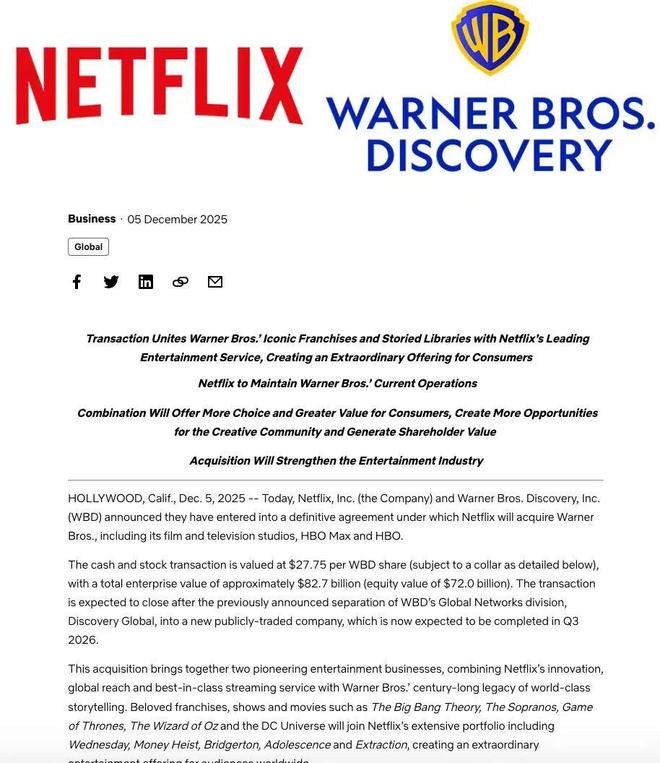
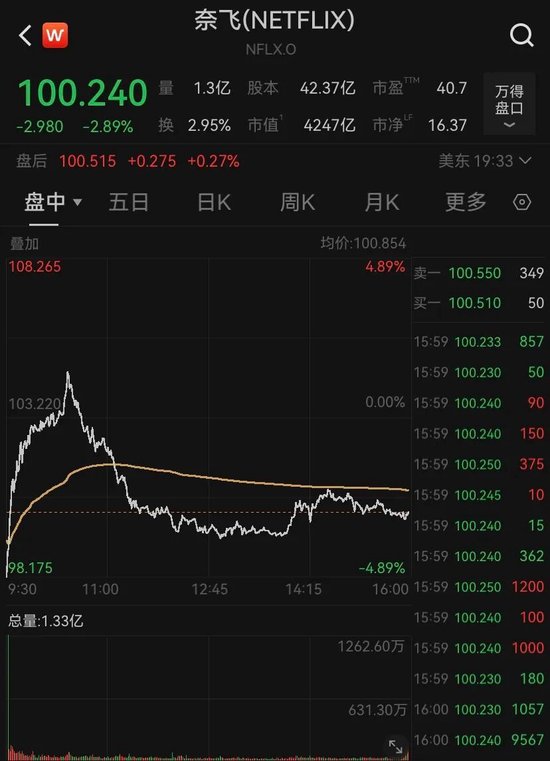
Core Viewpoint - Netflix announced plans to acquire Warner Bros. Discovery's film production and streaming business for approximately $82.7 billion, which has raised concerns in the market about the implications for the entertainment industry and traditional cinema [1][2]. Group 1: Acquisition Details - The acquisition involves a payment of about $72 billion in equity and the assumption of Warner Bros. Discovery's debt, with completion expected within 12 to 18 months [1]. - If successful, this acquisition would merge Netflix's popular IPs like "Stranger Things" and "Squid Game" with Warner Bros.' classics such as "Friends" and the "Harry Potter" series, along with HBO Max streaming services [1]. Group 2: Market Reaction - Following the announcement, Netflix's stock fell by 2.89% to $100.24 per share, while Warner Bros. Discovery's stock rose by 6.28% to $26.08 per share, reflecting a total market capitalization of approximately $64.6 billion for Warner Bros. [2][7]. - Despite receiving debt financing support from major banks, the acquisition is viewed as expensive, especially considering Netflix's cumulative net profit of about $32.1 billion from 2018 to Q3 2025 [2]. Group 3: Industry Concerns - Hollywood unions and cinema owners have expressed concerns that the acquisition could threaten the traditional cinema business model, potentially leading to reduced film production budgets and impacting industry professionals' incomes [5][6]. - There are fears that Netflix may push more Warner Bros. films to premiere on streaming platforms rather than in theaters, which could result in a 25% decrease in box office revenues in the U.S. and Canada [5]. - The acquisition has been criticized as a potential violation of antitrust laws, with warnings about job losses, wage reductions, and a decline in content diversity [6][8].
Netflix收购华纳兄弟:重塑娱乐产业格局
Jing Ji Guan Cha Bao· 2025-12-07 03:32
Core Viewpoint - Netflix's acquisition of Warner Bros. Discovery for $72 billion marks a significant shift in the global entertainment industry, potentially reshaping Hollywood and the streaming market [1] Group 1: Transaction Overview and Strategic Significance - The total enterprise value of the acquisition is $82.7 billion, encompassing Netflix's platform and Warner Bros.' extensive film and television production assets, including HBO and HBO Max [2] - Netflix aims to enhance global storytelling and entertainment offerings by integrating Warner Bros.' iconic IPs like "Friends" and "Harry Potter" with its original content [2] - The acquisition allows Netflix to maintain Warner Bros.' existing operational model, particularly in theatrical releases, while leveraging Warner's production capabilities to increase content output [2] Group 2: Potential Challenges and Employee Reactions - Some Warner Bros. employees express caution regarding the acquisition, particularly in the tech team, fearing job security due to Netflix's established technology platform [3] - Despite concerns, some employees appreciate Netflix's culture, viewing it as more appealing compared to competitors, indicating mixed sentiments about job security post-acquisition [3] Group 3: Netflix's Acquisition Motivation: Filling IP Gaps - Netflix's acquisition addresses its relative weakness in traditional IP compared to competitors like Disney, enhancing its content depth and user engagement [4] - The deal provides access to high-value IPs such as "Frozen" and strengthens Netflix's global content library, potentially increasing subscriber loyalty and platform attractiveness [4] Group 4: Regulatory Scrutiny and Industry Competition - The acquisition requires approval from the U.S. Department of Justice, the Federal Trade Commission, and Warner Bros. shareholders, making regulatory review a critical factor for completion [5] - The deal may pressure other major Hollywood companies and streaming platforms, particularly competitors like Paramount and Comcast, as Netflix solidifies its leadership in content production and IP control [5][6] Group 5: Future Outlook: Reshaping the Entertainment Industry - This acquisition signifies a pivotal moment in the entertainment industry, as streaming evolves from a supplementary role to a dominant force [7] - If approved, Netflix will not only expand its market share but also emerge as a key player in the global cultural industry, potentially leading to further industry consolidation and competition [7] - The transaction may herald a wave of similar large-scale acquisitions driven by capital market dynamics, technological advancements, and changing consumer demands [7]
一个顶级的人生格局:落子无悔
洞见· 2025-12-06 12:36
Core Viewpoint - The article emphasizes the importance of accepting one's choices and experiences in life, advocating for a mindset of no regrets and learning from every situation encountered [5][10][15]. Group 1: Acceptance of Choices - The narrative illustrates that individuals should take responsibility for their decisions and not dwell on regrets, as every experience contributes to personal growth [9][15]. - The story of Zhao Xiaohui, who left a stable job to pursue her passion for stand-up comedy, highlights the value of following one's heart despite potential failures [12][15]. - The concept of "loss aversion" in psychology is discussed, indicating that clinging to past losses can lead to unnecessary suffering [18][23]. Group 2: Embracing Loss and Moving Forward - J.K. Rowling's experience of losing part of her manuscript serves as a reminder that sometimes loss can lead to better outcomes, as it allows for a clearer focus on what truly matters [25][30]. - The article encourages readers to accept losses and not to dwell on what has been lost, as this acceptance is crucial for personal peace and growth [34][36]. - The life choices of Yi Zhongtian illustrate that every decision, whether good or bad, shapes one's journey and should be embraced without regret [50][51]. Group 3: Life as a Series of Choices - The article posits that life is a series of choices that lead to various outcomes, and individuals should accept the results of their decisions as part of their unique path [51][52]. - The idea that there are no absolute right or wrong choices is reinforced, suggesting that as long as decisions align with personal values, they are valid [53][54]. - The overarching message is that life is not about achieving perfection but about making the best of each moment and learning from every experience [57][58].

超5000亿元!奈飞收购华纳兄弟,《哈利波特》《蝙蝠侠》换主人
Xin Lang Cai Jing· 2025-12-06 01:20
Core Viewpoint - Netflix has agreed to acquire Warner Bros. Discovery's film and television studios, along with its HBO Max and HBO streaming services, marking a significant consolidation in the streaming and entertainment industry [1][4][6] Financial Details - Warner Bros. Discovery shareholders will receive $23.25 in cash and $4.50 in Netflix common stock per share, valuing the equity of the deal at $72 billion (approximately 509.06 billion RMB) and the enterprise value at about $82.7 billion (approximately 584.71 billion RMB) [1][6] - Wells Fargo, BNP Paribas, and HSBC will provide $59 billion in debt financing for the transaction [1][6] Transaction Timeline and Conditions - The merger is expected to be completed within 12 to 18 months, pending the separation of Warner Bros. Discovery's news division into an independent publicly traded company called "Discovery Global" [4][9] - The deal requires approval from relevant regulatory authorities [4][9] Strategic Implications - This merger represents a union between the largest paid streaming service and one of Hollywood's oldest and most prestigious film companies, potentially reshaping the content landscape [4][9] - Warner Bros. has a rich history with iconic franchises such as Batman, Superman, and Harry Potter, while Netflix has gained significant traction with original hits like Stranger Things and Squid Game, boasting over 300 million global subscribers [4][9][10] Cost Synergies - Netflix anticipates achieving annual cost savings of at least $2 to $3 billion starting in the third year post-merger [10] - The company plans to maintain Warner Bros. Discovery's existing operations and continue to develop its strengths, including theatrical releases, which have been a concern in Hollywood [10]
网飞宣布收购华纳兄弟
Zhong Guo Jing Ying Bao· 2025-12-06 01:04
Core Viewpoint - Netflix has finalized a deal to acquire Warner Bros for a total equity value of $72 billion and an enterprise value of approximately $82.7 billion, with Warner Bros shareholders receiving $27.75 per share and some Netflix stock [1][2]. Group 1: Acquisition Details - The acquisition includes the condition that Warner Bros Discovery will complete the divestiture of its cable television assets, including CNN, TBS, and TNT, allowing Netflix to focus on acquiring its film studio and HBO Max streaming service assets [1]. - Warner Bros possesses a vast content library, including major franchises such as Batman, Superman, The Matrix, Harry Potter, The Lord of the Rings, and The Hobbit, which have significant global market influence and commercial value [1]. Group 2: Financial Performance and Market Impact - HBO Max has achieved profitability in 2023, making it one of Warner Bros' most valuable businesses, and the combined user base of Netflix and HBO Max is expected to exceed 400 million, strengthening Netflix's competitive position against Disney [2]. - Following the announcement, Netflix's stock fell by 2.89% to $100.24 per share, while Warner Bros Discovery's stock rose by 6.28% to $26.08 per share [2].
好莱坞大地震,派拉蒙天舞拟竞购华纳兄弟探索,华纳兄弟股价飙升近29%
Hua Er Jie Jian Wen· 2025-09-11 21:39
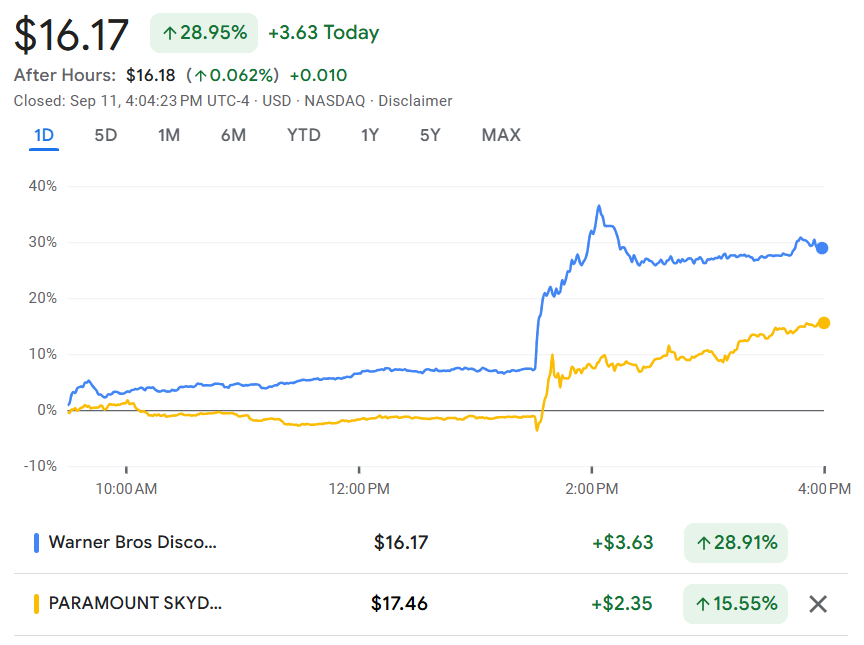
Group 1 - Paramount is preparing a cash offer to acquire Warner Bros. Discovery, which would be the largest consolidation in Hollywood since Disney's $71 billion acquisition of Fox in 2019 [1] - The acquisition plan is backed by the Ellison family, with David Ellison's father, Larry Ellison, being the co-founder of Oracle and one of the world's richest individuals with a net worth of $383 billion [1] - Following the news, Warner Bros. stock surged nearly 29%, while Paramount's stock rose over 15% to $17.46 after an initial dip [1] Group 2 - Warner Bros. CEO David Zaslav's decision will significantly influence the success of the potential acquisition, as he announced plans to split the company into two focusing on cable and streaming production [4] - Zaslav believes that separating the debt-laden cable network will enhance the value of its streaming and production assets [4] - For the acquisition to proceed, Ellison's offer must convince Zaslav that an immediate sale is more beneficial than waiting for the split [4] Group 3 - If the deal is finalized, it would reduce the number of major traditional media studios in the U.S. from five to four, marking a significant industry reshuffle [5] - The merged entity would possess some of the most recognized IP assets in the industry, including Paramount's "Mission: Impossible" series and "The Godfather," along with Warner Bros.' "Harry Potter" series and HBO's "The Sopranos" [6][5] - The merger would consolidate both companies' substantial production facilities in Southern California, enhancing their competitive edge in content creation [6] Group 4 - The potential acquisition is driven by the severe challenges facing the traditional media industry, including subscriber losses to streaming platforms like Netflix and YouTube, and stagnant cinema attendance [7] - Major media companies, including Warner Bros., are undergoing restructuring to prioritize paid streaming services amid pressure from investors for profitability [8] - The industry has seen significant layoffs and budget cuts in content production due to the need for rapid transformation and the impact of recent strikes by writers and actors [8] Group 5 - The trend of seeking restructuring and divestiture is evident, with Warner Bros. planning a split and Comcast announcing plans to divest its cable networks [9] - Comcast, the parent company of NBCUniversal, is expected to complete the spin-off of its networks by the end of this year, indicating a broader strategy among traditional media giants to focus on core businesses [10]
财经观察:产业外迁,好莱坞能否“再次伟大”?
Huan Qiu Shi Bao· 2025-05-13 22:37
Core Viewpoint - Hollywood's global market share in the film industry has significantly declined, dropping from over 90% in 2009-2010 to 69.5% in 2024, while China's share has increased from 5.5% to 16.5% during the same period [2][3] Group 1: Decline of Hollywood - Hollywood's global box office share has decreased by 16 percentage points over the past decade, indicating a structural decline in the industry [2][3] - The rise of streaming platforms like Netflix and Disney+ has shifted audience viewing habits, contributing to Hollywood's challenges [3][4] - Labor disputes, including strikes by writers and actors, have further complicated the industry's recovery efforts [3][4] Group 2: Globalization of Film Production - The film production industry has become highly globalized, with Hollywood relying on international collaboration and outsourcing to manage costs [5][7] - Countries like the UK and Canada have become key destinations for Hollywood productions due to lower costs and favorable tax incentives [7][8] - Australia and New Zealand are also significant players in providing production services for international films, with substantial investments in the industry [8] Group 3: Challenges and Future Prospects - The traditional high-risk, low-innovation production model of Hollywood has led to a decline in market tolerance for mid-sized original films [4][9] - The industry faces pressure to innovate and adapt to new technologies, including the impact of artificial intelligence [10][11] - Efforts to revitalize Hollywood, such as tax incentives, are ongoing but face criticism and challenges, indicating a long road ahead for recovery [11]