上汽大众途昂

Search documents
2025年汽车行业研究报告
艾瑞咨询· 2025-12-31 00:04
Core Insights - The automotive industry is undergoing significant transformation, with domestic brands emerging as the primary growth engine, and new energy technologies reshaping value rules and pricing strategies [1][2][4] Group 1: Domestic Brand Growth - Domestic brands have become the sole growth driver in the automotive market, with sales increasing by 20.3% year-on-year, translating to a net increase of 1.855 million vehicles, contributing to a 9.2% overall market growth [2][4] - The share of domestic brands in the market has risen significantly, with their market share increasing from 90% to 97% in the under 100,000 yuan segment [8] Group 2: Pricing and Value Restructuring - The application of new energy technologies has led to a redefinition of pricing standards, where product value now supersedes brand symbolism [4][6] - The competition landscape is shifting towards price tier management, with a focus on cost reduction and efficiency becoming a new operational challenge [9][8] Group 3: Advertising and Marketing Trends - Overall advertising investment in the automotive industry has decreased compared to the previous year, with a notable contraction in the number of advertisers [12][14] - The luxury segment (vehicles priced above 300,000 yuan) accounted for 41.3% of advertising investment, while the mainstream market (10,000-200,000 yuan) represented 38.5% [17] Group 4: AI and User Engagement - Baidu's automotive ecosystem is leveraging AI to enhance user experience and marketing workflows, with a 5.3% increase in automotive search volume and a 34.4% rise in user reading volume [25][21] - AI is transforming the search engine into an AI engine, reshaping user interaction and content consumption patterns [37][39] Group 5: User Behavior and Decision-Making - The average decision-making period for users has shortened, with a 37.5% increase in the number of models compared during the search process [48][53] - Users are increasingly favoring content that provides strong comparative references and purchase recommendations, indicating a shift towards more informed decision-making [53][48]


2025年汽车行业研究报告
艾瑞咨询· 2025-11-24 00:05
Core Insights - The automotive industry is undergoing significant transformation, with domestic brands emerging as the primary growth engine, and new energy technologies reshaping value rules and pricing strategies [1][2][4] Group 1: Industry Overview - Domestic brands have become the sole growth driver in the automotive market, with a 20.3% year-on-year increase in sales from January to September 2025, contributing to a 9.2% overall market growth [2][4] - The shift towards new energy vehicles (NEVs) has redefined user pricing decisions, emphasizing product value over brand symbolism [4][6] - The competitive landscape is evolving, with a focus on cost reduction and efficiency as key challenges for businesses [9][12] Group 2: User Behavior and Decision-Making - The car purchasing decision cycle has shortened, with users conducting more detailed comparisons, particularly favoring technology and smart features in NEVs [1][48] - Users are increasingly engaging in diverse search behaviors, with a notable rise in interest for intelligent experience-related searches, which surged by 38% [50][51] - The average number of models searched per user has increased by 37.5%, indicating a trend towards more thorough comparisons before making a purchase [48][53] Group 3: Advertising and Marketing Trends - Overall advertising investment in the automotive sector has decreased compared to the previous year, with a notable contraction in the number of advertisers [12][14] - Baidu has emerged as a leading platform for automotive advertising, with a significant increase in mobile advertising investments [18][20] - The integration of AI in marketing strategies is reshaping how automotive companies engage with consumers, enhancing user experience and streamlining workflows [21][62] Group 4: AI and Content Strategy - Baidu's AI capabilities are transforming the automotive marketing landscape, enabling a more personalized and efficient user interaction experience [37][62] - The introduction of AI-generated content (AIGC) is significantly enhancing content creation and user engagement, with a marked increase in user reading volume by 34.4% [25][42] - Video content has become the most popular format among users, with a substantial increase in viewership, particularly for car reviews and purchasing recommendations [44][46]
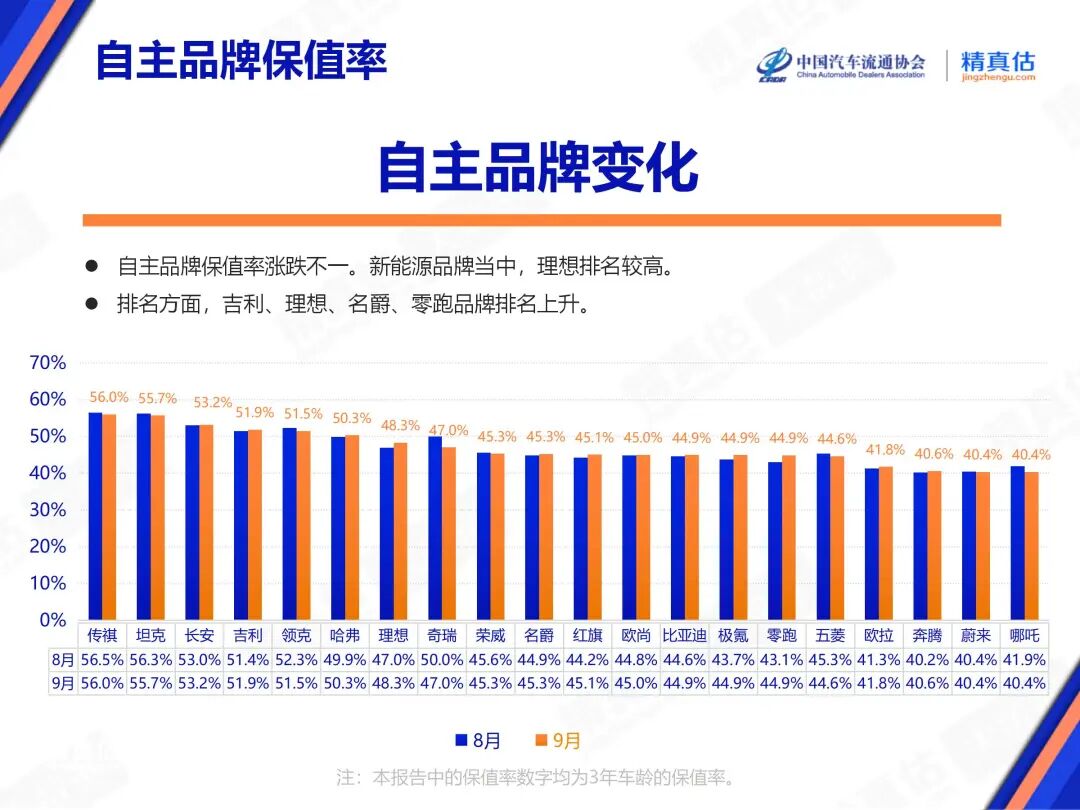
中国汽车流通协会:自主品牌保值率表现不一 乐道L60保值率于纯电动中型SUV市场排名第一
智通财经网· 2025-10-10 07:56
Core Insights - The report highlights the varying residual values of domestic automotive brands in China, with traditional strong brands like GAC and Geely maintaining stability, while brands like BYD show robust performance due to rapid electrification [1] - The shift from "market for technology" to "technology creates value" is emphasized as domestic brands evolve [1] Group 1: Electric SUVs - The pure electric mid-size SUV market is highly competitive, characterized by intense high-end battles and mainstream acceleration, with the Leado L60 achieving the highest residual value [3] - Tesla Model Y and ZEEKR 7X follow closely in the residual value rankings, indicating strong market acceptance [3] - In the compact electric SUV segment, the "Matthew effect" is evident, with top models like Song PLUS, AION Y, and Yuan PLUS establishing significant advantages due to technology and market reputation [7] Group 2: Plug-in Hybrid SUVs - In the plug-in hybrid compact SUV market, BYD's Song Pro and Song PLUS dominate the residual value rankings, showcasing the strength of BYD's DM technology [12] - The plug-in hybrid mid-size MPV market sees GAC's E9 leading in residual value due to its luxurious features and advanced battery management [16] Group 3: Compact Cars - In the popular compact car market, the Volkswagen Lavida ranks first in residual value, followed by the Volkswagen Sagitar and Audi A3, reflecting the strong foundation of German brands in China [17] Group 4: Mid-size SUVs - The domestic mid-size SUV market has established a stable value hierarchy, with GAC's GS8 leading in residual value due to its spaciousness and luxury features [21] - The competitive landscape in the mainstream joint venture mid-size SUV segment is dominated by German and American brands, with SAIC Volkswagen's Teramont achieving the highest residual value [23] Group 5: Japanese Brands - The price decline of Japanese brands like Toyota, Honda, and Nissan indicates a convergence in product quality, negatively impacting their residual values in the new energy era [25] - The increase in residual value for Volkswagen brands is attributed to strong contributions from their sedan products, while French brands face significant declines due to ongoing price wars [25]

车圈反腐!东风62岁元老被查,上汽大众有采购员工被警方带走
21世纪经济报道· 2025-06-25 14:59
Core Viewpoint - The automotive industry is currently facing a wave of anti-corruption efforts, which are crucial for maintaining the integrity of supply chains and ensuring product quality in a highly competitive market [2][3][4]. Group 1: Anti-Corruption Efforts - Dongfeng Motor has seen six executives under investigation for serious violations since May, including a senior manager [2]. - SAIC Volkswagen is also involved in investigations, with a procurement department employee detained, indicating a broader trend of scrutiny within the industry [2][3]. - The internal email leak alleging corruption in SAIC Volkswagen's procurement department highlights ongoing issues, although the company claims no substantial evidence was found [3]. Group 2: Supply Chain Management - The automotive supply chain is extensive, involving thousands of parts, and any corruption can lead to significant financial losses for companies [3][4]. - BYD's chairman emphasized that corruption is a major obstacle to healthy company growth, and the company has implemented reporting incentives to combat it [4]. - NIO is adopting a "transparent supply chain" approach to reduce waste and improve cost visibility, which is critical for maintaining product quality [5]. Group 3: Financial Performance and Challenges - SAIC Volkswagen's profit margins have been severely compressed in the new energy era, with past models achieving margins of 20-30% now facing significant challenges [6]. - The company aims to achieve a profit margin of around 10% for its new range-extended products, which is a considerable challenge given current market conditions [6]. - Recent reforms under new management include cost-cutting measures and a focus on enhancing operational efficiency, such as reducing development licensing fees and internalizing outsourced R&D work [6][7]. Group 4: Future Strategies - SAIC Volkswagen plans to launch seven new models by 2026, including electric and hybrid vehicles, as part of its strategy to improve market competitiveness [7]. - The company is reforming its dealer assessment system to enhance customer service, indicating a shift towards a more customer-centric approach [7]. - Despite cost-cutting measures, SAIC Volkswagen is committed to maintaining quality and safety standards, as evidenced by investments in safety features for new models [7].